Your Complete Guide to VHF Radios, EPIRBs, and First Aid Kits in the UK
When it comes to maritime safety, having the right equipment on board isn’t just about regulatory compliance — it’s about ensuring you and…
Your Complete Guide to VHF Radios, EPIRBs, and First Aid Kits in the UK
When it comes to maritime safety, having the right equipment on board isn’t just about regulatory compliance — it’s about ensuring you and your crew can respond effectively in an emergency. Whether you’re operating a commercial vessel, managing a charter boat, or enjoying recreational sailing beyond coastal waters, three pieces of safety equipment stand out as absolutely essential: a reliable VHF marine radio, an ACR EPIRB for distress alerting, and an MCA-approved Category C first aid kit.
At ADEC Marine, we understand that UK mariners need equipment that meets stringent Maritime and Coastguard Agency (MCA) standards whilst delivering proven performance when it matters most. This comprehensive guide will help you understand why these safety essentials are crucial and how to choose the right equipment for your vessel.

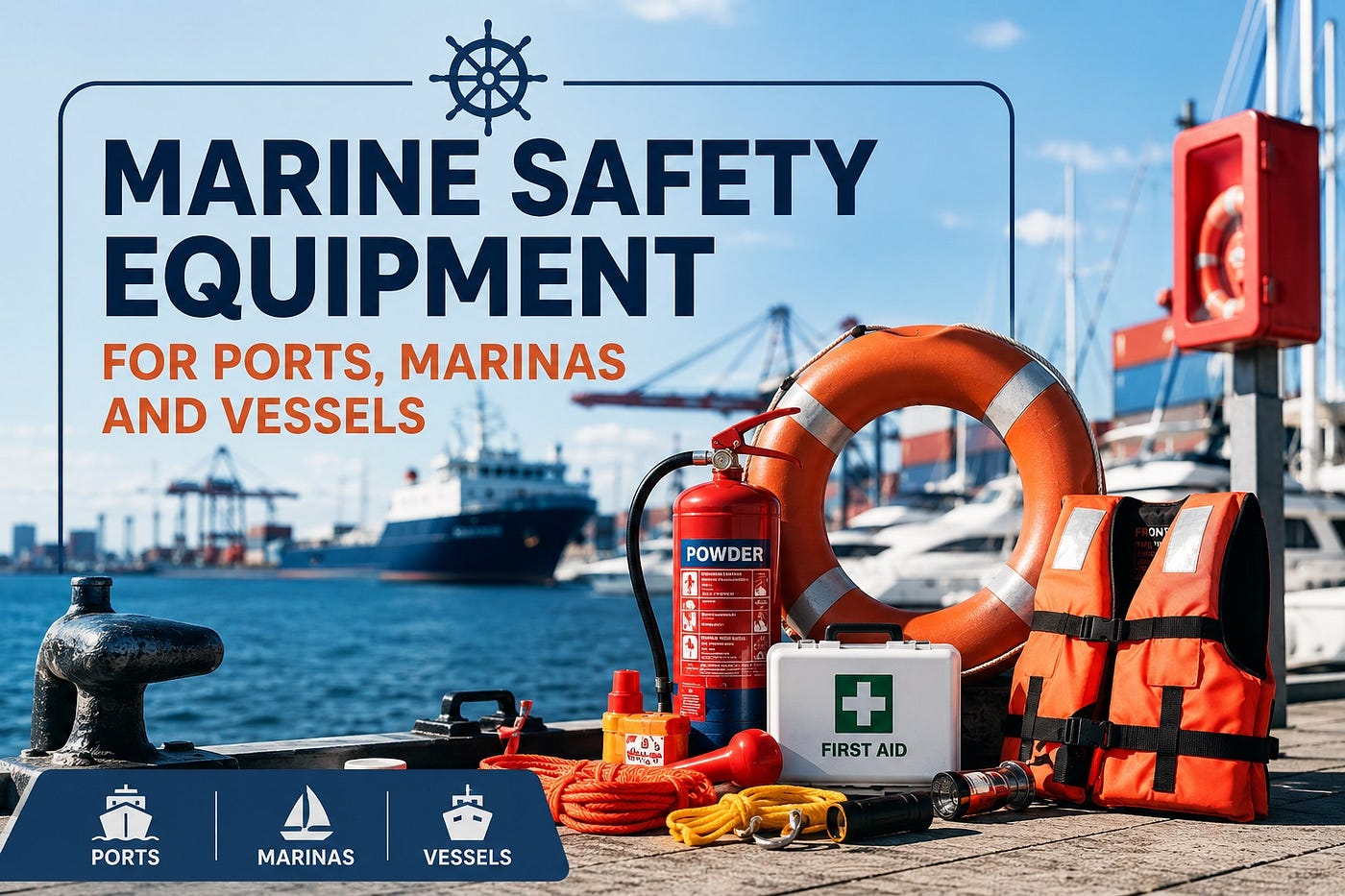
Image Credit- Adec Marine Marine Safety Supplies UK
Understanding VHF Marine Radio: Your Primary Communication Lifeline
A VHF marine radio represents your primary means of communication at sea, connecting you to other vessels, marinas, harbours, and crucially, the UK Coastguard. Unlike mobile phones, which lose signal rapidly once you leave coastal areas, a VHF marine radio provides reliable line-of-sight communication that can reach distances of up to 60 nautical miles in ideal conditions.
Why Every Vessel Needs a VHF Marine Radio
The importance of carrying a VHF marine radio cannot be overstated. In emergency situations, being able to broadcast a Mayday call on Channel 16 — the international distress frequency — can mean the difference between a successful rescue and tragedy. Even for non-emergency situations, VHF radios enable you to communicate weather forecasts, coordinate with lock keepers, receive navigational warnings, and maintain contact with your marina.
Modern VHF marine radios come equipped with Digital Selective Calling (DSC) capability, which has revolutionised maritime safety communications. DSC allows you to send a distress alert at the push of a button, automatically transmitting your vessel’s position (when connected to GPS) along with your unique Maritime Mobile Service Identity (MMSI) number. This ensures rescue services know exactly who you are and where to find you, even if you’re unable to speak on the radio.
Fixed Mount vs Handheld VHF Marine Radio Options
Choosing the right VHF radio for your vessel depends on several factors, including your boat size, typical operating area, and whether you need portability. Fixed-mount VHF radios offer higher transmission power (typically 25 watts compared to 5–6 watts for handhelds), resulting in greater range and clearer communication. They connect to a permanent antenna mounted at the highest practical point on your vessel, maximizing signal reach.
Fixed installations are ideal for larger vessels and those regularly venturing beyond coastal waters. The higher transmission power means your distress calls have a better chance of being heard, and you’ll maintain clearer communication with shore stations and other vessels at greater distances. Many modern fixed VHF marine radios also feature integrated AIS receivers, allowing you to see other vessels’ positions and information directly on the radio display.
Handheld VHF marine radios, meanwhile, provide invaluable backup communication and portability. They’re perfect for taking aboard tenders, carrying in your lifejacket pocket, or storing in your grab bag. While their lower power output reduces range, quality handheld models offer excellent performance for close-range communication and can be lifesaving if you need to abandon ship. Look for waterproof, buoyant models with long battery life when selecting a handheld VHF marine radio.
Essential VHF Marine Radio Features to Consider
When evaluating VHF marine radios, prioritise these key features:
DSC Capability: Essential for modern maritime safety, allowing one-button distress alerting and position transmission to rescue services and nearby vessels.
GPS Integration: Ensures your distress calls include your exact position, enabling faster rescue response.
Waterproof Rating: Look for IPX7 or IPX8 ratings, indicating the radio can withstand immersion in water.
Battery Life: Particularly crucial for handheld units — aim for radios offering at least 8–10 hours of operation.
Noise-Cancelling Technology: Advanced models filter out engine and wind noise, ensuring clearer communication even in challenging conditions.
Dual/Triple Watch: Allows simultaneous monitoring of multiple channels, so you never miss important calls or weather updates.
Understanding these features helps you select the most appropriate VHF marine radio for your operational needs, ensuring reliable communication capability in all conditions.
ACR EPIRB: The Ultimate Emergency Position Indicating Beacon
While a VHF marine radio allows you to call for help when you’re within range of other vessels or shore stations, an ACR EPIRB (Emergency Position Indicating Radio Beacon) provides a critical backup that works anywhere on Earth, regardless of how remote your position.
How ACR EPIRBs Save Lives
When activated, an ACR EPIRB transmits a powerful 406 MHz distress signal to the international Cospas-Sarsat satellite system, which then alerts Search and Rescue (SAR) authorities worldwide. Modern ACR EPIRBs incorporate GPS technology, providing rescue services with your precise coordinates within minutes of activation. Even without GPS data, satellites can triangulate your position using the 406 MHz signal alone, though this takes longer and is less accurate.
Additionally, ACR EPIRBs broadcast a 121.5 MHz homing signal that guides rescue teams directly to your position once they’re in the vicinity. This dual-frequency approach ensures the fastest possible response from Search and Rescue services, dramatically increasing survival rates in maritime emergencies.
The Royal Yachting Association (RYA) recommends that small craft regularly cruising outside reliable VHF range should carry a 406 MHz beacon as essential equipment rather than merely desirable. When you venture beyond the 12–20 nautical mile range where VHF communication becomes unreliable, an ACR EPIRB becomes your lifeline to the outside world.
The ACR V5 AIS EPIRB: Next-Generation Emergency Beacon Technology
The ACR V5 AIS EPIRB represents cutting-edge emergency beacon technology, combining traditional 406 MHz satellite distress alerting with AIS (Automatic Identification System) transmission. This dual-mode capability provides both global satellite communication for alerting distant rescue coordination centres and local AIS signalling that immediately alerts nearby AIS-equipped vessels to your emergency.
When activated, the ACR V5 AIS EPIRB simultaneously broadcasts your distress signal via satellite whilst transmitting an AIS MOB (Man Overboard) alert. Any vessel within VHF range equipped with an AIS receiver will see your distress position appear on their chart plotter, potentially enabling nearby mariners to reach you before official SAR assets arrive. This is particularly valuable in busy shipping lanes or popular cruising areas where other vessels may be closer than Search and Rescue services.
The GlobalFIX V5 features a powerful GPS receiver that acquires your position rapidly, even in challenging conditions. Its robust construction meets stringent maritime standards, with a buoyant design that ensures the antenna remains above water when deployed. The internal battery provides a minimum of 48 hours of continuous transmission, exceeding regulatory requirements and ensuring sustained signalling throughout extended rescue operations.
EPIRB Registration and Legal Requirements
UK maritime law requires all 406 MHz EPIRBs to be registered with the UK Beacon Registry. Registration is free and can be completed online, linking your beacon’s unique identifier to your vessel details and emergency contact information. When your EPIRB is activated, rescue coordination centres immediately access this registration data, allowing them to determine whether you’re operating a small yacht, fishing vessel, or commercial ship — crucial information for planning appropriate rescue resources.
Registered EPIRBs also help prevent unnecessary SAR missions caused by accidental activations. If your beacon is triggered unintentionally, the Maritime Rescue Coordination Centre can contact your emergency contacts to verify whether there’s a genuine distress situation before launching expensive rescue operations.
All ACR EPIRBs must also be included on your vessel’s Ship Radio Licence (or Ship Portable Radio Licence for transportable units). Failure to properly register and licence your emergency beacon can result in penalties and, more seriously, may delay rescue response if you need to activate it in a genuine emergency.
Choosing Between Automatic and Manual EPIRBs
ACR EPIRBs come in two main categories: Category I (automatic release) and Category II (manual activation). Category I EPIRBs are mounted in special hydrostatic release brackets that automatically deploy the beacon if the vessel sinks. As water pressure increases beyond approximately 4 metres depth, the hydrostatic mechanism releases the EPIRB, which then floats to the surface and begins transmitting.
This automatic capability is invaluable if your vessel founders rapidly, potentially giving you no time to manually activate emergency equipment. The EPIRB will alert rescue services even if all crew members are incapacitated or forced to abandon ship immediately.
Category II EPIRBs require manual activation and are typically stored in readily accessible locations such as near the companionway or within grab bags. They’re suitable for vessels where the crew would have time to manually deploy safety equipment before abandoning ship. Many operators choose to carry both — a Category I unit in an automatic bracket for catastrophic sinking scenarios, plus a Category II unit in their grab bag for controlled abandonment situations.
Category C First Aid Kit UK: Meeting MCA Medical Stores Requirements
While communication and distress alerting equipment help summon rescue, comprehensive medical supplies enable you to manage injuries and illness until professional medical help arrives. The UK Maritime and Coastguard Agency mandates specific medical stores for commercial vessels, with requirements scaled according to your operating area and distance from shore-based medical facilities.
Understanding MCA First Aid Kit Categories
The MCA utilizes three categories of medical and first aid kits designed to meet requirements based on vessel activities and operating areas:
Category C First Aid Kits are intended for small commercial vessels undertaking inshore operations — essentially no further than 60 nautical miles from shore or six hours from medical care. These kits contain essential supplies for managing common minor injuries and medical situations that arise aboard vessels operating in coastal waters.
Category B Medical Kits are required for vessels staying within 12 to 24 hours from medical care or 150 nautical miles from the coast. These comprehensive kits enable crews to manage most minor and moderate medical scenarios before additional help arrives.
Category A Medical Kits comply with MSN 1768 requirements for ocean-going vessels operating beyond 150 nautical miles offshore, outside helicopter range or prompt reach of offshore rescue services. These extensive kits include oxygen and equipment to treat major wounds, fractures, and burns.
What’s Inside a Category C First Aid Kit UK?
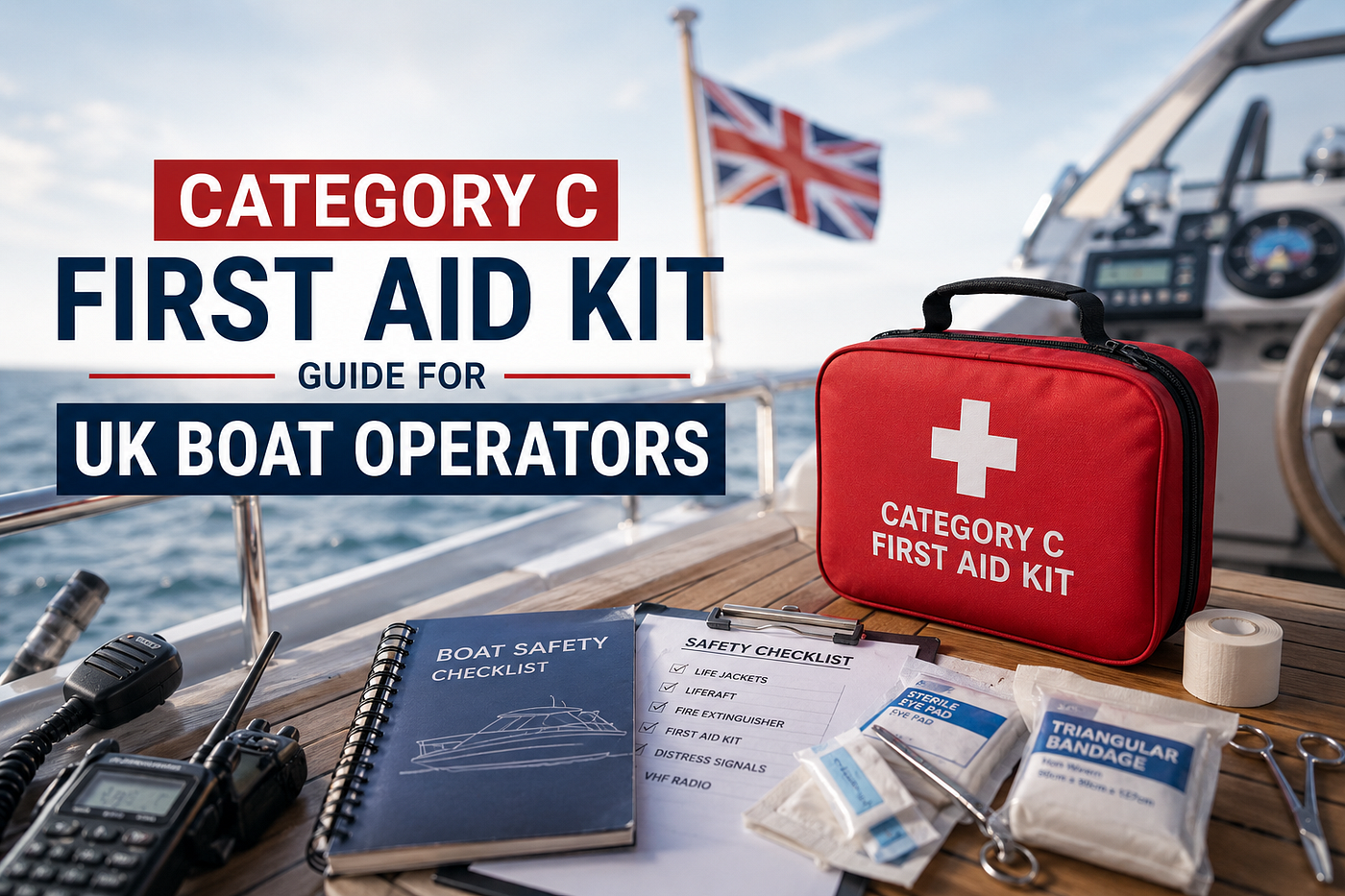
A properly equipped Category C first aid kit UK contains carefully selected supplies to address the most common medical issues encountered during inshore maritime operations. These MCA-approved kits typically include:
- Assorted adhesive plasters and wound dressings in various sizes for managing cuts and abrasions
- Triangular bandages for supporting injured limbs and creating slings
- Conforming and crepe bandages for securing dressings and providing compression
- Adhesive tape and safety pins for securing bandages
- Disposable gloves to maintain hygiene when treating injuries
- Trauma shears for cutting clothing away from injuries
- Resuscitation face shield or pocket mask for performing CPR safely
- Thermal protective aid (space blanket) for treating hypothermia
- Basic medications including paracetamol, seasickness tablets, and antihistamines
- Sterile eye wash and dressings for treating eye injuries
- Comprehensive first aid manual providing guidance on treating various conditions
The Category C first aid kit from £68.64 available through ADEC Marine meets all UK MCA and Lloyd’s Register of Shipping type approval requirements for Category C vessels, including lifeboats and liferafts. These kits are CE marked and comply fully with EC Directive 92/29, ensuring they meet rigorous European safety standards.
Legal Requirements for Category C First Aid Kits
UK maritime regulations make Category C first aid kits mandatory for specific vessel types and operations. Commercial vessels operating within 60 nautical miles of shore, charter boats and yachts carrying paying passengers, and all lifeboats and liferafts must carry appropriately approved Category C medical stores.
Recent changes in UK medicines regulations have added important purchasing restrictions for these kits. Due to implementation of Medicines and Healthcare products Regulatory Agency (MHRA) legislation, only registered skippers and vessel owners can purchase Category C first aid kits containing prescription medicines. Suppliers must hold appropriate Wholesale Distribution Authorisation (WDA) licenses to legally distribute these medical stores.
When ordering a Category C first aid kit UK from ADEC Marine, you’ll need to provide vessel name, skipper details, and contact information for traceability purposes. This ensures compliance with current regulations whilst maintaining the safety standards that protect mariners operating in UK waters.
Maintaining Your Marine First Aid Kit
Simply purchasing an MCA-approved first aid kit isn’t enough — regular maintenance ensures your medical supplies remain effective when needed. Assign a responsible crew member to check expiry dates on medications and sterile supplies at least quarterly, replacing expired items promptly. Many medical items, particularly medications and sterile dressings, degrade over time or when exposed to the marine environment’s heat, humidity, and salt air.
Store your Category C first aid kit in a cool, dry location away from direct sunlight and moisture. While the kits come in waterproof packaging, additional protection in a dedicated storage locker helps preserve contents. Keep the kit readily accessible — medical emergencies require immediate response, and fumbling through cluttered lockers wastes precious time.
Consider supplementing your Category C first aid kit with additional supplies relevant to your crew’s specific medical needs. If crew members require prescription medications for chronic conditions, ensure adequate supplies are aboard. Similarly, if anyone has known allergies, carry appropriate antihistamines or prescribed EpiPens beyond the kit’s standard contents.
Integrating Safety Equipment: Creating a Comprehensive Safety System
While each piece of safety equipment serves a specific purpose, they work together as an integrated system protecting your vessel and crew. Your VHF marine radio provides primary communication for routine operations and emergencies within VHF range. Your ACR EPIRB ensures you can summon help regardless of location or VHF range limitations. Your Category C first aid kit UK enables you to manage medical situations while awaiting rescue or return to port.
Consider how these systems interact in various emergency scenarios:
Medical Emergency Near Shore: Use your VHF marine radio to contact the Coastguard on Channel 16, request medical advice via radio medical link, and arrange evacuation if necessary. Your Category C first aid kit provides supplies for stabilising the patient until professional help arrives.
Vessel Dismasting Beyond VHF Range: With your VHF antenna damaged, normal radio communication may be impossible. Activate your ACR EPIRB to alert Search and Rescue via satellite, ensuring help is summoned even though you cannot make voice radio contact. Use your first aid kit to treat any injuries sustained during the incident.
Rapid Sinking Situation: If your vessel founders quickly, a Category I ACR EPIRB automatically deploys and begins transmitting, alerting rescue services even if you cannot reach the radio. Grab your emergency bag containing your handheld VHF marine radio and supplementary first aid supplies as you abandon to your liferaft.
This layered approach to safety ensures you have multiple options for communicating distress and managing emergencies, providing redundancy that significantly increases survival chances in worst-case scenarios.
Why Choose ADEC Marine for Your Safety Equipment Needs
As a leading UK supplier of marine safety equipment, ADEC Marine combines extensive product knowledge with genuine commitment to mariner safety. We stock only equipment from proven manufacturers that meets or exceeds UK and international maritime safety standards.
Our range includes the latest ACR EPIRB technology, comprehensive VHF marine radio options for vessels of all sizes, and MCA-approved Category C first aid kits that fulfil all legal requirements for UK commercial vessels. We hold appropriate MHRA licensing (WDA Licence Number 43533) for authorised distribution of Category C medical stores, ensuring full regulatory compliance.
Beyond supplying equipment, we provide expert guidance helping you select the right safety gear for your specific vessel and operational requirements. Our team understands UK maritime regulations and can advise on meeting MCA requirements whilst staying within budget constraints. We recognise that effective safety equipment must be reliable, properly specified, and appropriately maintained — we’re here to support you throughout the equipment lifecycle.
Making Informed Safety Equipment Decisions
Investing in quality marine safety equipment represents essential risk management for anyone operating vessels in UK waters. While initial costs may seem significant, consider them against the potential consequences of inadequate safety provisions. Quality VHF marine radios enable reliable communication. Proven ACR EPIRBs provide dependable distress alerting regardless of location. Properly equipped Category C first aid kits UK enable effective medical response.
When evaluating safety equipment options, prioritise reliability and regulatory compliance over price considerations alone. The cheapest option rarely proves most economical if it fails when you need it most or doesn’t meet legal requirements. Look for established brands with proven maritime heritage — companies like ACR have decades of experience developing life-saving equipment trusted by commercial and recreational mariners worldwide.
Ensure any safety equipment you purchase carries appropriate approvals for UK waters. MCA type approval for Category C first aid kits, ETSI approval for VHF radios, and Cospas-Sarsat certification for EPIRBs guarantee equipment meets stringent safety and performance standards.
Conclusion: Prioritising Maritime Safety
The three essential safety equipment categories — VHF marine radios, ACR EPIRBs, and Category C first aid kits — form the foundation of responsible maritime operations in UK waters. Whether you’re operating commercially, chartering, or pursuing recreational sailing, proper safety equipment represents your primary defence against the inherent risks of marine environments.
Reliable communication via VHF marine radio keeps you connected to shore stations, other vessels, and rescue services. Your ACR EPIRB provides crucial backup distress alerting when beyond VHF range or when radio systems fail. Comprehensive first aid supplies enable effective medical response while awaiting professional assistance.
Don’t compromise on safety equipment quality or regulatory compliance. Explore ADEC Marine’s comprehensive range of marine safety equipment, including advanced VHF marine radios, the innovative ACR V5 AIS EPIRB, and MCA-approved Category C first aid kits. Our expert team stands ready to help you select equipment that meets your vessel’s specific requirements whilst ensuring full compliance with UK maritime safety regulations.
Remember: quality marine safety equipment doesn’t guarantee you’ll never face emergencies at sea — but it dramatically improves your chances of surviving them and returning safely to port. Make informed decisions, maintain your equipment properly, and ensure your crew knows how to use all safety systems effectively. Your life and the lives of those sailing with you depend on it.
메타데이터
- post_id
- 97040d56a32c
- slug
- your-complete-guide-to-vhf-radios-epirbs-and-first-aid-kits-in-the-uk-97040d56a32c
- url
- https://medium.com/@adecmarine26/your-complete-guide-to-vhf-radios-epirbs-and-first-aid-kits-in-the-uk-97040d56a32c
- canonical_url
- https://medium.com/@adecmarine26/your-complete-guide-to-vhf-radios-epirbs-and-first-aid-kits-in-the-uk-97040d56a32c
- author_url
- https://medium.com/@adecmarine26
- status
- ok
- fetched_at
- 2026-07-24 11:33:09