Challenging the Dominance of Complete Abstinence: A Call for Inclusive and Effective Addiction…
Abstinence can save lives. But when it becomes doctrine, it leaves people behind. Let’s build treatment that meets reality, not ideology.
Challenging the Dominance of Complete Abstinence: A Call for Inclusive and Effective Addiction Treatment
Abstinence can save lives. But when it becomes doctrine, it leaves people behind. Let’s build treatment that meets reality, not ideology.
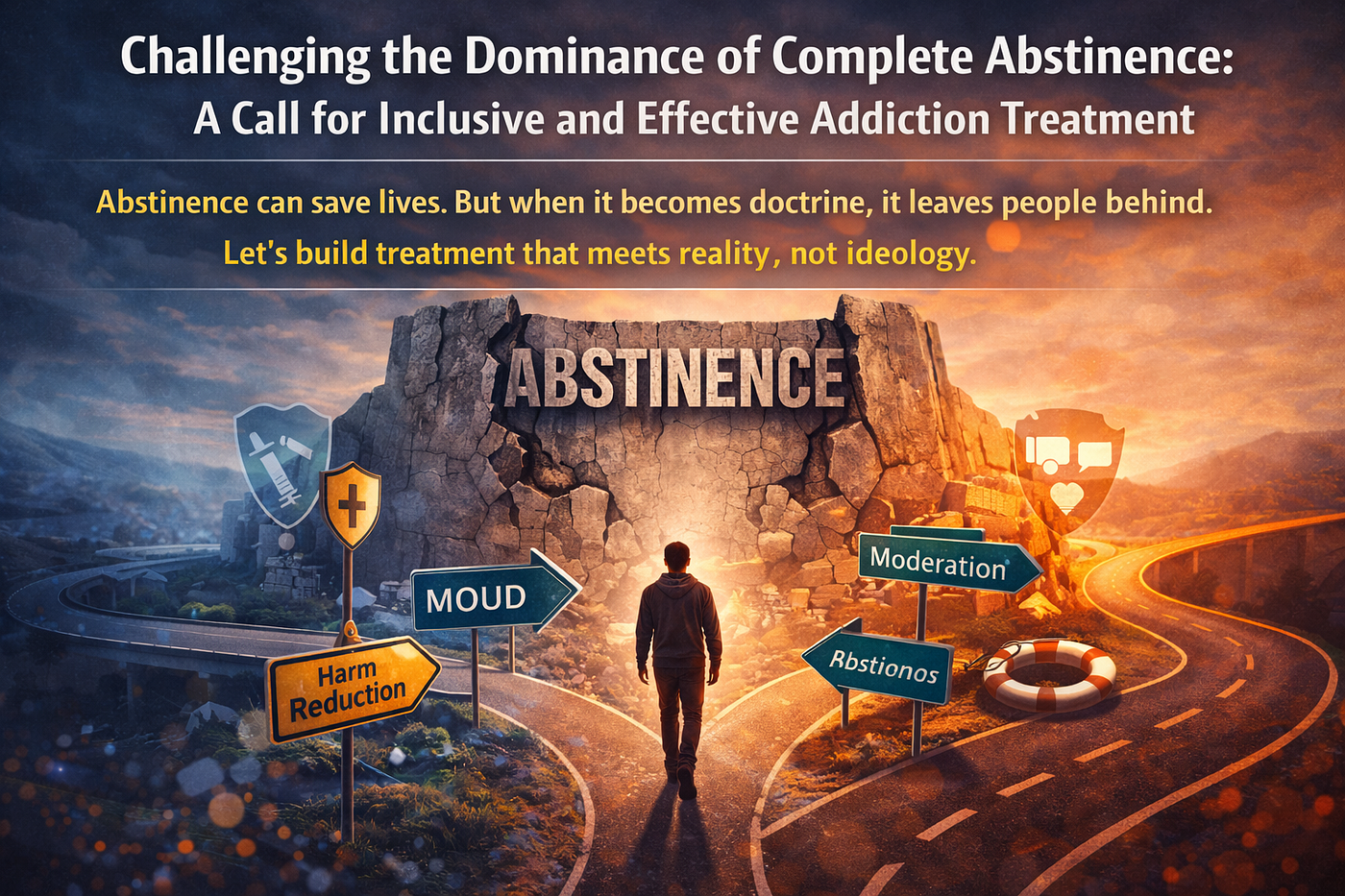
Source: Midjourney
When we talk about addiction treatment, the concept of complete abstinence dominates the conversation like a monolithic, unyielding wall.
It’s hailed as the “gold standard,” the go-to solution for anyone struggling with substance use. For some, it’s a lifeline. For others, it’s a source of shame, harm, and alienation.
While complete-abstinence modalities have undeniably helped many, it’s time to interrogate their efficacy and acknowledge the very real harms they’ve caused, not just to individuals but to the broader landscape of substance use treatment.
People who use drugs (PWUD) deserve better than a one-size-fits-all model that monopolizes funding, stigmatizes alternative approaches, and perpetuates harmful narratives about recovery.
The Problem with Complete Abstinence as a “First-Line” Treatment
In healthcare, first-line treatments are those that are widely effective, well-tolerated, and safe for the majority of people.
Complete abstinence, for all its cultural dominance, doesn’t fit the bill.
While it has helped some individuals achieve sobriety, its effectiveness is highly variable, and it’s often implemented in ways that ignore individual needs, co-occurring conditions, and the complexities of substance use.
Worse, abstinence-only frameworks can exacerbate stigma, alienate people who fail in them, and deter PWUD from seeking help altogether.
Consider the case of opioid use disorder (OUD).
Medication-assisted treatments like methadone and buprenorphine have been proven to reduce overdose deaths, improve quality of life, and support long-term recovery.
Yet the abstinence-only ethos often undermines these evidence-based treatments.
Studies show that stigma against medications for addiction treatment (MAT), fueled by abstinence-only rhetoric, impedes engagement and retention in MOUD.
This not only puts lives at risk but also limits the reach of some of the most effective tools we have in combating the opioid crisis.
The harms aren’t just systemic. They’re deeply personal.
For individuals who fail to achieve or maintain abstinence, the resulting shame and self-blame can be devastating.
Instead of being met with compassion and alternative options, they’re often told they weren’t “working the program” hard enough.
This cycle of failure and stigma perpetuates the very feelings of hopelessness and isolation that drive substance use in the first place.
How Complete Abstinence Harms Alternative Approaches
The hegemonic control exerted by abstinence-only thinking doesn’t just harm the individuals who struggle within its framework.
It also stifles the development and adoption of other treatment modalities.
Harm reduction, moderation management, and MAT are often dismissed or underfunded because they don’t align with the abstinence-first philosophy.
This isn’t just an oversight; it’s a direct consequence of cultural narratives and funding structures that prioritize abstinence over all else.
Take harm reduction, for example. Programs that provide clean syringes, safe consumption spaces, and overdose prevention services save lives and improve public health outcomes.
Yet these approaches are frequently dismissed as “enabling” by abstinence-only proponents.
Similarly, moderation management, which helps individuals reduce their substance use without quitting entirely, is often treated as a lesser form of recovery, even though it can be transformative for those who aren’t ready or willing to pursue abstinence.
The result is a treatment landscape that’s heavily skewed toward a single approach, leaving countless people without access to the care that would best serve their needs.
It’s a self-perpetuating cycle: abstinence-only programs receive the lion’s share of funding and cultural validation, while alternative approaches are marginalized, making it harder for individuals to find or trust them.
The Role of Stigma and Evangelism in Sustaining the Status Quo
So why does complete abstinence remain so dominant despite its limitations? The answer lies in a potent mix of societal stigma, financial incentives, and outright evangelism by its proponents.
Addiction has long been framed as a moral failing rather than a health issue, and abstinence aligns neatly with this narrative.
It appeals to the idea of redemption through self-denial, a concept deeply rooted in religious and cultural traditions.
This moral framing not only fuels stigma against PWUD but also delegitimizes harm reduction and other non-abstinence-based approaches.
Funding structures further entrench abstinence-only dominance.
Programs like 12-step fellowships often receive uncritical financial and institutional support, while harm reduction initiatives and MAT face significant barriers to funding and implementation.
This disparity isn’t rooted in evidence — on the contrary, harm reduction and MAT have decades of research backing their efficacy.
Instead, it reflects a societal bias that prioritizes abstinence as the “right” way to recover, regardless of the data.
Finally, there’s the issue of evangelism.
Many proponents of abstinence-only programs are deeply committed to their approach, often because it worked for them.
While their passion is understandable, it can sometimes cross into dogmatism, dismissing other pathways as inferior or invalid.
This evangelism reinforces the idea that abstinence is not just one option among many but the only “real” recovery.
Acknowledging the Harms of Abstinence-Only Frameworks
To be clear, the goal isn’t to eliminate complete-abstinence modalities.
For some, they are life-saving and deeply meaningful. The problem arises when abstinence is treated as the only legitimate approach, to the exclusion of all others.
This narrow focus ignores the diversity of experiences, needs, and goals within the recovery community and perpetuates harm for those who don’t fit the mold.
I speak from personal experience. For two years, I practiced complete abstinence and was deeply involved in an abstinence-only community.
While I gained some valuable insights during that time, I also internalized stigma and judgment that I’m still working to undo.
The pressure to conform to a single model of recovery left me feeling disconnected from my own needs and values, and it’s taken years to rebuild a healthier relationship with myself and my journey.
That said, I fully support those who voluntarily choose complete abstinence as their path. Recovery is deeply personal, and what works for one person may not work for another.
The key is ensuring that everyone has access to the options that best align with their needs and goals, without judgment or coercion.
A Call for Inclusive, Evidence-Based Treatment
It’s time to reimagine addiction treatment as a diverse, inclusive, and evidence-based ecosystem.
This means recognizing the limitations of complete-abstinence modalities and prioritizing safer, more effective approaches like harm reduction, MAT, and moderation management.
It also means dismantling the stigma that has long shaped our understanding of addiction and ensuring that all pathways to recovery are treated with respect and legitimacy.
Healthcare providers, policymakers, and community leaders must work together to create a system that meets people where they are rather than demanding they fit a predetermined mold.
This includes increasing funding for harm reduction programs, expanding access to MAT, and providing education about the full spectrum of recovery options.
It also means amplifying the voices of PWUD, who are often excluded from conversations about the very policies and programs that affect their lives.
People Who Use Drugs Deserve Better
Addiction is not a moral failing — it’s a complex health issue that requires compassion, nuance, and flexibility.
By moving beyond the dominance of complete-abstinence modalities and embracing a broader range of approaches, we can build a system that truly supports individuals in their recovery journeys.
People who use drugs deserve better than a one-size-fits-all solution that prioritizes ideology over evidence.
They deserve care that recognizes their humanity, respects their choices, and empowers them to build meaningful, fulfilling lives.
Conclusion
What has been your experience with abstinence-based programs or alternative approaches? How can we create a more inclusive and effective addiction treatment landscape?
Please share your thoughts in the comments, and let’s start a conversation about building a future where every recovery journey is valued.
About the Author:
Hi, I’m Johnny, an ex-street junky with 9 years sober. I’m into multiple pathways to recovery, harm reduction, alternative health & personal growth — and loud, raw, noisy guitars.
You can check out my band here.
Check out my extensive list of Self-Growth and **Recovery Workbooks**
I also create short guides to resources to help others live with more freedom and intention, work smarter, and recover openly.
메타데이터
- post_id
- 970df24db257
- slug
- challenging-the-dominance-of-complete-abstinence-a-call-for-inclusive-and-effective-addiction-970df24db257
- url
- https://medium.com/@JohnMakohen/challenging-the-dominance-of-complete-abstinence-a-call-for-inclusive-and-effective-addiction-970df24db257
- canonical_url
- https://medium.com/@JohnMakohen/challenging-the-dominance-of-complete-abstinence-a-call-for-inclusive-and-effective-addiction-970df24db257
- author_url
- https://medium.com/@JohnMakohen
- status
- ok
- fetched_at
- 2026-07-13 11:39:10