Advanced Suno AI Prompting in 2026: 7 Techniques Most Creators Haven’t Found Yet
The 5-element framework gets you to good. These techniques get you to repeatable.
Advanced Suno AI Prompting in 2026: 7 Techniques Most Creators Haven’t Found Yet
The 5-element framework gets you to good. These techniques get you to repeatable.
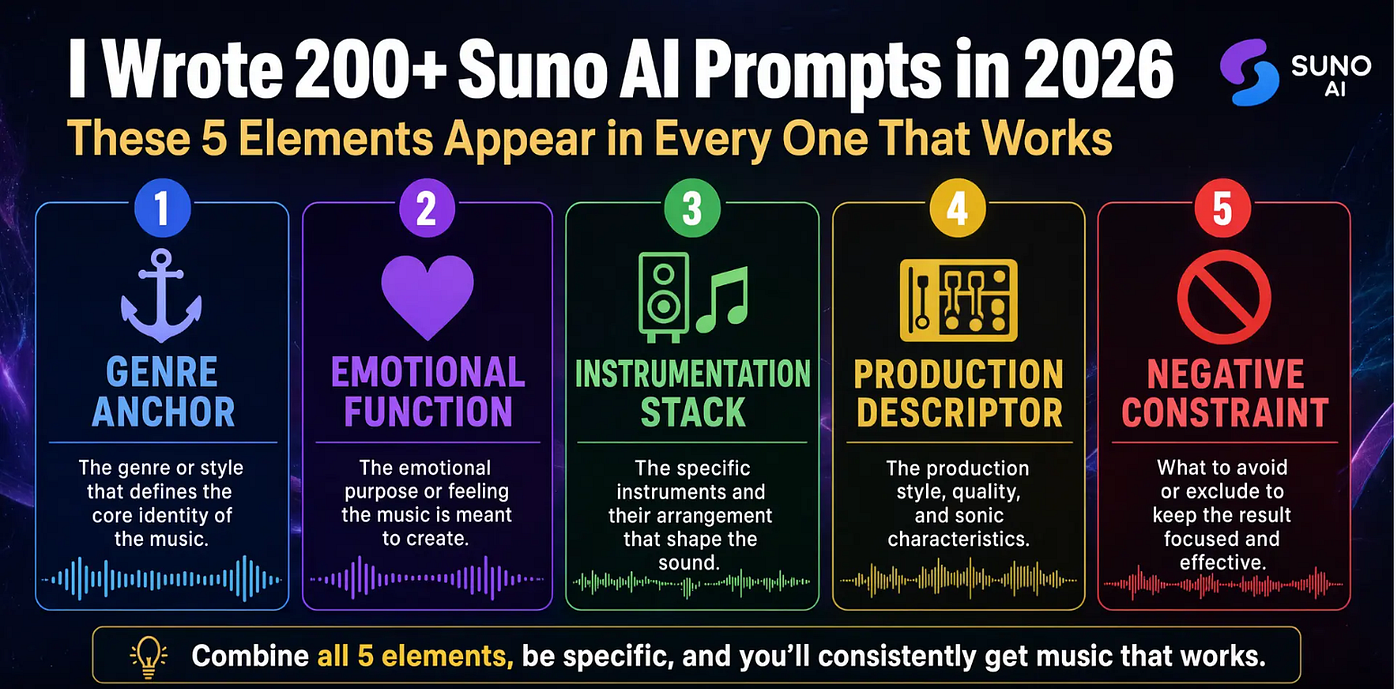
In my previous article : **I Wrote 200+ Suno AI Prompts in 2026 — These 5 Elements Appear in Every One That Works. **I covered the foundational structure: genre anchor, emotional function, instrumentation stack, production descriptor, negative constraint.
That framework is the floor. This article is the ceiling.
These 7 techniques are what I use when I need a track to hit a specific distribution target, fit a playlist brief, or match a client’s functional requirement. They’re not beginner concepts. They assume you already know how to write a structured prompt.
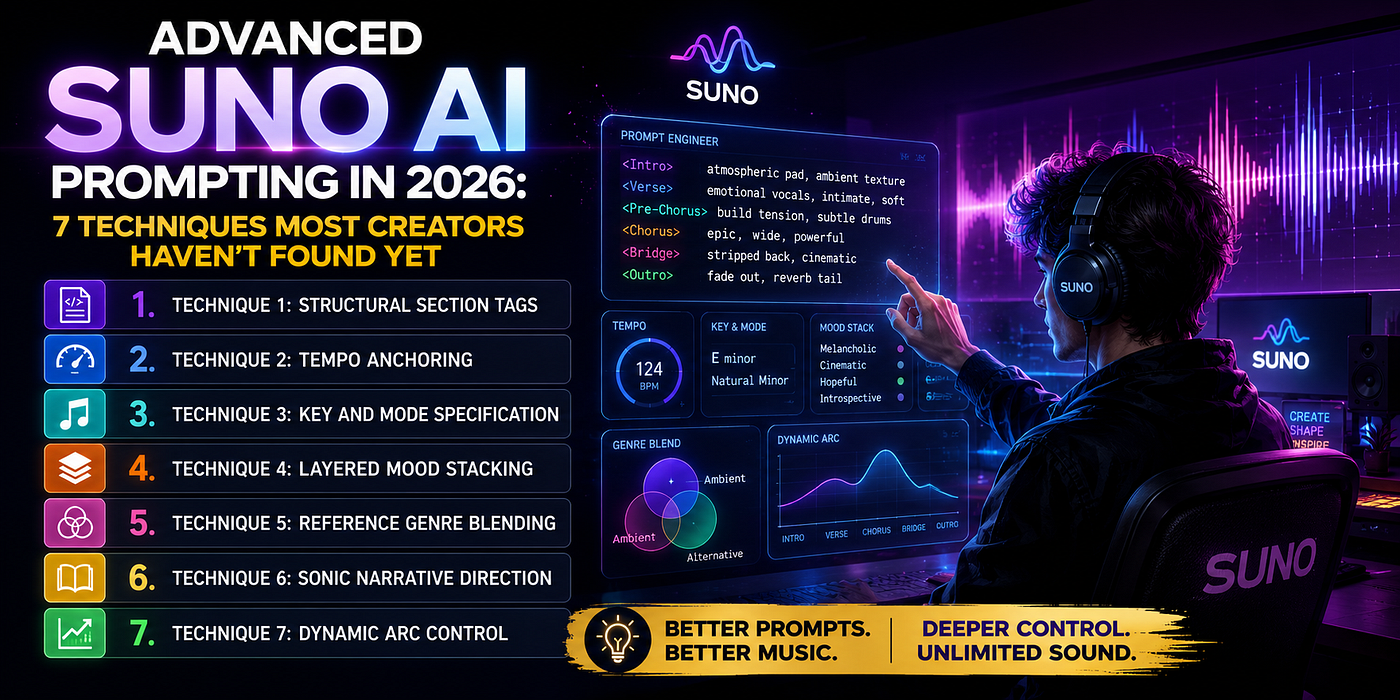
Advanced Suno AI prompting in 2026 goes beyond genre and mood. The 7 techniques covered here: structural section tags, tempo anchoring, key and mode specification, layered mood stacking, reference genre blending, sonic narrative direction, dynamic arc control, and style exclusion stacking. Each one changes a specific dimension of the output. Combined, they give you a level of directorial control most Suno AI users don’t know exists.
Why Advanced Techniques Matter Now
Suno’s model in 2026 is significantly more responsive to precise language than earlier versions were.
In 2024, many of these techniques produced inconsistent results. Suno AI would partially interpret a structural tag, or ignore a key specification entirely. The current model has closed most of those gaps.
This means the ceiling for prompt control has risen. Creators who learned Suno on the 2024 model and never updated their prompting approach are leaving output quality on the table.
The techniques below are ordered from structural (highest leverage) to textural (highest nuance).
Technique 1: Structural Section Tags
What it does: Controls the architecture of the track. Where it starts, how it develops, where it ends.
Suno AI supports meta-tags embedded directly in the prompt or lyrics field that signal structural intent. The most reliable ones in 2026:
- Intro : signals a low-energy opening passage
- Verse : main thematic section
- Chorus : peak energy, repeated hook
- Bridge : contrast section before final chorus
- Outro : fade or resolution passage
- Intrumental Break : clears vocals, holds groove
- Build : gradual tension increase toward a drop or chorus
How to use them: Place them as inline markers in the lyrics field, or reference them in the style prompt as behavioral instructions.
Style prompt example:
“structure: extended intro 30 seconds, slow build to main theme, no abrupt transitions, soft outro fade”
This is especially important for ambient and sleep music where structural predictability is part of the product. A baby sleep track that jumps straight into the main theme without an establishing intro is harder to use in a real sleep routine.
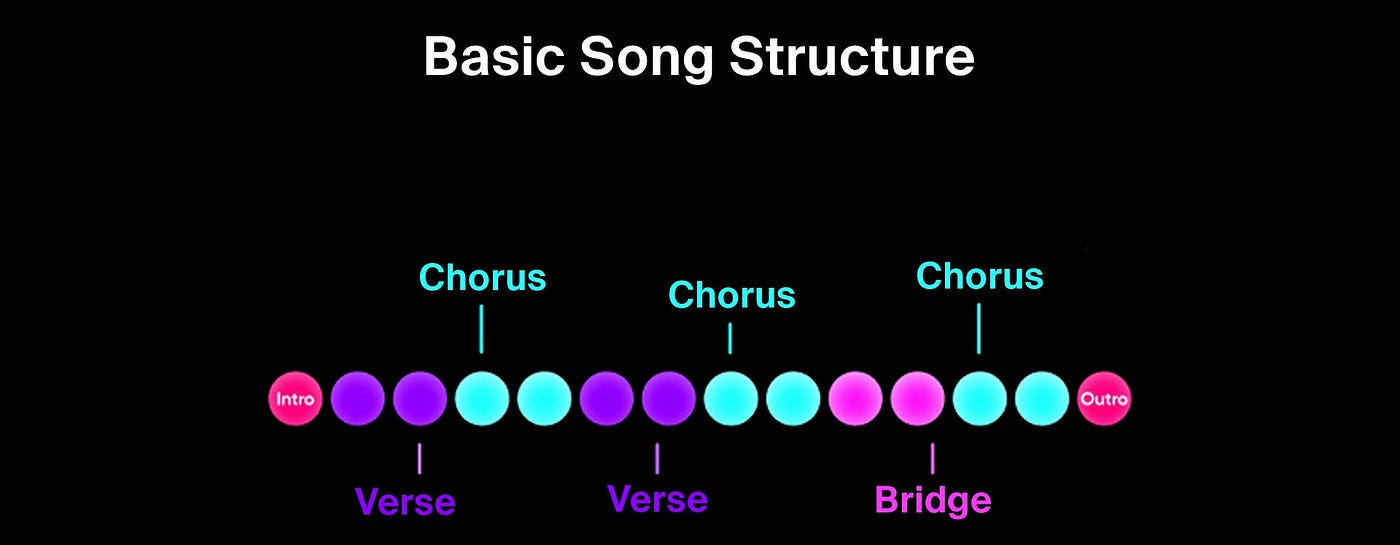
Test result from my own sessions: Adding **[Intro] and [Outro]** tags to a baby sleep prompt reduced the number of unusable generations (due to abrupt starts or hard endings) from roughly 40% to under 15%.
Technique 2: Tempo Anchoring
What it does: Pins the rhythmic feel to a specific BPM range rather than leaving it to genre convention.
Most genre anchors carry an implied tempo. “lo-fi hip-hop” implies 70–90 BPM. “phonk” implies 130–140 BPM. But implied tempo and actual output tempo don't always match, and even a 15 BPM drift can shift a track from usable to unusable for its intended context.
Explicit tempo anchoring:
- Slow tempo, approximately 60–70 BPM
- Mid-tempo groove, 90–100 BPM
- Fast-paced energy, 140+ BPM
For functional music niches, tempo is a clinical parameter. Research on sleep and relaxation music consistently points to sub-60 BPM as the range that matches resting heart rate. For a baby sleep track, “very slow tempo, under 60 BPM, heart rate matching” is not stylistic, it's a product specification.
Combine with genre anchor: “dark ambient, very slow tempo, under 60 BPM, no rhythmic pulse”, the tempo instruction overrides the genre's default rhythmic convention.
Technique 3: Key and Mode Specification
What it does: Locks the harmonic color of the track to a specific tonal center and scale type.
This is the most underused advanced technique. Most Suno users never specify key or mode, they rely on genre conventions to imply harmonic character. That works for common cases. It fails for deliberate emotional targeting.
Key specification:
- In the key of C minor : darker, introspective
- In D major : bright, open, resolved
- In F# minor : melancholic, cinematic tension
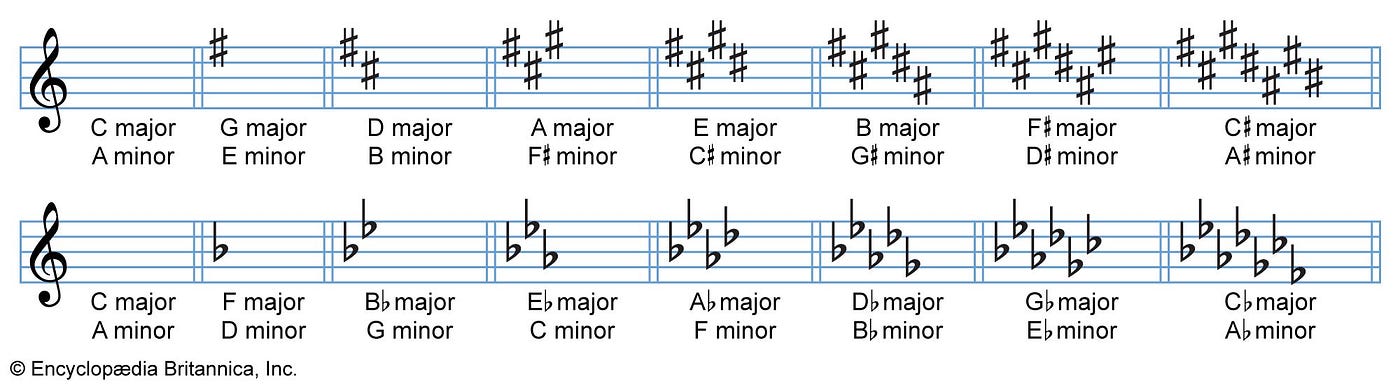
Mode specification is even more powerful for ambient and instrumental niches:
- Dorian mode : minor feel with a raised 6th, creates bittersweet space (think classic lo-fi jazz)
- Lydian mode : major scale with a raised 4th, creates floating, dreamlike quality (ideal for ambient)
- Phrygian mode : dark, tense, Spanish or Middle Eastern flavoring (strong for phonk, cinematic)
- Mixolydian mode : major feel with a flattened 7th, warm and slightly unresolved (good for chill beats)
For a focus music track I produced for the deep work niche: “Lydian mode, slow evolving synthesizer pads, no resolution, suspended harmonic field” : the Lydian specification removed the gravitational pull toward tonal resolution that makes music feel episodic rather than continuous. That's exactly what a 45-minute focus session needs.
Technique 4: Layered Mood Stacking
What it does: Combines two or more emotional states to create a specific psychological texture that a single mood word can’t achieve.
Single mood words are blunt instruments. “calm” gives Suno AI a wide target. “calm but slightly melancholic, like a quiet Sunday morning after a difficult week” gives it a precise emotional coordinate.
Mood stacking pairs contrasting or complementary states:
- Peaceful but slightly tense, like calm before a storm : ambient with edge
- Nostalgic and warm, like an old photograph : lo-fi, vintage tone
- Focused and urgent, like working toward a deadline you believe in productive pressure without anxiety
- Melancholic but accepting, not sad : emotional depth without darkness
The key is the conjunction : “But” creates productive tension between two states. “And” stacks them additively. “Like” provides a scene reference that activates Suno’s associative training.
Use one mood stack per prompt. Two creates conflicting signals. One, precisely written, does more work than five generic mood words.
Technique 5: Reference Genre Blending
What it does: Creates a hybrid sonic space by naming two genre references and specifying the blend ratio or dominant element.
Suno’s training data includes a wide range of genre intersections. You can navigate those intersections deliberately:
- 70% ambient, 30% neoclassica, let the piano lead over synthesizer texture.
- Dark phonk with cinematic orchestral undertones, trap rhythm dominant, strings secondary.
- Lo-fi jazz with bossa nova chord voicings brushed drums, acoustic guitar, upright bass.
- Post-rock ambient guitar textures, no vocals, stadium reverb, no drums.
The ratio language matters. Stating which element is dominant prevents Suno from averaging the two genres equally, which often produces something that sounds like neither.
This technique is particularly useful for sync and app licensing targets where you need music that fits a specific mood category but sounds more distinctive than the genre default.
Technique 6: Sonic Narrative Direction
What it does: Gives the track a journey a beginning state, a middle development, and an end state without using structural section tags.
Where structural section tags are architectural (they define the map), sonic narrative direction is cinematic (it defines the story).
Examples:
- Begins in sparse silence, grows slowly into warmth, ends in resolution like dawn breaking.
- Opens with tension, releases gradually into calm, ends unresolved like a question left open.
- Starts at full energy, slowly decays into stillness, like a fire burning out.
This technique works particularly well for:
- Long-form ambient tracks (20–45 minutes on Spotify)
- Meditation and sleep music that needs to guide a listener through a state transition
- Sync placements where the track needs to mirror a scene arc
It requires Suno AI to interpret the narrative as a dynamic instruction. The current 2026 model handles this more reliably than previous versions narrative language now has measurable influence on how a track develops over its duration.
Technique 7: Dynamic Arc Control
What it does: Specifies the energy envelope of the track where it peaks, how it moves, how much variation is allowed.
This is distinct from sonic narrative (which describes a story) and structural tags (which mark sections). Dynamic arc control is a pure energy instruction:
- Flat dynamic arc, no peaks or drops, consistent energy throughout : ideal for focus/study music
- Slow crescendo from low to medium energy, never reaching high intensity : sleep music ramp-down
- Single peak at the 60% mark, then gradual decay : cinematic single-climax structure
- Alternating waves of intensity, never fully quiet, never fully loud: continuous background music
The most important application is negative dynamic control, preventing Suno from introducing the kind of spontaneous energy spikes that make a functional music track unusable.
For baby sleep music specifically: “completely flat dynamic arc, no crescendo, no drop, no variation in intensity, constant low-level warmth” is the instruction that separates professional sleep music from amateur attempts. Technique 8: Style Exclusion Stacking
What it does: Extends the basic negative constraint (Element 5 from the foundation framework) into a comprehensive exclusion layer that blocks entire style families, not just individual elements.
Basic negative constraints block specific instruments or events:
“no drums, no vocals”
Style exclusion stacking blocks aesthetic categories:
“avoid all EDM conventions, no sidechain compression, no four-on-the-floor kick pattern, no filter sweeps, no drop structure” “exclude all pop production tropes, no verse-chorus structure, no hook repetition, no radio-ready compression” “no Western tonal resolution, avoid perfect cadences, avoid dominant-tonic movement”
This technique is essential when you’re working in a niche that lives adjacent to a mainstream genre you’re trying to avoid. Ambient music sits next to new age. Lo-fi sits next to bedroom pop. Phonk sits next to trap. Without style exclusion stacking, Suno will drift toward the more common adjacent genre.
Stack 3–5 style exclusions for maximum boundary definition. More than 5 starts creating conflicting constraints that confuse the output.
Combining Techniques: A Real Production Example
Here’s a complete advanced prompt I used for a deep work focus track targeting the Spotify “Focus Flow” playlist ecosystem:
“Lydian mode [key/mode], 75–85 BPM steady tempo [tempo anchor], ambient electronic with neoclassical piano undertones, 70% ambient synthesizer texture 30% acoustic piano [reference genre blend], designed for sustained cognitive focus over 30–45 minutes without mental fatigue [emotional function], slow evolving synthesizer pads, soft prepared piano, faint sub-bass drone [instrumentation stack], wide stereo field, long reverb tails, spatial depth, warm analog warmth [production descriptor], completely flat dynamic arc, no variation in intensity [dynamic arc control], begins in stillness, slowly opens into full texture by minute 2, holds that space, ends with a gradual fade [sonic narrative], no drums, no vocals, no percussion, no chord resolution, avoid all EDM or pop production conventions, no dominant-tonic movement [style exclusion stack]”
That prompt is long. Every element does specific work. The output on the third generation was distribution-ready.
Building an Advanced Prompt Template System
The goal is not to write this from scratch every session.
Once you’ve validated the techniques that work for your specific niche, you build templates. Fixed elements stay fixed. Variable elements (genre anchor, instrumentation stack, mood stack) rotate based on the specific track brief.
I maintain four active templates in Notion/Excel:
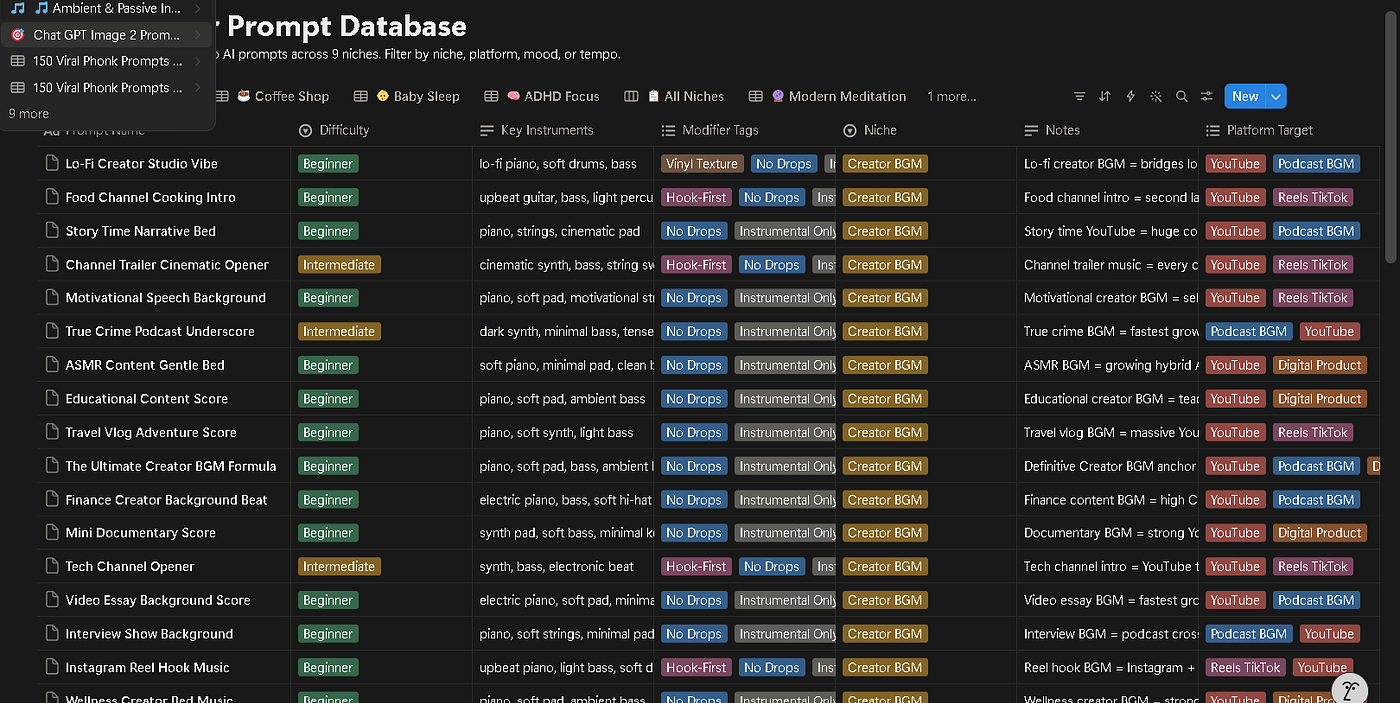
- **Baby sleep (heavy on dynamic arc control + negative constraints)**
- **Deep work focus (heavy on key/mode + flat dynamic arc)**
- **Dark ambient (heavy on sonic narrative + style exclusion)**
- **Phonk (heavy on tempo anchor + genre blend)**
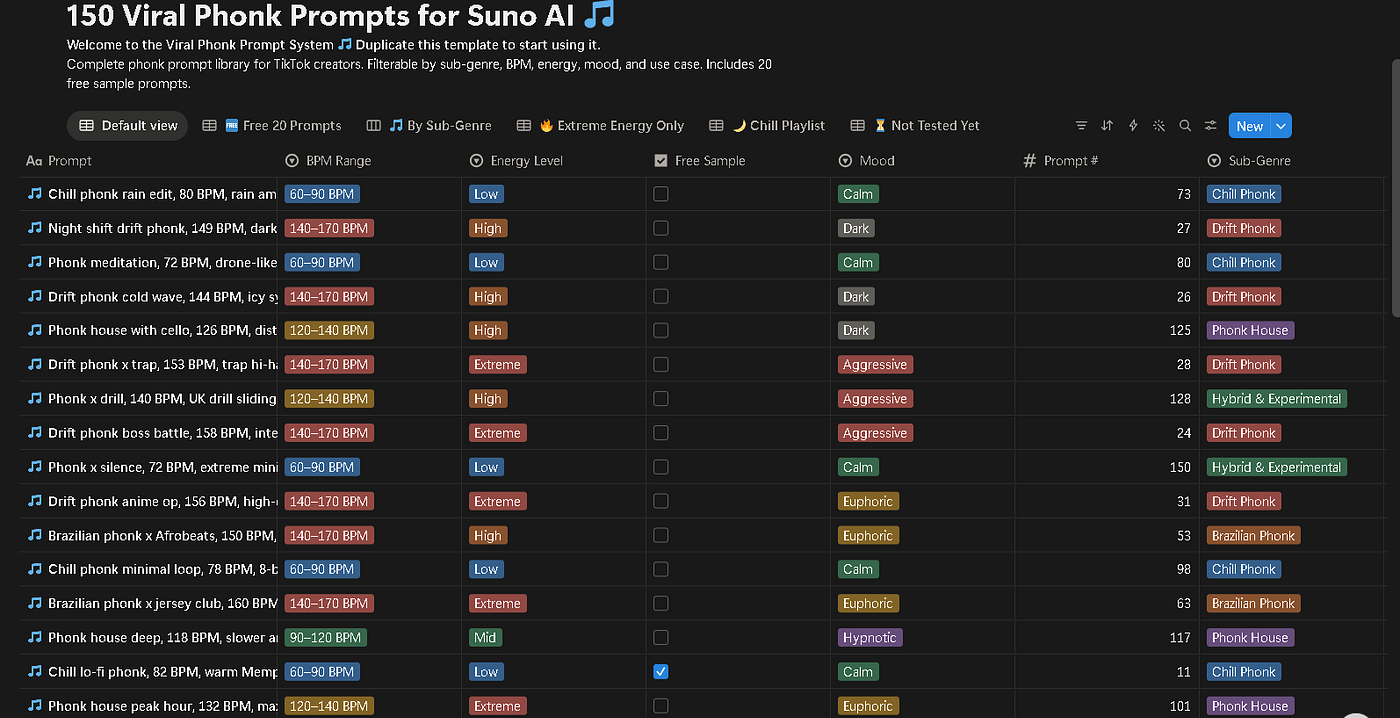
Each template was built through 15–20 test generations. Each one now produces usable tracks at a 70%+ hit rate.
***The Ultimate Suno AI Prompt Library *contains the validated prompt templates across 10 niches : not raw prompts, but tested structures with the advanced techniques already built in. If you want to skip the 20-generation testing phase per niche, that’s what it’s for.
What to Watch in Late 2026
Suno AI continues to update its model. Two areas where I’m monitoring changes:
Longer output control : Suno’s extend feature (covered separately in [**I Tested Suno’s Extend Feature on +5 Tracks**]) interacts with these techniques in ways that aren’t fully documented. Structural tags applied to extended tracks behave differently than in standard generations.
Vocal style control : For creators working with lyric-based tracks, advanced vocal style descriptors are becoming more reliable. “spoken word delivery”, “falsetto lead”, “choir texture, no solo voice” now produce more consistent results than 12 months ago. I'll cover vocal prompt engineering as a standalone article once I have enough test data.
This is Part 2 of the Suno AI prompt engineering series. Start with I Wrote 200+ Suno AI Prompts in 2026 — These 5 Elements Appear in Every One That Works if you haven’t read it.
메타데이터
- post_id
- 971bab0cad9c
- slug
- advanced-suno-ai-prompting-in-2026-7-techniques-most-creators-havent-found-yet-971bab0cad9c
- url
- https://medium.com/@alex-hustler/advanced-suno-ai-prompting-in-2026-7-techniques-most-creators-havent-found-yet-971bab0cad9c
- canonical_url
- https://medium.com/@alex-hustler/advanced-suno-ai-prompting-in-2026-7-techniques-most-creators-havent-found-yet-971bab0cad9c
- author_url
- https://medium.com/@alex-hustler
- status
- ok
- fetched_at
- 2026-06-12 07:40:50