The (Reverse)Flynn Effect
Are we becoming quasi intelligent?
The (Reverse)Flynn Effect
Are we becoming quasi intelligent?
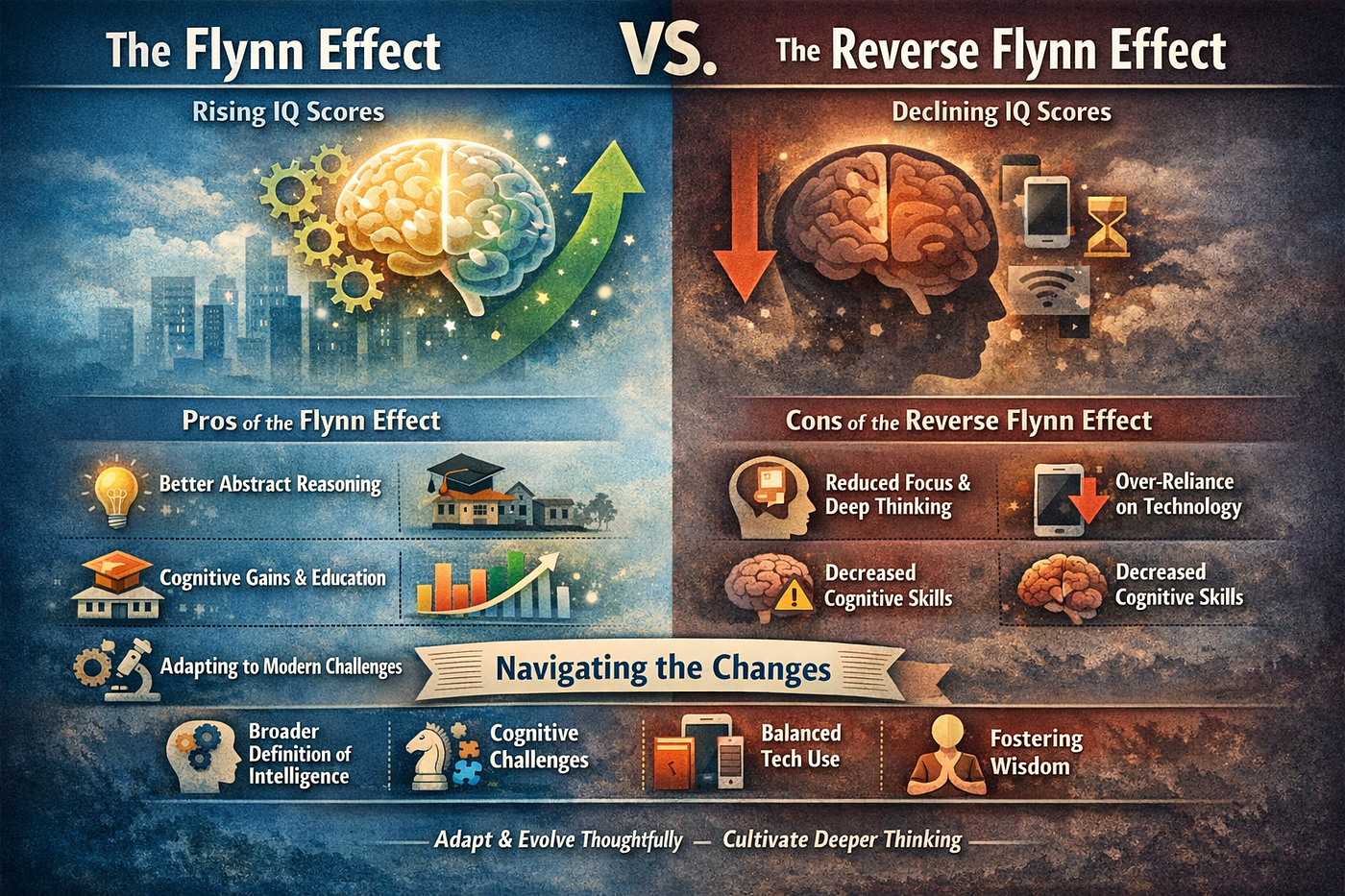
The Flynn Effect and the Reverse Flynn Effect:
Rising Intelligence, Cognitive Trade-offs, and How Society Should Respond
Introduction
For much of the 20th century, psychologists observed a striking phenomenon: average IQ scores were rising steadily across generations. This trend, first systematically documented by political scientist and intelligence researcher James R. Flynn, came to be known as the Flynn Effect. However, in recent decades, several developed nations have reported a stalling or reversal of this trend, termed the Reverse Flynn Effect.
Together, these two phenomena raise a critical psychological question:
Are we becoming more intelligent, differently intelligent, or cognitively fragile in new ways?
Understanding the Flynn Effect
What is the Flynn Effect?
The Flynn Effect refers to the systematic increase in IQ test scores over successive generations, typically estimated at 2–3 IQ points per decade during the 20th century (Flynn, 1987).
Notably, the strongest gains were observed in:
• Fluid intelligence
• Abstract reasoning
• Pattern recognition
• Classification and analogy tasks
rather than in rote knowledge or vocabulary.
Psychological Explanations
Research suggests the Flynn Effect is environmental rather than genetic, driven by:
- Improved Nutrition and Health
Better prenatal care, reduced infectious disease burden, and childhood nutrition enhanced neurodevelopment.
- Education and Test Familiarity
Formal schooling increasingly emphasizes abstract symbols, graphs, hypotheticals, and logic.
- Cognitive Complexity of Modern Life
Urbanization, technology, and professional specialization require constant symbolic reasoning (Flynn, 2007).
- Shift from Concrete to Abstract Thinking
Modern societies reward rule-based and hypothetical reasoning more than experiential wisdom.
Advantages of the Flynn Effect
1. Enhanced Abstract Reasoning
Individuals became better at solving novel problems, interpreting patterns, and thinking hypothetically — skills vital for science, engineering, and policy-making.
2. Cognitive Democratization
Improvements were strongest among lower-scoring populations, reducing cognitive inequality and improving access to education and skilled work.
3. Adaptation to Complex Systems
Modern institutions — law, finance, technology, bureaucracy — require abstract mental models, which the Flynn Effect appears to support.
The Hidden Costs and Drawbacks
Despite rising IQ scores, psychologists began noticing paradoxes.
1. IQ ≠ Wisdom or Judgment
Higher abstract intelligence does not automatically translate to:
• Better moral reasoning
• Emotional regulation
• Real-world decision-making
This disconnect echoes findings in dual-process theory (Kahneman, 2011).
2. Narrow Cognitive Gains
The Flynn Effect disproportionately boosts test-specific abilities, not necessarily:
• Long-term planning
• Systems thinking
• Metacognition
• Emotional intelligence
3. Cognitive Overconfidence
Improved reasoning skills may increase illusion of explanatory depth — people feel they understand complex systems far better than they actually do (Rozenblit & Keil, 2002).
The Reverse Flynn Effect: A Cognitive Warning Sign
What is the Reverse Flynn Effect?
Since the early 2000s, countries like Norway, Denmark, Finland, the UK, and parts of Western Europe have shown declining IQ scores, especially in younger cohorts (Bratsberg & Rogeberg, 2018).
Possible Psychological Causes
- Reduced Deep Reading and Attention
Digital environments favor skimming, multitasking, and short-form cognition, weakening sustained attention.
- Educational Dilution
Emphasis on credentials over cognitive rigor may reduce reasoning depth.
- Environmental and Lifestyle Factors
Sleep deprivation, sedentary behavior, screen exposure, and reduced free play affect executive functions.
- Cognitive Offloading
Reliance on technology reduces memory, navigation, and problem-solving effort.
Is the Reverse Flynn Effect “Bad”?
Not entirely — but it is diagnostic.
It suggests:
• Intelligence is plastic, not guaranteed
• Cognitive skills atrophy without environmental demand
• Modern systems may reward speed over depth
The decline is strongest in fluid intelligence, not crystallized knowledge — suggesting reduced cognitive exercise rather than reduced potential.
How Should We Navigate These Changes?
1. Redefine Intelligence Broadly
Move beyond IQ to include:
• Metacognition
• Emotional regulation
• Ethical reasoning
• Systems thinking
2. Design Cognitively Demanding Environments
Education and work should:
• Encourage slow thinking
• Reward reasoning processes, not just answers
• Promote problem formulation, not only problem solving
3. Balance Technology with Cognitive Effort
Use tools as amplifiers, not replacements:
• Write before using AI
• Think before searching
• Reflect before reacting
4. Cultivate Cognitive Humility
Teach awareness of:
• Biases
• Overconfidence
• Limits of abstraction
This aligns with research on epistemic humility and wisdom (Grossmann et al., 2020).
Conclusion
The Flynn Effect reflects humanity’s remarkable capacity to adapt cognitively to changing environments. The Reverse Flynn Effect reminds us that intelligence must be continuously exercised, not assumed.
The core lesson is not that we are getting smarter or dumber — but that society shapes the kind of minds it produces.
The psychological challenge ahead is to design environments that cultivate depth, judgment, and wisdom, not merely higher scores.
References
• Bratsberg, B., & Rogeberg, O. (2018). Flynn effect and its reversal are both environmentally caused. Proceedings of the National Academy of Sciences, 115(26), 6674–6678.
• Flynn, J. R. (1987). Massive IQ gains in 14 nations: What IQ tests really measure. Psychological Bulletin, 101(2), 171–191.
• Flynn, J. R. (2007). What Is Intelligence? Beyond the Flynn Effect. Cambridge University Press.
• Kahneman, D. (2011). Thinking, Fast and Slow. Farrar, Straus and Giroux.
• Rozenblit, L., & Keil, F. (2002). The misunderstood limits of folk science. Cognitive Science, 26(5), 521–562.
• Grossmann, I., et al. (2020). Wisdom in context. Perspectives on Psychological Science, 15(2), 410–426.
메타데이터
- post_id
- 971cfbc47394
- slug
- the-reverse-flynn-effect-971cfbc47394
- url
- https://medium.com/@alchlonist/the-reverse-flynn-effect-971cfbc47394
- canonical_url
- https://medium.com/@alchlonist/the-reverse-flynn-effect-971cfbc47394
- author_url
- https://medium.com/@alchlonist
- status
- ok
- fetched_at
- 2026-07-26 07:10:32