How Can AI Development Help Businesses Survive Inflation and Economic Uncertainty?
Rising inflation, supply chain disruptions, increasing workforce expenses, and unpredictable consumer behavior are creating major…
How Can AI Development Help Businesses Survive Inflation and Economic Uncertainty?
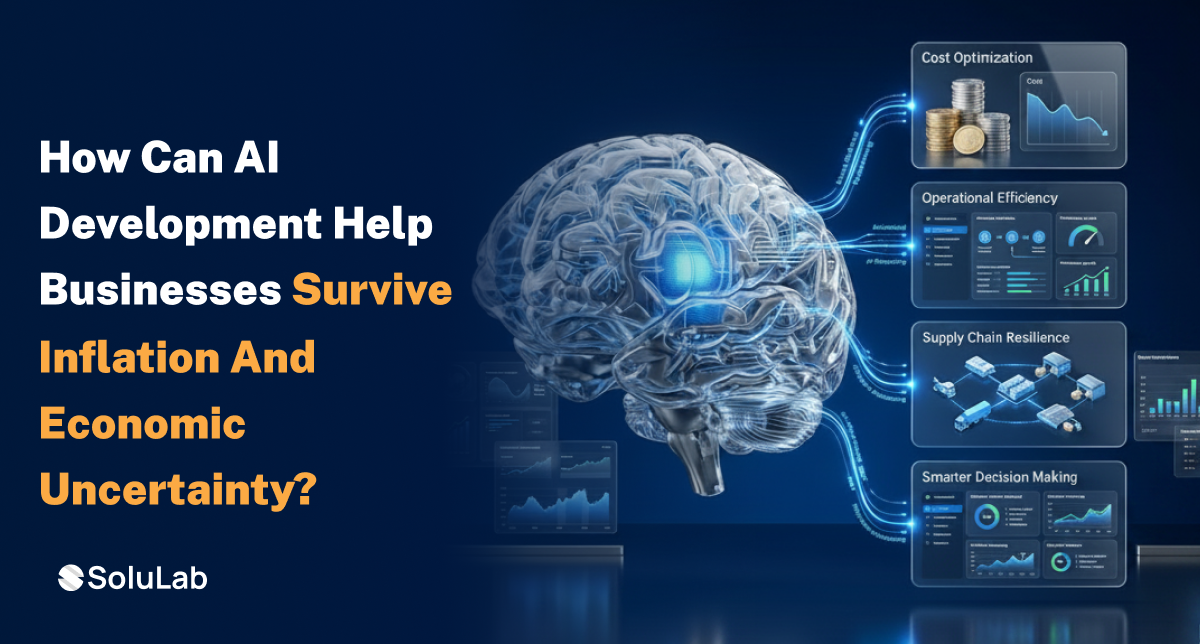
Rising inflation, supply chain disruptions, increasing workforce expenses, and unpredictable consumer behavior are creating major challenges for businesses across industries.
However, artificial intelligence is now emerging as a practical business survival tool rather than a futuristic innovation reserved for large enterprises. Businesses are using AI to improve demand forecasting.
According to **McKinsey**, generative AI could add $2.6 trillion to $4.4 trillion annually to the global economy across multiple business use cases.
From predictive analytics to AI-powered automation, organizations are leveraging technologies to become more adaptive. Continue reading this blog to know more about the impact of inflation on businesses and how AI can contribute to overcoming inflation challenges.
The Impact of Inflation on Business
Inflation is changing how businesses operate by increasing production costs, reducing consumer purchasing power, and creating long-term financial uncertainty across global industries.
- Rising fuel prices
- Labor expenses
- Raw material costs
- Logistics disruptions
According to the **International Monetary Fund (IMF)**, prolonged inflationary environments can weaken business confidence, reduce investment activity, and slow economic productivity across sectors.
At the same time, inflation is impacting workforce management, business expansion, and long-term strategic planning. Companies are under pressure to increase salaries and employee benefits while balancing reduced consumer spending and tighter operational budgets.
A recent report from **Deloitte** Insights explains that enterprises are increasingly adopting technologies and data-driven decision-making systems to improve resilience, reduce inefficiencies, and sustain operational stability during periods of economic volatility.
Why Traditional Methods No Longer Work?
Economic uncertainty demands faster, data-driven business decisions, but many traditional operational strategies struggle to adapt to changing markets, rising costs, unpredictable consumer behavior, and modern competitive business environments.
1. Layoffs Hurt Long-Term Growth
Reducing workforce costs may offer temporary financial relief, but repeated layoffs often damage productivity, employee morale, innovation capacity, and long-term business stability.
2. Manual Forecasting Is Slow
Traditional forecasting methods rely heavily on historical data and human assumptions, making them inefficient during rapidly changing economic and market conditions.
3. Static Pricing Models Fail During Volatility
Fixed pricing strategies cannot respond to inflation, shifting demand, competitor pricing, or fluctuating operational costs across evolving market environments.
4. Reactive Decision-Making Increases Risk
Businesses reacting after disruptions occur often face delayed responses, operational inefficiencies, revenue losses, and reduced adaptability during uncertain economic situations.
How AI Helps Businesses Reduce Operational Costs?
Businesses are increasingly adopting AI-powered solutions to minimize operational expenses, improve workforce productivity, automate repetitive processes, and maintain efficiency during growing market competition and evolving customer expectations.
- AI-powered workflow automation: AI automates repetitive operational workflows across departments, reducing processing delays, minimizing human intervention, and improving productivity through faster task execution and intelligent decision-making systems.
- Reducing manual operational overhead: AI reduces dependency on manual processes by streamlining approvals, reporting, scheduling, and administrative operations, helping businesses lower labor costs and operational inefficiencies.
- AI chatbots for customer support: AI chatbots handle customer queries instantly, reduce support staffing pressure, improve response consistency, and deliver uninterrupted customer assistance across multiple communication channels.
- Document processing: AI-powered document processing extracts, verifies, and organizes business information automatically, reducing paperwork handling time, data entry errors.
- AI in HR and recruitment optimization: AI improves recruitment efficiency by automating candidate screening, workforce analysis, onboarding processes, and employee performance tracking while reducing hiring-related operational expenses.
Industries Already Using AI in Economic Uncertainty
Businesses across industries are increasingly adopting AI development services to reduce operational risks, improve forecasting accuracy, optimize spending, and maintain stability during inflation, market volatility, and rapidly changing economic conditions.
- Banking and finance: Financial institutions use AI for fraud detection, risk assessment, automated customer support, and predictive financial planning during uncertain market fluctuations.
- Retail and ecommerce: Retail businesses leverage AI for inventory optimization, demand forecasting, personalized recommendations, and reducing operational inefficiencies during changing consumer spending patterns.
- Healthcare industry: Healthcare providers implement AI-driven automation for patient management, operational planning, diagnostics support, and resource allocation during economic and workforce pressures.
- Manufacturing sector: Manufacturers use AI-powered predictive maintenance, production optimization, and supply chain monitoring to minimize downtime and improve operational efficiency during inflationary disruptions.
- Logistics and transportation: Logistics companies rely on AI for route optimization, fuel efficiency, warehouse automation, and real-time shipment tracking during volatile economic conditions.
- Real estate sector: Real estate companies apply AI for market forecasting, property valuation, customer engagement, and investment analysis amid fluctuating economic and interest rate conditions.
- SaaS and technology companies: Technology businesses adopt AI to automate workflows, improve customer retention, optimize cloud infrastructure costs, and enhance operational productivity during market slowdowns.
Future of AI in Economic Uncertainty
Economic uncertainty is pushing businesses toward automation, predictive operations, and adaptive AI ecosystems that improve resilience, operational visibility, and decision-making across rapidly changing market and customer environments.
- AI-native enterprises: Businesses are designing operations around AI-first infrastructure, enabling faster adaptability, automated decision-making, and improved efficiency during unpredictable economic and market conditions.
- Autonomous operations: Organizations are adopting self-managing systems capable of automating workflows, reducing operational dependencies, and maintaining business continuity with minimal manual intervention during disruptions.
- AI copilots for enterprises: Enterprise AI copilots assist teams with reporting, analytics, communication, and operational tasks, improving productivity while helping businesses reduce costs and response times.
- AI agents in enterprise operations: Intelligent AI agents are managing customer interactions, workflow coordination, and internal process execution, helping enterprises improve operational speed, consistency, and resource optimization.
Final Thoughts
As inflation, market instability, and economic uncertainty continue affecting industries worldwide, businesses are moving towards AI for long-term operational resilience and smarter decision-making.
AI helps organizations reduce unnecessary costs, automate repetitive processes, improve forecasting accuracy, and respond to changing customer behavior and market conditions.
Companies that strategically invest in AI technologies today are better positioned to adapt, innovate, and remain competitive. What are your thoughts on the impact of economic uncertainty on businesses?
메타데이터
- post_id
- 973290cb3d6d
- slug
- how-can-ai-development-help-businesses-survive-inflation-and-economic-uncertainty-973290cb3d6d
- url
- https://ai.plainenglish.io/how-can-ai-development-help-businesses-survive-inflation-and-economic-uncertainty-973290cb3d6d
- canonical_url
- https://ai.plainenglish.io/how-can-ai-development-help-businesses-survive-inflation-and-economic-uncertainty-973290cb3d6d
- author_url
- https://medium.com/@solulab
- status
- ok
- fetched_at
- 2026-06-15 22:55:51