The Room That Opens When You Stop Explaining Yourself
An Alignment Archive escape room about the moment clarity turns into self-erasure.
THE ALIGNMENT ARCHIVE // SOCIAL PRESSURE
The Room That Opens When You Stop Explaining Yourself
An Alignment Archive escape room about the moment clarity turns into self-erasure.
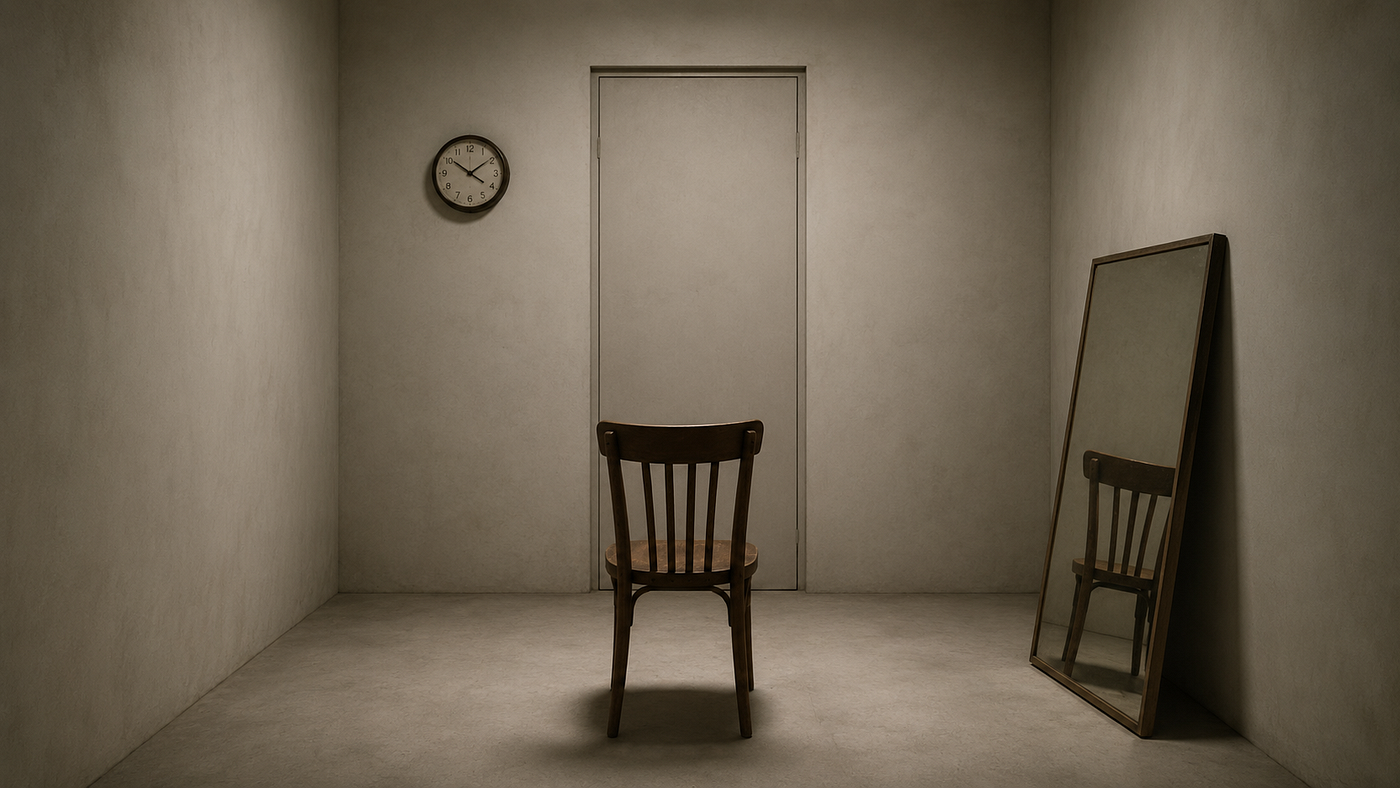
You wake up in a quiet room.
There are no windows. There is one door, but no handle, no lock, and no visible way out.
At first, nothing about the room feels dangerous. It is too plain for that. Too quiet. Just a chair, a door, a mirror, and a clock ticking like it has all the time in the world.
On the door, someone has written three lines:
Be clear. Be reasonable. Make them understand.
You read them once, then again. They seem harmless enough, so you do what most people would probably do.
You start explaining why you should be allowed to leave.
“I don’t belong in here,” you say.
Nothing happens.
You try again, this time sounding more reasonable.
“I understand if there’s been some kind of misunderstanding, but I really do need to get out.”
The light hums. The clock ticks. The door stays shut.
So you adjust. You hear yourself getting careful. You soften your voice, because you do not want to sound angry. You do not want to make the situation worse. You do not want the room, whatever it is, to think you are being difficult.
“I’m not trying to cause a problem. I just think there may have been a misunderstanding.”
Something moves behind you.
You turn around.
The chair has slid one inch closer.
For a second, you just stare at it. Then you look around the room, waiting for something else to happen, but everything has gone still again.
You step toward the mirror. At first, it shows nothing. Not even your body standing in front of it. Then, when you open your mouth to speak, your reflection appears.
You stop talking.
The reflection disappears.
You test it, because of course you do.
“I just want to clarify…”
There you are.
You go silent.
Gone.
That is the first clue.
The mirror is not showing you who you are. It is only showing the version of you still trying to be understood.
You turn back toward the door. The three lines are still there.
Be clear. Be reasonable. Make them understand.
So you try to be clearer. You explain your intention. You explain your tone. You explain what you meant, what you did not mean, and why your first explanation may not have come out right.
The chair slides closer.
The clock resets.
That is when you notice it. Every time you explain yourself again, the clock goes back to the beginning.
You are not getting closer to the exit. You are restarting the room.
That is the second clue.
The room is not asking for clarity. It is using your need to provide it.
By now the chair is close enough to touch the back of your legs, so you sit down. The second you do, a small drawer opens under the seat.
Inside is a card.
On it is written:
What if the door is not waiting for the right explanation?
You stare at the sentence longer than you want to.
It annoys you, mostly because part of you still believes there has to be a correct arrangement of words somewhere. A cleaner sentence. A calmer tone. A version of the truth so reasonable that nobody could push back against it.
You stand up and face the door again.
“I already explained this.”
The room pauses.
For the first time, the clock does not reset. The mirror flickers. Something shifts, but the door still does not open.
So you say it again, a little more plainly.
“I do not need to keep proving the same answer.”
The light dims.
The words on the door begin to fade.
Be clear.
Gone.
Be reasonable.
Gone.
Only one line remains.
Make them understand.
You look at it, and then you see the trap.
The room was never locked by confusion. It was locked by the belief that your answer required approval.
That is the third clue.
Some rooms do not keep you there by force. They keep you there by making you feel responsible for someone else’s refusal to accept what you already said.
You step closer to the door.
This time, you do not explain why you should leave. You do not justify your tone. You do not soften the answer. You do not offer one more paragraph in exchange for peace.
You place your hand where the handle should be.
There is still no handle.
So you say the only sentence the room has not been built to use against you:
My answer is complete.
A thin line appears in the door.
Then it begins to open.
The room had been waiting for you to stop negotiating with it.
The door opens.
Outside is not a hallway. It is an ordinary conversation. A text message. A family gathering. A meeting. A comment thread. A relationship.
A place where someone asks the same question twice, not because they need information, but because they do not like the boundary.
A place where the tone is warm, but the pressure is still there.
A place where your first answer was already enough, but the silence after it made you doubt yourself.
That is where the room actually lives.
Not in stone. Not inside some strange locked puzzle. It lives in the moment after you have spoken clearly and still feel pulled to keep talking.
Explaining is not the problem.
There are moments when another sentence is needed. There are moments when repair matters.
But over-explaining is different.
Over-explaining begins when clarity turns into proof.
You give one more reason. One more softening. One more piece of yourself to someone who was not asking to understand you, but to keep you uncertain.
And that is how you end up back in the room.
The chair moves closer. The clock resets. The mirror waits for you to perform your own reasonableness again.
The way out is not rudeness.
It is knowing when your answer is already complete.
A boundary does not become invalid because someone asks about it again.
A decision does not need endless footnotes before it becomes real.
Some rooms only open when you stop explaining.
My answer is complete.
…
I write more about the small, easy-to-miss patterns that shape daily life at The Alignment Archive.
메타데이터
- post_id
- 973b1e23a3e2
- slug
- stop-explaining-yourself-973b1e23a3e2
- url
- https://medium.com/the-alignment-archive/stop-explaining-yourself-973b1e23a3e2
- canonical_url
- https://medium.com/the-alignment-archive/stop-explaining-yourself-973b1e23a3e2
- author_url
- https://medium.com/@thealignmentarchive
- status
- ok
- fetched_at
- 2026-06-15 20:49:13