The Security Team That Fixed 33,000 Hours Worth of the Wrong Things
Security isn’t running out of visibility. It’s running out of decision capacity. Why the real bottleneck in cybersecurity has quietly…
The Security Team That Fixed 33,000 Hours Worth of the Wrong Things
Security isn’t running out of visibility. It’s running out of decision capacity. Why the real bottleneck in cybersecurity has quietly shifted from finding risk to knowing which risk deserves your finite remediation effort — and what that means for the next decade of the market.
Sonu Goswami: Positioning Specialist (2026) for funded B2B SaaS in security, compliance & regulated markets | Clarifying the economic wedge that accelerates complex deals
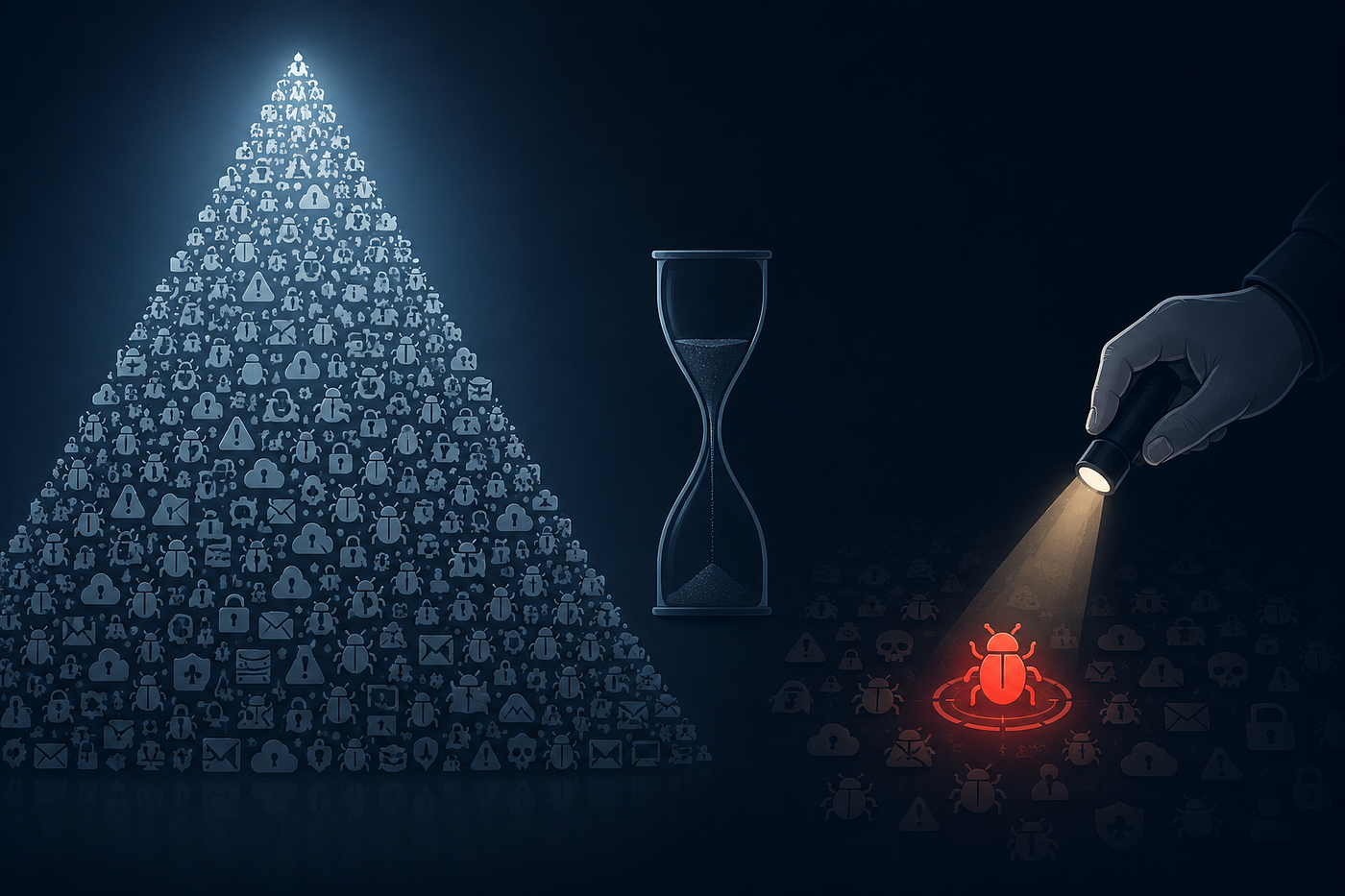
When Log4Shell was disclosed in December 2021, one U.S. federal agency did what any responsible security organization would do. It mobilized. It scanned every system. It cataloged every exposure. It put every available person on the problem.
By the time the dust settled, that agency had devoted 33,000 hours to Log4j vulnerability response.
That number deserves a moment of stillness. Thirty-three thousand hours. Roughly fifteen people working full-time for an entire year. Not on building capability. Not on reducing broader organizational risk. On a single vulnerability — one that, in many environments, sat on internal systems that were never reachable by external attackers in the first place.
The agency wasn’t negligent. It wasn’t unsophisticated. It did exactly what every security framework told it to do: find the risk, fix the risk.
The problem was the assumption underneath the framework.
The Assumption That Stopped Scaling
Cybersecurity built itself around a logic that was reasonable when it was formed: if you can find more risk, you can reduce more risk. The industry organized itself around that premise. Vulnerability scanners got better. Attack surface management tools proliferated. Threat intelligence feeds multiplied. Exposure management platforms emerged. Then continuous validation. Then attack path analysis.
Visibility improved dramatically. And for a long time, that was the right investment. When vulnerabilities were manageable in number, when analysts had the capacity to review findings, when attackers moved at human speed — finding more was genuinely the bottleneck.
It isn’t anymore.
In 2024 alone, over 40,000 new CVEs were published. That is an average of 109 new vulnerabilities, every single day. The 2026 Verizon Data Breach Investigations Report — drawing from one of the largest breach datasets ever assembled — found that vulnerability exploitation has now overtaken credential abuse as the leading initial access vector, accounting for 31% of all breaches. And the median time organizations take to fully patch a critical vulnerability has stretched from 32 days to 43 days. Not because teams got worse. Because the volume grew faster than any human capacity to process it.
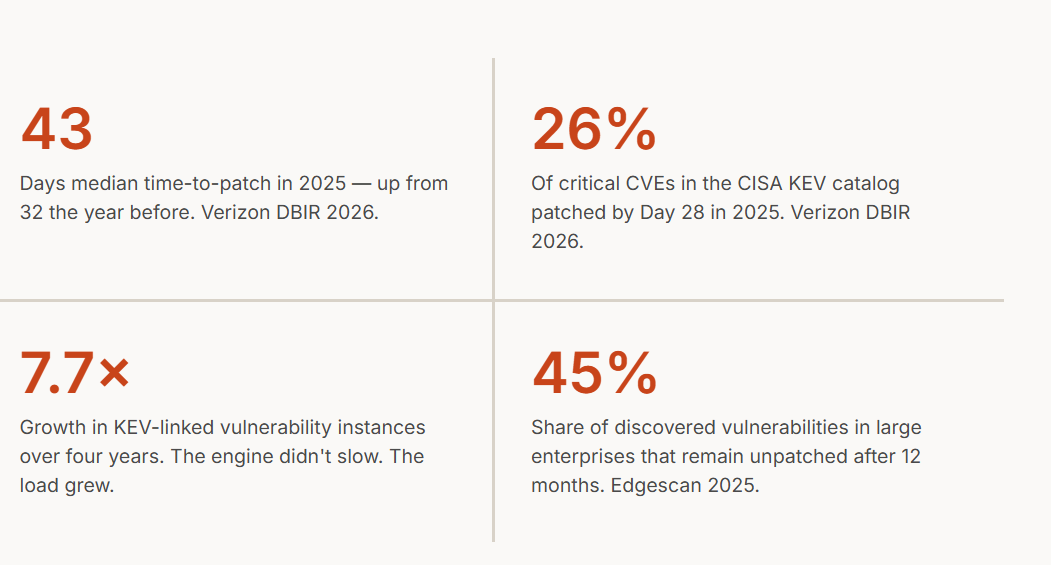
Security teams are not falling behind because they’re working less. They are falling behind because the problem has fundamentally changed shape, and the mental model most organizations are running hasn’t caught up.
What AI Changed — and What It Didn’t
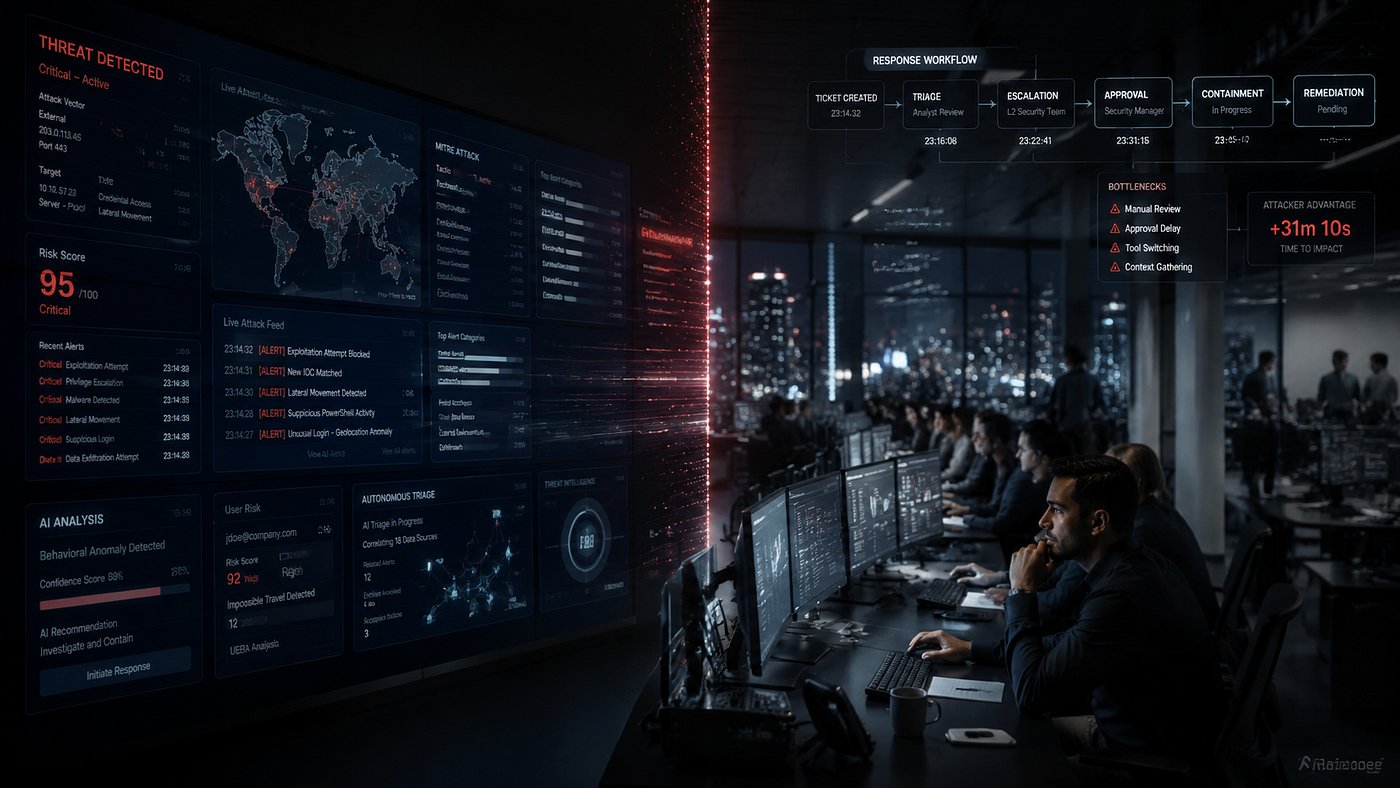
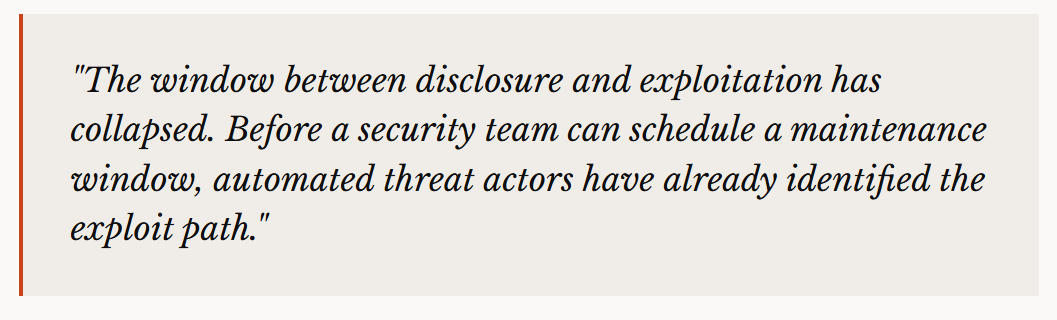
The instinct is to frame this as an AI story. Attackers are now using AI to discover vulnerabilities faster, weaponize them within hours of disclosure, and orchestrate multi-stage intrusions with minimal human oversight. All of that is true. The window between disclosure and exploitation has collapsed.
But here’s what most conversations miss: AI didn’t create the allocation problem. It exposed one that was already forming. The 2026 Verizon report is explicit about this. The structural capacity crisis was accelerating well before AI became a meaningful factor in the attacker toolkit. The volume of vulnerability records in their dataset grew eightfold over four years. Remediation teams were already losing ground.
What AI did was remove the buffer. It closed the defensive window that organizations used to rely on. It made the gap between “we know about this” and “they’re already inside” functionally zero in the worst cases.
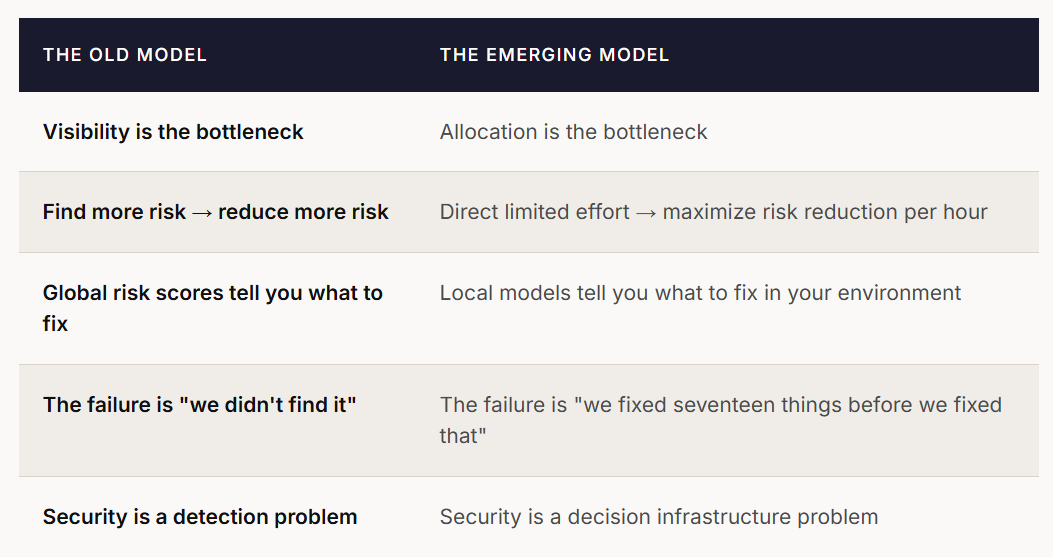
Which means the old question — “What should we find next?” — is no longer the question that governs security outcomes. The question governing outcomes now is: “Of everything we’ve already found, which item deserves the next available hour of remediation effort?”
That is a categorically different problem. And the industry has barely begun to address it as such.
The Assumption Nobody Questioned
Walk into almost any security operations team and watch what happens when an alert fires. A ticket opens. An analyst picks it up. The implicit logic underneath that workflow is that if something was flagged, it deserves attention. Nobody decided that. It’s just what the process assumes.
At lower volumes, that assumption held. At current volumes, it’s the thing quietly breaking the model.
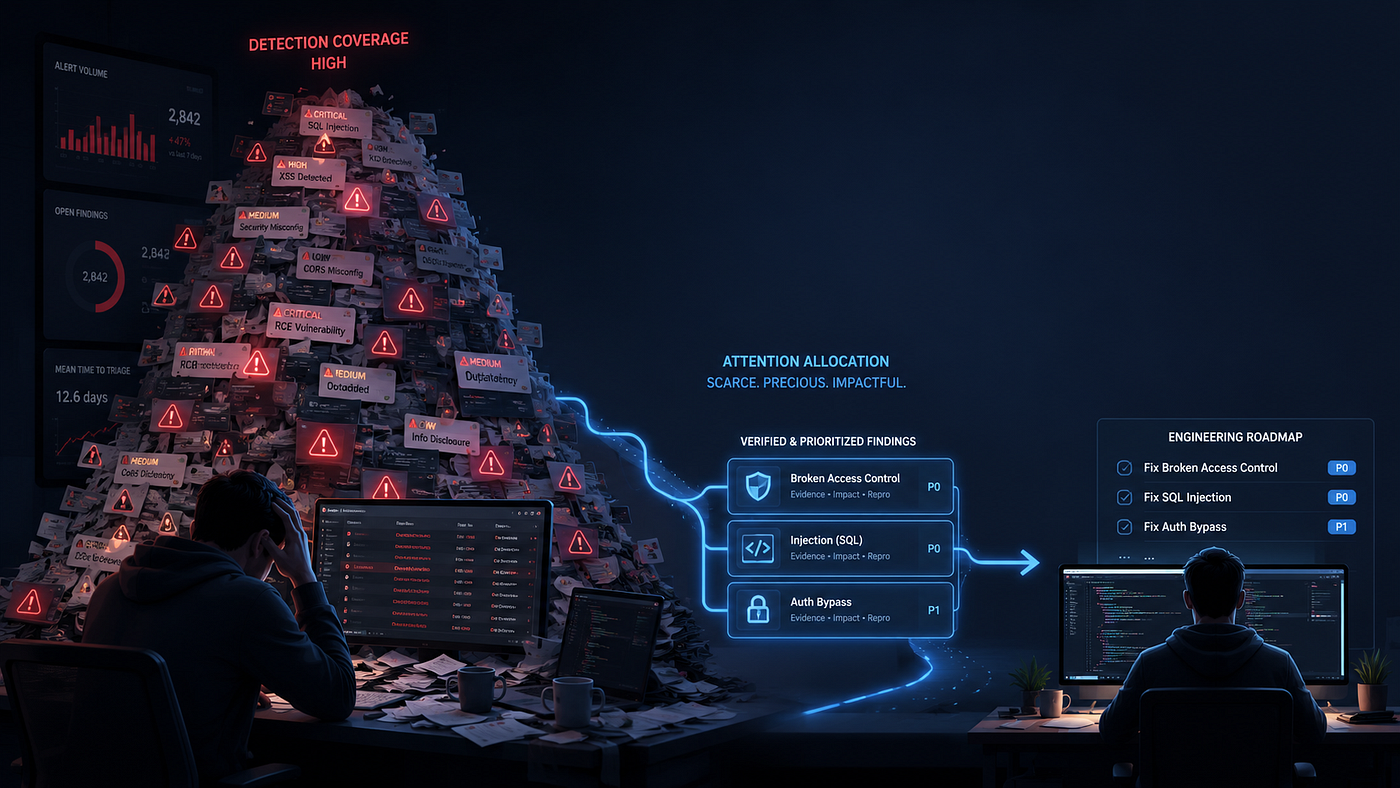
One research finding illustrates the math with brutal clarity: the average application generates roughly 17 new vulnerabilities every month. The average AppSec team closes about six. Organizations accumulate vulnerability debt nearly three times faster than they eliminate it. And unlike financial debt, vulnerability debt doesn’t compound quietly in the background — it sits in queues where real engineers spend real time making real decisions about which items to touch next.
Remediation is not an unlimited resource. Security teams don’t have uncapped engineering time, infinite change approval windows, endless analyst capacity, or unmetered executive attention. Every decision to fix one thing is a decision not to fix something else.
The scarce resource is no longer visibility. It never was, really. It just took two decades of building detection capability to make that obvious.
The scarce resource is remediation capacity.
Why Generic Models Start Breaking
The industry’s response to prioritization pressure has been to build risk scoring systems. CVSS scores. EPSS scores. Threat intelligence enrichment. Each of these tries to answer a reasonable question: given everything we’ve found, what should we fix first?
The problem isn’t that these models are badly built. The problem is that the world they were built for no longer exists.
Ten years ago, enterprise environments were relatively similar. Most organizations ran comparable infrastructure. Architectures followed recognizable patterns. Attack surfaces, while varied, were drawn from a small shared vocabulary of components. Under those conditions, industry averages were genuinely useful. If something was dangerous for most companies, it was a reasonable proxy for whether it was dangerous for yours.
That comparability has fragmented. Today one organization runs Kubernetes across multi-cloud with AI agents operating autonomously in production, contractor ecosystems with inconsistent access controls, and several hundred SaaS integrations, many of which security teams didn’t approve and don’t fully inventory. Another organization runs a completely different stack. A third has rebuilt its architecture twice in three years to keep pace with product demands. The surface area of what can be attacked, and how, is now genuinely specific to each organization in ways it simply wasn’t before.
Environments stopped being average. Which means averages stopped being answers.
This is the deeper problem with global risk models. It isn’t that they describe risk incorrectly. It’s that they describe risk for a population that your organization no longer resembles. Attackers aren’t running campaigns against the average company. They’re probing yours — its specific configurations, its specific integrations, its specific gaps. A score calibrated to the population tells you something. It just doesn’t tell you enough when your attack surface has diverged from the population mean in ways the model can’t see.
When environments were similar, shared models were a reasonable shortcut. Now that they’ve fragmented, the shortcut leads somewhere else.
The Trigger Moment
The organizational conversation that precedes a buying decision in this space almost never starts with “we need better prioritization.” That’s the product answer to a human problem.
The conversation that actually happens sounds more like this:
“We spent three months fixing a class of vulnerabilities that turned out to be unreachable from external networks. None of those systems were ever in the attack path. Meanwhile, a misconfiguration in a cloud integration — something lower on every risk score we ran — was the actual entry point.”
Or: “We can only address a fraction of what we find. Our current process of picking what to fix is mostly educated guessing layered over a risk score that doesn’t know anything about our environment. How do we know we’re not consistently choosing wrong?”
At that point, the discussion changes. The team isn’t asking for more visibility. They have too much. They’re asking for a different kind of confidence — confidence that the limited capacity they have is being directed at the risks most likely to produce a breach in their specific environment.
What the Market Is Actually Buying
If you watch how security teams describe what they want — not in product demos, but in internal retrospectives after incidents — a pattern emerges.
They’re not asking “why didn’t we find it?” The finding is almost always there, somewhere in a queue. They’re asking “why did we fix seventeen other things before we fixed that?”
The pain is misallocated effort. The failure is not insufficient scanning. It’s the sequence of decisions about where limited engineering and analyst time went — and the inadequacy of the information that drove those decisions.
Here’s how the chain actually works. Visibility produces findings. Decision-making allocates where effort goes. Remediation executes those decisions. The industry has spent enormous capital making findings more comprehensive. The layer that decides which findings deserve the next available engineer — that’s the part that hasn’t kept pace. The constraint isn’t at the front of the chain. It’s in the middle.
One interpretation of where this leads: the job buyers are actually hiring for isn’t better prioritization scores. It’s confidence that remediation effort is going to the risks most likely to produce a breach in their specific environment. If that’s right, this starts to look less like a tooling problem and more like a decision infrastructure problem — the machinery that sits between findings and action, and currently runs mostly on educated guessing.
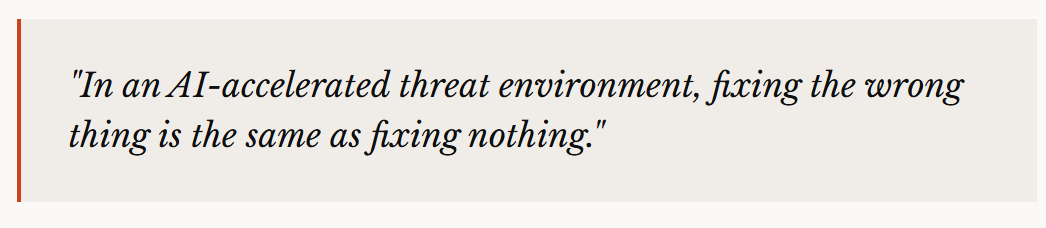
The economic logic follows from that directly. Every unnecessary remediation consumes engineering time, analyst cycles, change management approvals, deployment windows, and executive attention. As vulnerability volume grows and AI compresses exploit timelines, **the cost of fixing the wrong thing compounds faster than the cost of finding additional risks.** The economic question CISOs are quietly beginning to ask is not “how do we find more?” It is: “how much security effort are we wasting on issues that never mattered?”
The Long-Term Category Forming
The market narrative organizations have internalized runs like this: find risk → prioritize risk → fix risk. The assumption was always that outcomes improve when you move more volume through the front of that chain.
The companies that figure out the middle layer — the decision machinery that routes known exposures to finite human capacity — won’t be competing primarily with vulnerability scanners. They’ll compete with systems that influence where security budgets go week to week. That’s a different category than most of the current vendor landscape occupies.
The long arc is from security as a detection problem to security as a resource allocation problem: given finite capacity, how do you maximize risk reduction per unit of effort?
The one-line version
Cybersecurity isn’t running out of visibility. It’s running out of decision capacity.
The federal agency that spent 33,000 hours on Log4j didn’t fail at finding risk. It failed at allocating its remediation effort to the risks that actually threatened it. That failure is about to become the defining challenge of enterprise security — not because security teams are becoming less competent, but because the volume of findings has outpaced the industry’s ability to decide intelligently which findings deserve the next available hour.
That’s the market shift hiding underneath the product narratives. And it’s just beginning to be named clearly.
The data used in this piece draws from the Verizon 2026 Data Breach Investigations Report, Edgescan’s 2025 Vulnerability Statistics Report, Tenable Research’s 2024 Vulnerability Intelligence Report, and Pixee’s AppSec remediation analysis. The Log4Shell federal agency figure was originally reported by Tenable and cited by SecurityWeek: securityweek.com/one-year-later-log4shell-remediation-slow-painful-slog.
메타데이터
- post_id
- 97472cbde257
- slug
- the-security-team-that-fixed-33-000-hours-worth-of-the-wrong-things-97472cbde257
- url
- https://medium.com/@sonuarticles74/the-security-team-that-fixed-33-000-hours-worth-of-the-wrong-things-97472cbde257
- canonical_url
- https://medium.com/@sonuarticles74/the-security-team-that-fixed-33-000-hours-worth-of-the-wrong-things-97472cbde257
- author_url
- https://medium.com/@sonuarticles74
- status
- ok
- fetched_at
- 2026-06-20 20:29:01