Santa Cruz Sidetracked — The “Streetcar Trail” Is a Detour We Can’t Afford
Later this week, Friends of the Rail and Trail (FORT) will try to make a big ballyhoo protest to build a ‘hybrid trail’ in segments 9 thru…
Santa Cruz Sidetracked — The “Streetcar Trail” Is a Detour We Can’t Afford

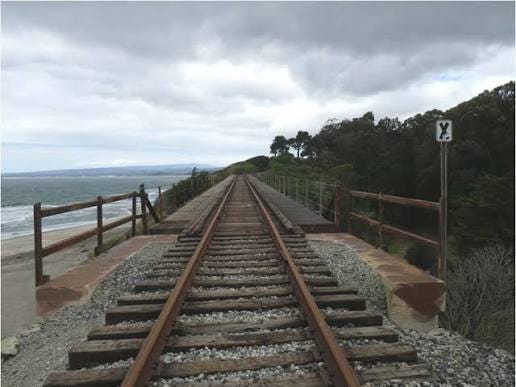
Eureka Slough Rail Bridge Rail-with-Trail Bridge showing a dangerous mix of slick rails with hi-grip rubber along with other hazards in attempting to keep unusable rails as a symbollic jesture (Photo Credit: County of Humboldt )
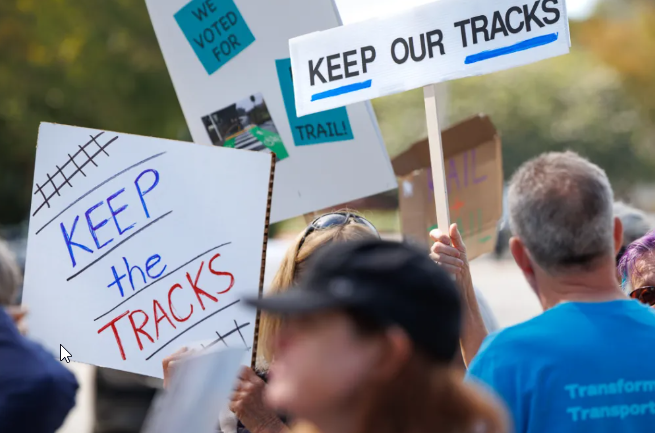
Later this week, Friends of the Rail and Trail (FORT) will try to make a big ballyhoo protest to build a ‘hybrid trail’ in segments 9 thru 11 as to not remove the unusable tracks. This is not only another obstacle to completing the trail within the requirements of the CTC grants, it also poses a serious safety concern for bike riders. This post goes through the reasons why we the RTC should not waste any more time on this approach.
Friends of the Rail and Trail (FORT) recently wrote a newsletter to its followers promoting a “streetcar-style” hybrid trail concept as a way to save both trail funding and the “future of rail in Santa Cruz County”. It’s an appealing idea on the surface. But once you look closely, it falls apart on funding, safety, and basic engineering, and risks undermining both goals it claims to support.
Start with the central claim: that embedding a trolley or streetcar into the corridor helps preserve eligibility for federal rail funding. That’s not how the program works. The Federal Railroad Administration Corridor Identification and Development Program is designed to advance intercity passenger rail projects that move people efficiently between communities at competitive speeds.
A slow-speed trolley sharing space with a bike path doesn’t meet that standard. It’s not about whether tracks exist; it’s about whether there is a credible, scalable transportation system behind them. Designing the corridor around “streetcar-speed excursion service” or demonstrations doesn’t strengthen our case, it weakens it. If anything, it signals that we are not serious about building the kind of rail system the program is intended to fund.
FORT also frames this as “preserving rail.” But embedding tracks in asphalt, narrowing clearances, and mixing rail with bikes and pedestrians isn’t preservation, it’s compromise. Modern passenger rail requires separation, consistent alignments, and safety buffers. A hybrid design would have to be torn out and rebuilt to meet those standards if real rail ever materializes. That means higher costs, longer delays, and more disruption down the line.
Then there’s safety. Streetcar-style operations can work in dense urban grids where speeds are low and users expect shared conditions. That’s not what this corridor is. The Coastal Rail Trail is being designed as a continuous, high-use recreational and transportation route, used by families, commuters, and visitors, many traveling at speed on bikes or e-bikes.
Mixing that environment with embedded rail introduces well-documented hazards: narrow flangeway gaps that can catch wheels, slippery surfaces in coastal conditions, and unavoidable conflict points where trail users must occupy the rail space. Rubber fillers, often cited as a fix, wear out, fail under load, and require ongoing maintenance. These are not theoretical concerns, they are known issues wherever this design has been tried.
FORT’s proposal also claims to save money. In reality, it adds layers of cost and complexity. It requires relocating tracks before trail construction even begins. It introduces specialized materials and engineering requirements. It complicates every constrained segment of the corridor, from bridges to tight right-of-way sections. And it increases long-term maintenance obligations for both trail and rail infrastructure.
By contrast, a straightforward interim trail, built within the existing corridor footprint, can be delivered faster, more safely, and within the constraints of the state’s Active Transportation Program funding. That program is specifically intended to support safe, accessible walking and biking infrastructure. Designing around hypothetical trolley operations moves us away from that goal, not toward it.
Perhaps most importantly, the “streetcar trail” tries to solve a problem that doesn’t actually exist. There is no active rail service today. There is no approved, funded intercity rail project ready for construction. Building a complex hybrid system now, in anticipation of a speculative future use, is not prudent planning, it’s wishful thinking.
We don’t have to choose between a trail and a future rail. But we do have to be honest about what moves each forward. A safe, cost-effective trail built now does not preclude future rail. A compromised, hybrid design built around low-speed trolley concepts, however, risks undermining both.
Santa Cruz County has a rare opportunity to deliver a long-promised trail with secured funding and clear public benefit. We shouldn’t jeopardize that with a concept that adds risk, increases costs, and doesn’t deliver on its central promise.
The “streetcar trail” isn’t a bridge to the future. It’s a detour, and one we can’t afford to take and will do nothing but add significant costs to the trail project that still needs to connect Watsonville to Aptos. A recent report by the RTC shows that continuing to build the “Ultimate Trail” that forces trail users onto busy streets and highways in Aptos and Watsonville will cost $850 million, pushing the overall trail project to well over $1 billion! It really is time to put the ZEPRT report on the shelf and proceed expeditiously on completion of the trail.
If you believe the RTC should prioritize completing a safe, direct, and financially realistic Coastal Rail Trail, now is the time to speak up. The Commission needs to hear from residents who are tired of delays, escalating costs, and impractical concepts that jeopardize both funding and public safety.
You can email the RTC directly at info@sccrtc.org or contact individual RTC commissioners and staff through the directory available at linktr.ee/coastaltrail. Let them know you support moving forward expeditiously with the trail, removing unnecessary obstacles, and ending further analysis of costly and unsafe hybrid rail-trail concepts.
The longer the RTC delays, the more expensive the project becomes, and the longer Santa Cruz County residents are left without the safe, continuous trail they were promised.
메타데이터
- post_id
- 9755c2b58c62
- slug
- the-streetcar-trail-is-a-detour-we-cant-afford-9755c2b58c62
- url
- https://medium.com/@jack.b.brown/the-streetcar-trail-is-a-detour-we-cant-afford-9755c2b58c62
- canonical_url
- https://medium.com/@jack.b.brown/the-streetcar-trail-is-a-detour-we-cant-afford-9755c2b58c62
- author_url
- https://medium.com/@jack.b.brown
- status
- ok
- fetched_at
- 2026-06-10 21:21:38