Field Dialogue 1: Listening for what is already speaking, with Joanna Crowson (Casa Gaia)
Snapshots from a living field — surfacing stories, practices, and insights in the evolving work of engaging the More-than-Human (For the…
Field Dialogue 1: Listening for what is already speaking, with Joanna Crowson (Casa Gaia)
Snapshots from a living field — surfacing stories, practices, and insights in the evolving work of engaging the More-than-Human (For the full version of this Field Dialogue, consisting of an **audio track** & written synthesis, go to Substack)
Listen to the conversation:
▶️🎙️Access the audio track on Substack
Read the synthesis:
🌿 Field Dialogue #1 — Joanna Crowson (Casa Gaia)
Listening for what is already speaking
What happens when you stop trying to “include nature” as an idea — and begin relating to it as a participant?
In this first Field Dialogue, we spoke with Joanna Crowson (Casa Gaia / Almenara), briefly joined by Andrew Zionts (Almenara), about what it actually means to work with the more-than-human — not as a concept, but as something that shapes how we design, decide, and relate.
This is not a polished methodology. It’s a glimpse into work that is still unfolding — alive, searching, and at times unresolved.
The Work — Designing with life, not just for it
At the heart of Joanna’s work is a quiet but profound shift: moving from working on the land to working with it — and increasingly, allowing it to guide decisions.
Through Almenara, a land-based regenerative project in southern Spain, this begins very concretely: stewarding land, working with permaculture principles, and creating spaces — like Councils of All Beings — where the more-than-human is actively invited into the conversation.
But a next step is emerging. Not just including nature in dialogue, but asking:
What would it mean to include the more-than-human in governance itself?
This question is now being explored through the EMCCINNO project, where Almenara is is collaborating with Be.Time as one of several “transformation sites.” Here, climate change is approached not only as an environmental issue, but as a cultural one — requiring shifts in how we think, organize, and make decisions.
Across both contexts, a shared premise becomes visible: human systems cannot transform if they remain disconnected from the living systems they are part of.
The Protocol — Learning to listen (without claiming certainty)
A central challenge in this work is deceptively simple: how do you listen without projecting?
What Joanna and Andrew are experimenting with is not one method, but a layered practice of attention.
On one level, listening is tangible. The land responds. After unusually heavy rains — the most in decades — the movement of water across across the water retention landscape they had designed became a form of feedback. It revealed what worked, what didn’t, and where assumptions needed to shift. Design becomes a loop: act, observe, adjust.
Alongside this, there is a more subtle layer of listening. One that involves the body, perception, and what Joanna describes as a “symbolic or poetic” register. Practices drawn from constellations, activism, and shamanic traditions are used not to claim “this is what nature says,” but to notice:
What arises when we are in relationship?
The line between perception and projection is never fully resolved. Instead, it is navigated with care — and with a certain lightness.
Not everything is taken as a message. But neither is everything dismissed.
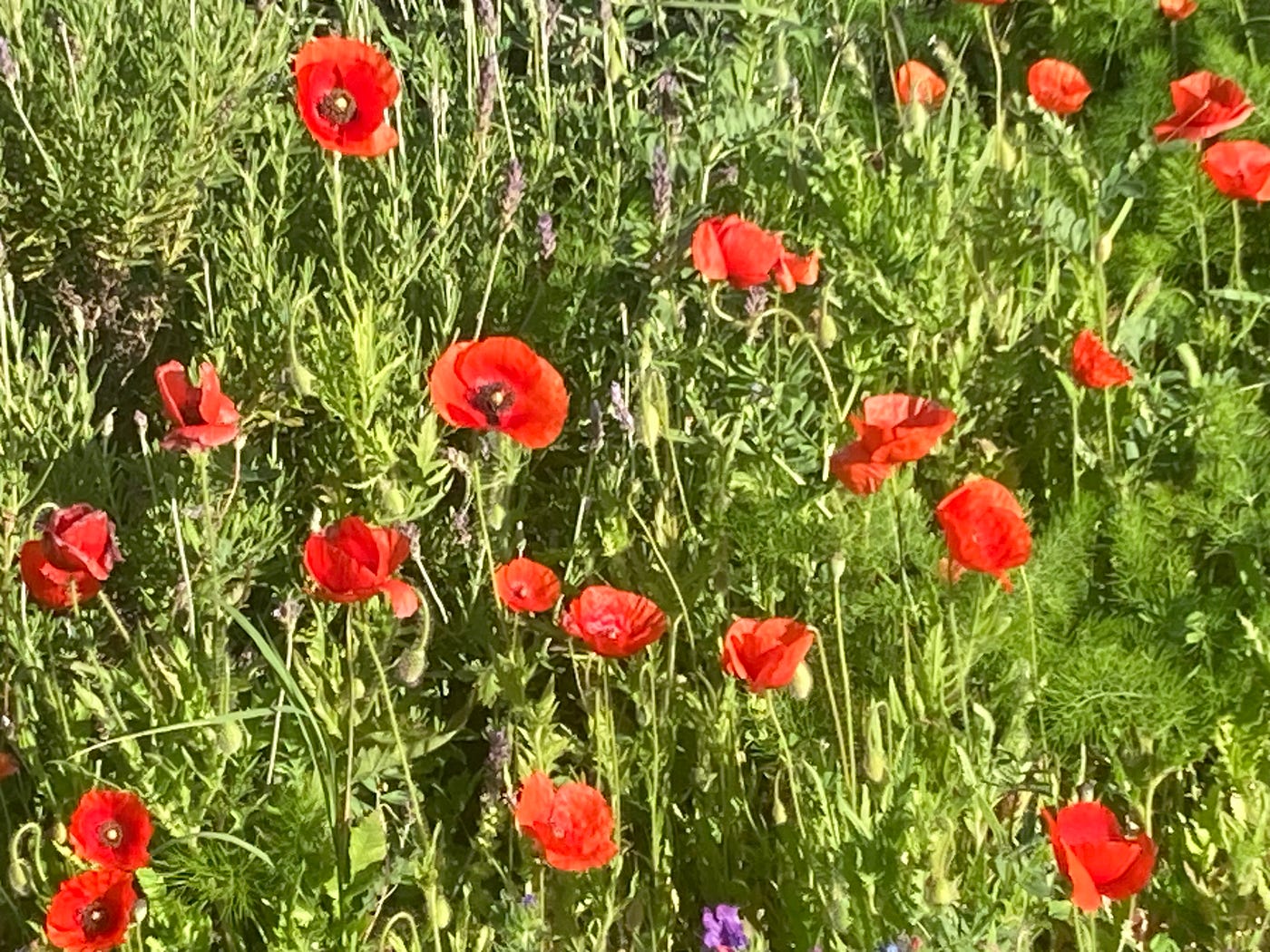
Image: poppies at Casa Gaia in Spain (2025). As Joanna says “they always bring me a surge of joy. I especially like the fact they represent beauty to share with to anyone who passes — you simply can’t pick them and take them home and keep them for yourself, they have to be enjoyed exactly where and as they are.”
The Friction — Where different worlds collide
When this way of working meets institutional contexts, the tensions become very visible.
Part of the friction is practical. Human systems run on timelines, deliverables, and measurable outcomes. Living systems operate on entirely different rhythms — seasonal, cyclical, often unpredictable.
But the deeper friction sits elsewhere: in what we consider valid knowledge.
Within the EMCCINNO consortium, this becomes tangible. Some partners rely on dense environmental data — sensors, metrics, real-time monitoring. Others, like Almenara, work through embodied observation and relational sensing. Both are forms of listening, yet they don’t easily translate into one another.
There is also a cultural layer. In the local context, many farmers carry a history of having their knowledge dismissed. As a result, there is both richness and resistance: deep ecological memory, alongside understandable mistrust.
The challenge is not just how to include the more-than-human — but what we recognize as knowledge in the first place.
The Insight — Life responds (but not on our terms)
One of the most striking moments Joanna shared was also the most concrete.
After decades of drought, a well long considered dry suddenly refilled following intense rainfall, in a place they hadn’t planned for.
It was both a confirmation and a humbling.
Life responds. But not necessarily where or how you expect it to.
Alongside these larger moments, there are quieter shifts. Even simple embodied practices — pausing, taking a few breaths — change the quality of interaction in groups. There is more presence, less friction, more space for listening.
And perhaps most tellingly: no group has ever resisted those moments of slowing down. If anything, people seem relieved by them.
The Shift — From expertise to participation
Working in this way doesn’t just change outcomes — it changes the practitioner.
There is a gradual movement away from being the expert who knows, toward someone who creates conditions for something else to emerge. This requires letting go of certainty, control, and sometimes even professional identity.
It also exposes a deeper tension within Western culture: the split between what is considered “objective” and what is dismissed as subjective, intuitive, or even irrational.
Much of this work sits precisely in that gap.
Not fully measurable — yet not arbitrary either.
The Unfolding — Small openings, real shifts
Despite the challenges, Joanna notices subtle but important openings.
Younger generations, in particular, show a willingness to engage with more-than-human perspectives — not as an abstract idea, but as something experiential. Even among scientifically trained participants, there is often curiosity — and even relief — when given permission to relate differently.
At the same time, there is a renewed appreciation for knowledge that has been sidelined. When invited, older generations readily share detailed memories of landscapes, water systems, and cultivation practices — stories that can inform present-day regeneration.
This points to another layer of the work: not just restoring ecosystems, but re-storying them. Reconnecting with what has been forgotten, lost, or devalued.
The question now is how this work can travel further without losing its essence — how to share practices that are inherently relational, without turning them into fixed tools or formulas.
A closing seed
This conversation does not offer a finished approach. It reveals a field in motion.
But one thread runs through it:
The more-than-human is not absent. Our systems — and our ways of paying attention — are simply not yet designed to include it.
And perhaps the work, for now, is just this: learning how to listen again.
The **Co-creation with the More-than-Human sandbox** is a collaboration between The Repatterning Collective and Kincentric Leadership.
If you’d like to receive announcements of our popular monthly online learning sessions, which use live dialogue & discussion to explore different approaches and praxes for meaningful co-creation with the more-than-human (natural) world, then register here for the sandbox’s mailing list.
To receive syntheses of Learning Sessions and Field Dialogues in your inbox, find us on Substack.
메타데이터
- post_id
- 97664675e009
- slug
- field-dialogue-1-listening-for-what-is-already-speaking-with-joanna-crowson-casa-gaia-97664675e009
- url
- https://medium.com/@rbecque/field-dialogue-1-listening-for-what-is-already-speaking-with-joanna-crowson-casa-gaia-97664675e009
- canonical_url
- https://medium.com/@rbecque/field-dialogue-1-listening-for-what-is-already-speaking-with-joanna-crowson-casa-gaia-97664675e009
- author_url
- https://medium.com/@rbecque
- status
- ok
- fetched_at
- 2026-06-09 15:37:30