Chihuahua Stories: The Alliance Module explained
The Alliance Module is an upcoming significant development in the Cosmos ecosystem, and the ChihuahuaChain will be amongst the first to get…
Chihuahua Stories: The Alliance Module explained
The Alliance Module is an upcoming significant development in the Cosmos ecosystem, and the ChihuahuaChain will be amongst the first to get it. Don’t worry if you never had the opportunity to study about it. The Chihuahua Community DAO is back in action!
The ChiCommunityDAO has recently posted a commonwealth proposal regarding this topic so if you want to check it out, visit this link.
Contents

Introduction 🤝
Alliance is an open-source Cosmos SDK module. Thanks to the structure of the Cosmos chains, the alliance module can be easily implemented by any chain with a software upgrade. By default, the native asset is the sole asset that can be staked in blockchains built with the Cosmos SDK. $HUAHUA, for example, is the Chihuahua Network’s native staking asset. This module allows numerous assets to be staked on a chain, allowing assets from one chain to be staked on another, forming bilateral partnerships between two chains and allowing them to exchange yield and promote cross-chain collaboration. For example, the Whale token or a liquid staking derivative of it, such as ampWhale or bWhale, could be staked on the Chihuahua Network!
How it works ⛓️
Technically, any asset, including IBC assets and Liquid Staking Derivatives (LSDs) from other chains, can become an Alliance asset. Assets can be minted on one chain, bridged via IBC, and staked on another using the Alliance module and it will begin to accrue staking incentives once staked. Alliance assets, like native staking assets, can be staked, unstaked, or redelegated to different validators. After unstaking, Alliance assets are also subject to an unbonding period. Using Migaloo’s native token “Whale” as an example, view the graphic below to learn how an alliance asset can be staked in an easy-to-understand way.
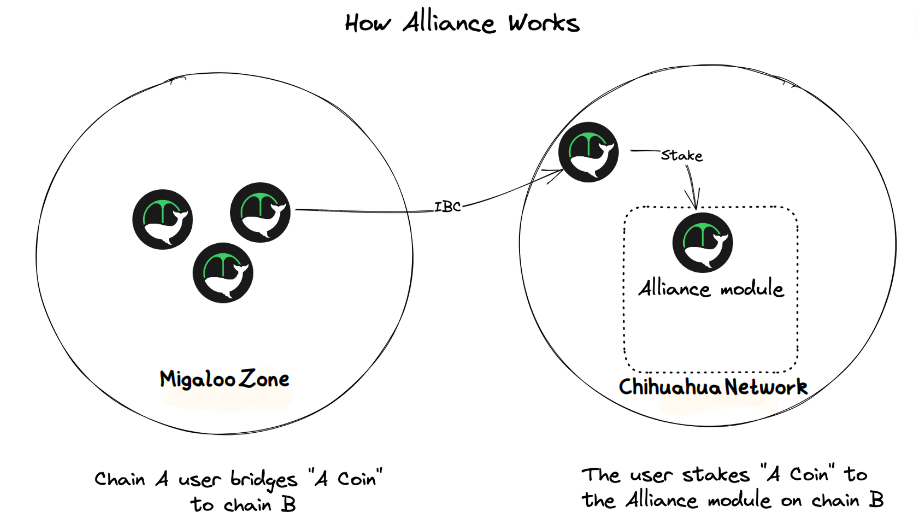
Graphic taken and modified from Terra Docs
Benefits ✅
The Alliance module is a brand new concept in Cosmos, and Chihuahua is planning to be one of the first chains to integrate it. What are the benefits of it, however? Why do we even need it?
Increased Liquidity and Adoption for Huahua 💸
The Alliance module can help increase liquidity and adoption for $HUAHUA by attracting new users and liquidity from allied chain participants who bridge and stake their assets within the Chihuahua ecosystem. The liquidity of two ecosystems becomes “one”.
Realistically, this will be accomplished through the usage of liquid staking derivatives. For example, it would be smarter to employ ampHuahua or bWhale as alliance assets to leverage liquidity in both ecosystems. For this, both ecosystems’ teams and contributors must double-check that the LSDs utilized as alliance assets are from reputable and professional providers. The ecosystems might progress at a great pace, but a serious “problem” with an alliance asset could cause a variety of problems.
If you’re unfamiliar with liquid staking derivatives, you can learn about them in our previous article.
Improved Security and Interoperability 🔒
Joining the Alliance module can improve the security and interoperability of Chihuahua by enabling interchain staking and bilateral, mutually beneficial alliances with other Cosmos chains. This can help to create a more robust and secure ecosystem for Chihuahua, as well as increase its potential for cross-chain collaboration.
Chihuahua’s security, as a delegated POS, is mainly reliant on Huahua’s market cap. While Huahua remains a microcap currency, some developers may be cautious to build on Chihuahua at this time. However, with the alliance module, the security of the Chihuahua network is no longer only dependent on the value of Huahua.
Increased Exposure and Collaboration Opportunities 🛠️
Joining the Alliance module can give Chihuahua exposure to a wider range of networks and communities within the Cosmos ecosystem, increasing collaboration opportunities and potential partnerships. This can lead to increased adoption and recognition for Chihuahua Network and Huahua. While Cosmos is the ecosystem of competitiveness, Chihuahua should be the network of collaborations and friendships.

Governance 🗳️
You are already aware that a staked $HUAHUA token allows you to vote on crucial network decisions. What about a staked alliance asset on the ChihuahuaChain?
Can I vote? 👌
By default, Alliance assets cannot be used directly in governance; however, their underlying staked native assets are still used in consensus and governance by validators. What does this mean in simple terms?
You can directly vote with your alliance assets in a proposal if:
- You are a ChihuahuaChain native asset staker
- You are a validator.
If you simply stake alliance assets in another chain, you will not be able to vote directly, but your validator will have the ability to vote for you. Make sure that your validators’ ideas about the network align with yours.
What is my voting power? 💪
In order for an Alliance asset to be added to an existing chain, the asset’s parameters need to be specified and a governance proposal needs to be made. One of those parameters is called “Reward weight”.
The “Reward weight” specifies the ratio of reward power given to each Alliance asset (a chain’s native asset assumes a reward weight of 1).
In simple terms, your voting power depends on the chain’s governance decisions. As it can be easily understood, not all alliance assets will have the same voting power. One alliance asset’s voting power depends on:
- The reward weight set by the governance before adding it to the alliance module.
- The amount of other alliance assets being staked on the specific chain. For example, if you stake 10 alliance tokens, you will have more voting power when the total alliance assets are 100 than when they are 1000.
TakeRate 🔄
This is something completely new that is coming with the alliance module. As pretty much everything in the alliance module is set by the governance, the take rate is one more parameter that needs to be set before adding a new asset to the alliance module.
What is it? 📜
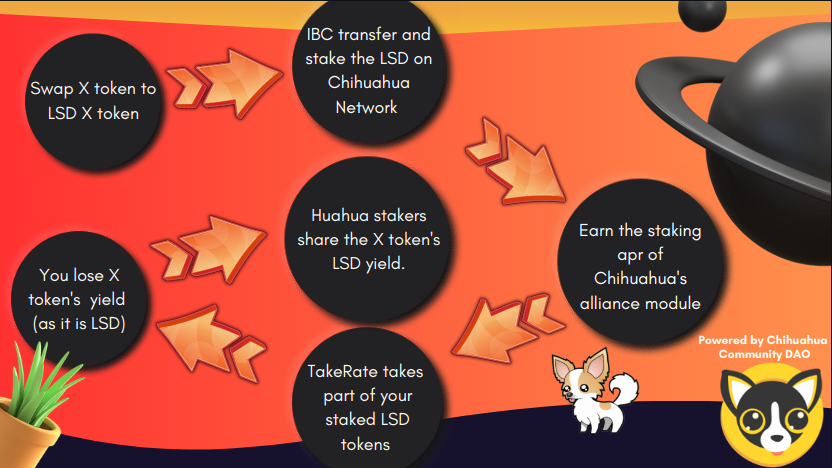
The TakeRate is a tax that redistributes a portion of staked Alliance coin to all stakers on-chain. Of course, this does not mean that you will lose your funds by staking your alliance assets. The TakeRate should be significantly lower than your yield through staking. Here is a hypothetical scenario of how it can be implemented:
If you stake $HUAHUA LST on the Ally1 (AL1) blockchain, you might have to pay a tax equal to the $HUAHUA LST’s appreciation rate. This tax money will be divided among all the stakers of the Ally1 chain, allowing the chain to have exposure to $HUAHUA LST. By staking $HUAHUA LST, you’ll earn rewards in AL1 tokens, which helps you diversify your holdings and the same goes for the AL1’s LST staked on ChihuahuaChain along with its stakers. So in short,
This trade benefits both chains, and smaller chains can benefit from larger chains by indirectly exchanging staking rewards.
Important Note: TakeRate could be set to 0, meaning that no tax in alliance assets is set. This decision is up to the governance.
Here is what TakeRate offers additionally:
- Diversification. Native stakers receive native staking rewards as well as alliance assets. Alliance asset stakers, on the other hand, exchange a small portion of their assets for a larger portion of another asset.
- Proof of trust. TakeRate is something that every staker should consider before staking. Extra incentives are not free, and thus only those who trust in the success of the native token should risk their alliance assets. If the TakeRate is 0%, the native token could become a source of free extra rewards to dump. However, setting the TakeRate to 0% will be up to the community if passed through governance.
Disclaimer ⚠️
As it was mentioned above, the Alliance Module can and should be configured based on the community’s will via on-chain governance. This article explains the basic principles of the Alliance module as it is now. Everything stated are pure examples and do not promise or reveal in any way the plans of the core team according to the alliance module.
Additionally, the module could be modified in the future. Remember that the module is quite new and has not been heavily “battle-tested” in real-life conditions yet. ChihuahuaChain is going to become one of the first chains to implement the Alliance Module.
If you want to dive deeper into Alliance module information, you can check Terra’s documentation here.
Woof woof! 🐾
For more news and updates on Chihuahua Chain:
Follow us on Twitter | Join us on Telegram | Join our Discord
Don’t forget to follow us on Medium and comment on anything you like below 👇
메타데이터
- post_id
- 9775d2bc70c7
- slug
- chihuahua-stories-the-alliance-module-explained-9775d2bc70c7
- url
- https://medium.com/chihuahua-community-updates/chihuahua-stories-the-alliance-module-explained-9775d2bc70c7
- canonical_url
- https://medium.com/chihuahua-community-updates/chihuahua-stories-the-alliance-module-explained-9775d2bc70c7
- author_url
- https://medium.com/@HuaHuaGR
- status
- ok
- fetched_at
- 2026-07-25 21:11:06