When Justice Met Mercy
‘Sometimes the greatest battle is not against our enemies — but against our own hearts.’
When Justice Met Mercy
‘Sometimes the greatest battle is not against our enemies — but against our own hearts.’
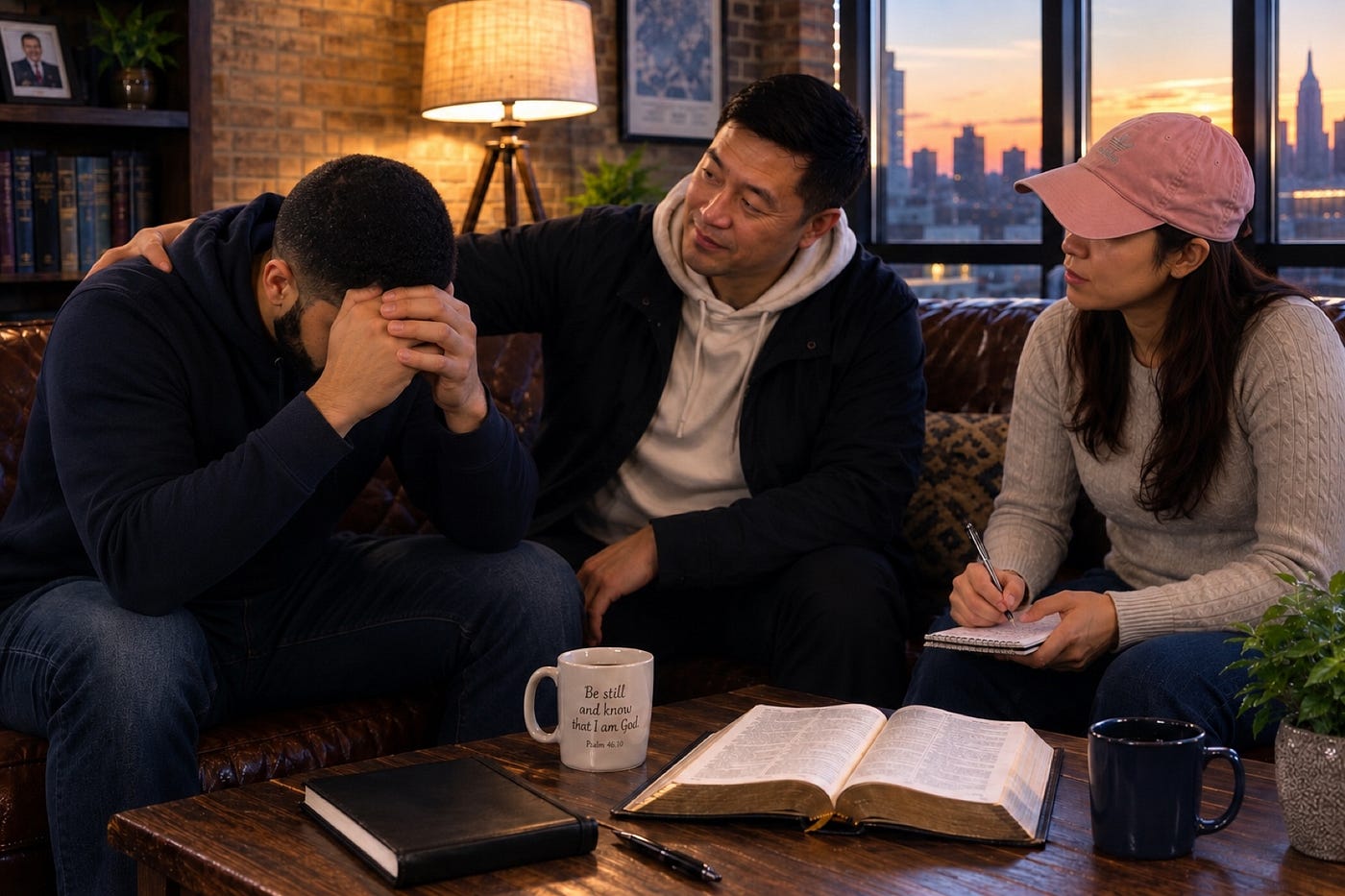
(Disclaimer: This picture is AI-generated for creative purposes. It does not depict any real person).
“He who walks in integrity and with moral character walks securely, but he who takes a crooked way will be discovered and punished.”
—Proverbs 10:9 (AMP)
Compromise has become increasingly prevalent in today’s society. Dishonesty is often dismissed as insignificant, promises are casually broken, and unethical conduct is frequently justified whenever it serves a personal advantage. Yet many who live this way find themselves wondering why genuine peace, lasting trust, and meaningful progress remain beyond their reach. More often than not, the issue is not a lack of opportunity but a deficiency of integrity.
Scripture teaches that integrity originates within the heart. Long before deception manifests itself through outward actions, it has already taken root within a person’s motives. Peter refers to this inner life as “the hidden person of the heart” (1 Peter 3:4). A compromised heart quietly asks, How much can I get away with without being discovered? How far can I stretch the truth before I am held accountable? How close can I come to crossing the line without suffering the consequences? By contrast, a person of integrity does not seek to test the boundaries of righteousness. Instead, they intentionally choose to remain as far from them as possible, pursuing what is honorable even when no one else is watching.
Integrity, however, should never be mistaken for a life free from hardship. It does not exempt a person from opposition, false accusations, betrayal, or injustice. Rather, integrity is most clearly revealed by how one responds when confronted with those very trials. Hidden motives, private decisions, and unseen responses eventually expose the true condition of the heart. God is not only concerned with what we do publicly but also with who we become when no one else sees.
It was this very truth that came to the forefront during my time at the Dan Jerusalem Hotel in Israel, where I was serving alongside my assigned missionary team. In continuation of my previous message, When God Reveals the Heart, David and Ashley encouraged me to continue recounting the events that followed. After taking a moment to reflect, I explained that, according to my recollection, the events occurred on May 19, 2019, in the Amherst, Massachusetts area, one day after the incidents that had unfolded on May 18.
By then, tensions had escalated considerably. Months of false accusations, harassment, physical confrontations, and repeated acts of intimidation had not only affected me personally but had also extended to those closest to me at my home. The cumulative weight of these experiences, spanning much of 2018 and continuing into the spring of 2019, left me carrying a profound sense of grief while strengthening my resolve to preserve an accurate and truthful account of everything that had occurred.
Rather than allowing the truth to become obscured by conflicting narratives, I committed myself to documenting every significant event with diligence and accuracy. Whenever possible, I preserved witness statements, security footage, phone records, written correspondence, and official police reports. I believed that truth deserved to be established through facts rather than emotion.
Looking back, however, I came to realize that the greatest test before me was not simply whether the truth would eventually come to light. The greater question was whether, amid injustice, anger, and deep personal pain, my own response would reflect the same integrity that I believed God required of every follower of Christ.
— —
-The Test Before Worship-
Upon my arrival at Mercy House Church, I intentionally arrived approximately one hour before the first service. Given the events that had unfolded during the preceding months, I took time to carefully observe my surroundings for my own safety. I discreetly noted whether the main entrances and exits were secured and remained attentive to anything that appeared unusual or potentially threatening.
Afterward, I took my seat along the right side of the sanctuary and quietly prayed. I asked God to grant me the wisdom, restraint, and strength to defend myself lawfully should another physical confrontation arise. Yet, instead of affirming the thoughts I had carried into the church, the Holy Spirit gently reminded me of God’s forgiving character. That conviction immediately shifted my attention from my circumstances to the condition of my own heart.
What followed was an intensely personal struggle. Knowing everything that had transpired, I wrestled with God in silence. I reminded Him of His justice, questioned why forgiveness should be extended after so much wrongdoing, and poured out every emotion I had been carrying. None of this surprised Him. He already knew my heart long before I expressed it. Yet each time my thoughts returned to justice alone, the Holy Spirit faithfully brought me back to the same truth: God’s character had not changed, and neither had His calling for those who belong to Him.
Although an unmistakable sense of peace gradually settled over me, the emotional conflict had not entirely disappeared. Sitting quietly with my hands resting upon my lap, I remained outwardly composed while inwardly continuing to wrestle with the weight of everything that had occurred.
A short time later, a woman quietly entered the sanctuary, sat beside me, and warmly greeted me. I readily admit that I felt somewhat awkward, as I had never seen her at Mercy House Church before, nor had our paths ever crossed. As we began talking, however, I noticed something that immediately captured my attention. While her words were kind and welcoming, her facial expressions and body language conveyed a different story. Beneath her calm demeanor, she appeared to be carrying a deep emotional burden that her voice alone did not reveal.
After a few moments, I politely attempted to conclude our conversation and stood to leave. Before I could do so, she unexpectedly asked whether I would watch over her purse while she stepped a few rows away to pray. Considering everything that had occurred in the months leading up to that morning, I found the request unusual and immediately became cautious. I questioned whether there might be another motive behind it, although I could not determine what that might be.
I could have politely declined or simply moved to another area of the sanctuary. Instead, as I listened more carefully to the subtle trembling in her voice — one that suggested she was quietly holding back tears — I chose to remain where I was. While staying alert to my surroundings and prepared to lawfully protect myself should the need arise, I also sensed the Holy Spirit quietly urging me to remain still. In that moment, I chose to wait.
— —
-When Stillness Became Obedience-
As I continued to wait, the Holy Spirit once again made His presence known to me. Gently, He impressed upon my heart the instruction to remain still. I understood those words in two distinct yet inseparable ways. First, I was being called to place my complete trust in Him, recognizing that He Himself was my peace. Second, I was being instructed to remain physically still. Both meanings proved profoundly significant in that moment. Choosing to surrender my anxiety to the Lord, I received His peace and quietly waited for the woman to finish praying.
Approximately five to eight minutes later, she rose from her knees, returned to where I was seated, and thanked me for watching over her belongings. As I handed her purse back to her, I gently asked whether she was alright. I admitted that I had found her request somewhat unusual, especially since she could have easily taken her purse with her while she prayed.
She smiled softly and replied that, despite recognizing how unusual her request had been, I had nevertheless chosen to remain, showing kindness by safeguarding her belongings rather than walking away.
I acknowledged that she was right. I could have politely declined her request or simply moved elsewhere within the sanctuary, yet I had chosen to stay.
Lowering her voice as she looked toward the stage, she quietly said, “God answered my first prayer.”
Curious, I asked what she meant.
She explained that she had spent the entire night in prayer, asking the Lord for an opportunity to speak with me because there was a personal request she hoped to make.
Before she could continue, I interrupted respectfully but firmly.
I asked whether her request concerned the leadership of Mercy House Church or members of Cru who, in my understanding at the time, had participated in making false accusations against me, harassing me, or assaulting me. I explained that if this was the reason for approaching me, she would likely be disappointed. I believed I possessed substantial documentation supporting my account, including witness testimony, security footage, phone records, and police reports, and I intended to pursue the matter through the appropriate legal process if necessary. At that point in my life, I was convinced it was too late to persuade me otherwise.
As I finished speaking and began to rise from my seat, she quickly reached for my hand. Holding it gently but firmly, she began to weep so quietly that only I could hear her words.
Through tears, she explained that the first time she had seen me from a distance, she struggled to describe what she believed she had perceived. She admitted that she initially questioned her own understanding, wondering whether she had imagined it. However, after praying and reflecting on Scripture, she came to believe that what had impressed her heart was not that I was Jesus, but that she perceived the presence and character of Christ being reflected through my life.
She told me that the passage repeatedly brought to her mind was Mark 1:7 (AMP):
“And he was preaching, saying, ‘After me One is coming who is mightier [far more powerful] than I, and I am not worthy to stoop down and untie the strap of His sandals.’”
I acknowledged what she had shared and explained that her observation reminded me of several parallel passages that express John the Baptist’s humility before Christ:
Matthew 3:11 (AMP): John declares that he is not worthy even to remove the sandals of the coming Messiah.
Luke 3:16 (AMP): “I am not worthy to untie the strap of His sandals.”
John 1:27 (AMP): “It is He… the straps of whose sandals I am not worthy to untie.”
Together, these passages emphasize not the exaltation of any human being, but the incomparable greatness of Jesus Christ and the humility of those who faithfully point others to Him.
— —
-Not Me, But Christ-
She responded with visible hesitation, admitting that she hoped I did not think she was irrational for sharing what she believed she had experienced. She carefully clarified that she was not suggesting I was Jesus. Rather, she explained that what had impressed her heart was not my identity, but the presence of the One who walks with me. In her understanding, she believed she had witnessed the character of Christ being reflected through my life.
Wanting to understand why she seemed so compelled to tell me these things despite the fact that we had never met, I asked why she had approached me so persistently.
She paused before quietly replying that there was a request she wished to make.
Before she could continue, I respectfully interrupted her. I explained that if her request concerned the wrongful actions that, in my understanding at the time, had been committed against me by individuals within the leadership of M.H Church, members of Cru, or others affiliated with the surrounding churches, I did not believe I was prepared to reconsider my position. Whether those involved had acted intentionally or had themselves been misled was, at that moment, of little consequence to me. I remained convinced that every individual should ultimately be held accountable for his or her own actions through the proper legal process.
The moment she heard my response, her demeanor changed. With evident urgency, she reached for my hand and pleaded with me not to allow my pain to determine my course of action. She urged me to give people time to repent and change, asking me not to allow the wrong committed against me to shape who I would become.
I answered that, from my perspective at the time, they had already been given ample opportunity. For nearly a year and a half, many of those individuals had known me, yet I believed few had taken the time to truly know my character before accepting accusations against me. I explained that, in my understanding, the conflict had escalated beyond false allegations and public humiliation, extending even to harassment affecting those closest to me at my home. Given everything I believed had occurred, I questioned how anyone could reasonably expect me to simply overlook those experiences.
She listened without interruption. When I finished speaking, she acknowledged the depth of my pain and admitted that she understood why I felt wounded. At the same time, she gently cautioned me not to allow righteous anger to harden into bitterness. She reminded me that although injustice should never be ignored, neither should it be permitted to consume the heart.
I answered honestly that what I carried within me went far beyond ordinary anger. The peace the Holy Spirit had given me before she entered the sanctuary had restrained what I had been feeling, but beneath that peace remained an overwhelming burden of grief, disappointment, and unresolved pain. Outwardly I appeared calm; inwardly I was still wrestling with emotions I had not yet fully surrendered to God.
She quietly nodded before telling me that she had never forgotten the first day she had seen me. Although she remembered my smile, she said what had remained with her most vividly was what she believed she had seen behind it. Looking into my eyes, she sensed a depth of sorrow and grief that she found difficult to describe.
She went on to explain that she had repeatedly tried to imagine herself in my position but found herself unable to comprehend the weight I appeared to be carrying. She confessed that she had even asked the Lord why she could not fully understand it. According to her testimony, rather than receiving a direct answer, one biblical figure continually came to her mind: King David.
She explained that the more she reflected on Scripture, the more she believed certain aspects of David’s life — his devotion to God, his profound grief, his longing for justice, and his continual dependence upon the Lord despite his own imperfections — had been impressed upon her heart as she considered everything she believed I had endured.
I respectfully interrupted her and explained that there was a part of my testimony I had not shared with anyone during that season of my life.
I told her that, as I had mentioned in earlier chapters, I devoted myself to the serious study of Scripture between 2014 and 2018. During that same period, from approximately 2014 to 2016, I had visited another church in Westfield, MA. While there, I came to believe that the ministry was operating in ways that stood in direct contradiction to the teachings of Christ.
From my perspective, I observed patterns of manipulation, intimidation, and deceptive practices concealed beneath an outward appearance of hospitality. I believed that personal information, including the home addresses of visitors and members, was being collected under the pretense of mailing church announcements and then used for purposes far beyond what had been represented. I also came to believe that financial offerings intended for the work of the ministry were being misused for personal gain.
As I became increasingly aware of what I believed was taking place, I also came to believe that my concerns had not gone unnoticed. In my understanding, resentment began to grow toward me, particularly as some visitors and members sought biblical guidance from me rather than from those in leadership. What followed, as I understood it, permanently altered the course of my life.
I explained that I had been abducted, severely assaulted, and left critically injured by individuals whom I understood to be the married pastoral couple, church leaders, and others closely associated with them. According to my account, I was left near my neighborhood, where nearby residents discovered me, rendered assistance, and summoned help. The injuries I sustained included a severe concussion that resulted in significant memory loss. For years, many of those memories remained suppressed. (It was not until 2023 that they gradually returned with greater clarity.)
During those intervening years, only fragments of my past remained consistently accessible. I retained memories of those closest to me, my years of biblical study, and my martial arts training. Yet through everything I had forgotten, one thing never left me: my faith in God. Even when much of my past had become clouded, my confidence in Christ remained firmly rooted.
I went on to explain that the limited memories I retained convinced me that there had once been people who wished to do me serious harm. Although I attempted to provide law enforcement with the information I possessed, the evidence available at the time was insufficient to support further legal action, and I believed that key witnesses or individuals with relevant knowledge were either unavailable or unwilling to come forward.
Those experiences profoundly shaped my outlook during that period of my life. They left me carrying an overwhelming desire to see the truth established and genuine accountability pursued. Looking back, I recognize that the weight of those unresolved events deeply influenced the way I viewed every subsequent conflict, including those surrounding M.H Church.
Even so, the Lord continued to restrain me. Although I struggled with grief, anger, and a longing for justice, God’s mercy repeatedly prevented those emotions from defining my life. My desire was that, in time, every person involved would ultimately be held accountable through truthful evidence and the proper administration of justice. And where justice might never be fully realized in this life, I entrusted the final judgment to the One whose judgments are always perfect, righteous, and true.
— —
-Set Apart, Yet Still Tested-
Her expression immediately changed. With evident surprise, she quietly said that her prayers had been confirmed a second time.
I asked what she meant.
She replied that she believed God had set me apart and that He had chosen me for His purposes.
I responded cautiously. I reminded her that if she was attempting to persuade me to overlook what, in my understanding, had been the wrongful actions committed against me by individuals within Cru, the leadership of M.H Church, or those associated with them, then she was greatly mistaken. I respectfully cautioned her to be careful how she applied and interpreted Scripture, reminding her that God’s Word should never be used to excuse sin or minimize accountability.
With tears filling her eyes, she acknowledged my concern and assured me that she was not attempting to manipulate me or pressure me into making a decision. Instead, she insisted that what she had shared was spoken sincerely before God. She explained that the biblical figure who continually came to her mind was King David — not because David was without fault, but because he was described as a man after God’s own heart, a man who loved righteousness, hated wickedness, and continually returned to the Lord despite his own failures.
As she continued speaking, I noticed a subtle change in both her voice and her demeanor. Her words no longer sounded like those of a stranger offering spiritual encouragement. Instead, she spoke with the desperation of a mother pleading on behalf of someone she deeply loved.
Recognizing that change, I interrupted her gently and asked, “Which one of the Cru members are you trying to save?”
She lowered her head before answering honestly.
She admitted that this had been the reason she had prayed throughout the entire night. The person she desperately hoped I would show mercy toward was the man I knew as Mr. Fitzpatrick.
Overcome with emotion, she continued pleading with me. I calmly asked her to compose herself and simply listen for a moment.
I explained that when I first learned Mr. Fitzpatrick’s name, it immediately reminded me of the biblical archangel Michael. Because of that association, I had once encouraged him to study Michael’s role in Scripture and reflect upon the qualities that characterized his unwavering loyalty to God.
She looked at me with surprise and asked whether Mr. Fitzpatrick and I had spoken together before.
I answered that we had.
I explained that, in my opinion at the time, his desire to be accepted by those around him had clouded his judgment and contributed to decisions that ultimately harmed both himself and others.
She responded by asking a simple but difficult question.
“If you understood that his judgment had become clouded,” she asked, “why not forgive him?”
I paused before answering.
I asked her to consider how she might respond if the very individual she was asking me to forgive had, according to my understanding of the events, participated alongside others in harassing those closest to me at my home while my young nephew was in my arms. I explained that this was not, from my perspective, an isolated misunderstanding but part of a much broader pattern that had begun with false accusations and continued as the situation escalated.
She quietly admitted that she had not known those details.
Again, she pleaded with me to forgive him.
I answered that if the matter ever proceeded before a court, I intended to rely upon truthful witnesses, documentary evidence, recorded communications, security footage, and official police reports to establish the facts as I understood them. My desire, I explained, was that the truth would be carefully examined through the proper legal process.
Still, she continued to plead on Mr. Fitzpatrick’s behalf, insisting that, despite everything, she believed he was capable of change.
I replied that every person involved also had families, loved ones, and people who cared deeply for them. I then asked why Mr. Fitzpatrick alone should receive an exception when others had likewise participated, in my understanding, in causing harm.
Before she could answer, an overwhelming awareness of the Holy Spirit settled upon me.
An unmistakable reverence filled my heart, leaving me unable to speak for several moments. In that silence, I sensed these words impressed clearly upon my spirit:
“I am with you.”
I understood those words not merely as a promise of God’s presence beside me, but as a reminder of my responsibility before Him. If the Lord was indeed with me and for me, then my life was also called to reflect His character. Whatever decision I ultimately made concerning justice, it had to be consistent not only with truth, but also with the heart of the God I professed to serve.
— —
-Mercy Chosen, Pride Revealed-
Then the woman spoke once more.
“…He is with you,” she said, referring to God. “Please forgive him. Let me speak with him. He will change. Please give me a chance.”
What surprised me was not the intensity of her pleading, but the timing of her words. At that very moment, I recognized that the Holy Spirit had confirmed in my heart the same message I had just sensed moments earlier: “I am with you.” Hearing those words echoed through her plea deeply impressed upon me that God was present in that moment.
As I stood to leave, she gently grasped my left arm, pleading with me not to walk away. Overcome with emotion, she lowered herself to her knees before me. I immediately knelt beside her and respectfully asked her to stand. After she regained her composure, I quietly replied,
“I have decided to forgive Mr. Fitzpatrick, and I will not pursue legal action against him. That decision applies only to him. As for everyone else associated with these events, I will determine how to proceed in due time.
However, if Mr. Fitzpatrick chooses to accuse me falsely by claiming that I assaulted him, he alone will bear responsibility for the consequences should it be established that he knowingly provided false statements to law enforcement or to a court.”
With tears still in her eyes, she thanked me repeatedly. After wiping away her tears, she quietly walked away, expressing her gratitude once more before disappearing into the crowd.
As the first worship service began, everything appeared peaceful.
However, when the service concluded, the atmosphere changed abruptly.
Mr. Fitzpatrick approached me in an aggressive manner and stated that he intended to pursue legal action against me. As he spoke, he placed both of his hands firmly upon my shoulders. I instructed him three separate times to release me, but he refused each request.
Believing it necessary to free myself from his physical restraint, I defended myself by breaking his hold and taking him to the ground. Looking directly at him, I rebuked him, saying that his pride had blinded his judgment.
In that moment, overcome with emotion, he cried out at the top of his lungs,
“That is all I have!”
When the same woman who had pleaded so earnestly for him heard those words, her expression immediately changed. She appeared to realize that the situation was far more complex than she had previously understood. Likewise, those nearby witnessed the confrontation unfold for themselves.
As I walked past him, I left him with one final warning.
“If you do not change the way you think, your pride will cost you everything. That is the nature of pride — it eventually destroys the very things we value most.”
— —
-When Mercy Was Questioned-
Before I could leave the. sanctuary to wait for the second service to begin, the woman who had pleaded with me only moments earlier to forgive Mr. Fitzpatrick suddenly called out to me and stopped me in my tracks.
In a voice loud enough for those nearby to hear, she declared four separate times that she hated me.
Surprisingly, I did not interpret her words as an expression of bitterness or personal malice directed toward me. Rather, I understood them as the anguished words of someone overwhelmed by what she had just witnessed. From my perspective, she was grieved to see Mr. Fitzpatrick injured, despite my belief that I had acted in self-defense. At the same time, she appeared deeply troubled by the realization that what she had witnessed did not align with what she had previously been led to believe about me. The conflict between her earlier impressions and the events unfolding before her seemed to leave her emotionally shaken.
A short time later, Mr. Fitzpatrick approached her and addressed her by saying, “Ma.”
Hearing that, I could only speculate that she was either his mother or someone he regarded as a maternal figure in his life.
Shortly afterward, Ms. Grandmaison, one of the leaders at Mercy House Church, approached with genuine concern and gently encouraged the woman to calm herself. After several moments, her breathing steadied, and the emotional intensity of the encounter gradually subsided.
When she had regained her composure, I spoke loudly enough for her to hear.
“You do not know the meaning of hatred the way I do,” I said. “Do yourself a favor and keep moving forward.”
She looked at me and asked what I meant.
Before I could respond, Ms. Grandmaison quietly replied to her, “That’s just the way Carlos is.”
At the time, I did not fully understand what Ms. Grandmaison intended by that remark, nor can I say with certainty that I understand it today. I do know, however, what I meant by my own words. Despite everything that had transpired, I had chosen to honor the promise I had made only moments earlier. I had forgiven Mr. Fitzpatrick, and I had resolved not to pursue legal action against him.
Turning toward Mr. Fitzpatrick, I stated plainly that I had already forgiven him. I further explained that it was because of the woman standing before us — whose heartfelt pleas had moved me to reconsider — that I had chosen not to seek legal action against him. Whatever happened from that point forward would be his responsibility before God and according to the choices he himself would make.
— —
-Before the Hardest Part-
I then left the sanctuary and quietly waited for the second service to begin.
At that point, I paused my testimony and looked toward David and Ashley.
“I need to prepare you for what happened next,” I said. “The events of the second service reveal the worst part of me. If, after hearing what comes next, either of you feels disappointed in me, I will understand.”
Neither of them responded with condemnation.
Instead, they both acknowledged that, considering everything I had already shared, they could understand how prolonged trauma, injustice, and emotional exhaustion could influence a person’s decisions. They were not attempting to excuse wrongdoing, but they recognized the weight that years of conflict had placed upon me.
David then encouraged all of us to pause for a few moments before continuing. He believed it was important not merely to understand the events themselves, but to reflect on the spiritual lessons they revealed.
— —
-Lessons Forged Through the Fire-
So, my dear reader, what can we learn from this?
There are moments in life when obedience to God is far more difficult than confronting our enemies. It is one thing to speak about forgiveness when no one has wounded us; it is another to choose mercy when we have every reason to seek revenge. Likewise, it is one thing to desire justice, and another to pursue it without allowing bitterness to take root within our hearts.
The Lord is deeply concerned not only with our actions but also with the condition of our hearts. He often allows seasons of testing to reveal what still needs to be surrendered to Him. Integrity is not demonstrated when life is easy, but when truth, justice, mercy, and humility compete within us at the same time.
As you continue reading, you will discover that I did not respond perfectly. Like many believers, I found myself wrestling with the tension between justice and grace. Yet even in my weakest moments, God did not abandon me. He continued to correct me, refine me, and faithfully shape me into the man He was calling me to become.
Perhaps that is the greatest lesson of all: God is not searching for flawless people. He is forming faithful ones — men and women who are willing to submit even their deepest wounds to His transforming grace.
— —
A Prayer for Today:
“Father, thank You for walking with us even in our weakest moments. Search our hearts and remove every trace of pride, bitterness, and unforgiveness. Give us the wisdom to pursue justice with integrity, the humility to receive Your correction, and the strength to reflect the heart of Christ in every decision we make. Continue shaping us into faithful disciples who honor You in both public and private. In Jesus’ name, Amen.”
메타데이터
- post_id
- 978fe89a78a8
- slug
- when-justice-met-mercy-978fe89a78a8
- url
- https://medium.com/@cjcanales04/when-justice-met-mercy-978fe89a78a8
- canonical_url
- https://medium.com/@cjcanales04/when-justice-met-mercy-978fe89a78a8
- author_url
- https://medium.com/@cjcanales04
- status
- ok
- fetched_at
- 2026-07-27 22:41:22