Colorado Photo Radar has legal issues
As many of you know already the Town of Kersey illegally issued $340 tickets despite state law and their own ordinance capping fines at…
Colorado Photo Radar has legal issues
As many of you know already the Town of Kersey illegally issued $340 tickets despite state law and their own ordinance capping fines at $40. After attempting to retroactively legalize this at a public meeting without public comment — violating Open Meetings law — they held a corrected meeting. At another meeting in January, rather than enacting a new ordinance to reinstate the $340 fine, they agreed to refund anyone who paid. Kersey had claimed C.R.S. 42–4–110.5 (1.5) exempted violations of 25mph+, but that exemption required following authorization in (1.7), which was repealed June 5, 2024. Ironically, the statute’s language suggests AVIS tickets cannot be issued for speeding 25mph+ over the limit. It has been reported that Kersey actually has police officers clocking drivers at the same location as the photo radar, possibly to issue tickets for 25+ violations due to this legal issue.
Screenshot from the Greeley! Anything still goes group on Facebook
Kersey’s photo radar legal issues don’t stop there though. As Regan Benson has pointed out in public comment, Kersey’s vendor Emergent Enforcement Solutions charges $14 per ticket, but disguises it as hourly billing to process and mail out the citations. This appears to run afoul of state law which states that “The compensation paid…may not be based upon the number of traffic citations issued or the revenue generated by such equipment or services.” I had posted about this back on December 9th, 2025 and filed a complaint with the Attorney General’s office at that time. Kersey’s own meeting minutes had noted “The invoices fluctuate based on the number of citations…”
Not to mention all of these municipalities, and even CDOT, insist the owner is liable, even if they are not driving. This is shocking because the statute implies only the driver is liable 42–4–110.5(2)(h):
(h) The state, a county, a city and county, or a municipality shall not require a registered owner of a vehicle to disclose the identity of a driver of the vehicle who is detected through the use of an automated vehicle identification system. However, the registered owner may be required to submit evidence that the owner was not the driver at the time of the alleged violation.
Recently, a Florida judge ruled on a similar law that this type of burden shifting of presuming the owner was driving is unconstitutionl. If, because our statute says simply that the owner ‘may’ be required to submit evidence that they’re not driving(and not shall) which agencies here have apparently determined means they can hold owners completely liable, even if they weren’t driving, it begs the question of how constitutional this law is that it penalizes owners for actions they didn’t even take.
These are not the only legal challenges Colorado’s photo radar systems face, however. Kersey and Hudson, who both use Emergent Enforcement Solutions, have falsely stated that the photo radar system is a “lidar” system. For example, on Kersey’s website (as of the time of this posting) it says “Many questions about the LIDAR program can be answered by reading the Colorado Revised Statute.” In fact the email address for disputes or questions is listed as lidar@kerseygov.com. Similarly Hudson’s website used to state “The system uses LIDAR (Light Detection and Ranging) to measure vehicle speed. If a driver exceeds the speed threshold, the device captures a photo of the vehicle and its license plate. Some systems may also record video footage for context.” — After I sent a CORA request for the calibration certificate and they returned a calibration certificate for a K-band radar device, I asked them to clarify. Their website now reads RADAR instead of LIDAR.
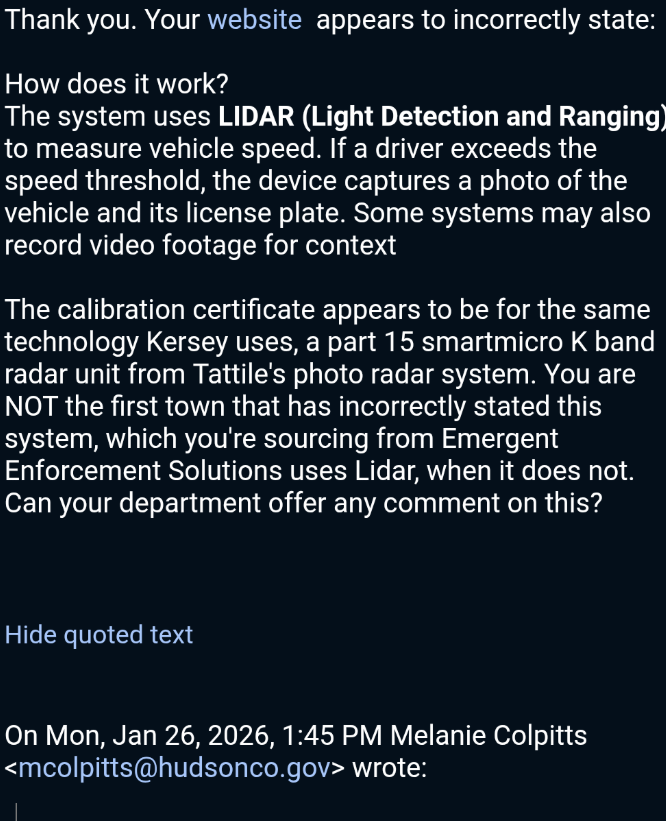
Email with Hudson before they updated their website.
The fact that there are various towns that are under the false impression that their photo radar equipment is LIDAR is concerning. In fact, Kersey was referring to their photo radar AVIS hearing officer as a “Lidar Hearing Officer” at various times. How can anyone expect to have a fair hearing contesting these tickets if the hearing officer and the town’s employees in general don’t even understand the subject matter and difference between RADAR and LIDAR? When I requested the calibration certificate, Kersey had the file name LIDAR Calibration.pdf:
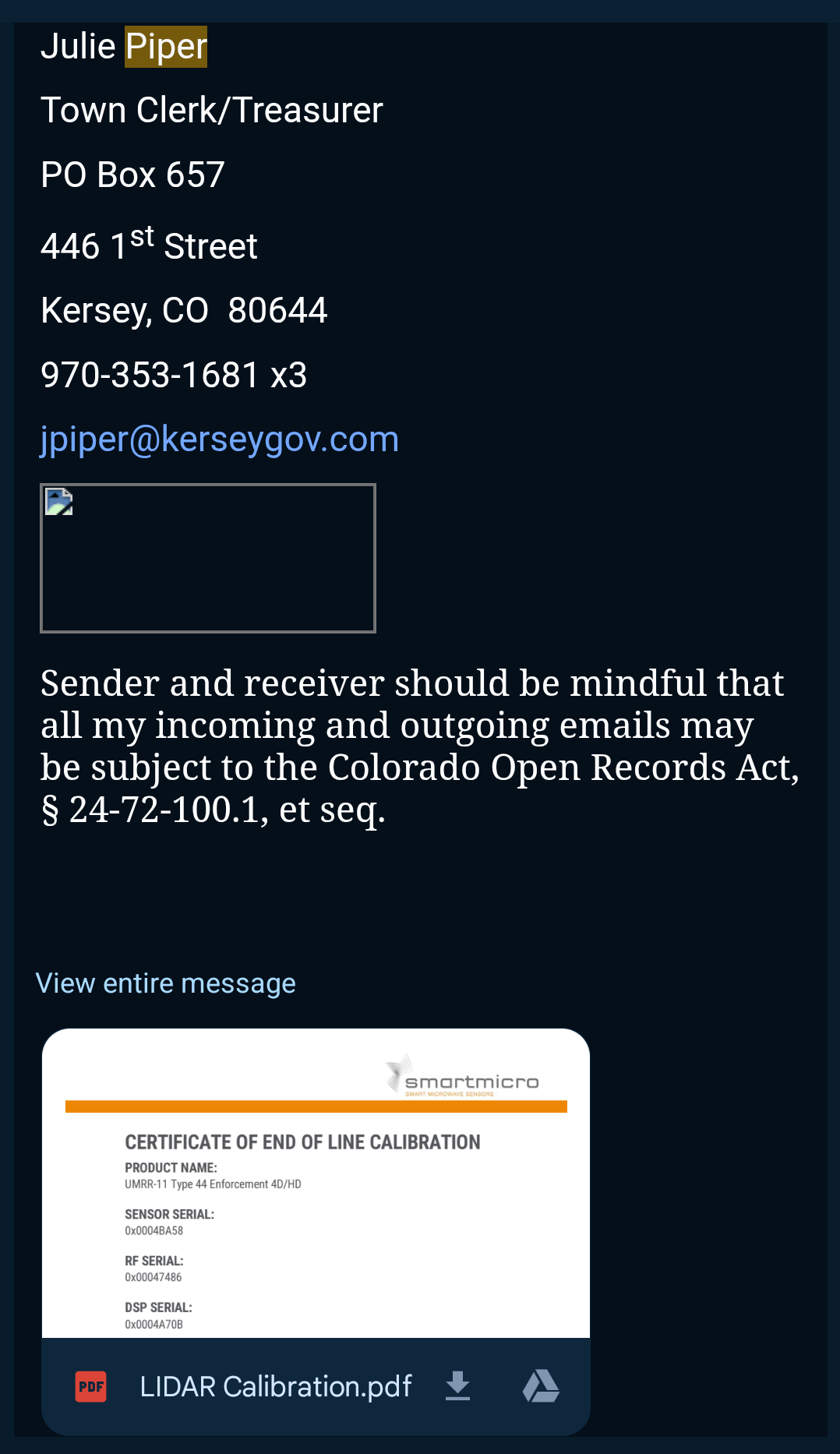
Kersey CORA for Calibration records
Towns may be confused because Emergent Enforcement Solutions also provides a free LIDAR gun (Kustom Signals LaserCam4) before towns opt to use their photo radar trailers, letting officers film violations and upload them to the cloud where EES issues citations. This likely violates state law requiring “Automated vehicle identification systems” to “automatically detect a violation” and simultaneously photograph the vehicle and license plate. Manual officer operation seems far from “automatic.” EES may be exploiting the gun’s “Video Automatic Mode” feature that auto-records over-speed violations, but if officers manually aim at targets, it’s questionable whether this qualifies as “automatic.”
Kersey’s website claims the camera was “last calibrated in February of 2025” and is “good for 24 months.” While the certificate’s file date is “7. February 2025,” page 5 shows calibration was actually performed May 13, 2024. The certificate states “This calibration is valid until 24 months after calibration date” — meaning it expires in May 2026, not February 2027. Kersey will need to recalibrate before May.
But not so fast, what even are the rules surrounding RADAR calibration? Well CRS 35–14–107 (g) says to:
Test annually the standards of weights and measures used by any city or county within the state and approve the same when found to be correct; except that tuning forks used to determine the accuracy of radar guns shall not be subject to annual testing.
Looking at the Metrology Laboratory’s website FAQ it states “You are required to submit your standards (tuning forks and LIDAR) on an annual basis according to CRS 35–14–107(g). There is a one year expiration date included on your certificate. You must submit your standards on or before this date.” — I find that odd since we just read tuning forks shall not be subject to annual testing per that same statute, but I digress. Tiffany Bringer, Deputy Division Director in the Division of Laboratory Services for the Metrology Laboratory told me in an email specifically that “We don’t calibrate radar.”
So, who does calibrate RADAR and how? According to People v. Walker, 610 P. 2d 496 — Colo: Supreme Court 1980:
Although we are not prepared at this time to require that police officers comply with any one of the tests set out above to the exclusion of all others, some minimum foundation must be established to insure “that the persuasive force of scientific results is not improperly triggered.” Commonwealth v. Whynaught, Mass. , 384 N.E.2d 1212 (1979). Accordingly, where a tuning fork test is used to calibrate a radar device, we hold that the prosecution must show that two tuning forks have been used, or, alternately, that the single tuning fork used has been certified as accurate within one year of the test. Upon such a showing, the trial court may admit the proffered radar evidence
So, it seems, the law enforcement agency operating the RADAR equipment is responsible for calibrating it. City of Aurora v. McIntyre, 719 P. 2d 727 — Colo: Supreme Court 1986 further provided:
The reliability of a radar device must be established by a proper foundation to insure that the device is accurate. We required that a tuning fork used to calibrate the radar device be certified within one year to insure the accuracy of the device. Where there is no evidence to show that the single tuning fork is accurate, its use may only mask the fact that the radar device itself is inaccurate. Walker, 610 P.2d at 499. Some minimum foundation is required to insure that the persuasive force of scientific results is based upon the use of a properly calibrated radar device. Id. at 500.
A tuning fork must initially be certified as accurate before its initial use. The fact that a tuning fork is certified after it is used to calibrate a radar device does not significantly erode the evidentiary foundation of the accuracy of the radar device if the tuning fork still meets the applicable standards. A tuning fork may lose its accuracy through age or damage, People v. Walker, 610 P.2d at 499, and if the tuning fork is tested as working properly after one year, then it is proper to conclude that the calibrations of the radar device performed within that one year period are accurate. We hold that the “within one year” language in *People v. Walker* means that the recertification of the tuning fork must occur either within one year before or one year after the radar device is tested.
US v. O’Shea, 952 F. Supp. 700 — Dist. Court, D. Colorado 1997 further provided:
In order to find Defendant guilty of speeding, this Court must be satisfied that the radar unit was operating correctly on that day and that a scientific basis existed for accepting the reading from the radar. Since Colorado law is incorporated by 32 C.F.R. Part 634, an examination must be made of applicable statutes and case law decisions concerning speeding cases. Colorado statutes are silent as to acceptance of radar speed results. See, Colo.Rev.Stat. § 42–4–1101. Thus, no statutory requirements must be followed before radar results may be admitted and considered by the Court. See, [United States v. Wornom, 754 F.Supp. 517 (W.D.Va.1991)](https://scholar.google.com/scholar_case?case=4690280661827651426&q=radar+tuning+fork&hl=en&as_sdt=4,106,120,137). … As the Colorado Supreme Court acknowledged in Walker and *McIntyre, a radar device may become inaccurate through use or damage*.* Frequent certification may provide a basis for acceptance of radar results, where only an internal test is used. Fourth, the certificate of calibration, Government Exhibit # 1, does not provide any indication that the internal test was checked. The certificate reflects only a calibration using an outside measuring device. The Court has no basis for concluding that any internal test was accurate at anytime. That is the reason that a certified tuning fork insures proper calibration of a radar device. … This Court agrees with the rationale set forth in Walker and McIntyre. There must be foundational evidence presented to establish the scientific reliability of a radar device. The simplest way of doing so is to utilize a single, certified tuning fork. This will test the accuracy of the radar unit on the day that it is used* to clock a motorist. Two tuning forks may also be used as an alternative means of calibration. Absent use of a tuning fork, the burden is placed upon the prosecution to establish a basis for acceptance of an internal test result**. No such foundational basis was presented in this case. (emphasis added)
Our investigation, however, found that Photo Radar equipment is NOT calibrated using tuning forks, and certainly no daily calibrations are taking place before and after a motorist is cited by Photo Radar to ensure the equipment that automatically detected the motorist’s speed was working ON THE DAY that it is used to clock a motorist as the previous precedents expect, at least when you’re cited by a police officer and not for a civil offense. We requested calibration certificates from various municipalities in Colorado and found that they appear to use “Electronic K-band Target Simulator Doppler Generator (EKTSDG)” to recalibrate this equipment.
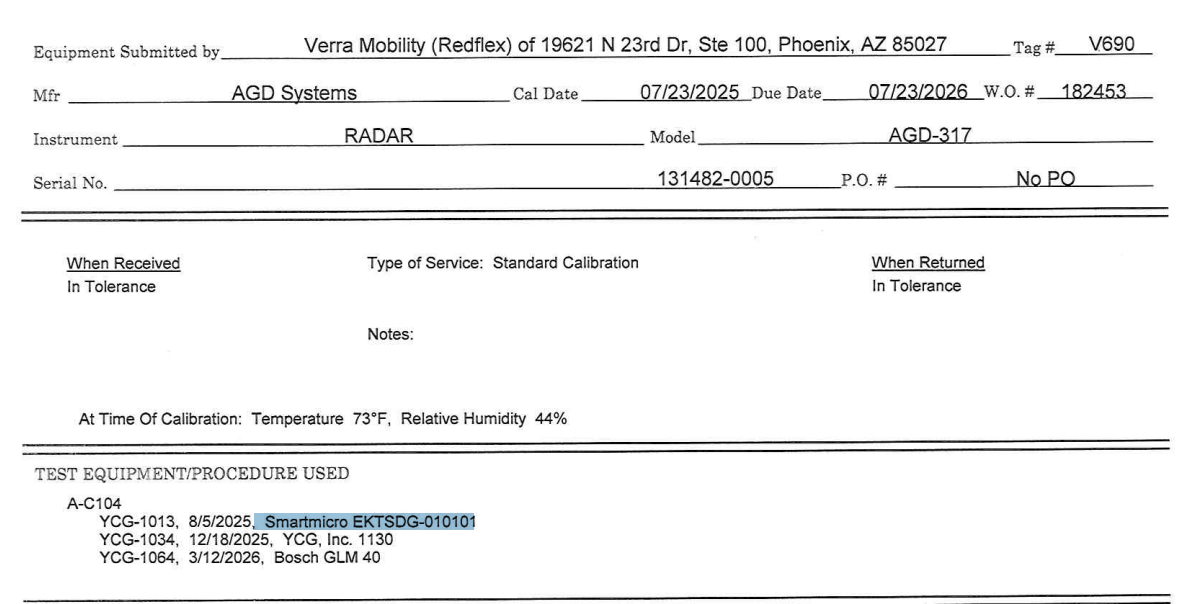
Screenshot of a Verra Mobility calibration certificate from Colorado Springs
This device does not appear to have any NIST traceability, serial number, or as far as we could find during our investigation, is itself calibrated. Instead of the tuning fork method used in regular police radar calibration, it “spoofs” a speed on the K-band RADAR frequency the Photo Radar devices operate on, and computer software determines if the test was successful.
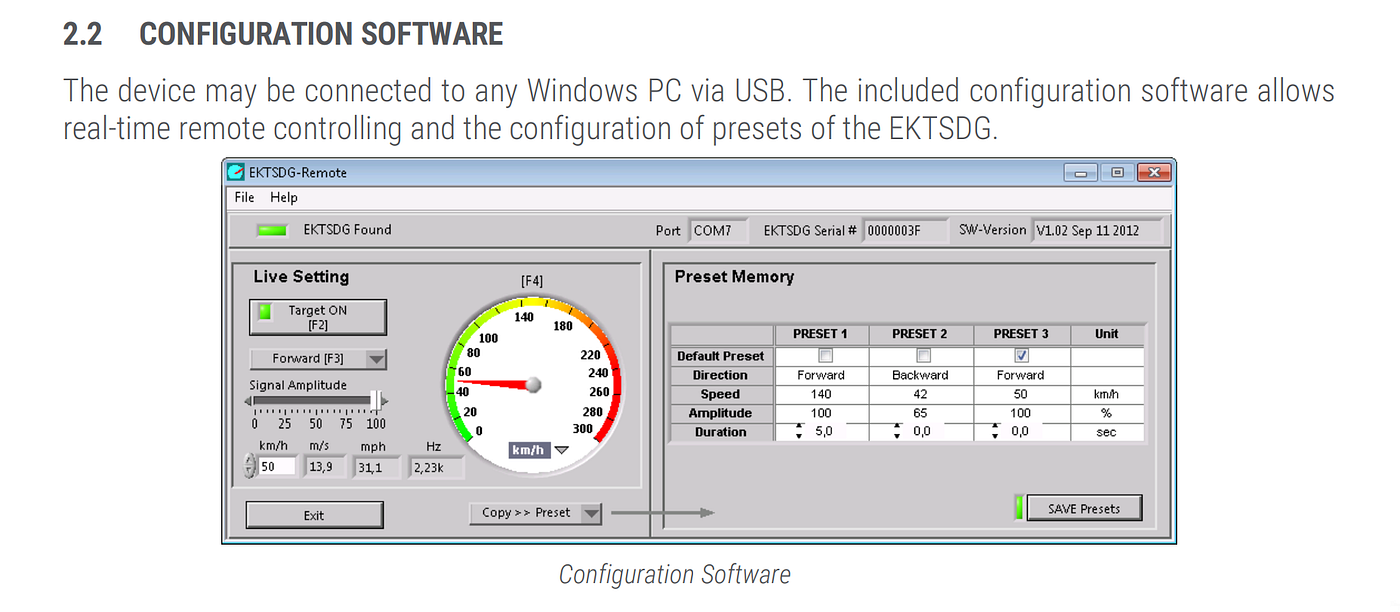
Screenshot of the software used for the EKTSDG
This device causes photo radar to detect a phantom target and record speed based on Doppler shift. Calibration occurs 2 years after manufacturer calibration, then annually (per Smart Micro). Similar methods are used by other vendors. This calibration method’s scientific reliability remains unchallenged in courts. Unlike police radar tested daily for accuracy, photo radar equipment can cite thousands of motorists over days or years with no daily verification — relying only on internal self-tests. As the O’Shea court noted, “The certificate reflects only a calibration using an outside measuring device…Absent use of a tuning fork, the burden is placed upon the prosecution to establish a basis for acceptance of an internal test result.” Equipment failures from frequency drift or malfunction may only be discovered at recalibration 1–2 years later, after thousands of motorists have already been cited.
One last thing, while we’re on the subject of photo traffic enforcement, it was recently discovered FLOCK Cameras were being used to issue at least one citation for traffic enforcement. A member of the FLOCK cameras must be stopped Facebook group originally reported this in the group on Feb 24th.
With ALL of these legal issues plaguing Colorado’s AVIS Photo Radar schemes, you may want to contact Byron Pelton and Matt Ball who plans on introducing a bill to “close the loopholes” that Kersey exposed and urge them to just repeal AVIS altogether as the vendors and equipment being used can’t be trusted in the first place.
메타데이터
- post_id
- 97a6b282cd12
- slug
- colorado-photo-radar-has-legal-issues-97a6b282cd12
- url
- https://medium.com/@lucky225/colorado-photo-radar-has-legal-issues-97a6b282cd12
- canonical_url
- https://medium.com/@lucky225/colorado-photo-radar-has-legal-issues-97a6b282cd12
- author_url
- https://medium.com/@lucky225
- status
- ok
- fetched_at
- 2026-06-22 18:00:48