Projection-Induced Non-Metric Information Channels
A Geometric Construction of the Ghidan 1/0 Bit-Qubit Substrate from Oblique Cube Projection
Projection-Induced Non-Metric Information Channels
A Geometric Construction of the Ghidan 1/0 Bit-Qubit Substrate from Oblique Cube Projection
Florin Ghidan
Ghidan Quantum Dynamics Laboratory
Melbourne, Australia
https://doi.org/10.5281/zenodo.20442263

“If Spacetime it is curved or stretched, then at Planck scale, Planck length would be also curved or stretched! But then, Planck length wouldn’t be Planck length anymore! The universe as we know it, would Collapse!” — Florin Ghidan
Abstract
This paper presents a projection-asymmetry argument for the Ghidan 1/0 Bit-Qubit substrate. Starting from a rigid three-dimensional Planck cube whose 12 edges are fixed at the Planck length ℓₚ, we show that a literal physical compression of this 3D cube into a purely two-dimensional metric surface is not admissible under a finite Planck-resolution substrate. Mathematical projection from 3D to 2D is always possible as a representation, but physical metric projection is different. If every edge of the cube already occupies the minimum metric channel length ℓₚ, then the four depth edges cannot be shortened below ℓₚ, collapsed to zero, or erased without violating either the Planck-resolution condition or conservation of the cube’s 12-channel capacity.
This produces a projection asymmetry. Physical 3D → 2D metric compression is forbidden, while 2D → 3D informational reconstruction is allowed. The fundamental substrate is therefore not a realized 3D cube being compressed into 2D. Instead, the physically admissible direction is reversed: a 2D Planck-resolution informational substrate, supplemented by non-metric binary transition channels, reconstructs the appearance of 3D geometry. When this reconstruction is dynamically updated through the throughput variable χ, the result is experienced as 4D spacetime.
The oblique cube projection serves as a diagnostic model. It separates the cube into eight metric-preserving face channels and four depth-transition channels. These four depth channels cannot be interpreted as physically shortened sub-Planckian metric lengths. Instead, they are reclassified as non-metric 1/0 transition gates carrying the conserved distinction between available throughput χ and committed load L. This gives the Ghidan conservation law:
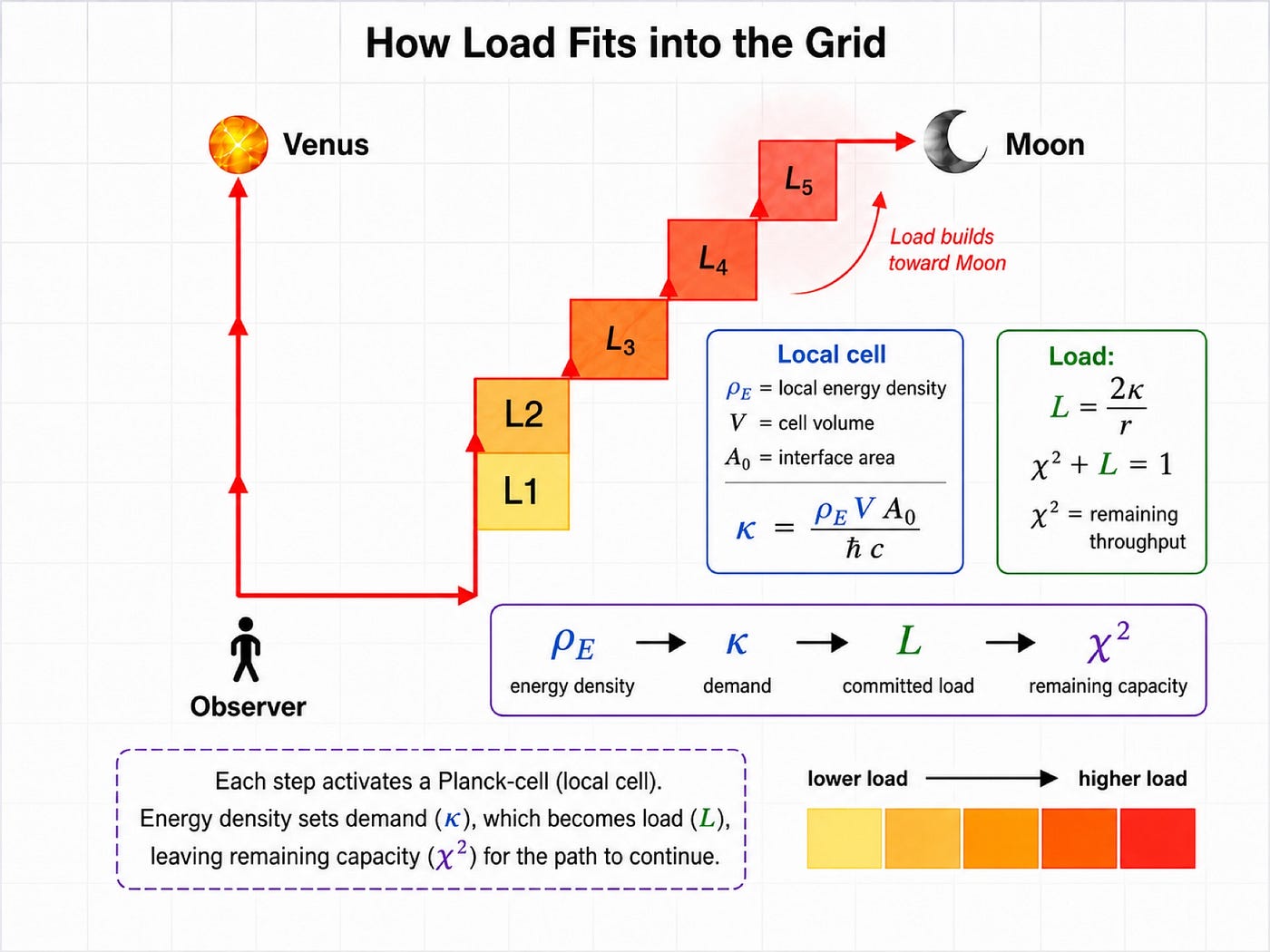
χ² + L = 1.
From this load-throughput structure, radial metric scaling, gravitational time dilation, and weak-field rotational shear can be reconstructed as emergent macroscopic decoding effects. The paper therefore proposes that apparent 4D reality is the dynamic decoded output of a 2D finite-capacity Planck substrate, not the primitive arena of physics.
I. Introduction
The standard assumption in physics is that spacetime is a four-dimensional continuum: three dimensions of space plus one dimension of time. General Relativity treats this continuum as a smooth pseudo-Riemannian manifold whose curvature determines gravitational dynamics. Quantum theory, however, suggests that indefinite metric subdivision cannot be physically meaningful at arbitrarily small scales. The Planck length,
ℓₚ = √(ℏG/c³),
is commonly understood as the scale at which quantum-gravitational effects become unavoidable.
In the Ghidan framework, ℓₚ is treated as the operational lower bound of metric resolution. A physical coordinate channel cannot be continuously shortened below this scale while remaining an ordinary metric coordinate. This does not require claiming that ℓₚ is proven to be the absolute smallest possible length in all theories. It is a substrate postulate: within the Ghidan model, ℓₚ is the minimum physical metric channel.
The Ghidan framework begins from the conservation law:
χ² + L = 1,
where χ ∈ [0, 1] represents available local throughput, χ² represents available channel capacity, and L ∈ [0, 1] represents committed load.
This paper develops the geometric and physical origin of that law using a projection-asymmetry argument. The argument begins with the elementary Ghidan Cube: a rigid 12-edge Planck cell. If this cube is already realized in 3D, then physically compressing it into 2D creates a contradiction. Its depth edges cannot be shortened below ℓₚ, collapsed into zero, or erased. Therefore, 3D → 2D metric compression is physically forbidden.
However, the reverse direction is not forbidden. A 2D Planck-resolution substrate can reconstruct apparent 3D geometry by encoding depth as non-metric transition information. When this reconstruction is dynamically updated, time appears as the update rate of the substrate.
Thus, the model suggests:
2D Planck substrate + non-metric transition channels + update dynamics → apparent 4D spacetime.
This is the core result of the paper.
II. The Ghidan Planck Cube
Define the elementary Ghidan Cube as a rigid finite-capacity cell with 12 equal edge channels. Each edge has length:
eᵢ = ℓₚ, i = 1, 2, …, 12.
The cube has:
A₀ = ℓₚ²,
V₀ = ℓₚ³.
Each edge is assigned one normalized Planck-channel capacity unit:
Cᵢ = 1.
Therefore, the total channel capacity of the cube is:
C_total = Σᵢ₌₁¹² Cᵢ = 12.
This cube may be viewed in two ways.
First, it is a geometric object with 12 Planck-length edges.
Second, it is an information register with 12 finite-capacity channels.
In this paper, the second interpretation is the deeper one. The cube is not primarily a little object floating inside pre-existing space. It is a minimal finite-capacity substrate cell whose decoded macroscopic behavior appears as geometry.
The key constraint is that its edge channels are already fixed at ℓₚ. They cannot be physically compressed into shorter metric channels without violating the assumed Planck-resolution limit.
III. Mathematical Projection versus Physical Projection
A mathematical projection is always possible. A three-dimensional cube can be drawn on a two-dimensional page. A 3D object can be represented by a 2D image, diagram, shadow, or coordinate map.
But mathematical representation is not the same as physical metric compression.
A drawing of a cube may show shortened depth edges, hidden edges, or overlapping faces. These are representational effects. They do not mean that the original physical cube has been compressed, shortened, or collapsed.
The Ghidan argument concerns physical substrate projection, not visual drawing.
If a realized 3D Planck cube were physically compressed into a purely 2D metric surface, its four depth edges would face three impossible options:
- They would have to shorten below ℓₚ.
-
- They would have to collapse to zero metric length.
-
- They would have to disappear, destroying capacity.
- All three options are forbidden under the Ghidan substrate assumptions.
- Therefore:
- A realized 3D Planck cube cannot physically project into a purely 2D metric surface by direct compression.
- This is the projection obstruction.
IV. Orthogonal Projection and the Physical Impossibility of Metric Depth Collapse
The strongest form of the argument appears in the orthogonal limit.
In an ordinary orthogonal projection, a 3D cube can be represented as a 2D square. The depth direction collapses along the line of sight. The four depth edges are hidden behind the front face.
As a drawing, this is harmless.
As a physical operation on a Planck substrate, it is impossible.
If every cube edge is already fixed at the minimum metric length ℓₚ, then the depth edges cannot be continuously shortened into the projection plane. They also cannot be collapsed to zero, because zero-length physical channels would destroy their capacity. Nor can they simply disappear, because the cube’s 12-channel information budget must remain conserved.
Thus, orthogonal projection shows the obstruction:
3D depth cannot be physically collapsed into 2D metric length.
The depth degree of freedom must survive in some other form.
The only admissible form is non-metric information.
Therefore, the hidden depth channels must become state-transition channels rather than ordinary spatial edges.
This is the physical origin of the Ghidan 1/0 depth register.
V. Oblique Projection and the 8 + 4 Channel Partition
While orthogonal projection exposes the impossibility of direct metric compression, oblique projection exposes the channel structure.
In an oblique projection of a cube, the 12 edges separate into:
8 face edges,
4 depth edges.
The 8 face edges remain aligned with the projected two-dimensional metric plane. They preserve ordinary metric interpretability.
The 4 depth edges appear as slanted connector lines. Their drawn length depends on the projection convention. For example, one may write:
ℓ_depth,proj = sℓₚ,
where s is a projection scaling factor.
In a Cabinet-style drawing, s = 1/2. In a Cavalier-style drawing, s = 1. Other projection conventions choose other values.
But this projected length is not the physical length of the original edge.
The original edge remains ℓₚ.
Therefore, the correct conclusion is not:
“the Planck edge physically becomes sub-Planckian.”
The correct conclusion is:
“the depth edge loses direct metric status in the lower-dimensional representation.”
Oblique projection is useful because it reveals that the depth information is carried by four special channels. These are the channels that must become non-metric transition gates in the physical substrate model.
Thus:
orthogonal projection shows that 3D → 2D metric compression is forbidden;
oblique projection shows that depth requires four transition channels;
information conservation explains why these channels become 1/0 gates.
VI. Projection Asymmetry: 3D → 2D Is Forbidden, 2D → 3D Is Allowed
The central principle of this paper is projection asymmetry.
A realized 3D Planck cube cannot be physically compressed into a purely 2D metric surface without violating the Planck-resolution condition or destroying capacity. Therefore:
3D → 2D metric compression is physically forbidden.
However, the reverse process is different.
A 2D Planck-resolution substrate does not need to stretch itself into a literal third metric dimension. Instead, it can encode the third-dimensional degree of freedom as non-metric transition information.
Thus:
2D → 3D informational reconstruction is physically allowed.
This is the critical asymmetry.
The 3D cube is not the primitive object. The primitive object is the 2D finite-capacity substrate plus transition channels. The apparent 3D cube is the decoded output.
The physical direction of emergence is therefore:
2D substrate → encoded depth → apparent 3D geometry.
Not:
3D object → physical 2D compression.
This changes the interpretation of the cube drawing. The drawing is not a literal image of a 3D object being compressed into 2D. It is a reverse-engineering clue showing how 3D geometry can be reconstructed from a lower-dimensional substrate.
VII. The 2D-to-4D Emergence Principle
The projection-asymmetry argument can be extended from space to spacetime.
If 3D geometry emerges from a 2D substrate through non-metric depth encoding, then 4D spacetime emerges when the reconstruction is dynamically updated.
The third spatial dimension emerges from transition channels.
Time emerges from update rate.
In the Ghidan framework, the local update-rate fraction is χ. Therefore:
dτ/dt = χ.
When χ = 1, the local substrate updates at full rate.
When χ < 1, local update capacity is reduced.
When χ = 0, outward update-throughput relative to an external observer vanishes.
This gives the emergence chain:
2D Planck substrate
• non-metric 1/0 transition channels
• throughput update rate χ
→ apparent 3D space
→ experienced 4D spacetime.
Thus, the model suggests that apparent 4D reality is not fundamental. It is the dynamic decoded output of a two-dimensional finite-capacity Planck substrate.
This may be stated as the Ghidan 2D-to-4D Emergence Principle:
A physical 3D Planck cell cannot be compressed into a 2D metric cell without violating finite metric resolution. Therefore, the physically admissible direction is reversed: a 2D Planck-resolution substrate reconstructs apparent 3D geometry through non-metric depth channels, and time emerges as the update rate of this reconstruction. Apparent 4D spacetime is the dynamic decoded output of 2D finite-capacity information.
VIII. Metric Channels and Non-Metric Transition Channels
The 2D substrate contains two functional channel classes.
A. Metric channels
The face-aligned channels define the directly accessible 2D metric grid.
Their total contribution is:
C_metric = 8.
These channels preserve adjacency, local distance, and coordinate order.
They form the visible metric interface of the projected substrate.
B. Non-metric transition channels
The four depth channels cannot survive as independent metric lengths in the 2D substrate. They therefore become transition channels.
Their total contribution is:
C_transition = 4.
Each transition channel carries one normalized unit of capacity.
But because it no longer functions as a continuous spatial coordinate, it must be represented as a state variable.
The primitive state variable is binary:
0 → available unresolved throughput,
1 → committed resolved load.
This is the Ghidan 1/0 structure.
The depth channel is therefore not “missing.” It is encoded.
IX. Capacity Conservation and the 1/0 Mechanism
Each non-metric transition channel carries a conserved capacity budget. That budget is divided between available throughput and committed load:
χ² + L = 1.
Here:
χ is the available throughput amplitude,
χ² is the available channel-capacity fraction,
L is the committed load fraction.
A fully available channel has:
χ² = 1,
L = 0.
A fully committed channel has:
χ² = 0,
L = 1.
Intermediate states satisfy:
0 < χ² < 1,
0 < L < 1.
Thus, the channel does not lose information. It redistributes finite capacity between availability and commitment.
The four transition channels contribute:
C_transition = 4(χ² + L).
The eight metric channels contribute:
C_metric = 8.
Therefore, the full cube capacity is:
C_total = C_metric + C_transition,
so:
C_total = 8 + 4(χ² + L).
Using:
χ² + L = 1,
we obtain:
C_total = 8 + 4 = 12.
Thus, the projected system preserves the cube’s full 12-channel capacity.
The apparent loss of depth is not a loss of capacity. It is the conversion of metric depth into non-metric binary state information.
X. The Ghidan Bit-Qubit State
Each transition channel may be represented as a normalized two-state capacity structure:
|G⟩ = χ|0⟩ + √L|1⟩.
The normalization condition is:
⟨G|G⟩ = χ² + L = 1.
Here:
|0⟩ represents available unresolved throughput,
|1⟩ represents committed resolved load.
This is why the model is called a 1/0 Bit-Qubit substrate.
It is bit-like because the channel has two primitive roles: available or committed.
It is qubit-like because these roles obey a normalized amplitude-load relation.
The state is not introduced as standard quantum mechanics. It is introduced as a finite-capacity representation of a non-metric transition channel.
At the microscopic level, the channel is binary.
At the macroscopic level, the statistical aggregation of many such channels appears continuous.
This is how smooth 3D geometry can emerge from finite 2D substrate information.
XI. Geometry as Decoded Information
In this framework, geometry is not primitive. Geometry is decoded.
The observer does not directly see the 2D substrate or the 1/0 transition channels. The observer experiences the aggregate decoded result.
The decoding relation is:
channel state → apparent metric geometry.
When χ is high, available throughput is high. The decoded geometry appears weakly curved or flat.
When L is high, more capacity is committed. The decoded geometry appears curved, delayed, or radially stretched.
When L = 1 and χ = 0, outward throughput vanishes. The decoded geometry contains a horizon.
Therefore:
flat space corresponds to high available throughput;
gravity corresponds to throughput gradient;
mass corresponds to committed load;
time dilation corresponds to reduced update rate;
radial curvature corresponds to reduced propagation capacity;
a horizon corresponds to channel saturation.
This produces a unified interpretation:
4D spacetime is the decoded macroscopic output of 2D finite-capacity information.
XII. Radial Metric Scaling from Throughput Reduction
Consider radial propagation through a loaded substrate.
Let dr be the projected coordinate interval. If local radial throughput is χ, then the reconstructed proper radial interval scales as:
dℓᵣ = dr/χ.
Squaring:
dℓᵣ² = dr²/χ².
Therefore, the radial metric coefficient is:
g_rr = 1/χ².
Using the capacity law:
χ² + L = 1,
we obtain:
χ² = 1 − L.
For a static spherical source, define the load fraction:
L(r) = 2κ/r,
where:
κ = GM/c².
Therefore:
χ²(r) = 1 − 2κ/r.
Substituting:
g_rr = 1/(1 − 2κ/r).
Using κ = GM/c²:
g_rr = 1/(1 − 2GM/(c²r)).
This is the Schwarzschild radial component.
In this interpretation, radial curvature is not first caused by a curved continuum. It is the decoded macroscopic appearance of reduced radial throughput.
XIII. Temporal Scaling and Update Rate
Time emerges as the update rate of the reconstruction.
If χ is the local update-rate fraction, then:
dτ/dt = χ.
Squaring:
dτ² = χ²dt².
Therefore, the temporal metric coefficient is:
g_tt = −χ².
Using:
χ² = 1 − 2κ/r,
we obtain:
g_tt = −(1 − 2κ/r).
Equivalently:
g_tt = −(1 − 2GM/(c²r)).
Thus, the same throughput variable χ controls both radial scaling and time dilation:
g_rr = 1/χ²,
g_tt = −χ².
The Schwarzschild line element can therefore be reconstructed as:
ds² = −χ²c²dt² + dr²/χ² + r²dΩ²,
with:
χ² = 1 − 2GM/(c²r).
This result should be interpreted as a reconstruction within the Ghidan substrate model. It does not claim that ordinary Euclidean projection alone proves General Relativity. It claims that, under the load-throughput law, the Schwarzschild metric components emerge as decoded information geometry.
XIV. Horizon as Saturated Information Boundary
At the Schwarzschild horizon:
r = 2κ.
Then:
L = 2κ/r = 1,
and:
χ² = 1 − L = 0.
Therefore:
χ = 0.
This is the saturation condition.
At the horizon, all outward available throughput has been converted into committed load. The transition channels no longer provide outward propagation capacity relative to an external observer.
The horizon is therefore not merely a geometric surface. It is a saturated information boundary.
In the projection model, this corresponds to the point where effective depth accessibility vanishes for the exterior observer. The system becomes boundary-dominated. Information remains conserved, but it is no longer available as outward metric throughput.
This gives a natural link to holography:
the horizon behaves as a 2D information boundary because outward depth reconstruction has saturated.
Thus, the horizon is where 3D/4D emergence fails relative to the external observer and the underlying 2D information character becomes dominant.
XV. Rotational Load and Weak-Field Kerr Reconstruction
The projection-asymmetry model can also be extended to rotation.
A rotating source introduces angular momentum J. In capacity terms, angular momentum represents directional bias in the substrate update structure.
The unique rotational length constructed from J, M, and c is:
a = J/(Mc).
The mass-load length is:
κ = GM/c².
Their coupling gives the weak-field angular shear scale:
Ω_drag ≈ 2κac/r³.
Substituting:
κ = GM/c²,
a = J/(Mc),
we obtain:
Ω_drag ≈ 2GJ/(c²r³).
This is the weak-field Lense-Thirring frame-dragging angular velocity.
The angular coordinate shift is:
dφ → dφ − Ω_dragdt.
Substituting into the angular term:
r²sin²θdφ²,
gives:
r²sin²θ(dφ − Ω_dragdt)².
Expanding to first order:
r²sin²θdφ² − 2r²sin²θΩ_dragdφdt.
Therefore:
g_tφ ≈ −r²sin²θΩ_drag.
Using:
Ω_drag ≈ 2GJ/(c²r³),
we obtain:
g_tφ ≈ −2GJsin²θ/(c²r).
Equivalently:
g_tφ ≈ −2κac sin²θ/r.
This is the weak-field Kerr/Lense-Thirring cross-term structure.
In the Ghidan interpretation, frame dragging is the decoded geometric expression of angular throughput shear in the finite-capacity substrate.
XVI. What Is Derived and What Is Postulated
The paper derives the following internal structure:
-
A 3D Planck cube contains 12 finite-capacity edge channels.
-
A purely physical 3D → 2D metric compression is forbidden because depth edges cannot be shortened below ℓₚ, collapsed to zero, or erased.
-
Orthogonal projection exposes the physical obstruction.
-
Oblique projection reveals the 8 + 4 channel partition.
-
The 8 face channels remain metric-accessible.
-
The 4 depth channels must become non-metric transition channels.
-
These transition channels naturally carry a binary available/committed distinction.
-
The conserved transition-channel law is χ² + L = 1.
-
The total 12-channel cube capacity is preserved:
C_total = 8 + 4(χ² + L) = 12.
-
Apparent 3D geometry emerges from 2D metric channels plus non-metric transition gates.
-
Apparent 4D spacetime emerges when the reconstruction is dynamically updated through χ.
-
Schwarzschild temporal and radial components are recovered when L = 2κ/r.
-
Weak-field rotational shear is recovered when angular momentum is encoded through a = J/(Mc).
The paper postulates the following:
-
ℓₚ is the operational minimum metric channel length of the substrate.
-
Total channel capacity is conserved.
-
Non-metric depth channels behave as binary transition gates.
-
χ² represents available throughput capacity.
-
L represents committed load.
-
Mass load is represented by L(r) = 2κ/r.
-
Time is the update rate of reconstruction, dτ/dt = χ.
Therefore, the paper should be classified as:
a projection-asymmetry derivation within the Ghidan finite-capacity substrate model.
XVII. Falsifiability and Testable Directions
The model becomes scientifically meaningful only if it leads to testable consequences.
- Horizon-adjacent throughput residuals
If horizon formation corresponds to χ → 0 through finite channel saturation, then near-horizon systems may exhibit small boundary-layer effects. These could appear as weak residual leakage, ring asymmetry, or polarization anomalies near black hole shadow boundaries.
- Strong-field deviations from smooth geometry
If geometry is decoded from finite transition channels, then extreme curvature environments may show small corrections to:
χ² = 1 − 2κ/r.
A testable version of the model must specify:
χ²(r) = 1 − 2κ/r + δχ²(r).
The correction term δχ²(r) would be the main target for observational comparison.
- Rotational throughput shear
If frame dragging is angular information-channel shear, strong-field rotating systems should provide enhanced tests. Relevant targets include rapidly rotating compact objects, pulsars near black holes, accretion-disk polarization, and next-generation Event Horizon Telescope observations.
- Information-density interpretation of mass
If mass is committed information load, the model must supply a quantitative bridge between L, κ, energy density ρ_E, and observable gravitational acceleration. This is required for a full empirical comparison with General Relativity and cosmology.
XVIII. Discussion
The main result of this paper is not that a cube drawing proves quantum gravity. It does not.
The result is more specific:
If a Planck-scale cube is already physically realized in 3D, then compressing it into 2D as a purely metric operation is forbidden under finite resolution. The depth channels cannot shrink below ℓₚ, collapse to zero, or vanish.
This forces a reversal of physical direction.
The real substrate cannot be a 3D object compressed into 2D. The admissible physical structure is a 2D substrate that reconstructs apparent 3D geometry.
This is why the projection argument supports a 2D-to-4D emergence model.
The role of the oblique cube is diagnostic. It shows that four special channels are required to encode depth. The role of information theory is to show that these channels conserve capacity by shifting between available throughput and committed load.
The resulting physical picture is:
the 2D substrate carries metric adjacency;
the 1/0 channels encode depth;
χ updates the reconstruction;
L commits structure;
4D spacetime appears as the decoded output.
Thus, reality is not reduced to a flat picture. Rather, the apparent depth and time of reality are reconstructed from lower-dimensional finite-capacity information.
XIX. Conclusion
This paper has updated the Ghidan cube-projection argument into a projection-asymmetry principle.
Mathematical 3D → 2D projection is always possible as representation. But physical 3D → 2D metric compression is forbidden under the Ghidan substrate assumptions, because Planck-length depth edges cannot be shortened below ℓₚ, collapsed to zero, or erased without violating capacity conservation.
The physically admissible direction is therefore reversed:
2D → 3D informational reconstruction is allowed.
When this reconstruction is dynamically updated through χ, apparent 4D spacetime emerges.
The core emergence chain is:
2D Planck substrate
• 1/0 non-metric depth channels
• χ update dynamics
• L committed load
→ apparent 3D geometry
→ experienced 4D spacetime.
The 12-channel cube capacity is conserved as:
C_total = 8 + 4(χ² + L) = 12.
The transition-channel law is:
χ² + L = 1.
From this, the Schwarzschild metric components are reconstructed:
g_rr = 1/χ²,
g_tt = −χ²,
with:
χ² = 1 − 2GM/(c²r).
Rotation introduces the length:
a = J/(Mc),
leading to the weak-field Kerr/Lense-Thirring cross-term:
g_tφ ≈ −2GJsin²θ/(c²r).
The final conclusion is:
4D spacetime is not the primitive arena. It is the dynamic decoded output of a 2D finite-capacity Planck substrate.
Geometry is not the source.
Geometry is the shadow of conserved information.
References
[1] Florin Ghidan, “The Ghidan Shift: From Analog Geometry to Digital Computing Physics,” Medium.
[2] Florin Ghidan, “Deriving Flat Galactic Rotation Curves within the Ghidan 1/0 Framework,” Medium.
[3] Florin Ghidan, “From Hilbert Space to Informational Throughput,” Medium.
[4] C. E. Shannon, “A Mathematical Theory of Communication,” Bell System Technical Journal, 1948.
[5] R. Landauer, “Irreversibility and Heat Generation in the Computing Process,” IBM Journal of Research and Development, 1961.
[6] J. A. Wheeler, “Information, Physics, Quantum: The Search for Links,” 1989.
[7] J. D. Bekenstein, “Black Holes and Entropy,” Physical Review D, 1973.
[8] S. W. Hawking, “Particle Creation by Black Holes,” Communications in Mathematical Physics, 1975.
[9] R. P. Kerr, “Gravitational Field of a Spinning Mass as an Example of Algebraically Special Metrics,” Physical Review Letters, 1963.
[10] J. Lense and H. Thirring, “On the Influence of the Proper Rotation of Central Bodies on the Motion of Planets and Moons,” Physikalische Zeitschrift, 1918.
[11] C. W. Misner, K. S. Thorne, and J. A. Wheeler, Gravitation, W. H. Freeman, 1973.
[12] R. M. Wald, General Relativity, University of Chicago Press, 1984.
메타데이터
- post_id
- 97b4cdca3f13
- slug
- projection-induced-non-metric-information-channels-97b4cdca3f13
- url
- https://medium.com/@fghidan/projection-induced-non-metric-information-channels-97b4cdca3f13
- canonical_url
- https://medium.com/@fghidan/projection-induced-non-metric-information-channels-97b4cdca3f13
- author_url
- https://medium.com/@fghidan
- status
- ok
- fetched_at
- 2026-06-13 16:00:06