Chip Tuning as Software Engineering: How Modern Engines Are Really Controlled
Chip tuning is often discussed in terms of power gains, torque figures, or acceleration numbers, but at its core, it is far more…
Chip Tuning as Software Engineering: How Modern Engines Are Really Controlled
Chip tuning is often discussed in terms of power gains, torque figures, or acceleration numbers, but at its core, it is far more interesting than that. In reality, chip tuning is a form of applied software engineering, where the “code” directly interacts with physics, mechanics, and real-world conditions. Understanding this changes the way tuning is perceived — not as a shortcut to performance, but as a complex process of optimization.
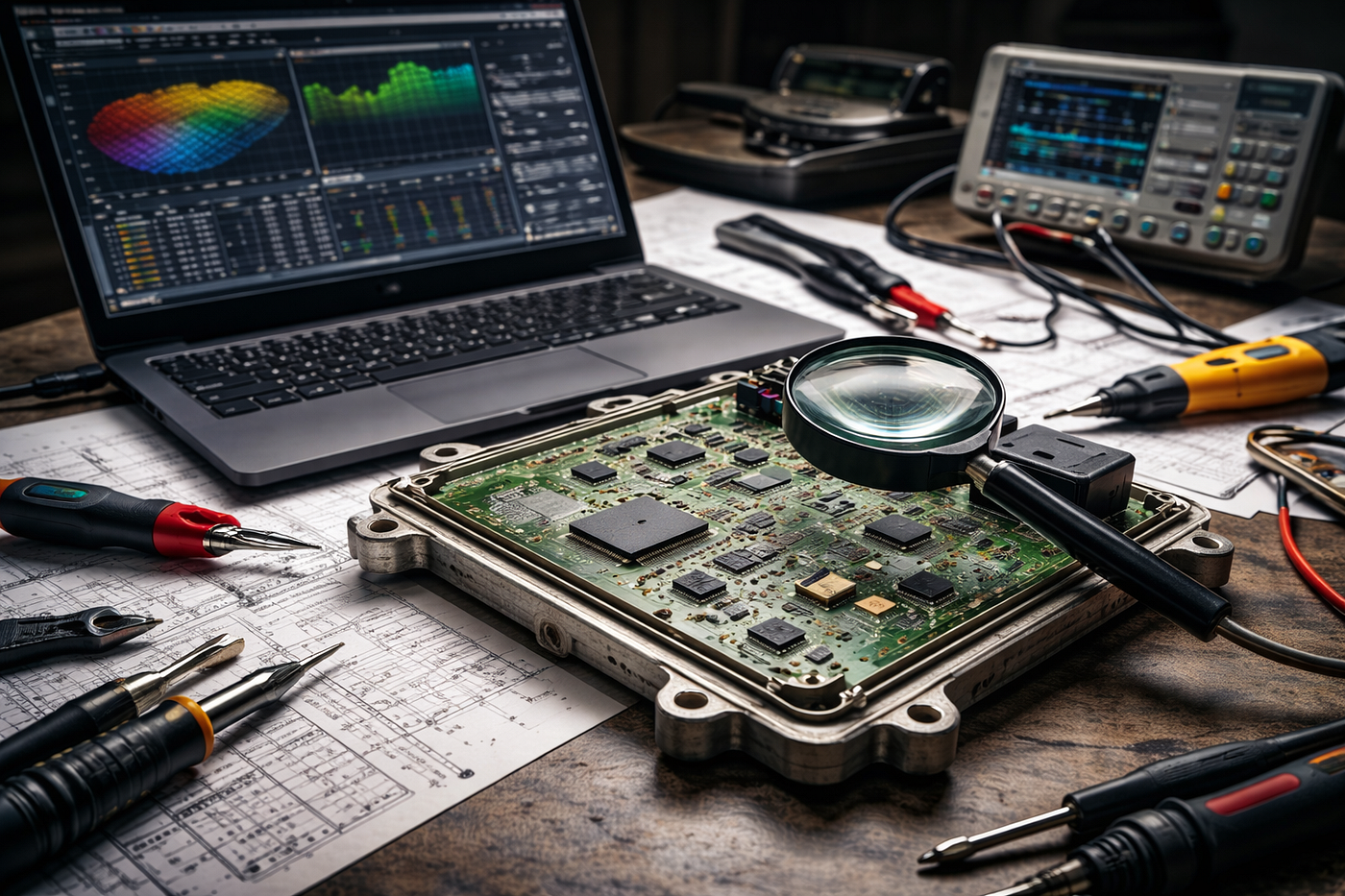
Modern engines are not purely mechanical systems anymore. They are controlled ecosystems where dozens of sensors continuously feed data into the ECU: air mass, temperature, pressure, exhaust composition, knock signals, and more. The ECU processes this information in real time and decides how the engine should behave in each specific moment. Every throttle input, gear change, or temperature shift is interpreted through software logic.
Factory firmware is designed with global conditions in mind. Manufacturers must account for different fuel qualities, climate zones, emission regulations, driving styles, and maintenance standards. Because of this, stock calibration always prioritizes safety margins and universality over optimization. These margins are not “wasted potential” in a reckless sense, but rather reserved flexibility that ensures long-term reliability across millions of vehicles.
Chip tuning works within this framework by adjusting how the ECU uses its existing logic. Contrary to popular belief, professional tuning rarely involves random changes or aggressive parameter shifts. Instead, it focuses on recalibrating relationships between maps, limiters, and control strategies. Torque modeling, load calculation, and feedback loops play a far greater role than raw fuel or boost values.
One fascinating aspect of ECU firmware is how layered it is. Beneath the visible maps lie correction tables, safety thresholds, and fallback strategies. For example, torque requests are often filtered through multiple models before reaching the final output stage. This means that changing a single map rarely produces a meaningful result unless it aligns with the rest of the control logic. Understanding these dependencies is what separates informed calibration from guesswork.
Different manufacturers implement these strategies in unique ways. Even within the same brand, ECU behavior can vary significantly depending on platform and generation. A Toyota ECU identified by a hardware family such as **Toyota 89663** reflects a specific approach to torque control, diagnostics, and fail-safe logic that must be respected when analyzing or modifying its firmware. These differences highlight why copying files blindly between vehicles is risky and often ineffective.
Another overlooked dimension of chip tuning is drivability. Not all improvements are measurable on a dyno. Smoother throttle response, better low-load behavior, and more predictable torque delivery can transform how a car feels in everyday driving. In many cases, these refinements improve efficiency and comfort rather than outright performance. This is why tuning is not always about pushing limits, but about refining behavior.
Diagnostics and error handling are also integral parts of ECU software. Modern firmware continuously checks plausibility between sensors and models. When inconsistencies appear, the ECU doesn’t simply fail — it adapts. Limp modes, substitute values, and degradation strategies are all embedded in the software. A well-calibrated ECU preserves these mechanisms instead of disabling them, ensuring the engine remains protected even in abnormal conditions.
From a broader perspective, chip tuning sits at the intersection of engineering disciplines. It requires knowledge of thermodynamics, electronics, control theory, and software architecture. Every adjustment has consequences that ripple through the system. This is why the most effective tuning is rarely dramatic; it is subtle, balanced, and grounded in understanding rather than experimentation.
Ultimately, chip tuning is not about defeating factory design, but about interpreting it. When approached thoughtfully, it becomes a way to explore how modern engines truly work — as adaptive, software-driven systems rather than static mechanical machines. Seen through this lens, chip tuning is less about modification and more about insight into one of the most complex technologies found in everyday vehicles.
메타데이터
- post_id
- 97bb704d98bc
- slug
- chip-tuning-as-software-engineering-how-modern-engines-are-really-controlled-97bb704d98bc
- url
- https://medium.com/@denmen.dp/chip-tuning-as-software-engineering-how-modern-engines-are-really-controlled-97bb704d98bc
- canonical_url
- https://medium.com/@denmen.dp/chip-tuning-as-software-engineering-how-modern-engines-are-really-controlled-97bb704d98bc
- author_url
- https://medium.com/@denmen.dp
- status
- ok
- fetched_at
- 2026-07-31 04:37:07