The Death of the Click: In Google’s “Zero-Traffic” Era, Can Your Paid Search Strategy Evolve?
In the modern marketing war room, the conversation usually orbits around a familiar set of acronyms: CAC, ROAS, and attribution windows…
The Death of the Click: In Google’s “Zero-Traffic” Era, Can Your Paid Search Strategy Evolve?
In the modern marketing war room, the conversation usually orbits around a familiar set of acronyms: CAC, ROAS, and attribution windows. Performance marketing has long been the darling of the boardroom, and for good reason — it’s exceptional for first-time acquisition.
But let’s face the facts: paid acquisition is highly capital intensive. When basic keyword bidding is utilised to drive transactions, it acts as a direct tax on the business. It eats away at the bottom line. For a business to achieve sustainable, high-margin growth, it must continually optimise its most expensive acquisition channel: Paid Search (SEM).
Today, we need to talk about Paid Search. It is undergoing a seismic shift, accelerated by the recent announcements at Google Marketing Live 2026 and Meta’s Performance Marketing Summit in India. The question now is: can the playbook your brand relied on even two years ago evolve to survive it?
The Evolution of Paid Search: From “Keywords” to Agentic AI
To understand where search marketing is heading, we must understand how it evolved. Since the advent of digital advertising, Paid Search has passed through five distinct phases:
The Keyword & Manual Bid Era (1998–2010): In the early days of Google AdWords, execution was rudimentary. It was an era of building massive keyword lists, exact match types, and manually adjusting bids by pennies. Success depended heavily on granular, human-led structuring.
The Quality Score & Automation Era (2011–2015): With the rise of mobile search, the focus shifted from sheer bidding power to ad relevance. Google introduced automated rules and enhanced CPCs. Marketers began grouping keywords tightly to optimise Quality Scores, reducing costs while improving ad rank.
The Machine Learning & Smart Bidding Era (2016–2020): As consumer journeys fragmented across devices, manual bidding became impossible. Google’s Smart Bidding (Target CPA, Target ROAS) took over. It was no longer just about the keyword, but the thousands of contextual signals (time, device, location) the algorithm processed at the moment of the auction.
The Performance Max & Black Box Era (2021–2024): As data privacy laws tightened, Google shifted heavily to asset-based, cross-channel campaigns. Performance Max (PMax) became mandatory to unify fragmented inventory (Search, YouTube, Display). Deep control was sacrificed for algorithmic efficiency, relying heavily on broad match and first-party data signals.
The Agentic AI & Conversational Era (2025 — Present): Welcome to the present. Driven by Generative AI and Gemini, Google Search has transitioned into an intelligence layer. Concurrently, Meta’s AI has moved from basic targeting to predictive behavioural modelling. Instead of serving a static link to a landing page, AI now dynamically orchestrates the ad format, the offer, and the conversation for every single user on a 1:1 basis.
How AI Has Impacted Search (The “Push and Pull” Dynamic)
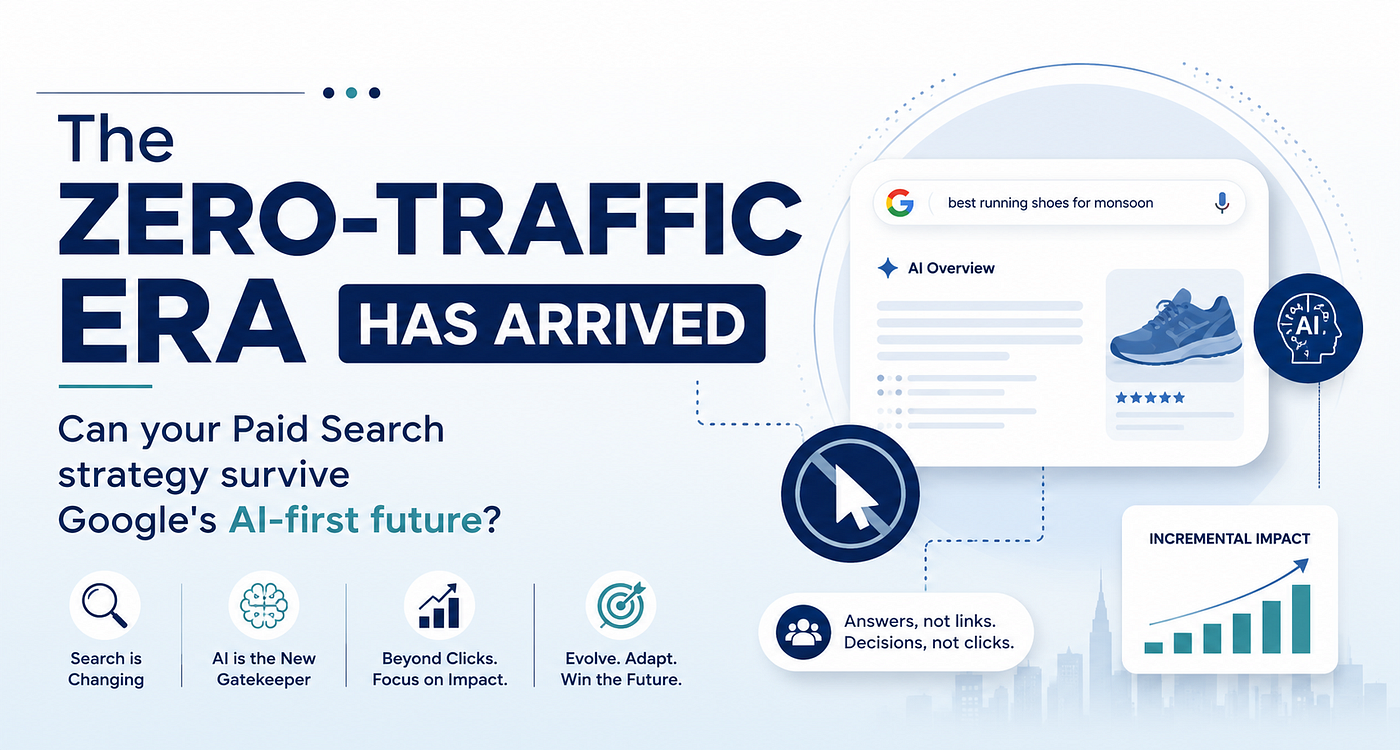
The integration of LLMs into consumer tech has created a phenomenon known as the “Zero-Traffic Era.” Users are aggressively relying on Google’s AI Overviews to answer complex queries directly on the search engine results page (SERP). The user gets the gist of your offering and decides without ever clicking through to your website.
To survive this, search professionals can no longer view Google in a silo. They must master the “push and pull” of the modern duopoly. Meta’s predictive algorithms manufacture demand before a user even searches (the push), and Google’s conversational AI captures it (the pull). The goal is no longer just “getting a click” — it is about bypassing the AI gatekeepers, achieving visibility inside AI answers, and converting users natively.
Creative Distinctiveness Over Targeting: As highlighted at Meta’s recent India summit, AI now handles all demographic targeting. Meta’s new retrieval engines actively penalise visually or psychologically redundant ads. Search marketers must adapt by feeding distinct, high-variance creative assets into the top-of-funnel ecosystem, letting Meta’s algorithms find the audience, which subsequently drives hyper-qualified branded search volume on Google.
Semantic Data Engineering: Relying on passive keyword intent is no longer sufficient. Brands are actively engineering their product catalogues with rich, conversational attributes. Instead of just listing “running shoes,” they are embedding semantic cues like “best breathable trainers for Mumbai monsoons,” ensuring Google’s Gemini can seamlessly pull their products into long-form, AI-generated answers.
Navigating the “Zero-Traffic” Scenario: The 2026 Ecosystem Updates
For marketers, a sudden drop in website traffic can induce panic. However, in an AI-curated landscape, a drop in traditional clicks does not necessarily mean a drop in conversions. To help marketing heads manage this new reality, major ecosystem players rolled out critical updates in mid-2026 to change how we measure success:
The “Incrementality” Shift: The industry is finally moving past last-click attribution. Major platforms are pushing for incrementality testing as the gold standard. Marketers can now isolate the true causal impact of their ads, proving mathematically whether an AI-driven campaign actually caused a sale that wouldn’t have happened organically.
Algorithmic Discovery vs. Conversational Intent: The ecosystem has permanently bifurcated. Meta dominates algorithmic discovery — analysing billions of signals to predict what consumers want before they know they want it. Google counters this by turning Search into a conversational commerce engine. Successful marketers are balancing predictive top-of-funnel demand generation with hyper-contextual bottom-of-funnel intent capture.
AI Summary Bypass Analytics: Platforms have introduced dedicated reporting for AI features. Marketers can now track how often their brand is cited in an AI Overview (Share of Model) versus traditional search real estate, shifting the performance focus from CTR to “AI visibility.”
Top 4 Paid Media Tools: Navigating the 2026 Landscape in India
To execute on these ecosystem shifts, relying solely on native publisher dashboards is no longer enough. The industry’s leading third-party tools underwent massive evolutions in 2026, pivoting from traditional bid management to “Autonomous Orchestration.” Here are the top four tools used by advanced search professionals, and their footprint in the Indian market:
Optmyzr (LLM Visibility Monitor): Founded by former Google pioneers, Optmyzr boasts a massive footprint in India, anchored by its dedicated engineering and support hub in Hyderabad. Highly popular among Indian performance agencies and mid-sized brands, its 2026 update introduced a dedicated suite to track a brand’s “Share of Model.” It analyses how often a brand is cited directly within Google’s AI Overviews and automatically suggests semantic tweaks to campaigns to improve inclusion rates within AI-generated answers.
Skai (Agentic Omnichannel Orchestrator): While Skai (formerly Kenshoo) operates from global hubs like Tel Aviv and London without a dedicated Indian headquarters, it remains the premium weapon of choice for top-tier Indian enterprise brands and major holding companies (like GroupM). Skai’s 2026 evolution focuses on bridging predictive demand and conversational intent. Its AI agents autonomously reallocate budgets intra-day across platforms, using synthetic control groups to measure which channel mix drives the highest incremental margin.
Channable (Semantic Feed Engine): Headquartered in the Netherlands, Channable is increasingly popular among Indian D2C and e-commerce brands pushing for cross-border expansion, competing fiercely with local Indian feed managers. Recognising that static feeds are ignored by modern AI, Channable’s 2026 update dynamically rewrites product titles and attributes in real-time. It matches the exact natural language phrasing consumers are using in their queries, ensuring products surface rapidly in conversational AI results.
Madgicx (Creative Variance AI): Highly popular among Indian boutique agencies, solopreneurs, and local DTC brands, Madgicx acts as an autonomous media buyer. To combat the algorithmic penalty for redundant ads, Madgicx rolled out its 2026 Creative Variance engine. It autonomously analyses a brand’s historical creative pipeline, identifies visual fatigue, and generates entirely new, high-variance creative angles designed specifically to manipulate algorithmic discovery before an Indian user even searches.
The Playbook for Indian Boardrooms in the “Zero-Traffic” Era
In India, we rarely have strategic discourse in boardrooms about the fundamental mechanics of Paid Search. It is often relegated to agency partners as a backend task of managing CPCs. But as the concept of “search leading to profitability” evolves, Marketing Heads must rewrite their playbook to safeguard margins.
Shift KPIs from “Clicks and ROAS” to “Incrementality and Margin”: Use third-party tools to track actual business value. Your website might get less traffic due to AI Overviews, but if the AI agent qualifies the lead in-SERP, the channel did its job. Pivot your dashboards to measure incremental revenue and profit margin rather than vanity click-through rates.
Focus on Data Infrastructure and API Connectivity: AI models don’t just match keywords; they synthesise contexts. You must build your brand’s internal data architecture seamlessly. This means your product catalogues, Merchant Center APIs, and offline conversion trackers must be pristine and interconnected. A robust, real-time data infrastructure is the new SEO and SEM combined.
Invest in Creative Variance, Not Just Volume: If an AI can auto-generate an ad in two seconds, standing out requires human insight. Your strategy must pivot to psychological distinctiveness. Stop A/B testing minor button colours. Test entirely different emotional hooks, creator perspectives, and value propositions to feed the AI engines the distinct signals they crave.
Rethink Search for Distribution Productivity (B2B2C Integration): For FMCG and offline brands, Paid Media is a distribution multiplier. By applying autonomous, geo-targeted campaigns precisely around your retailer network, you drive off-take directly. Brands must turn their digital ads into an engaged, high-velocity asset that drives physical footfall, measuring success through offline conversion imports rather than digital carts.
Bridge the Offline Data Void: The greatest hurdle for offline-heavy brands is the lack of first-party data flowing back to algorithmic bidding engines. To execute profitable paid media without direct retailer data, brands must capture first-party data through their own digital gateways (warranties, loyalty programmes, QR codes on packaging). Feeding this high-quality, zero-party data back into your bidding engines is the only way to train the algorithms on what your most valuable customer actually looks like.
The Zero-Traffic era is not the death of Paid Search; it is its maturation. The brands that stop chasing the cheap click, leverage the latest 2026 third-party agentic tools, and start optimising for genuine incrementality, unified data, and creative distinctiveness will be the ones that protect their margins and dominate the next decade of digital commerce.
Marketing #SEM #PPC #GoogleAds #MetaAds #ArtificialIntelligence #CMO #DigitalMarketing #IndiaMarketing #ZeroTrafficEra #Leadership #BusinessStrategy #PerformanceMarketing #AdTech
메타데이터
- post_id
- 97dbca1e1c1e
- slug
- the-death-of-the-click-in-googles-zero-traffic-era-can-your-paid-search-strategy-evolve-97dbca1e1c1e
- url
- https://medium.com/@deepaktolani/the-death-of-the-click-in-googles-zero-traffic-era-can-your-paid-search-strategy-evolve-97dbca1e1c1e
- canonical_url
- https://medium.com/@deepaktolani/the-death-of-the-click-in-googles-zero-traffic-era-can-your-paid-search-strategy-evolve-97dbca1e1c1e
- author_url
- https://medium.com/@deepaktolani
- status
- ok
- fetched_at
- 2026-08-12 18:09:30




