coinIX at EthCC 9: Interview with The Graph - The Google of Blockchains
The Graph is an indexing protocol for blockchain data, similar to what Google does for the internet. Therefore, it is also often referred…
coinIX at EthCC 9: Interview with The Graph - The Google of Blockchains
The Graph is an indexing protocol for blockchain data, similar to what Google does for the internet. Therefore, it is also often referred to as the Google of blockchains. The protocol creates important infrastructure for Web 3.0 and makes blockchains searchable.
Since its launch in 2018, tens of thousands of developers have built subgraphs for dapps across 70+ blockchains — including Ethereum, Arbitrum, Optimism, Base, Polygon, Celo, Fantom, Gnosis, and Avalanche.
The Graph is one of our success stories at coinIX. We invested 46k EUR in the Graph back in 2020 in the form of a SAFT or simple agreement for future tokens and it reached 1,5M EUR.
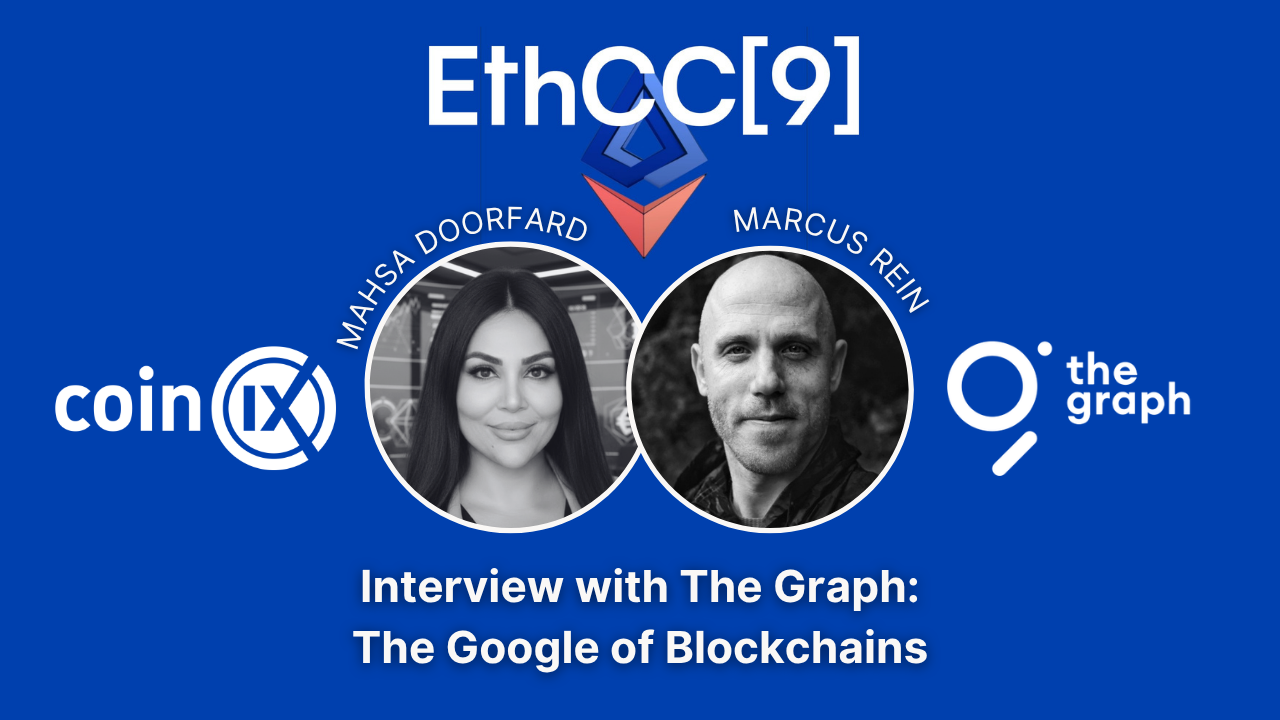
Mahsa Doorfard, the sales and marketing manager of coinIX interviewed Marcus Rein, Senior Developer Relations at Edge & Node — the team behind The Graph — during EthCC 9 in Cannes.
Mahsa: what’s your story? How did you end up in the blockchain industry?
Marcus: this goes back quite a few years. I started out scripting in Python in my free time — just something I did at home out of curiosity. At the time, I was actually working as a doctor of physical therapy. I practiced for about eight years and really enjoyed it, while continuing to build my technical skills on the side.
During the pandemic, I found an internship at a small startup, and that was my entry point into the tech world. From there, I just dove in headfirst.
What carried over from my previous career was my ability to connect with people — understanding their pain points and explaining complex topics in a way that makes sense, regardless of their level of expertise. Whether someone is very advanced in blockchain or completely new, that ability to communicate clearly has been critical.
Eventually, I moved into developer relations, and that’s where I am today. So yes, it’s been quite a journey — from healthcare into crypto — but I think that reflects the nature of this industry. We’re bringing people from traditional backgrounds into this new technological frontier, and it’s been a great experience so far.
Mahsa: If you had to explain The Graph to your grandmother — how would you describe it in simple terms?
Marcus: I would say that The Graph is responsible for collecting and organizing data so that websites can use it efficiently. Most of that data is financial data coming from blockchains.
So if I were speaking to my grandmother, I’d say: The Graph takes blockchain data and makes it accessible on the internet, so people can use it easily in applications they interact with every day.
Mahsa: We often describe The Graph as the “Google of blockchain”.
Mahsa: Are there other players in the market doing something similar? Do you have competitors?
Marcus: Yes, there are a few competitors, and honestly, that’s a healthy sign for the industry. Back during DeFi summer, we were really the ones powering a lot of that activity. Now, the presence of competitors validates that there’s real demand for this type of infrastructure. What’s important is that we’ve not only kept up — we’ve continued to push the market forward. Over the past eight years, we’ve introduced multiple products and continued evolving. That consistency — from early success during DeFi summer to ongoing innovation — is a strong signal of long-term relevance.
Mahsa: When was the initial idea for The Graph born?
Marcus: I wasn’t there at the very beginning — I joined later — but I know that Yaniv Tal was a key figure behind the original idea, along with others. Yaniv is a friend of mine, and even today he’s constantly full of big ideas. So shoutout to Yaniv — I really appreciate his vision and everything he’s contributed to the ecosystem, along with the early team from seven or eight years ago.
Mahsa: are you bearish or bullish for 2026?
Marcus: Honestly, neither. I see 2026 as a transition year. I don’t expect massive moonshots, but I also don’t expect major collapses.
Crypto is currently finding its footing at the intersection of DeFi and traditional finance. Because of that, we’ll likely see volatility — some spikes and dips — but overall, I expect a more stable, consolidating year.
I think 2027 and 2028 will give us better clarity. For now, it’s about observing how the market matures.
Mahsa: If you had €1 million to invest today, where would you allocate it?
Marcus: I’m very focused on the intersection of traditional finance and stablecoins. That’s where I see the industry consolidating.
We’re at a point where many ideas are being tested, but only those with real product-market fit will survive — and stablecoins clearly fall into that category.
I’d look closely at the stablecoin ecosystem and identify companies building strong infrastructure around it. For example, we’re working with a technology called AMP that supports compliance and data layers within that economy.
So if I had €1 million, I’d invest in the stablecoin space — especially at the intersection of technology, compliance, and traditional finance integration.
Mahsa: What sector do you think might disappear or lose relevance in the next two years?
Marcus: I think we’re already seeing signs of it. The multi-chain narrative and the L2 hype were huge just a couple of years ago.
But now, with Ethereum scalability improving significantly, it’s becoming harder to argue that L2s alone are the future.
We’re seeing some L1s carve out very specific niches, and ecosystems like Solana developing their own strong positioning. But many L2s struggle to differentiate themselves.
Simply offering cheaper scalability is no longer enough. Unless L2s clearly define their identity and value proposition, I don’t see them maintaining strong relevance five to ten years down the line.
That said, I’d be happy to be proven wrong — they do serve a purpose. But they need stronger differentiation.
Mahsa: What sector do you believe will be the next big thing?
Marcus: We already touched on stablecoins, but I’d go one level deeper: compliance and auditing.
Crypto has historically been a “wild west,” which has led to innovation — but also volatility, scams, and uncertainty. That’s made it difficult for traditional financial institutions to fully engage.
To build trust, we need more than just stablecoins — we need transparency, auditability, and clear data lineage. Banks need to know where data comes from, how it moves, and whether it meets regulatory standards.
So I believe compliance infrastructure within the stablecoin ecosystem will be critical for long-term adoption and for bridging crypto with traditional finance.
Mahsa: That’s a very important point. Regulation and having a global framework are key. Right now, we still have fragmented regulations — Europe and the US, for example, operate quite differently. Hopefully, we’ll see more alignment in the coming years.
Mahsa: Many people have lost confidence in crypto. What keeps you in this space? What motivates you?
Marcus: For me, it started with data sovereignty and identity — the idea that individuals should own their data and have control over it.
The challenge today is increasing consolidation, especially as traditional finance enters the space. So I’m trying to find that balance — where we can still preserve privacy, permissionless access, and user ownership while integrating with larger systems.
This is a transitional phase — not just for the industry, but for me personally as well. I’m shifting from developer relations more into business-focused roles, working on value propositions, partnerships, and feedback loops.
We always talked about onboarding billions of users. But the reality is — it’s hard. Even moving someone from one Web2 app to another is difficult. Now imagine asking them to learn wallets, bridging, slippage, and token mechanics — that’s a huge barrier.
So instead of expecting users to come to crypto, I think crypto is moving toward users.
What keeps me here is the belief that crypto still needs representation in that future — where billions of users interact with technology, even if they don’t realize it’s powered by blockchain.
Watch the interview on coinIX YouTube channel:
[embed]
About coinIX Capital GmbH
Since 2017, coinIX Capital GmbH, headquartered in Hamburg, has been at the forefront of analyzing blockchain projects and cryptocurrencies, facilitating investments in this dynamic sector. Comprising specialists with extensive experience in asset management, venture capital, and cutting-edge technology analysis, the coinIX team manages a portfolio boasting over 20 investments in blockchain startups alongside crypto assets. Shares of coinIX GmbH & Co. KGaA are listed on the free market of the Düsseldorf Stock Exchange and are also traded on the Berlin and Munich stock exchanges.
About coinIX COINVEST SCI1
Launched in June 2022, coinIX COINVEST SCI1 is an open domestic special AIF under the KAGB. As a sub-portfolio of coinIX COINVEST Investment Stock Corporation with variable capital, its assets are managed by coinIX Capital GmbH, acting as a registered capital management company. Available for subscription by professional or semi-professional investors, the fund has the flexibility to invest up to 100% of its capital in crypto assets, aiming for a diversified portfolio of digital assets actively managed through ongoing selection processes.
Additional income streams are generated through staking and other blockchain-native mechanisms. With the ISIN DE000A408Q55, subscriptions to the fund are only available directly through the investment company, with private investor acquisition prohibited.
메타데이터
- post_id
- 97ed0c2c01ca
- slug
- coinix-at-ethcc-9-interview-with-the-graph-the-google-of-blockchains-97ed0c2c01ca
- url
- https://medium.com/@coinix/coinix-at-ethcc-9-interview-with-the-graph-the-google-of-blockchains-97ed0c2c01ca
- canonical_url
- https://medium.com/@coinix/coinix-at-ethcc-9-interview-with-the-graph-the-google-of-blockchains-97ed0c2c01ca
- author_url
- https://medium.com/@coinix
- status
- ok
- fetched_at
- 2026-08-07 09:37:55