Multi-Granular Hypergraphs
Real-world data is rarely clean or neatly structured. In domains such as video surveillance, social networks, or bioinformatics, the…
Multi-Granular Hypergraphs
Real-world data is rarely clean or neatly structured. In domains such as video surveillance, social networks, or bioinformatics, the relationships between entities are often overlapping, uncertain, and dynamic. Traditional graph representations struggle to capture this complexity. Multi-granular hypergraphs offer a more flexible modeling framework by organizing data into granules — cohesive clusters of information — and encoding rich, possibly hierarchical relationships among them.
What Are Multi-Granular Hypergraphs?
A multi-granular hypergraph is a data structure designed to represent and process complex, heterogeneous, and evolving data. It stems from the paradigm of granular computing, which focuses on modeling information through granules — self-contained, meaningful groups of elements.
A granule might represent image patches in computer vision, word clusters in text mining, or people within a defined spatial zone in behavioral analysis. What makes this approach powerful is the ability to represent the same system at multiple abstraction levels: micro (fine details), meso (intermediate groupings), and macro (global patterns). This multi-resolution view is what gives multi-granular hypergraphs their unique expressive power.
Core Operations on Granules
Multi-granular hypergraphs allow data to be transformed dynamically through three fundamental operations:
- Aggregation: Combining similar or related granules into a larger unit, useful for abstracting information or reducing complexity.
- Dissociation: Breaking down a granule into its constituent parts, to explore finer details or resolve ambiguity.
- Association: Linking granules across different levels or contexts, which enables knowledge transfer and holistic analysis.
These operations make it possible to adapt the granularity of data processing based on the specific task, whether it be clustering, classification, or pattern recognition.
Visualizing and Structuring Multi-Granular Hypergraphs
Visually, a multi-granular hypergraph can be thought of as a generalization of a traditional graph. Granules are represented as nodes, and the edges — or more generally, hyperedges — express the relationships among them. Unlike simple graphs where an edge links only two nodes, a hyperedge can connect multiple nodes at once, allowing for richer, n-ary relationships.
Edges may also carry semantic meaning: for instance, they might represent containment, similarity, or causal dependence. These edges can be weighted to reflect the strength or significance of the relationships. This structure enables flexible, dynamic modeling of real-world data in a way that scales across complexity levels.
Application Example: Person Re-Identification in Videos
A compelling application of multi-granular hypergraphs is in video-based person re-identification, where the goal is to match people across multiple, possibly non-overlapping, camera views.
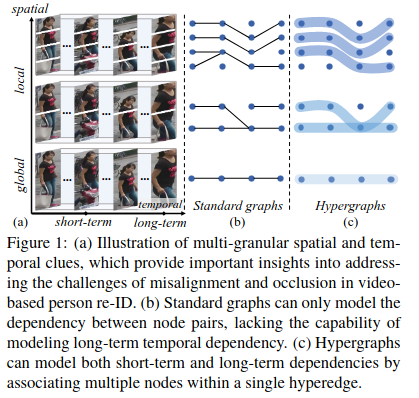
Example from the paper(Learning Multi-granular hypergraph for video Video-Based Person Re-Identification
In the paper “Learning Multi-Granular Hypergraph for Video-Based Person Re-Identification” by Zhao et al. (2021), the authors propose a method that models the relationships between short video clips of individuals using a multi-granular hypergraph. Each node represents a temporal segment of a video (a granule), and hyperedges model intra-person similarities across different granularities — such as short-term appearances or longer behavioral patterns.
This approach allows the system to capture both fine-grained variations (like subtle changes in clothing or pose) and coarse-grained semantics (such as consistent gait or body shape), resulting in improved accuracy for person re-identification in complex environments.
Final Thoughts
As datasets become more multi-modal, noisy, and temporally dynamic, the limitations of flat graph structures become more apparent. Multi-granular hypergraphs stand out as a promising direction for modeling such data — enabling flexible, hierarchical, and context-aware analysis.
Their applications extend beyond computer vision, with potential impact in areas such as natural language understanding, bioinformatics, knowledge representation, and recommender systems. As research progresses, we can expect these powerful structures to become a cornerstone in the design of intelligent, adaptive systems.
📄 Reference: Zhao, S., Wang, G., Guo, Y., Li, Z., Wang, M., & Zhang, Z. (2021). Learning Multi-Granular Hypergraph for Video-Based Person Re-Identification. In Proceedings of the IEEE/CVF International Conference on Computer Vision (ICCV), pp. 8231–8240.
메타데이터
- post_id
- 97fa6cb7045
- slug
- multi-granular-hypergraphs-97fa6cb7045
- url
- https://medium.com/@moncefboujou96/multi-granular-hypergraphs-97fa6cb7045
- canonical_url
- https://medium.com/@moncefboujou96/multi-granular-hypergraphs-97fa6cb7045
- author_url
- https://medium.com/@moncefboujou96
- status
- ok
- fetched_at
- 2026-08-30 02:42:56