Gulfstream G650 vs. Bombardier Global 7500: Which Charter Jet Fits Your Route?
A route-by-route comparison of range, cabin layout, and airport performance to help you choose the right ultra-long-range charter aircraft…
Gulfstream G650 vs. Bombardier Global 7500: Which Charter Jet Fits Your Route?
A route-by-route comparison of range, cabin layout, and airport performance to help you choose the right ultra-long-range charter aircraft — before you book.
If you’re chartering an ultra-long-range jet, you’ve probably already narrowed the field to two aircraft: the Gulfstream G650 (or its extended-range sibling, the G650ER) and the Bombardier Global 7500. Both are flagship-tier, purpose-built business jets. Both show up in the fleets of the world’s most established charter operators. And both are routinely marketed as “the best” — which isn’t a very useful answer when you’re trying to book an actual flight.
The right aircraft for you depends less on which jet is objectively superior and more on your specific route, party size, and how you plan to use the cabin in flight. Here’s how the two compare on the factors that actually affect a charter decision.
The short version
- Gulfstream G650 / G650ER: three-zone cabin, up to 7,000 nm range (7,500 nm for the G650ER), Mach 0.925 top speed, in service since 2012, with the largest operator fleet of any ultra-long-range jet in this class.
- Bombardier Global 7500: four-zone cabin including a dedicated crew rest area, up to 7,700 nm range, Mach 0.925 top speed, in service since 2018, and the largest cabin volume of any purpose-built business jet.
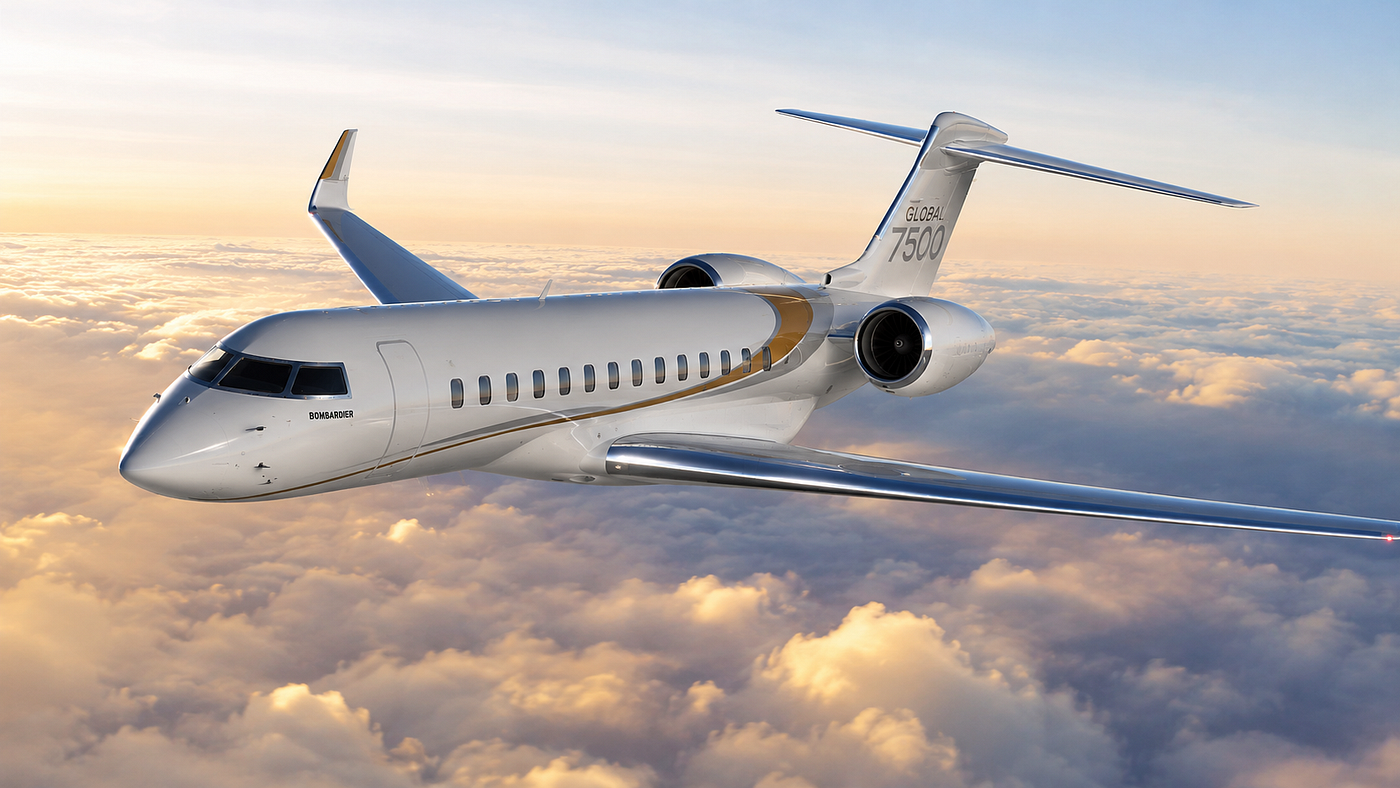
The Bombardier Global 7500: four cabin zones and the longest baseline range of the two. (AI Generated Image)
Neither aircraft is “faster” in a way that matters for trip planning — both cruise near the top of what’s aerodynamically practical for a business jet before wave drag and fuel burn make the extra speed uneconomical. The real differentiators are range margin, cabin configuration, and fleet availability on your specific route.
Range: does your route actually need 7,500 nautical miles?
This is the question most charter clients skip, and it’s the one that should come first.
The Global 7500 offers a baseline range of roughly 7,700 nautical miles under standard operating assumptions (eight passengers, four crew, NBAA IFR reserves, Mach 0.85 cruise). The standard G650 offers up to 7,000 nm under comparable conditions, while the extended-range G650ER pushes to approximately 7,500 nm. In practice, both aircraft have demonstrated non-stop city-pair flights well beyond their published baseline figures under favorable conditions — the G650ER has flown Singapore to Tucson (roughly 8,379 nm), and the Global 7500 has flown the same city pair and later a Sydney–Detroit routing of over 8,200 nm. These are demonstration flights, not standard operating guarantees, and actual mission range will always depend on payload, winds, and routing.
For most charter routes, this range gap is irrelevant. New York to London, Los Angeles to Tokyo, or Geneva to Dubai all fall comfortably within either aircraft’s capability with fuel reserves to spare. The distinction starts to matter on the outer edge of the ultra-long-range map — nonstop New York to Hong Kong or Singapore, Sydney to the U.S. West Coast, or any routing where headwinds could force a technical stop. If your itinerary sits in that category, the extra margin on the Global 7500 or G650ER is worth confirming with your operator before booking, rather than assuming either aircraft will make it comfortably.
Cabin layout: three zones vs. four
This is where the two aircraft diverge most meaningfully, and it’s often a better basis for choosing between them than range.
The G650 is built around a three-zone cabin — typically a forward seating/dining area, a mid-cabin conference or lounge section, and an aft area that can convert to sleeping berths for long-haul rest. It uses an oval fuselage cross-section, unusual among business jets, which Gulfstream designed to maximize usable cabin width relative to overall fuselage size. The cabin is well regarded for its 16 large windows and low cabin altitude, both of which reduce the physiological fatigue associated with long flights.
The Global 7500 was the first purpose-built business jet designed around a four-zone layout, and it remains the only aircraft in this class with a genuinely separate crew rest area in addition to the four passenger zones. Its cabin length is longer than the G650’s, and Bombardier’s configuration allows for a dedicated bedroom suite and, in some layouts, a stand-up shower — features that are difficult to replicate in the G650’s three-zone footprint.
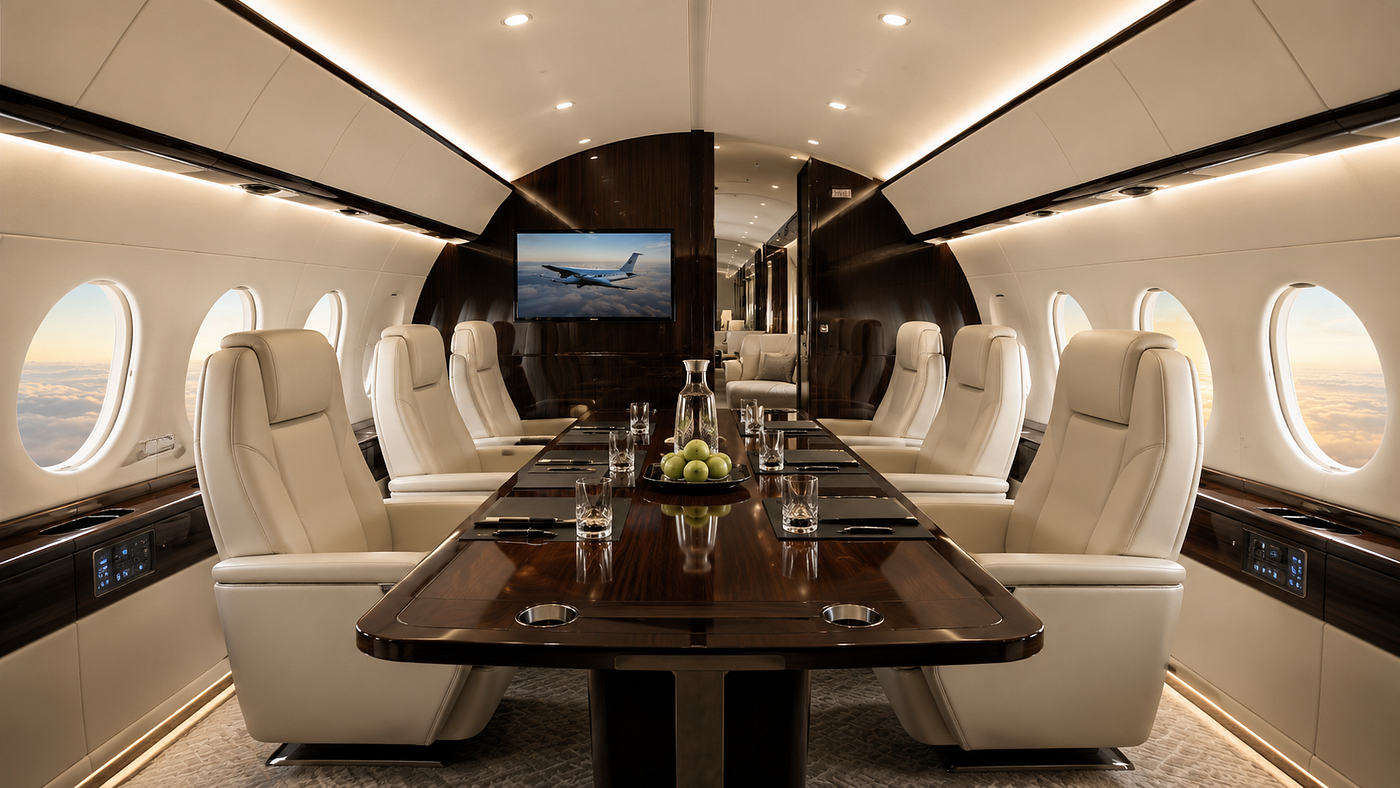
Cabin zoning — not raw speed — is often the more practical differentiator between these two aircraft. (AI Generated Image)
For a party of four to six traveling on a transatlantic day flight, either cabin will feel spacious and functional. For a larger group on a 14-plus-hour sector — where some passengers want to work, others want to sleep, and a formal dining or meeting space is also needed — the Global 7500’s fourth zone and separate crew suite tend to be the more practical fit. If privacy segmentation between work and rest is a priority for your trip, ask your charter broker specifically about zone configuration on the tail they’re proposing, since interior layouts vary by individual aircraft and operator.
Speed and airport performance
Both aircraft have a maximum operating speed of Mach 0.925, so neither offers a meaningful time advantage over the other on a like-for-like route — the marketing claims about “shaving hours” off a flight generally compare against slower aircraft classes, not against each other.
Where the two aircraft do differ is runway and airport access. The G650 requires a somewhat shorter takeoff distance than the G650ER under standard conditions, and both Gulfstream variants are FAA- and EASA-certified for steep-approach operations, which extends access to airports with restrictive approach geometry. The Global 7500’s high-lift wing design, with leading-edge slats and double-slotted flaps, is engineered to give it strong short- and steep-field performance despite its larger size, and operators frequently cite this as a reason it can access airports that its size would otherwise rule out. If your itinerary includes a challenging airport — high elevation, a short runway, or a steep approach — this is a detail worth confirming with your operator for the specific tail being offered, since published specifications represent standard conditions rather than guarantees for every airport.
What this means for choosing a charter aircraft
In practical terms, most charter decisions come down to three questions, in this order:
- Does your route require the extra range margin of the G650ER or Global 7500, or does the standard G650’s 7,000 nm cover it comfortably?
- Does your group need a fourth cabin zone and separate crew rest area, or does a three-zone layout suit the trip?
- Which aircraft is actually available, at the right price, for your departure window?
That third question is often the one that decides the booking in practice. Both aircraft are heavily utilized by fractional and charter operators, and availability on a specific date and route can matter more than a marginal specification difference. This is where working with an experienced charter broker becomes genuinely useful — not because one aircraft is secretly superior, but because a broker with a wide operator network can tell you, in real time, which of the two is actually available for your dates, and at what price, rather than leaving you to compare brochures in the abstract.
This is one of the areas where a broker like Villiers can save real time: rather than contacting individual operators to check G650 and Global 7500 availability separately, a broker with access to a large certified operator network can return comparable quotes across both aircraft types for the same route and date, so the decision is based on actual availability and pricing rather than specification sheets alone.
Common mistakes when choosing between these two aircraft
- Booking on range alone. Most routes don’t come close to testing either aircraft’s maximum range, so this shouldn’t be the deciding factor unless your trip is genuinely at the ultra-long-range edge.
- Assuming cabin configuration is fixed. Individual aircraft within each fleet vary in interior layout, seating capacity, and amenities. Always confirm the specific tail’s configuration rather than relying on the manufacturer’s standard brochure layout.
- Ignoring positioning costs. If the aircraft isn’t based near your departure airport, a repositioning (“deadhead”) leg may be added to the quote. This is standard practice, but it should be disclosed and itemized clearly before you book.
- Treating published specs as guarantees. Range, takeoff distance, and speed figures are calculated under specific standard conditions (payload, weather, reserves). Real-world performance on your particular route and load should be confirmed by the operator, not assumed from a spec sheet.
The bottom line
The Gulfstream G650 and Bombardier Global 7500 are both excellent aircraft, and for the majority of charter routes, the differences between them won’t be the deciding factor in your trip. The G650 offers a proven, three-zone layout with a strong operational track record and the largest fleet in its class. The Global 7500 offers a longer baseline range, a four-zone cabin with a dedicated crew suite, and the largest cabin volume of any purpose-built business jet currently flying.
Choose based on your actual route length, your group’s need for a fourth zone or separate rest area, and — just as importantly — which aircraft is genuinely available for your dates. A charter broker with a broad operator network, such as Villiers, can be a practical way to compare live availability and pricing across both aircraft types rather than choosing on paper alone.
Disclosure: This article contains affiliate links. If you choose to book through those links, I may receive a commission at no additional cost to you. Recommendations are based on relevance to the topic and are intended to help readers make informed decisions.
메타데이터
- post_id
- 980fbcb7011e
- slug
- gulfstream-g650-vs-bombardier-global-7500-charter-comparison-980fbcb7011e
- url
- https://medium.com/@profreelancer146/gulfstream-g650-vs-bombardier-global-7500-charter-comparison-980fbcb7011e
- canonical_url
- https://medium.com/@profreelancer146/gulfstream-g650-vs-bombardier-global-7500-charter-comparison-980fbcb7011e
- author_url
- https://medium.com/@profreelancer146
- status
- ok
- fetched_at
- 2026-07-21 01:00:30