Why Framer Is My New Creative Playground
How I built a playful pixel-art webpage using an AI agent, a little nostalgia, and plenty of imagination
Why Framer Is My New Creative Playground
How I built a playful pixel-art webpage using an AI agent, a little nostalgia, and plenty of imagination
For years, my work in design has moved between branding, graphic design, motion, websites, and user experience. Every tool gives me a different way to create, but only a few make me feel like I am genuinely playing.
Framer has become one of those tools.
Recently, I created a small personal webpage inspired by the visual language of classic platform games. It has pixel-art typography, question blocks, pipes, clouds, a game-style interface, and even a pixelated version of me as “Player 1.”
It is not a large website. It does not solve a complicated business problem. It was simply an idea that made me smile and Framer gave me a place to bring it to life.
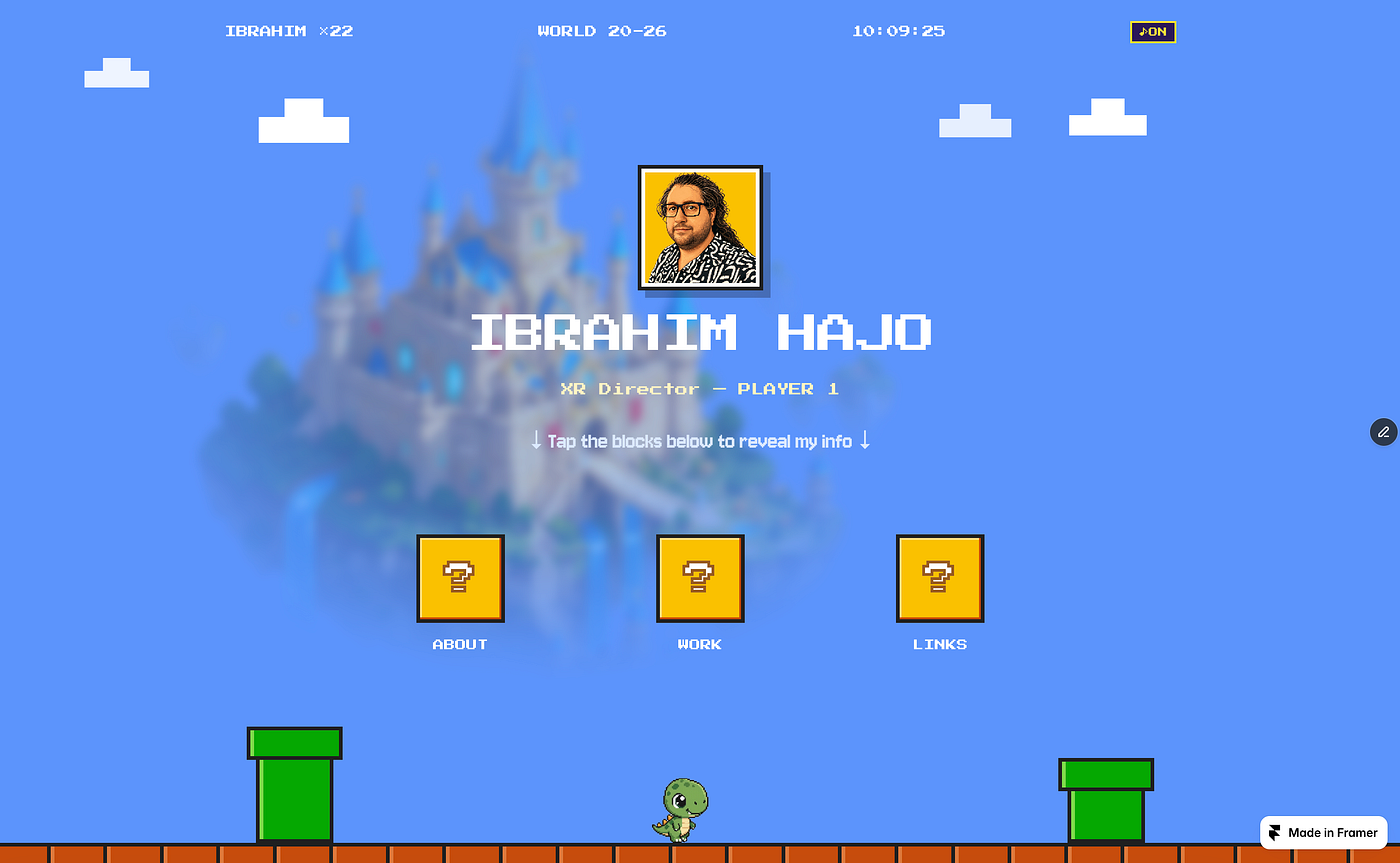
My pixel-art Framer experiment: part portfolio, part game screen, and completely personal.
It started with a simple idea
I wanted to create a personal webpage that did not feel like another traditional portfolio.
Most portfolio websites follow a familiar structure: a large introduction, a profile photo, selected projects, a list of services, and a contact form. There is nothing wrong with that structure, but I wanted to explore something with more personality.
So I imagined my portfolio as the opening screen of an old video game.
Instead of ordinary navigation cards, visitors would discover About, Work, Links, and Contact through question blocks. The interface would introduce me as “Creative Developer — Player 1,” while the entire page would feel like a small world waiting to be explored.
The idea was simple, nostalgic, and slightly ridiculous.
From designing pages to building experiences
What I enjoy about Framer is that it allows me to move quickly between visual thinking and interaction.
I can begin with composition, typography, colour, spacing, and hierarchy — the familiar language of graphic design — and then immediately think about what happens when someone moves, taps, clicks, or scrolls.
A static layout can quickly become an experience.
The question blocks are not only decorative elements. They invite interaction. The labels suggest exploration. The small instructions, game statistics, and footer messages help support the illusion that the visitor has entered a playable world rather than opened a conventional portfolio.
This is where Framer becomes more than a website builder for me. It becomes a creative playground.
I am not simply arranging sections on a page. I am experimenting with atmosphere, behaviour, storytelling, and personality.
The agent became part of the creative process
I also used an AI agent while developing the page.
The agent helped me turn ideas into working components, test interactions, solve small technical problems, and explore possibilities more quickly. I could describe what I imagined, see a version of it, react to the result, and continue refining it.
But the agent did not replace the creative process.
It needed direction.
It did not decide that my portfolio should look like a game. It did not choose the nostalgic mood, determine how the interface should feel, or understand which details made the experience feel like me.
Those decisions still came from imagination, taste, experimentation, and many small corrections.
I see the agent less as an automatic website creator and more as a creative collaborator — one that can help remove the distance between an idea and a working prototype.
The better I could describe the feeling I wanted, the more useful the agent became.
AI makes imagination more valuable, not less
There is a growing assumption that AI will make creative skills less important because anyone can generate a design or produce code.
My experience has been almost the opposite.
When production becomes faster, the idea matters even more.
If everyone has access to similar tools, the difference will not come from who can generate the most content. It will come from who can imagine something interesting, recognise what feels wrong, and continue refining it until it has character.
AI can help create a question block.
Imagination decides why the question block should exist, what happens when someone presses it, and how it contributes to the story of the page.
The tool can produce possibilities. The designer still gives those possibilities meaning.
A playground encourages experimentation
Professional design work usually begins with requirements, deadlines, approvals, brand guidelines, and practical limitations. Personal experiments allow something different.
They allow us to ask:
What if my portfolio behaved like a game?
What if navigation felt like discovery?
What if my profile picture were turned into pixel art?
What if the footer thanked visitors for playing instead of simply displaying a copyright notice?
Not every experiment needs to become a product. Sometimes its value is in what it teaches us.
This little page helped me think differently about interaction, visual storytelling, AI-assisted development, and the space between design and code. It also reminded me that creativity grows when we give ourselves permission to make things simply because they are fun.
A new way of creating.
A new way of learning.
And, most importantly, a new place to play.
Game on.
메타데이터
- post_id
- 982116fa82ec
- slug
- why-framer-is-my-new-creative-playground-982116fa82ec
- url
- https://medium.com/@ihaj0/why-framer-is-my-new-creative-playground-982116fa82ec
- canonical_url
- https://medium.com/@ihaj0/why-framer-is-my-new-creative-playground-982116fa82ec
- author_url
- https://medium.com/@ihaj0
- status
- ok
- fetched_at
- 2026-08-06 13:46:50



