When You Make the Two One…
Inside and Outside: The Stubborn Illusion of Our Reality
When You Make the Two One…
Inside and Outside: The Stubborn Illusion of Our Reality
Every human reaction is born at a boundary. This boundary runs between inside and outside: along the tension between outer experience and inner perception.
If you’re not a Medium member, you can read the full essay through this friend link.
We tend to believe that the more rigid this boundary becomes, the more capable we are of asserting ourselves. As if we could only be someone if we could draw a precise line around where we end and where the world begins. And yet the opposite happens: the more firmly we draw this line, the further we move from who we truly are. Rigid boundaries make it easier to defend, possess, explain, and identify. But once a door opens along this boundary, we begin to realize that the line between inside and outside is not a wall of separation, but a meeting point.
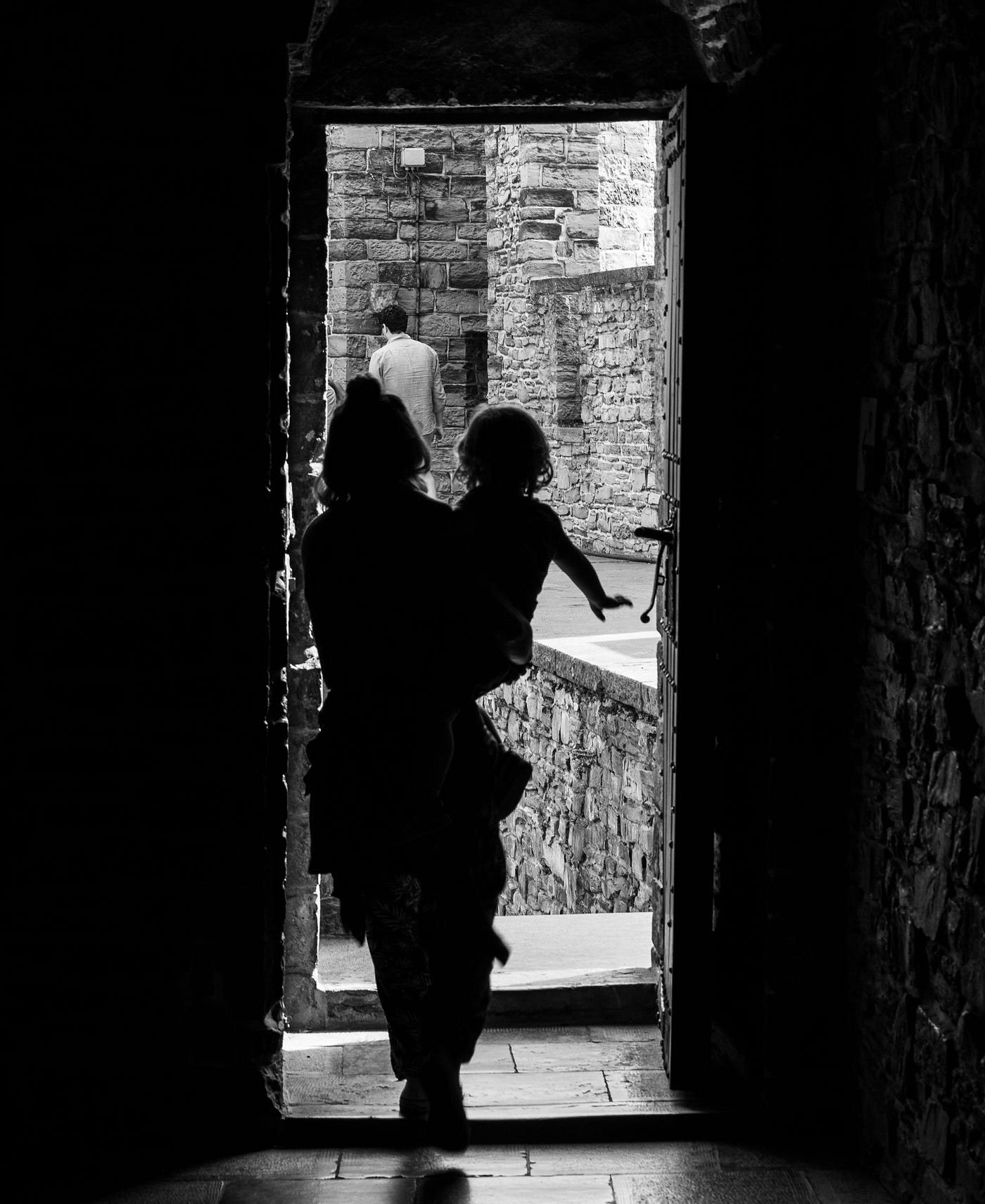
Photo by Rohan Rangaswami on Unsplash
One of the great unresolved tensions in Western philosophy is the divide between inside and outside, subjective and objective, mind and body, consciousness and world. Modern thought has often tried to resolve this tension by making one side primary. Either the external, material world is treated as the foundation from which inner experience can be derived, or inner experience is treated as the space in which the world appears. Classical dualism, meanwhile, claims that mind and body are two fundamentally different kinds of reality.
Whenever I return to the tension between inside and outside, between the objective world and subjective experience, I have the feeling that we are applying the wrong kind of logic from the very beginning. The kind of logic we have grown used to through our knowledge of the physical world: we arrange everything into concepts, force things into boundaries, and try to pull them into systems of cause and effect.
And then I remember a strange apocryphal saying attributed to Jesus. I am thinking of Logion 22 of the Gospel of Thomas, which reads as follows:
Jesus saw some little ones nursing. He said to his disciples: “These nursing infants are like those who enter the kingdom.” They said to him: “Then shall we enter the kingdom by becoming little ones?”
Jesus said to them: “When you make the two one, and when you make the inside like the outside, and the outside like the inside, and the above like the below, and when you make the male and the female one and the same, so that the male is not male and the female is not female; and when you make eyes in place of an eye, a hand in place of a hand, a foot in place of a foot, an image in place of an image: then you will enter [the kingdom].”
(Gospel of Thomas, Logion 22; English rendering after Bentley Layton, The Gnostic Scriptures.)
The complete Coptic version of the Gospel of Thomas is preserved in Nag Hammadi Codex II, Tractate 2, usually dated to the fourth or fourth/fifth century. Earlier Greek fragments from Oxyrhynchus — especially P.Oxy. 1, 654, and 655 — show that the text also circulated in Greek before the surviving Coptic manuscript, while the date of the composition itself remains debated.
Change the Way You See
Within the Gospel itself, Logion 22 feels like an especially dense, almost initiatory text. It uses images that do not stop at moral explanation or religious symbolism. The image of the nursing infants, the making of the two into one, the inside and the outside, the above and the below, the male and the female, the image and the bodily members — all these motifs are layered upon one another.
One recognizable feature of many sayings attributed to Jesus is that they do not simply tell us what to see. They show us how to see. In today’s language, it is almost as if they offered a method of inner perception, one through which the workings of reality might disclose themselves differently.
The text does not close something down; it opens something up. It unsettles our familiar way of seeing reality: the very logic that is also at work in the tension between inside and outside. Behind these images, there is a palpable metaphysical stake. It is as if the text were asking: is reality truly structured according to the logic we have grown used to?
It leads us to an experiential threshold where our familiar dualities — inside and outside, self and world, body and image, male and female, above and below — begin to lose the solidity we once took for granted. Because perhaps the boundary between inside and outside is not the final structure of reality, but the stubborn interpretation the human mind has made of it.
Trample Your Garments, and See Like Infants
The motifs of Logion 22 are not entirely without parallels. Among others, 2 Clement 12 is often mentioned, where we also find the idea of “when the two shall be one” and the “outside as the inside.” A similar motif appears in Book III of Clement of Alexandria’s Stromata, where Clement quotes a saying attributed to Jesus in connection with Salome. According to this passage, when Salome asked when the things she was asking about would become known, the Lord answered:
“When ye have trampled on the garment of shame, and when the two become one and the male with the female is neither male nor female.”
(Gospel of the Egyptians, cited by Clement of Alexandria, Stromata III.13.92.)
Clement explicitly notes that this saying is not found in the four handed-down Gospels, but in the Gospel of the Egyptians.
Here, the motif of “making the two one” is joined by the image of removing or trampling upon the garments of shame — a motif that, interestingly, also returns in Logion 37 of the Gospel of Thomas. There, the disciples ask Jesus when he will become visible to them, and he answers that when they undress without shame, take their garments, place them under their feet like little children, and trample upon them, then they will see the Son of the Living One, and they will not be afraid.
Through the motif of shame connected to bodily nakedness, the text opens a deeper layer of meaning. Our attachment to garments can be compared to the way we cling to the roles that have been placed upon us, to the images we have formed of ourselves, and to social and gendered patterns of identity. It is especially interesting that the motif of children also appears in Thomas 37.
Jesus compares the way we should approach the perception of reality to a childlike way of seeing. An infant does not yet have a fully formed social identity, role, or self-image fixed by names and boundaries. The image of the infant may therefore point toward a pre-dual state of experience: one in which inside and outside, self and other, body and world have not yet been separated by rigid conceptual boundaries.
Be There at the Meeting Point
There is a distinctly relational way of reading Thomas 22. In its simple imagery, the text suggests that what we experience as outside and inside are not two separate realms of reality, but they are not simply the same thing either. Rather, they are two sides of a relation. There is no indication that one is merely the mirror image of the other. The Jesus of this logion simply says: they must be made one. This making-one can be understood as finding the state in which outside and inside are joined. The difference between them does not disappear; what disappears is their separation.
The outside and the inside meet at one point: in the one who perceives. And we have a capacity of perception that can reveal this meeting to us: when we are present at this meeting point.
The text also places strong emphasis on the duality of male and female. Perhaps because this is one of the most deeply experienced human differences, part of our sense of self.
When the text says that the male and the female should become “one and the same,” so that the male is not male and the female is not female, this must have sounded radical in its own time. But this does not mean the abolition of sexuality or gender roles. It is more as if the text were saying: go to the place where male and female are still one and the same. Go before the forms of gendered identity, to the place where difference is not yet a final self-definition, and where the experience of the “I Am” is primary.
The “I Am” is present before every form. Presence precedes every duality: it is the state in which dualities can appear at all. In presence, nothing else happens than this: we are confronted with our own existence, with the phenomenological minimum of “I am.” And there, at that point, the rigid boundary of outside and inside, of separation itself, begins to dissolve within us.
The Thomasine texts, of course, do not speak of presence in the language of contemporary awareness. Jesus does not say, “be present,” or “become aware of the state of presence.” And yet, through simple images, he seems to lead us precisely toward such an experience: toward the recognition of the basic state of life.
Open the Door and Stand on the Threshold…
An image comes to mind for this state: as if a person opened a door between inside and outside, and stood on the threshold.
When she looks inward, she sees herself: her personality, her mental world, her memories, her feelings. When she looks outward, she sees the world around her: bodies, objects, events, relationships. But in all this looking, we most often forget the one who is standing on the threshold. We forget the one in the doorway, the one who is the meeting point of these two directions.
It is as if the rigid structure of inside and outside arises precisely because we do not perceive the threshold on which we stand, because we do not recognize our own presence. We tip now toward the outside, now toward the inside, and in doing so we make ourselves dependent on one direction or the other. The door becomes a boundary line for us, not a meeting point.
But if we stand still on the threshold, everything begins to fall into place. As the text itself continues: hand in place of hand, foot in place of foot, eye in place of eye, image in place of image.
In presence, things become what they are: they return to their proper place. Forms, whether material or mental, do not disappear, nor do they become meaningless. They simply cease to rule over our perception.
When duality, when separation, determines us, forms become identity. The body becomes “me.” A thought becomes “truth.” A role becomes “selfhood.” An image becomes “reality.” We become dependent on them. But on the threshold, in the state of presence, these things return to their place:
The body remains body. A thought remains thought. An image remains image. A role remains role.
And none of them takes the place of the one who perceives. The place of the one who stands in the doorway.
…and Enter the Kingdom
What does Jesus mean by the kingdom one can enter? I suspect it is not a place where we receive a moral reward, nor a state in which we gain worldly influence.
The kingdom is a metaphor for the state of recognized presence: the state in which the separation between inside and outside ceases for us. Presence works as a meeting point. In this state, we stand on neither side: neither outside nor inside. We stand precisely on the threshold, where outer and inner experience enter into constant relation with one another. In recognized presence, the “I Am” sees itself as the connecting relation.
And this is the key for us: the threshold itself is the “kingdom.” Or, as Logion 37 of Thomas puts it so strikingly, there “the Son of the Living One” becomes visible. In this reading, this is an archaic formulation of the “I Am.”
Let us dig deeper, down to the ontological level, and within that, toward a relational interpretation.
According to this reading, the “I Am” is a unique orientation that stands in a constitutive relation to everything it experiences as an inner and outer world. A constitutive relation is a relation whose very existence gives rise to our two-directional experience. It does not connect two separate realities after the fact, nor does it derive one from the other. It is not the external, objective world that comes first, from which the inner can be derived; nor is it the inner world from which the outer follows. What comes first is the relation that constitutes them both: the connection in which the two directions can become distinct without ever truly becoming severed from one another.
The one who recognizes that they are standing on the threshold begins to see. They can perceive the relational states behind forms from the very meeting point from which those forms arise. And in this perception grounded in presence, forms no longer direct our existence. We no longer become dependent on either the outer or the inner side.
This kingdom gives us the power of presence: we become freer to shape our relations. We regain sovereignty over our own relations.
Conclusion
The relational-phenomenological reading presented above is supported by the motif of “making the two one.” As much as we might wish it did, Logion 22 of Thomas does not take a position on the philosophical dilemma of whether the outer — material, objective — or the inner — subjective, experiential — is more primary than the other.
Perhaps because it suggests something else.
Instead, it highlights a relational movement: make them one. And this can happen by letting go of the rigid images we have formed of them, and of the expectations we attach to them.
This can take place in the state of recognized presence, which allows us to enter the kingdom. The boundary thus becomes a threshold. Separation becomes meeting. Dependence becomes strength. And lack becomes possibility.
If you are interested in the relational-ontological background of this essay, you may also like:
메타데이터
- post_id
- 9837d01576ab
- slug
- when-you-make-the-two-one-9837d01576ab
- url
- https://medium.com/@kiss.melinda/when-you-make-the-two-one-9837d01576ab
- canonical_url
- https://medium.com/@kiss.melinda/when-you-make-the-two-one-9837d01576ab
- author_url
- https://medium.com/@kiss.melinda
- status
- ok
- fetched_at
- 2026-07-08 15:11:24