Qwen3.7-Max Review: When an AI Model Finally Develops Good Taste
On May 20, barely a month after its previous release, Alibaba Qwen dropped its next-generation flagship Qwen3.7-Max. Positioned as a…
Qwen3.7-Max Review: When an AI Model Finally Develops Good Taste
On May 20, barely a month after its previous release, Alibaba Qwen dropped its next-generation flagship Qwen3.7-Max. Positioned as a universal agent foundation model, it aims to finally strip away the “chat tool” label from traditional large language models.
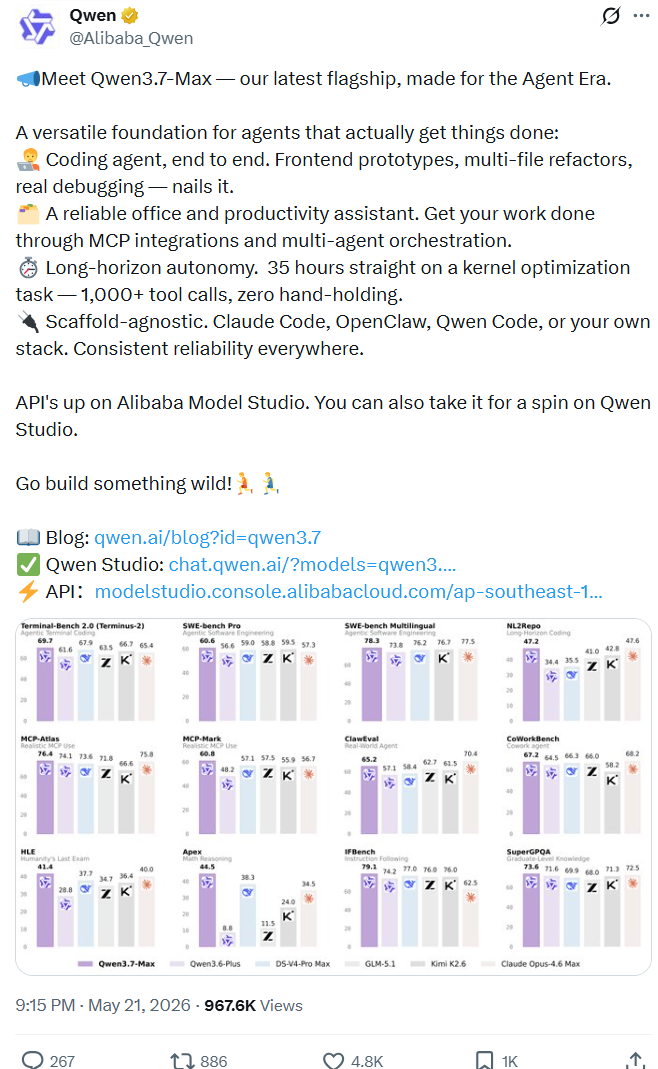
With a rock-solid base architecture supporting million-token context windows, Qwen3.7-Max delivers significant leaps in complex logical reasoning, mathematical capability, and multilingual understanding across both Chinese and English.
Based on official documentation, here are the headline upgrades:
1. A True “Coding Agent” — No More Toothpaste-Squeezing The previous Qwen3.6 coding model set records for daily API calls and token consumption within developer circles. Qwen3.7-Max pushes this further: it functions as a frontier programming agent capable of understanding entire project structures and writing, debugging, and shipping complete codebases.
2. Long-Cycle Autonomous Execution — Real Office Automation This is the upgrade working professionals have been waiting for. Qwen3.7-Max supports autonomous planning and execution lasting several hours, performing thousands of tool calls and dozens of version iterations to continuously improve deliverable quality. You don’t need to hand-hold it step-by-step; throw a goal at it, and it will deconstruct the task, invoke tools, and quietly close the business loop on its own.
3. Cross-Framework Generalization — A Universal Foundation Whether you deploy on Claude Code, the viral OpenClaw assistant, or toolchains like Qwen Code and Hermes Agent, Qwen3.7-Max plugs in seamlessly. No complex prompt tuning for specific frameworks required.
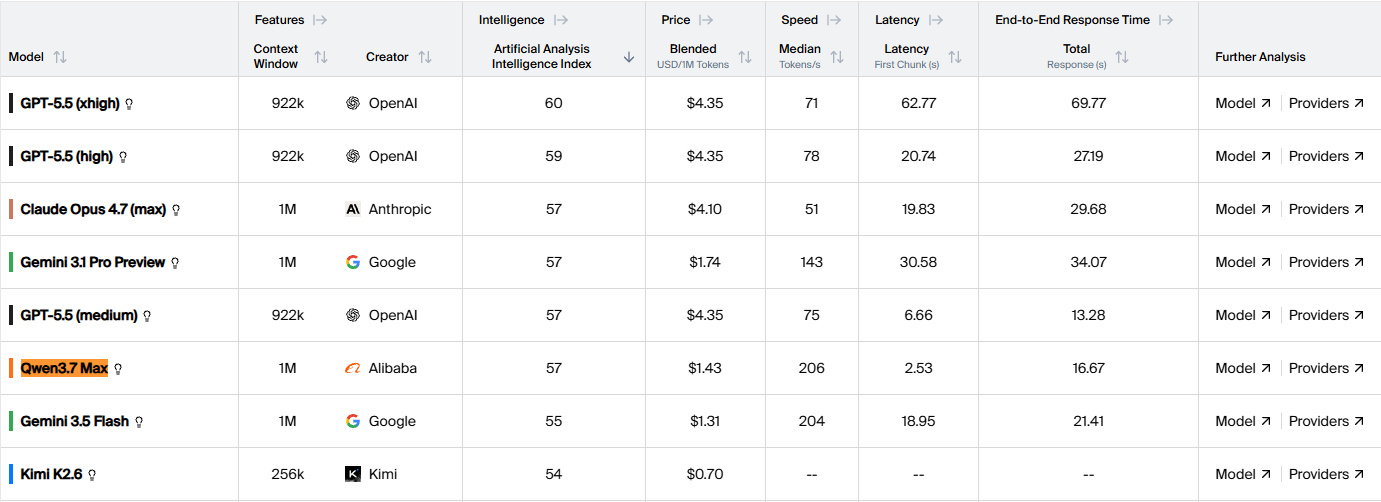
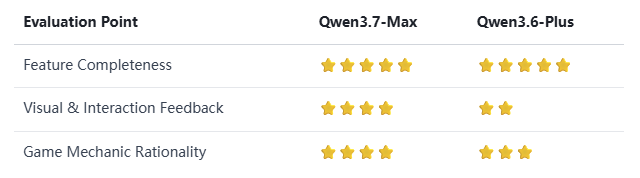
Currently, Qwen3.7-Max ranks #6 on the Artificial Analysis leaderboard.
In this review, 302.AI Benchmark Lab puts this new “Max-tier digital employee” through real-world productivity scenarios to see what it can actually do.
I. Evaluation Setup
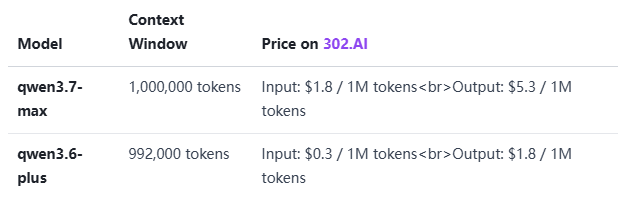
Pricing on 302.AI
Evaluation Goals
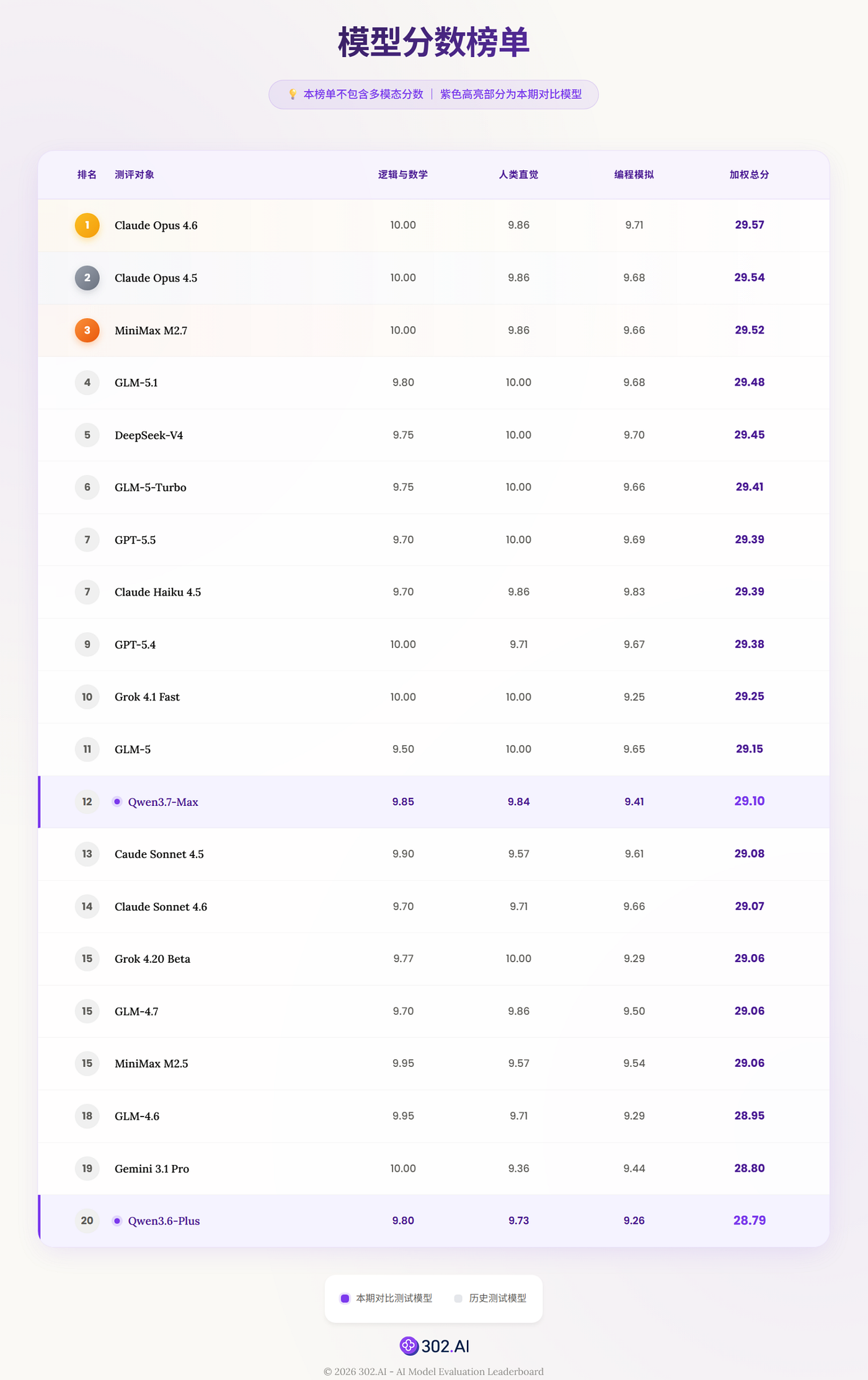
This review focuses on logic, mathematics, programming, multimodal reasoning, and human-intuition tasks. It is not an authoritative frontier benchmark, but an empirical assessment of model evolution trends.
Methodology
We used the 302.AI internal benchmark dataset across three categories:
- Logic & Mathematics: 10 questions
- Human Intuition: 7 questions
- Programming Simulations: 12 questions
All models were tested in the 302.AI Studio client with unified prompts, taking only the first generated result. Programming tests ran in Vibe Mode using the Claude Code sandbox.
II. Results Overview
III. Case Studies
Case 1: Complex Logical Reasoning
🔍 Qwen3.7-Max differs significantly from Qwen3.6-Plus in reasoning style and output structure.
- Qwen3.7-Max leans toward constructive proofs, emphasizing the dynamic reasoning process. Its outputs feel almost educational.
- Qwen3.6-Plus tends toward template-driven derivation, immediately pattern-matching against classic problem types rather than reasoning through physical mechanisms step-by-step.
Prompt: One hundred fish swim in a stream at different speeds. If one fish catches another, it eats the prey and continues swimming. How many fish are expected to survive?
Qwen3.7-Max: ✅ Correct.
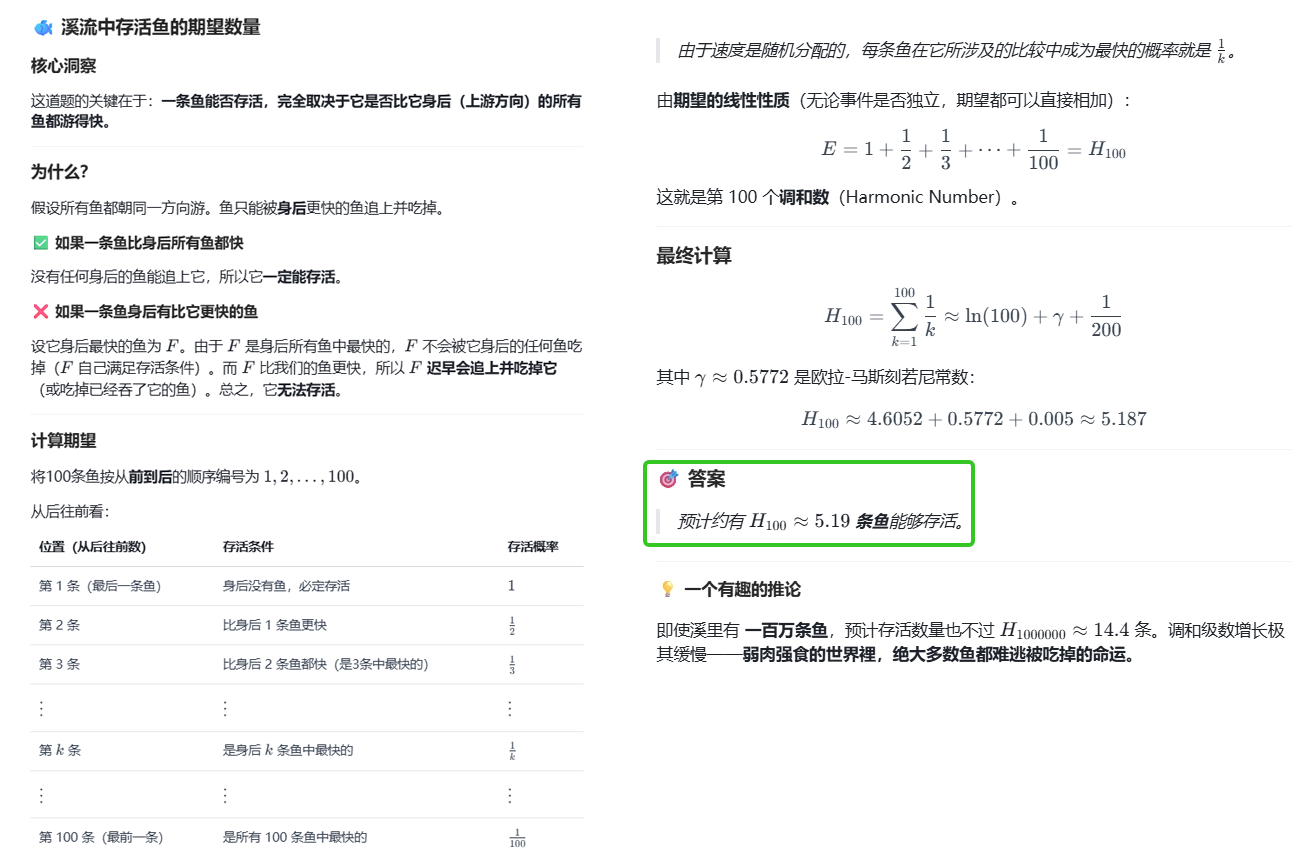
Qwen3.6-Plus: ✅ Correct.
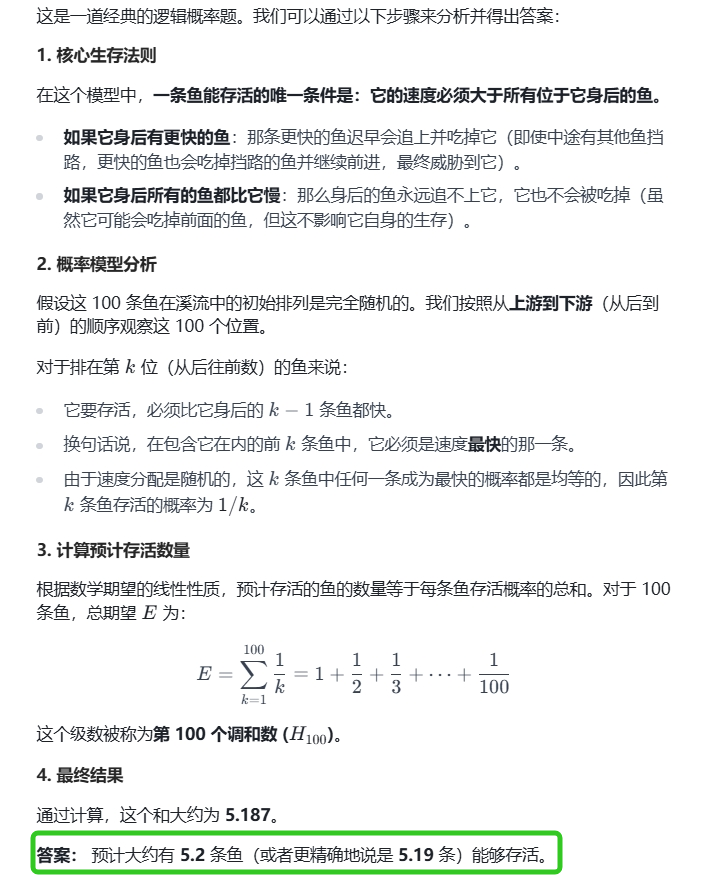
Both models reached the correct answer, but via noticeably different cognitive paths.
Case 2: Procedural SVG Generation
Prompt: Draw an animated SVG of a pelican riding a bicycle.
Qwen3.7-Max: Superior dynamic physics compared to Qwen3.6, though slightly less stylistic richness in background details.

Qwen 3.7

Qwen 3.6
Prompt: Draw an animated SVG of a dolphin leaping out of the ocean.
Qwen3.7-Max: The scene aligns better with the prompt, but the physics are imperfect — the splashing water appears stiff, and the dolphin jumping backward defies physical reality.

Qwen3.6-Plus: Too abstract. The core failure: it rendered “dolphin leaping from the sea” as simple vertical bobbing, which does not match real-world behavior.

Case 3: Three.js 3D Mini-Game
Prompt: Create a single-file HTML + JavaScript Three.js 3D “Black Hole Devours the City” mini-game.
Requirements:
Visual Style: Bright, casual cartoon low-poly aesthetic. Blue sky, white clouds, procedurally generated city grid (grass + roads).
Player: Cartoon-style black hole.
Edible Objects: 9 urban elements (streetlights, cars, trees, bungalows, high-rises, landmarks) built from basic geometric primitives.
Growth Mechanics: All object sizes exist from the start; after consuming objects, the black hole smoothly grows, unlocking larger targets.
Physics: Objects adsorb, spin, and vibrate when near; colliding with objects far larger than yourself bounces the black hole away.
Camera & Controls: Mouse/touch movement, dynamic camera follow with height adapting to black hole size; screen shake on large collisions.
Systems: Scoring, growth progress bar, 90-second timer, and end screen. Optimize with shared geometries and materials. No external dependencies.
Qwen3.7-Max Output:
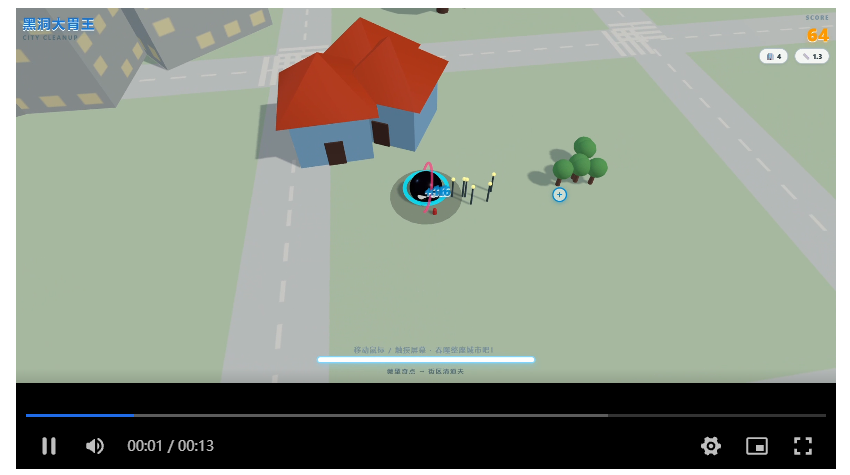
✅ Strengths:
- More detailed visual style and graphical elements; strong animation rhythm
- Black hole volume elasticity implemented; superior swallowing animation and score feedback
- More nuanced physics interactions for adsorption and bouncing
❌ Weaknesses:
- Camera follow implemented, but height adaptation to black hole size is insufficient. When the black hole grows too large for the screen, the camera fails to pull back in time.
Qwen3.6-Plus Output:
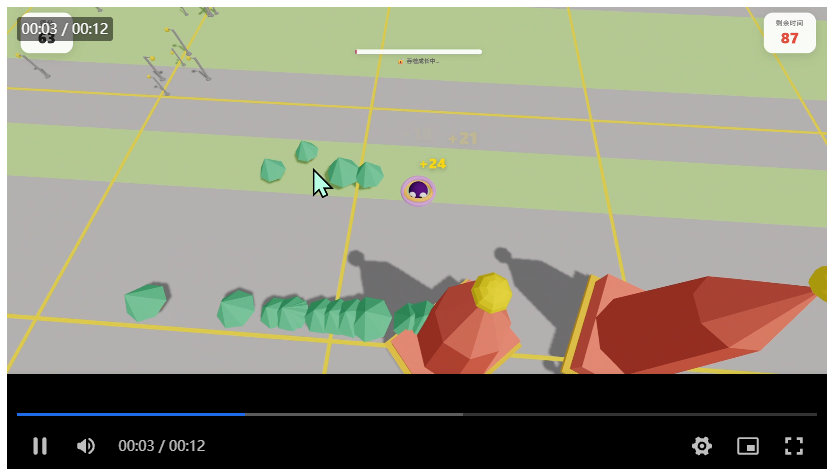
- Also achieved complete functionality, but visual details and texture quality are slightly inferior to 3.7
- Black hole growth variable control is poorly tuned, causing expansion that is too rapid and eventually fills the entire screen.
Case 4: Brand Hero Page
Prompt: Act as a world-class creative frontend developer and digital product designer.
Create a cinematic, highly immersive travel landing page in a SINGLE HTML file using Tailwind CSS via CDN and Vanilla JavaScript only.
The experience should feel like a modern premium product launch — emotionally engaging, visually atmospheric, and interaction-driven rather than template-like.
CORE GOAL: Design a hero experience that feels alive, premium, and memorable. The page should immediately create a sense of exploration, movement, and anticipation.
TECH CONSTRAINTS:
Single
index.htmlonly
Tailwind CSS via CDN
Vanilla JavaScript only
Fully responsive
Smooth performance on both desktop and mobile
BACKGROUND: Use this exact background video: [URL] The video should feel deeply integrated into the experience rather than simply placed behind content.
VISUAL DIRECTION:
Cinematic and atmospheric
Elegant typography
Strong visual hierarchy
Premium motion design
Modern glassmorphism / soft lighting / subtle depth effects are encouraged
Avoid generic startup aesthetics
The experience should feel intentional and art-directed
CONTENT: Brand: Trav Main heading: “Begin Your Next Big Adventure” Supporting text: “Discover hidden gems, plan unforgettable trips, and explore the world — all in one seamless app.” CTA: “Download Now”
INTERACTION & MOTION: The page should include layered entrance animations and refined motion design that feel smooth, premium, and choreographed.
Encourage:
staggered text reveals
cinematic timing
depth-based motion
immersive transitions
tactile hover states
subtle environmental movement
elegant mobile menu interactions
Avoid:
robotic animations
overly generic fade-ins
basic template motion
The final result should feel close to an Awwwards-quality product landing page rather than a standard SaaS hero section.
Qwen3.7-Max Output:

✅ Strengths:
- More mature control of typography, layout, and color. Introduced an amber accent color that improves reading order; parallax effects are more pronounced.
- Cards feature scroll-triggered interactions and dynamic tilt effects; entrance animations are smooth.
❌ Weaknesses:
- Heavy animation and DOM operations may stress low-end devices. Video parallax is performance-intensive.
Qwen3.6-Plus Output:
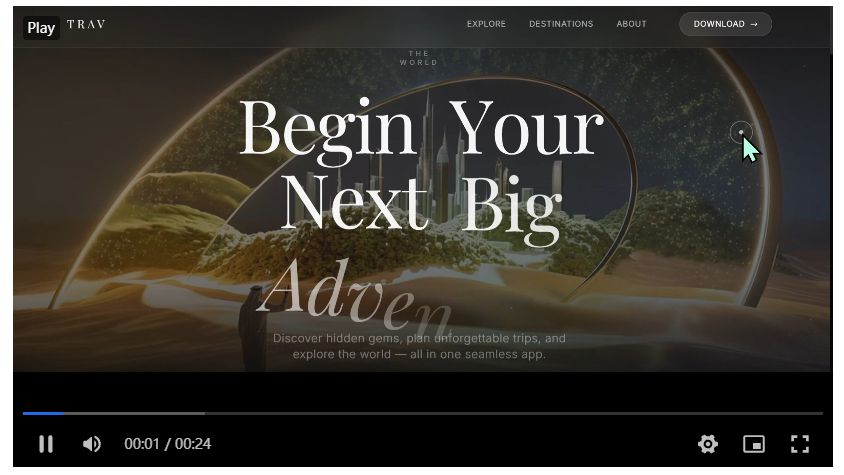
- Cleaner code structure. Rather than chasing visual spectacle, it prioritizes functional completeness, robust interaction, and readable code.
Case 5: Frontend App Simulation
Prompt: Act as a senior product designer and frontend engineer.
Build a fully interactive fitness product prototype for a premium brand called “PulseFit”.
IMPORTANT: This should feel like a REAL product experience, not a marketing landing page or startup website.
Create the project as a SINGLE self-contained HTML file using:
HTML
Tailwind CSS via CDN
Vanilla JavaScript only
The result should be directly runnable in a browser.
CORE GOAL: Design a realistic fitness platform interface that users can actually interact with, as if this were a real SaaS product or mobile fitness app in active use.
Focus on:
product UX
dashboard interactions
workout tracking
analytics
health visualization
app flows
micro-interactions
realistic UI behavior
AVOID:
oversized hero sections
generic startup landing page layouts
excessive marketing sections
fake corporate presentation style
static mockup composition
INCLUDE REAL PRODUCT SCREENS:
Interactive fitness dashboard
Daily activity tracking
Workout planner
Nutrition tracker
Heart rate analytics
Progress charts
Workout history
Goal system
Mobile companion app UI
Settings/profile area
Community/trainer interactions
DESIGN STYLE:
Premium dark-mode UI
Modern fitness aesthetic
Clean spacing and layout rhythm
Glassmorphism and layered depth
Smooth shadows and lighting
High-end mobile-app feel
Strong typography hierarchy
Realistic charts and widgets
INTERACTION & MOTION: Add polished UI animations and interactions:
animated progress rings
hover states
live chart animation
smooth transitions
draggable or clickable components
floating panels
subtle motion feedback
LAYOUT: The experience should feel like opening a real product:
app dashboard first
immersive product UI
realistic navigation
sidebar/topbar systems
multiple app sections visible
cohesive desktop + mobile ecosystem
The final result should feel like a polished Figma prototype brought to life in code.
Return ONLY the complete HTML file.
Qwen3.7-Max Output:
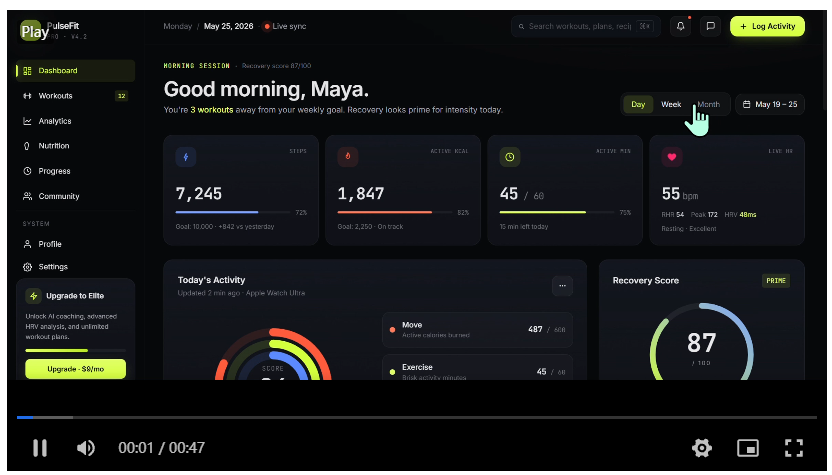
✅ Strengths:
- Visual design leans brand-forward and modern; highly consistent page style. Strong use of grid systems; card layouts are tight and precise.
- More vibrant interaction animations, including heartbeat pulses and progress ring loading animations.
- High data visualization density; all numbers are precise to single digits with self-consistent logic.
❌ Weaknesses:
- Lacks breadth in feature coverage; for example, the Settings page was not developed.
Qwen3.6-Plus Output:
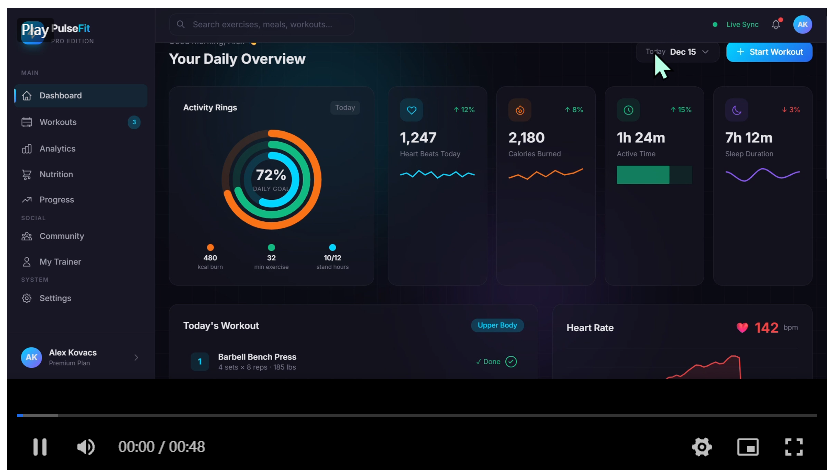
- Highly consistent visuals but slightly conservative; fonts and colors play it safe. Under high information density, the layout feels somewhat cramped and reading focus is diffused.
- However, its relative advantage is clear: product modules are more comprehensive, covering almost all core and derivative features of a mature fitness app.
IV. Final Verdict
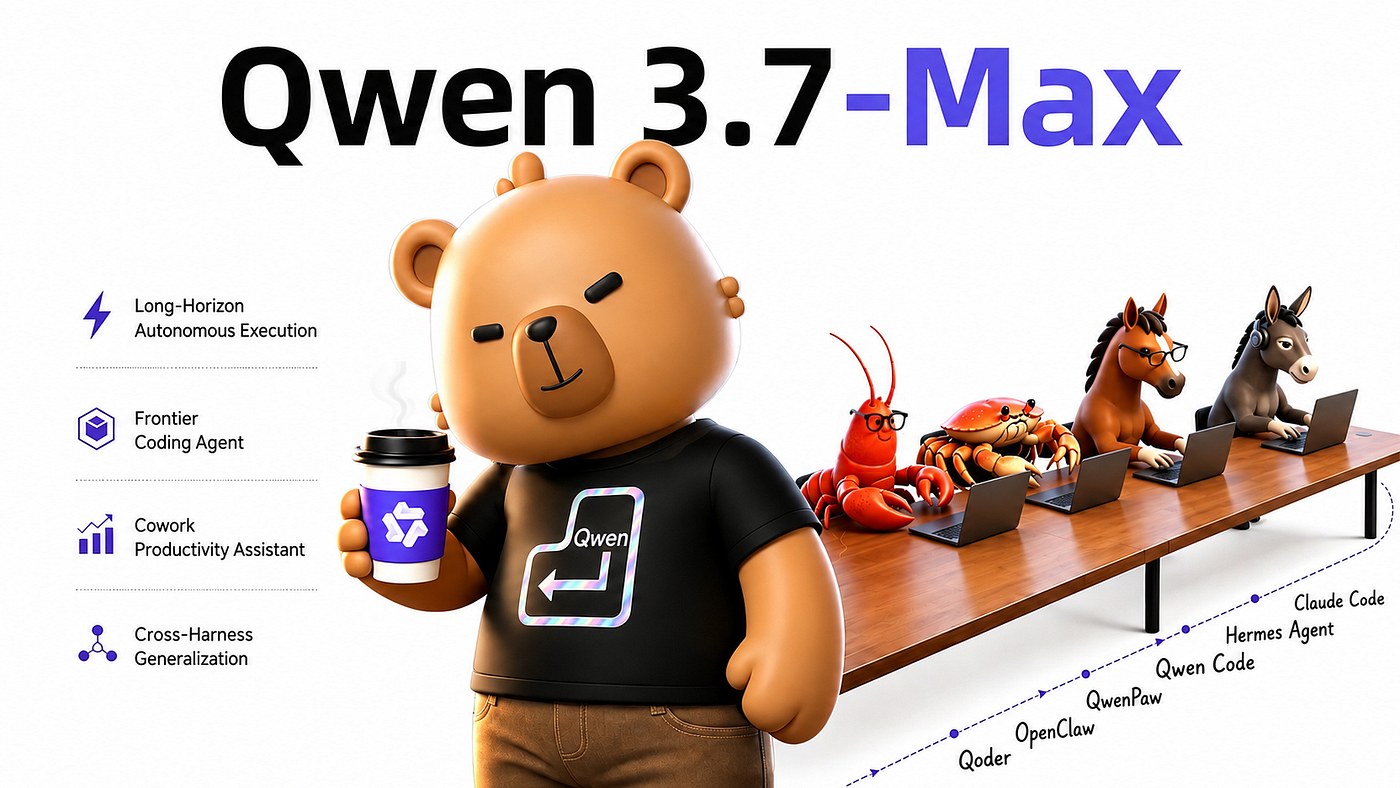
After extensive testing, the most immediate impression Qwen3.7-Max leaves is this: the model suddenly developed good taste.
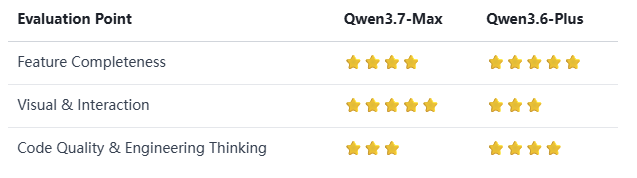
Compared against Qwen3.6-Plus, its improvements are noticeable without being revolutionary. Visual expressiveness and interaction detail have leaped forward, while feature completeness and engineering stability show clear trade-offs.
1. Constructive Reasoning Over Template Matching
In complex logical reasoning tests, Qwen3.7-Max demonstrates more constructive thinking. When facing classic logic puzzles, Qwen3.6-Plus tends to rapidly identify the problem template and apply formulas. Qwen3.7-Max, by contrast, treats the problem as a dynamic physical or logical mechanism — deconstructing it step-by-step, layer-by-layer, with natural language organization that dramatically lowers comprehension barriers.
This improvement is validated by hard benchmarks: on the notoriously difficult HLE test, Qwen3.7-Max scored 41.4, surpassing Claude Opus-4.6’s 40.0. It also leads on GPQA Diamond and HMMT 2026 Feb, aligning perfectly with our hands-on observations of its reasoning style.
2. Significant Visual and Interactive Improvements
This is the most immediately perceptible change in our testing. Across SVG animations, the Three.js black hole game, the travel brand Hero page, and the PulseFit fitness app prototype, Qwen3.7-Max’s visual and interactive advantages almost universally dominate its predecessor. It handles color, layout, micro-interactions, and physics feedback with greater maturity, delivering aesthetically bolder and more dynamic results. The black hole swallowing animations are more delicate; the Hero page’s parallax and glassmorphism feel premium. This matches the official “frontier programming agent” positioning — especially in creative output scenarios, where the model’s design taste has clearly evolved.
However, aesthetic ambition occasionally overreaches. When visual pursuit becomes too aggressive, heavy animation and DOM operations introduce performance risks, and feature breadth suffers. In Case 5’s PulseFit prototype, the Settings page and some functions were missing, while Qwen3.6-Plus — visually conservative but complete — delivered every module with higher engineering finish. So: choose 3.7 for the wow factor, but 3.6 for stability.
3. The Critical Upgrade: Long-Horizon Task Stability
Beyond benchmark scores, Qwen3.7-Max’s most valuable improvement lies in long-horizon task stability.
One official metric deserves special attention: 35 hours of autonomous runtime, 1,158 tool calls, achieving a 10× kernel performance acceleration on an unseen chip. This wasn’t a throwaway demo. It was a full closed loop from understanding the task, compiling, benchmarking, analyzing bottlenecks, restructuring architecture, to fixing bugs — entirely without human intervention. Competing first-tier models either achieved far lower speedups or gave up when they realized they couldn’t finish. Additionally, during an 80+ hour reward monitoring task, Qwen3.7-Max autonomously evolved 13 new anti-cheat rules and flagged 1,618 cheating cases.
This demonstrates that when task chains stretch to dozens of hours and thousands of steps, Qwen3.7-Max doesn’t forget what it’s doing, unlike many models. It continuously discovers new optimization directions through sustained iteration.
In summary, Qwen3.7-Max’s improvements concentrate in two directions: visual expressiveness and long-horizon task stability. The former delivers immediate impact; the latter expands the model’s capability boundary from single-turn dialogue toward sustained execution — arguably the more meaningful evolution.
메타데이터
- post_id
- 9848008c19ba
- slug
- qwen3-7-max-review-when-an-ai-model-finally-develops-good-taste-9848008c19ba
- url
- https://medium.com/@302.AI/qwen3-7-max-review-when-an-ai-model-finally-develops-good-taste-9848008c19ba
- canonical_url
- https://medium.com/@302.AI/qwen3-7-max-review-when-an-ai-model-finally-develops-good-taste-9848008c19ba
- author_url
- https://medium.com/@302.AI
- status
- ok
- fetched_at
- 2026-06-10 10:12:36