12 Proven Ways to Avoid Hitting Your Claude Fable 5 Token Limit in Just One Hour
Fable 5 return wasn’t as easy as many had expected. According to a source, following the recent suspension, Anthropic reinstated the model…
12 Proven Ways to Avoid Hitting Your Claude Fable 5 Token Limit in Just One Hour
Fable 5 return wasn’t as easy as many had expected. According to a source, following the recent suspension, Anthropic reinstated the model but reduced usage limits to 50% of the current subscription plans.
The reason for the block was troubling: users were able to bypass the security measures and use the model to carry out cyberattacks.
Fable 5 is now usable again, but with one important caveat:
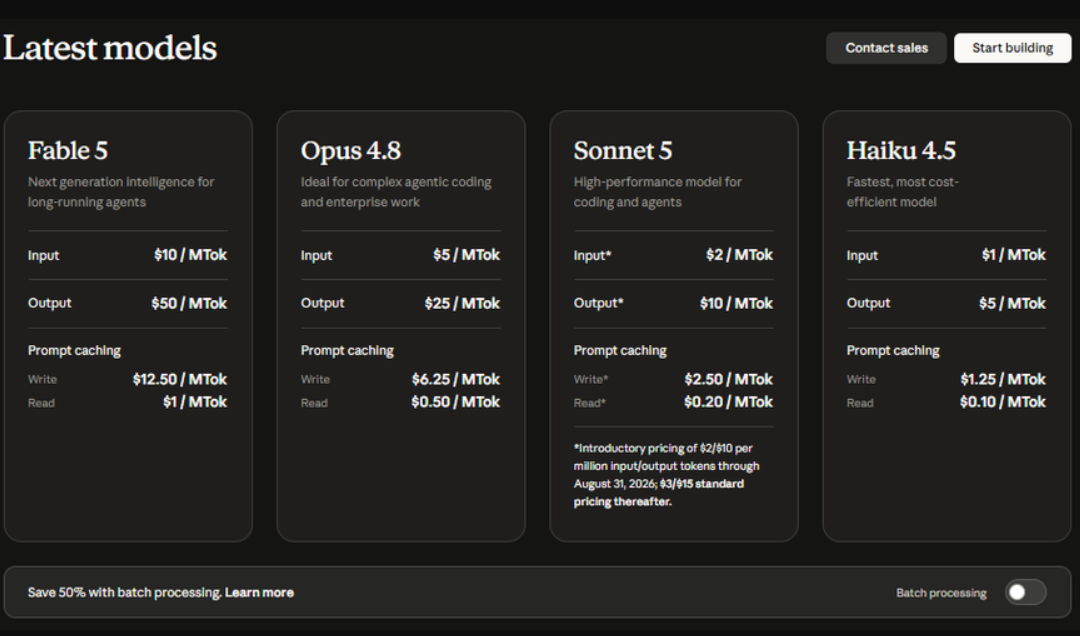
Until July 7 -> Access included with subscription After July 7 -> Paid access API -> $50 per 1 million output tokens
A separate limit specifically for Fable has appeared in the settings.
And most importantly:
Fable tokens cost about five times as much as tokens from other models within the same session.
In other words, Fable 5 can no longer be used like a regular compiler that you can endlessly feed files, logs, and error messages to and ask it to “try again.”
This approach will quickly burn through your limits.
Now, the most important skill isn’t just knowing how to use Fable.
And to know when it’s actually worth turning it on.

Fable isn’t a coder
The biggest mistake is forcing Fable 5 to write code by hand.
Yes, it’s a strong model.
Yes, she can solve complex problems.
But if you use it as a regular executor, it will:
▸ Read files ▸ Open tools ▸ parse logs ▸ write code ▸ check for errors ▸ Read the files again ▸ Edit the code again
And each such step will be costly.
For example:
Fable -> architecture, specs, solutions Sonnet -> code, project analysis, implementation Haiku -> reading the backlog, simple checks, low-cost routine tasks
This way, Fable spends tokens only where its power is truly needed.
Don’t run Fable in Chaos Mode
The fastest way to use up your limits is to give Fable an uncontrollable task like this:
ultracode: completely revamp the project
or:
Analyze the entire repository and do the best you can.
That sounds convenient.
But in practice, the model may trigger a process that is too broad:
▸ Read about unnecessary files ▸ Run the wrong checks ▸ Perform refactoring as you go ▸ to fix something she wasn’t asked to fix ▸ Get bogged down in details that don’t affect the task
This mode is too expensive for Fable.
It’s better to build a strict pipeline:
Fable writes a spec -> a subagent receives the task -> the subagent implements it -> a separate agent verifies the result -> Fable is only called if a solution is needed
In other words, Fable isn’t meant to be a workhorse.
She should be the mastermind behind the process.
Control the reasoning level
Fable has different levels of reasoning difficulty.
Officially, you can use “high” for complex tasks and “xhigh” for the most demanding ones.
But it’s important to understand:
The higher the reasoning level, the more the model thinks, gathers context, and consumes tokens.
If the problem is really difficult:
▸ architectural design ▸ a complex product fork ▸ critical bug ▸ An important security issue
In that case, using “high” or “xhigh” might be justified.
But if it’s a standard problem:
▸ Rewrite the text ▸ test a simple idea ▸ Provide a brief outline ▸ choose between two obvious options
It’s best to use “low” or “medium.”
Not every problem warrants deep thought.
Keep the context clean
You can’t feed Fable 5 to just anyone.
Context is now more important than ever.
A bad approach:
Here’s the entire project Here are all the logs Here are past discussions Here are previous decisions Take a look and fix it properly
A good approach:
Objective of the Task Current Problem Constraints What We’ve Already Tried What Solution We Need What Cannot Be Changed
Fable should not receive the maximum context, but rather the correct context.
And here’s another important rule:
Don’t let the model do anything she wasn’t asked to do.
For example:
Don’t add new features. Don’t do refactoring on the side. Don’t change the architecture without a separate decision. Don’t clean up the code if the task is just to fix a bug. Don’t expand the scope on your own.
Otherwise, the model will start improving everything around it.
And you’ll pay for it with your limits.
Limit QA cycles
Another way to ruin Fable is through endless cycles of fixes.
The model writes the solution.
The check is failing.
The model corrects it.
The test is failing again.
The model corrects itself again.
And so on until the limits run out.
We need a strict limit.
For example, the two-attempt rule:
1. The subagent carries out the task 2. The verifier checks the result 3. If there is an error, the subagent makes the first revision 4. If there is another error, the subagent makes a second revision 5. If it still doesn’t work, the task is blocked
After that, the task is assigned the following status:
block
And Fable keeps moving forward instead of getting bogged down by a single bug.
This is especially important in large projects.
Sometimes the problem isn’t with the model but with a poorly defined problem, a broken environment, or a conflict of requirements.
Be Careful with Parallelism
Parallel agents look impressive.
But if several agents edit the same files simultaneously, merge conflicts occur.
And who’s going to sort them out afterward?
Most likely, Fable.
In other words, the expensive model will once again start spending tokens on technical noise.
Therefore, the parallelism must be precise.
Good:
agent 1 -> auth agent 2 -> UI agent 3 -> docs agent 4 -> tests
Bad:
Agent 1 -> edits api.ts Agent 2 -> also edits api.ts Agent 3 -> also edits api.ts
If the work involves the same files, it’s best to proceed step by step.
Refine the task before you start
The cheapest token is the one you haven’t spent.
Therefore, before launching Fable, it’s a good idea to narrow down the scope.
To do this, you can use an approach like Grill.me
The meaning is simple:
Before it starts, the AI asks you follow-up questions until the task is clear enough.
For example:
▸ What result are you looking for? ▸ What can’t be changed? ▸ Which files are affected? ▸ What are the restrictions? ▸ How can you tell if the task has been completed? ▸ What solutions have you already tried?
This might seem like an unnecessary step.
But in practice, one good round of clarification saves more tokens than five attempts to correct a misunderstood task.
What workflow would I use?
In short, this is how I would approach working on Fable 5:
1. Grill.me clarifies the task 2. Fable writes a spec 3. Fable creates a GitHub Issue 4. Sonnet implements the task 5. Haiku or a separate verifier checks the result 6. A maximum of two revisions 7. If it doesn’t work → block 8. Fable is only involved in resolving branching issues
So Fable remains in the role of architect.
And the cheap models are just for routine tasks.
The Main Rule
Fable 5 is back, but the old way of doing things no longer works.
Whereas in the past it was possible to simply run a powerful model on everything, that’s now too expensive.
Fable should be used sparingly:
▸ for architecture ▸ for complex solutions ▸ for planning ▸ for conflict resolution ▸ for setting objectives
Not for endlessly reading files and rewriting code.
Conclusion
The return of Fable 5 is good news.
But reduced limits change the rules of the game.
Nowadays, it’s not the one who simply launches the most powerful model who wins.
And someone who knows how to delegate work properly:
Fable -> thinks and controls Sonnet -> writes and analyzes Haiku -> reads and checks a simple routine
Fable 5 is a dear Team Lead. Don’t make the Team Lead dig trenches. Let him make his own decisions.
메타데이터
- post_id
- 984ca65544ff
- slug
- 12-proven-ways-to-avoid-hitting-your-claude-fable-5-token-limit-in-just-one-hour-984ca65544ff
- url
- https://medium.com/coding-nexus/12-proven-ways-to-avoid-hitting-your-claude-fable-5-token-limit-in-just-one-hour-984ca65544ff
- canonical_url
- https://medium.com/coding-nexus/12-proven-ways-to-avoid-hitting-your-claude-fable-5-token-limit-in-just-one-hour-984ca65544ff
- author_url
- https://medium.com/@codebun
- status
- ok
- fetched_at
- 2026-07-08 18:29:56