How I Found the Sweet Spot Between Model Complexity and Generalization
God help me, I used to think more neurons meant more intelligence. You know, like a freshman CS major stacking dense layers like Lego…
How I Found the Sweet Spot Between Model Complexity and Generalization
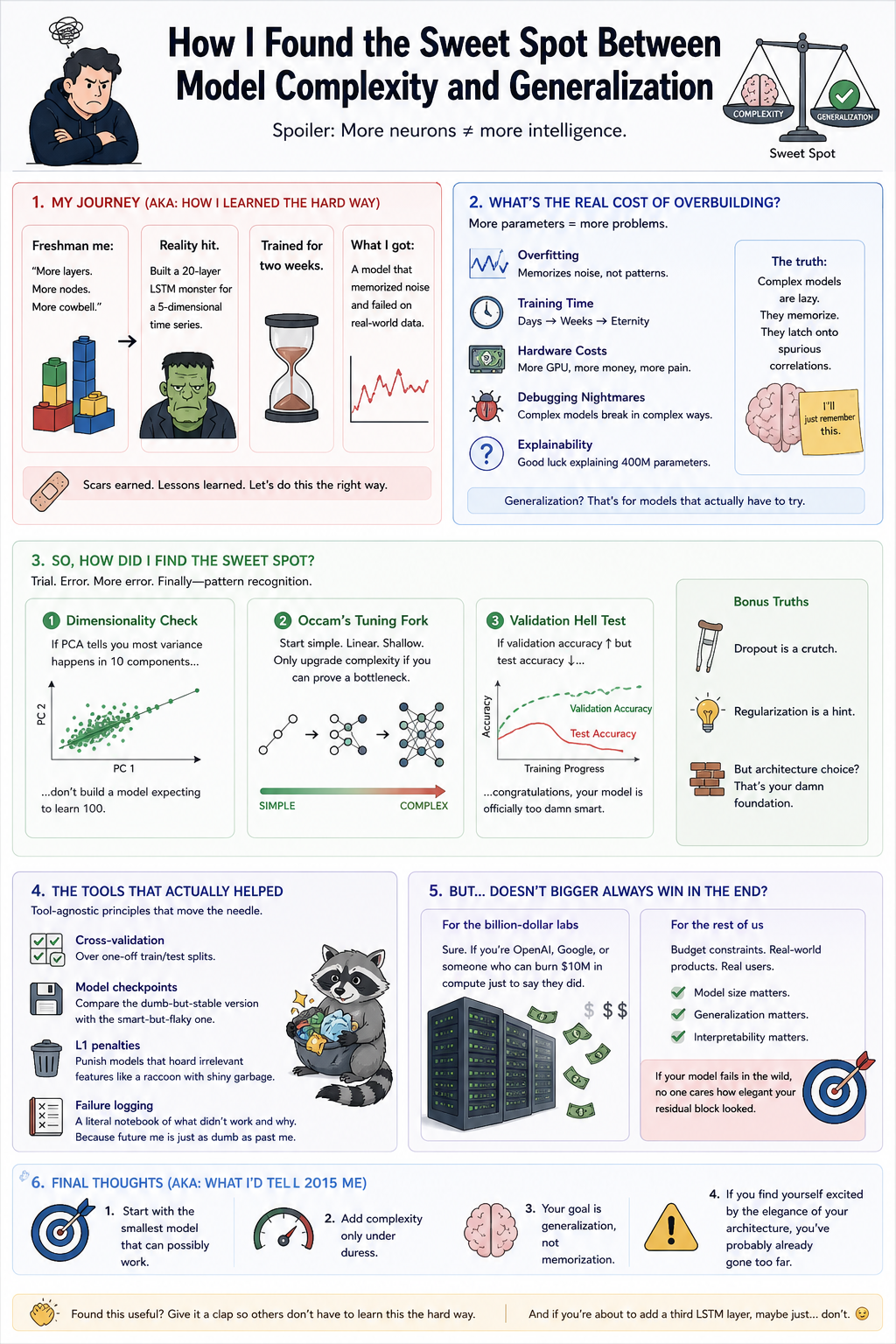
God help me, I used to think more neurons meant more intelligence. You know, like a freshman CS major stacking dense layers like Lego bricks and wondering why the thing still overfits on MNIST.
More layers. More nodes. More activation functions. More cowbell. That was my gospel.
And then it broke. Repeatedly.
I’ve got scars from that era. Like the time I built a 20-layer LSTM Frankenstein for time-series data that had five actual useful dimensions. It was trained for a week. No — scratch that. Two weeks. And what did I get? A model that memorized noise and choked the moment I showed it real-world variance.
So yeah, I’m cranky. But I’ve earned it.
You want to build models that generalize? Then sit down, shut up, and stop listening to people who worship at the altar of “bigger is better.” Because here’s the dirty little secret: every extra degree of complexity you add has a price. And that bill comes due in the form of interpretability, robustness, and maintenance hell.
Alright, deep breath. Now that my PTSD from that project is out of the way, let’s actually break this down.

What’s the Real Cost of Overbuilding a Model?
First, let’s kill the myth that more parameters = more performance.
Every extra parameter you add is a potential liability. Not just in overfitting, but in training time, hardware costs, debugging nightmares, and explainability. You want to explain to your PM why a 400M parameter transformer made the wrong recommendation? Good luck, buddy.
The thing is, machine learning isn’t just about learning. It’s about forgetting the right things. Complex models are lazy. They memorize. They latch onto spurious correlations. They see training data and go, “Cool, I’ll just keep all of this.” Generalization? That’s for smaller models that actually have to try.
So, How Did I Find the Sweet Spot?
Trial. Error. More error. Even more error. And finally — pattern recognition.
The breakthrough came when I stopped thinking like an engineer and started thinking like a mechanic. You don’t throw a turbocharger on a lawnmower. You match the engine to the job.
For me, that meant three things:
- Dimensionality Check — If PCA tells you most variance happens in 10 components, don’t build a model expecting to learn 100.
- Occam’s Tuning Fork — Start simple. Linear. Shallow. Only upgrade complexity if you can prove a bottleneck.
- Validation Hell Test — If your validation accuracy goes up while your test accuracy goes down, congratulations, your model is officially too damn smart for its own good.
Also: Dropout is a crutch. Regularization is a hint. But architecture choice? That’s your damn foundation.
The Tools That Actually Helped
I won’t list a specific stack; the half battle is tool agnosticism. But here’s what mattered:
- Cross-validation over one-off train/test splits.
- Model checkpoints to compare the dumb-but-stable version with the smart-but-flaky one.
- L1 penalties to punish models that hoard irrelevant features like a raccoon with shiny garbage.
And perhaps most importantly: failure logging. Yes, a literal notebook where I wrote down what didn’t work and why. Because future me is just as prone to bad ideas as past me.
But… Doesn’t Bigger Always Win in the End?
Sure. If you’re OpenAI and training GPT-5. Or Google. Or someone who can burn $10M in compute just to say they did.
But if you’re working on a real-world product with budget constraints, model size matters. Generalization matters. Interpretability matters. And if your model fails in the wild, no one gives a damn how elegant your residual block looked on paper.
Final Thoughts (aka: What I’d Tell 2015 Me)
- Start with the smallest model that can possibly work.
- Add complexity only under duress.
- Your goal is generalization, not memorization.
And if you find yourself excited by the elegance of your architecture, you’ve probably already gone too far.
Found this useful? Give it a clap so others don’t have to learn this the hard way. And if you’re about to add a third LSTM layer, maybe just… don’t.
메타데이터
- post_id
- 985c9fc6288f
- slug
- how-i-found-the-sweet-spot-between-model-complexity-and-generalization-985c9fc6288f
- url
- https://medium.com/aimonks/how-i-found-the-sweet-spot-between-model-complexity-and-generalization-985c9fc6288f
- canonical_url
- https://medium.com/aimonks/how-i-found-the-sweet-spot-between-model-complexity-and-generalization-985c9fc6288f
- author_url
- https://medium.com/@abduldattijo1
- status
- ok
- fetched_at
- 2026-07-08 20:12:56