The Twin Towers Strategy: Will the Celtics’ Double-Big Lineup Break the Knicks?
Analyzing the matchup nightmare of Boston’s versatile bigs against New York’s physical frontcourt.
The Twin Towers Strategy: Will the Celtics’ Double-Big Lineup Break the Knicks?
Analyzing the matchup nightmare of Boston’s versatile bigs against New York’s physical frontcourt.
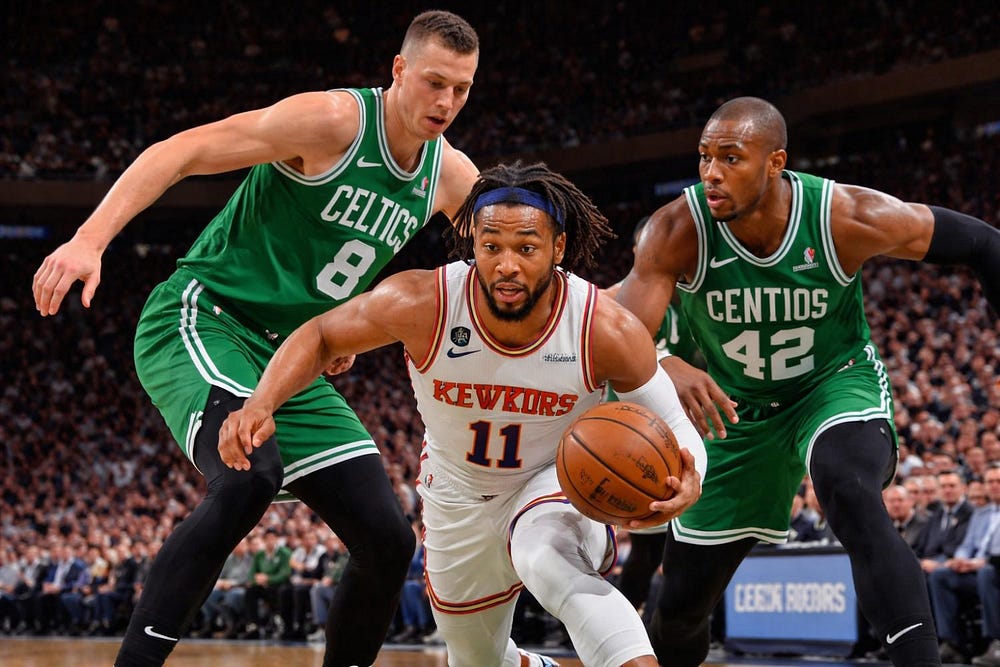
When Jalen Brunson drives into the paint against Boston, he isn’t just facing a defense, he is staring into a forest of seven-footers designed specifically to break the Knicks’ offense. For years, the NBA dictated that playing two traditional big men was tactical suicide. Coaches pivoted toward speed, switching, and small-ball lineups that prioritized perimeter mobility over interior presence. Then Joe Mazzulla paired Kristaps Porzingis with Al Horford, and the Celtics started bullying the most physical team in the East. This strategic collision inside Madison Square Garden represents the ultimate test of modern roster construction. As bodies collide near the painted area, the reality of the Celtics’ Double-Big Lineup becomes undeniable. New York demands relentless physicality, but Boston answers with overwhelming length. Pundits doubted this supersized strategy, questioning the mobility of two aging or injury-prone centers. Yet the results speak for themselves, turning the paint into a graveyard for opposing drives. This stylistic clash could easily define the Eastern Conference Finals.
The Shifting Eastern Conference Topography
The rivalry between these two cities remains fierce. New York reconstructed its roster to hunt championships, adding serious perimeter firepower alongside Mitchell Robinson and Isaiah Hartenstein. Their shooters wait for kick-out passes, and data from Cleaning the Glass shows they lead the league in offensive rebound percentage at 33 percent. While the rest of the league went small, Boston stubbornly built a giant frontcourt to bully the bullies. The Celtics’ Double-Big Lineup neutralizes many traditional attacks by deploying two towering defenders to protect the rim simultaneously. Opposing guards face a terrifying forest of arms. Drivers hesitate before challenging the basket. Perimeter defenders pressure the ball relentlessly, and shot clocks often expire under suffocating defensive pressure. This chess match dictates the future of the league, and analysts will dissect every single possession of this war for years to come.
Evaluating the Frontcourt Chess Match
Understanding this matchup requires analyzing three crucial battlefield domains. First, we examine the defensive rebounding rate. Second, analysts must scrutinize high pick-and-roll coverage. Third, offensive spacing remains a vital component. These factors decide the victor. Boston relies heavily on the Celtics’ Double-Big Lineup to control the glass, even when New York counters with unmatched ferocity. Data from NBA Advanced Stats reveals the Knicks dominate second-chance points, but Horford and Porzingis learned to leverage their combined wingspan to mitigate this. New York finds fewer easy put-backs, and we see a stark contrast in philosophies here. Tension builds before every single jump ball as these two giants prepare to collide.
10. The Weak-Side Rim Protection Paradigm
Porzingis fundamentally alters the geometry of the basketball court. Offensive players constantly monitor his looming presence because he blocks shots with terrifying ease. Many observers wondered if he could survive on the perimeter, but his weak-side rotations shut down easy layups. Per Second Spectrum data, Boston allows just 25.2 restricted area attempts per game, the lowest mark in the NBA. This metric highlights their interior dominance. The Celtics’ Double-Big Lineup dictates the terms of engagement, forcing New York to rethink their driving angles. Brunson keeps attacking the teeth of the defense, but fear rarely dictates New York basketball. Mitchell Robinson tries to tear down the rim through traffic, but the height advantage remains a constant obstacle for the Knicks.
9. Horford Defending the Switch
Agility remains Al Horford’s hidden superpower. When a smaller guard tries to isolate the veteran, they expect an easy bucket. Guards try to snap his ankles with quick crossovers, but Horford rarely bites, sliding his feet with remarkable precision. Film sessions highlight his flawless positioning, and Synergy Sports ranks him in the 92nd percentile in isolation defense. Fans vividly recall his crucial stops during past playoff runs, and opponents eventually stop hunting him entirely. New York faces a stagnant offensive possession when the veteran big man simply refuses to concede ground. His defensive instincts remain sharper than ever, forcing frustrated guards to settle for contested jumpers just beyond the arc.
8. The Offensive Rebounding Battleground
New York lives and dies by the offensive glass. Their guards launch heavily contested jumpers, and Mitchell Robinson crashes the paint hunting loose balls. Boston sometimes struggles with this, but pairing two bigs mitigates this glaring weakness. They create a physical wall around the basket. The Knicks never stop fighting, and rebounding percentages from Basketball Reference highlight their historic prowess. Sheer effort collides with overwhelming size, and bodies hit the floor constantly. Referees often swallow their whistles in these moments. Coaches scream for box-outs as the battle for possession becomes a literal fight for territory.
7. Spacing the Floor Horizontally
Spacing dictates modern professional basketball success. The Celtics’ Double-Big Lineup stretches defenses incredibly thin because both bigs shoot flawlessly from deep, averaging over 37 percent from beyond the arc. Opposing centers must abandon the painted area to account for them. Traditional coaches once hated big men shooting threes, but the league completely embraced this revolution. Boston exploits this mathematical advantage ruthlessly. Porzingis drains contested shots effortlessly, forcing New York to choose between protecting the rim or guarding the perimeter. Math heavily favors the shooting team, and Boston’s relentless math advantage simply breaks opposing defenses. A barrage of three-pointers often breaks the game wide open, and leads balloon to twenty points before the half ends.
6. Brunson Attacking the Drop
Jalen Brunson destroys drop coverages with clinical precision. He usually finds a sliver of daylight near the elbow to punish retreating defenders. However, Boston tweaked their traditional schemes specifically for him. Mazzulla asks his bigs to play closer to the level of the screen, putting Brunson in immediate ball pressure. He must pass out of the trap, and tracking data from ESPN Stats and Info shows his efficiency in the midrange drops to a staggering 38 percent against this specific look. The crafty guard still finds creative ways to score using his signature hostage dribble, but the windows are much smaller. He uses brilliant hesitation moves to make defenders stumble backward, yet the size of the Celtics’ Double-Big Lineup makes every floater a high-wire act.
5. Transition Defense Vulnerabilities
Playing two massive athletes creates obvious speed disadvantages. Fast breaks become dangerous because of a potential loss of foot speed. New York pushes the tempo relentlessly after missed shots, sprinting towards the corners to catch the defense out of position. Boston prioritizes offensive rebounding over getting back, and coaches often scream at the video screen about lazy transition defense efforts. The Celtics’ Double-Big Lineup requires precise communication to stop early offense, and players must learn to match up quickly in chaos. They sometimes fail, and fast break points completely shift momentum. A thunderous transition dunk can erupt the crowd, making a timeout absolutely necessary to stop the bleeding.
4. The Corner Three Dilemma
Protecting the paint often leaves shooters unguarded. New York wings wait patiently for a pass while Boston heavily helps off the strong-side corner. This generates wide-open perimeter looks for the Knicks, who shoot roughly 40 percent from the corner. Fans once ripped this defensive strategy as mathematically foolish, but the coaching staff trusts the math entirely. Contested twos yield fewer points than corner threes over a long series. The game devolves into a shooting variance contest, and one hot streak can decide the final outcome. Role players like Donte DiVincenzo hit massive shots, and home crowds hold their collective breath as the ball hangs in the air.
3. Punishing the Mismatch in the Post
Guards frequently end up switching onto Porzingis, and he simply turns and shoots over them. The height differential makes defending him impossible for smaller players. It has been a long time since we saw a post threat this lethal, as Porzingis produces 1.25 points per possession in the post. Boston feeds him the rock consistently, and he delivers highly efficient offense despite the pressure. New York tries to front the post aggressively and sends rapid double teams to force turnovers. However, the Celtics’ Double-Big Lineup punishes defensive rotations with sharp passing. Quick ball movement destroys scrambled defenses, and an open cutter often catches a brilliant bounce pass for an easy layup that halts a New York run.
2. The Physical Toll of Trench Warfare
Banging bodies inside drains energy rapidly. Players feel the intense soreness in their legs for days after these matchups. Playing massive frontcourts requires extraordinary physical conditioning. Fourth quarters become unpredictable when stamina fades. New York thrives in muddy, exhausting contests where tired legs lead to missed jump shots. Boston relies on deep bench rotations to stay fresh, with reserves often needing to play 18 or more minutes to preserve the starters. Survival depends entirely on sheer willpower. The Celtics’ Double-Big Lineup tests the limits of human endurance, and sweaty jerseys cling to exhausted frames. Mental toughness eventually eclipses physical talent, and champions find a way to execute despite the fatigue.
1. Crunch-Time Spacing Dynamics
Closing games requires flawless execution. The court shrinks during the final two minutes as defenses tighten their rotations drastically. Putting two centers on the floor once seemed risky, but Boston weaponizes their size to create elite spacing. Their 125.0 offensive rating in clutch time proves that five-out offenses force New York to make impossible choices. Jayson Tatum isolates against a terrified defender, and help defense arrives far too late. The buzzer sounds on another victory because floor geometry dictates history. This fundamental truth remains undisputed, and superstars finally get the breathing room they need to operate.
The Final Verdict on the Frontcourt Collision
Basketball evolves constantly through tactical innovation, and the Celtics’ Double-Big Lineup represents a fascinating counterculture movement. Small ball dominated the professional landscape for a decade, forcing teams to downsize to maximize shooting and speed. Boston zigged while others zagged, building a towering roster capable of dominating the paint. Opponents struggle to adapt because they lack the traditional big men to match this size. New York presents the ultimate physical test for this experiment, and the Knicks embrace the brutal challenge. Fans witness a beautiful clash of opposing philosophies as grit collides directly with overwhelming length. The next championship banner awaits the victor, but will sheer size conquer raw tenacity? The players must settle the debate on the hardwood, and history will record the aftermath. The echoes of this battle will define a generation, and pundits will continue debating the merits of sheer size while purists cherish these gritty hardwood wars. Prepare for an unforgettable clash as the lights dim inside the arena.
READ ALSO: Detroit Pistons Bench Unit Became a Secret Weapon
FAQs
What is Boston’s double-big lineup? Boston’s double-big lineup puts Kristaps Porzingis and Al Horford on the floor together. It gives Boston size at the rim without killing its spacing.
Why does the Celtics’ double-big lineup matter against the Knicks? New York wins with force, rebounds, and paint pressure. Boston uses length and size to meet that style head-on.
Can Jalen Brunson still score against Boston’s size? Yes. He can still reach his spots, but Boston makes every touch tighter and every finish more crowded.
What is the biggest strength of Boston’s two-big look? It gives Boston rim protection and spacing at the same time. That mix makes the lineup hard to solve on both ends.
What is the biggest risk in playing two bigs? Speed is the risk. If Boston misses a rotation in transition, New York can strike before the defense gets set.
Originally published at https://sportsorca.com on March 25, 2026.
메타데이터
- post_id
- 986f62c3d7f3
- slug
- the-twin-towers-strategy-will-the-celtics-double-big-lineup-break-the-knicks-986f62c3d7f3
- url
- https://medium.com/@zanechalk/the-twin-towers-strategy-will-the-celtics-double-big-lineup-break-the-knicks-986f62c3d7f3
- canonical_url
- https://medium.com/@zanechalk/the-twin-towers-strategy-will-the-celtics-double-big-lineup-break-the-knicks-986f62c3d7f3
- author_url
- https://medium.com/@zanechalk
- status
- ok
- fetched_at
- 2026-07-13 07:01:24