Why Vibe Coding Still Needs Real Engineering
The software industry is experiencing one of the fastest productivity shifts in its history. AI-assisted development tools such as Cursor…
Why Vibe Coding Still Needs Real Engineering
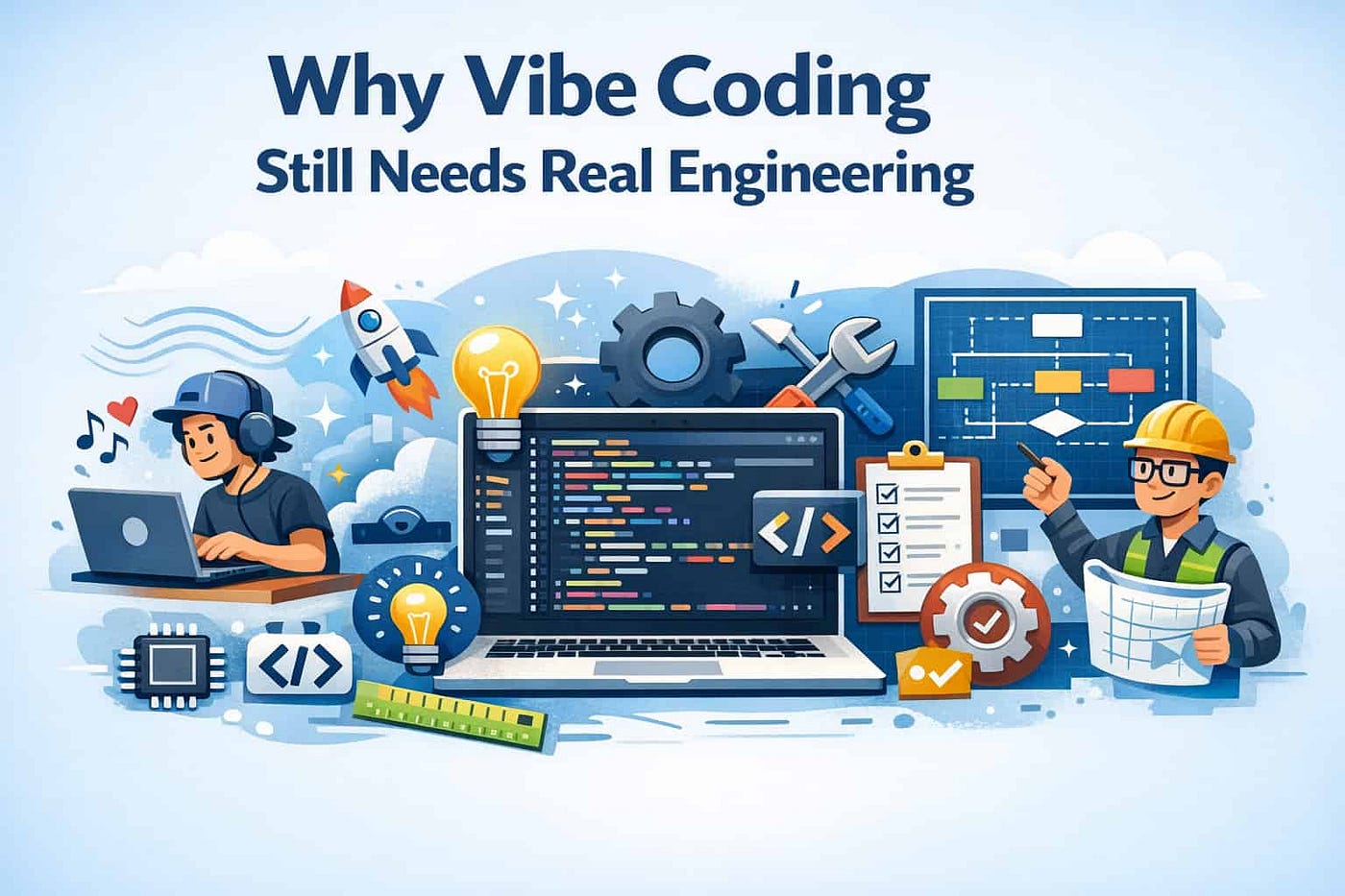
Why Vibe Coding Still Needs Real Engineering
The software industry is experiencing one of the fastest productivity shifts in its history. AI-assisted development tools such as Cursor, Anthropic, and GitHub are enabling developers to generate working applications at unprecedented speed. Features that once required days of coding can now appear within hours through prompts, conversational workflows, and automated code generation.
This new development style is often referred to as “vibe coding.” Instead of carefully designing every component from the ground up, developers collaborate with AI systems to rapidly iterate toward functional results. The approach prioritizes speed, experimentation, and momentum.
Businesses are embracing this shift enthusiastically. Startups can validate ideas faster, product teams can prototype more aggressively, and engineering departments can accelerate delivery timelines. In many cases, vibe coding genuinely improves productivity and lowers barriers to software creation.
However, rapid software generation does not eliminate the complexity of production engineering. Applications that appear functional during development often encounter serious issues once deployed into real-world environments. AI can generate code quickly, but stable systems still require architecture, testing, scalability planning, operational discipline, and long-term maintainability strategies.
The future of software development is not a choice between AI and engineering. Instead, the challenge is learning how to combine the speed of AI-assisted development with the rigor of real engineering practices.
Why Vibe Coding Became So Popular
The popularity of vibe coding is easy to understand. Traditional software development can be slow, expensive, and heavily constrained by engineering capacity. AI-assisted tools dramatically reduce the time required to transform ideas into working software.
Developers can now generate user interfaces, APIs, integrations, database queries, and infrastructure configurations through conversational interactions. This creates a development experience that feels far more fluid and experimental than conventional programming workflows.
For startups, this speed creates enormous advantages. Early-stage companies can test business ideas before investing heavily in large engineering teams. Internal tools can be built quickly. Proofs of concept become easier to create. Product iterations happen faster.
Large organizations benefit as well. Engineering teams can automate repetitive tasks, accelerate prototyping cycles, and reduce implementation friction. AI-generated code often helps developers focus more on business logic and less on boilerplate.
The accessibility of these tools has also expanded software creation beyond traditional engineering specialists. Designers, founders, analysts, and technically curious operators can now participate more directly in product development processes.
Importantly, none of this is inherently negative. Vibe coding is genuinely useful. It accelerates innovation, lowers experimentation costs, and improves development efficiency in many scenarios.
The problem arises when businesses mistake rapid generation for production readiness. A functioning demo is not necessarily a sustainable application.
Fast Code Generation Does Not Guarantee Stable Architecture
One of the most common misconceptions surrounding AI-assisted development is assuming that functional output automatically reflects strong engineering foundations.
AI systems optimize primarily for generating code that appears to solve the immediate problem presented in a prompt. They do not inherently understand long-term architectural goals, future scalability requirements, organizational standards, or operational constraints unless developers explicitly enforce them.
As vibe-coded projects grow, this limitation becomes increasingly visible.
Applications often accumulate inconsistent architectural patterns because generated code evolves through fragmented conversations and isolated tasks. One section of the system may use one approach to authentication while another uses a completely different implementation. State management, error handling, data validation, and API structures may vary widely across the same application.
Initially, these inconsistencies may not appear problematic. Small projects with limited traffic can still function reasonably well despite structural weaknesses.
However, production environments expose hidden instability quickly. Real users generate unpredictable workloads, edge cases, concurrency issues, and scaling demands that prototypes rarely encounter during development.
Without coherent architecture, applications become fragile. Small changes create unexpected side effects. Debugging grows increasingly difficult. Developers lose confidence in deployments because system behavior becomes hard to predict.
Another common issue is duplicated business logic. AI-generated workflows frequently recreate similar functionality rather than abstracting reusable services. Over time, multiple versions of the same logic appear throughout the application, eventually leading to inconsistent behavior and operational confusion.
Strong architecture remains essential because software systems become more complex as they evolve. AI accelerates implementation, but engineering discipline determines whether systems remain maintainable.
Hidden Technical Debt Accumulates Faster Than Expected
One of the most significant risks in vibe-coded applications is the rapid accumulation of technical debt.
Technical debt refers to the long-term cost created by short-term implementation decisions. In AI-assisted development environments, this debt can grow exceptionally quickly because developers can generate large amounts of functionality before structural problems become visible.
Many vibe-coded systems initially prioritize speed over maintainability. Teams focus on launching features, validating ideas, and meeting aggressive timelines. Important engineering concerns are often postponed until “later.”
Unfortunately, later arrives faster than expected.
Applications may lack proper modularization, dependency management, testing coverage, or documentation. Infrastructure decisions made during early experimentation can become permanent production bottlenecks. Generated code may include unnecessary libraries, inefficient queries, or insecure configurations.
Over time, engineering velocity begins slowing down instead of accelerating. Developers spend increasing amounts of time debugging regressions, tracing unclear dependencies, and repairing unstable workflows.
This is where many organizations discover the need for vibe code fixing initiatives. The original speed advantages of AI-assisted development remain valuable, but sustainable growth requires stabilizing the underlying system before complexity becomes unmanageable.
Technical debt is not unique to AI-generated software. Traditional development teams accumulate it as well. However, vibe coding increases the rate at which complexity can spread throughout a codebase because implementation speed often exceeds review capacity.
Without governance, rapid generation eventually creates operational friction that limits future development.
Production Systems Need More Than Working Code
A major challenge with vibe-coded applications is that developers often focus heavily on feature functionality while underestimating operational engineering requirements.
Production-ready software requires far more than working interfaces and successful API responses.
Testing is one of the most overlooked areas. AI-generated code can appear correct while still containing hidden edge-case failures, concurrency issues, or integration vulnerabilities. Without comprehensive automated testing, small updates may introduce serious regressions into production systems.
Continuous integration and deployment pipelines are equally important. Applications deployed without proper CI/CD practices often suffer from inconsistent releases, failed rollbacks, and unstable environments. AI can help generate deployment scripts, but operational reliability still depends on disciplined engineering processes.
Security introduces another critical challenge. Rapidly generated applications may expose secrets, misuse authentication mechanisms, or depend on outdated packages. Production systems must withstand external threats, regulatory scrutiny, and evolving attack surfaces.
Scalability planning is also essential. Code that performs well with a few users may collapse under real production load. Inefficient database structures, synchronous bottlenecks, and unoptimized infrastructure patterns become increasingly expensive as traffic grows.
Observability is another area frequently ignored during rapid development cycles. Without monitoring, logging, tracing, and performance analytics, teams struggle to diagnose production incidents effectively.
Engineering exists partly because software systems behave differently at scale than they do during development. Stable production environments require operational maturity, not just rapid implementation.
The Best Future Is AI-Assisted Engineering, Not AI-Replaced Engineering
The rise of vibe coding does not mean engineering practices are becoming obsolete. In many ways, the opposite is happening. As software generation becomes easier, the value of strong engineering oversight increases.
Organizations that succeed with AI-assisted development are typically those that combine rapid generation with disciplined technical governance.
They establish architectural standards before projects scale. They enforce testing requirements. They conduct code reviews. They prioritize observability, security, and deployment reliability. Most importantly, they treat AI-generated code as a starting point rather than a finished product.
This balanced approach creates significant advantages. Teams maintain the speed benefits of vibe coding while avoiding the long-term instability that often emerges in uncontrolled environments.
AI tools are exceptionally effective at accelerating implementation and reducing repetitive work. They help developers move faster, experiment more freely, and explore ideas with lower initial cost.
Human engineering expertise remains essential for system design, operational reliability, scalability strategy, risk management, and long-term maintainability.
The future of software development will likely involve even deeper collaboration between AI systems and engineering teams. Businesses that understand how to integrate both effectively will gain major competitive advantages.
The companies that struggle will not necessarily be those using AI. Instead, they will be the ones assuming that AI eliminates the need for engineering discipline altogether.
Conclusion
Vibe coding represents a major shift in how software is created. AI-assisted development tools have made rapid application generation more accessible, faster, and more efficient than ever before. This transformation is already changing product development across startups, enterprises, and independent development teams.
The benefits are real. Faster prototyping, accelerated iteration, reduced implementation friction, and lower experimentation costs create significant business value.
However, production-ready software still requires real engineering.
Applications deployed into live environments must handle scalability challenges, operational complexity, security risks, unpredictable workloads, and long-term maintenance demands. These problems cannot be solved through rapid code generation alone.
Architecture, testing, CI/CD, observability, dependency management, and engineering governance remain critical components of sustainable software systems.
The future is not about choosing between AI and engineering. The strongest teams will use AI to accelerate development while relying on engineering expertise to ensure stability, reliability, and scalability.
Vibe coding is an incredibly powerful tool for modern software creation. But lasting production systems still depend on the fundamentals of real engineering.
메타데이터
- post_id
- 9877609aeb99
- slug
- why-vibe-coding-still-needs-real-engineering-9877609aeb99
- url
- https://medium.com/@eugene.afonin/why-vibe-coding-still-needs-real-engineering-9877609aeb99
- canonical_url
- https://medium.com/@eugene.afonin/why-vibe-coding-still-needs-real-engineering-9877609aeb99
- author_url
- https://medium.com/@eugene.afonin
- status
- ok
- fetched_at
- 2026-06-09 15:37:30