Why Procurement Consultancy Is Becoming Essential for Smarter Business Growth
Procurement is often viewed as a simple purchasing function: identify what the business needs, compare suppliers, negotiate prices, and…
Why Procurement Consultancy Is Becoming Essential for Smarter Business Growth
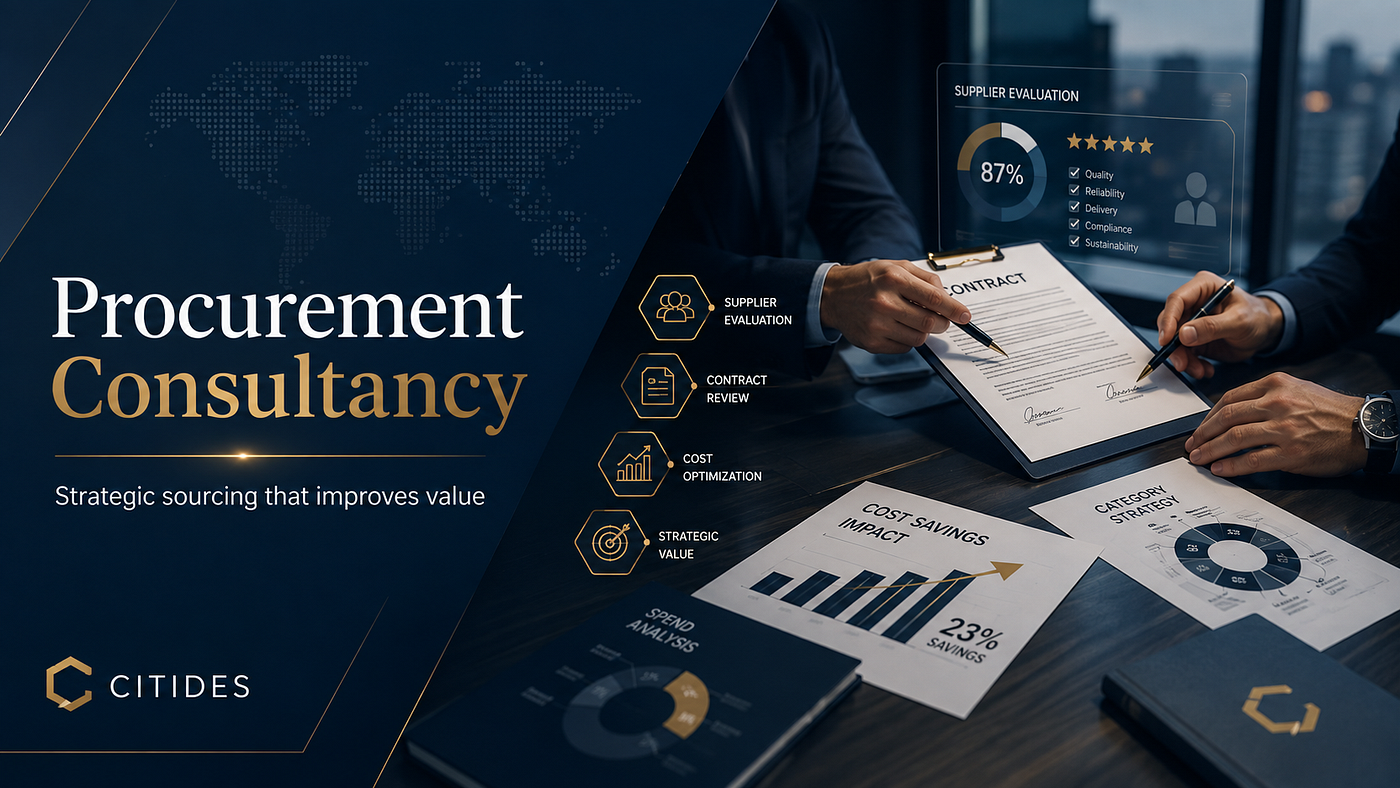
Procurement is often viewed as a simple purchasing function: identify what the business needs, compare suppliers, negotiate prices, and place orders.
In reality, modern procurement is far more strategic.
The way a company buys products, services, technology, raw materials, and external expertise can directly influence profitability, operational stability, supplier performance, and long-term growth. Poor procurement decisions can increase costs, create supply disruptions, weaken negotiating power, and expose the business to unnecessary risk.
This is why many organizations are turning to professional procurement consultancy to improve the way they source, evaluate, negotiate, and manage suppliers.
A strong procurement strategy is not simply about paying less. It is about achieving the right balance between cost, quality, reliability, risk, flexibility, and long-term value.
Procurement Has Become a Strategic Business Function
Traditional procurement teams were often measured mainly by one question:
“How much did we save?”
Cost remains important, but modern procurement departments are expected to contribute much more.
They may be responsible for:
- Supplier resilience
- Category strategy
- Contract performance
- Risk management
- Sustainability
- Compliance
- Supply continuity
- Innovation
- Data visibility
- Working-capital improvement
This shift has changed the role of procurement from a transactional function into a strategic one.
For example, choosing the lowest-priced supplier may create short-term savings. But if that supplier frequently delivers late or produces inconsistent quality, the wider business may experience production delays, customer complaints, and additional operating costs.
A more strategic procurement approach evaluates the entire business impact.
What Does Procurement Consultancy Actually Involve?

Procurement consultancy helps organizations improve specific areas of purchasing and supplier management.
The exact scope depends on the company.
Some businesses need help reducing excessive spending.
Others need to build stronger sourcing processes.
A company expanding internationally may need support identifying suppliers in new markets.
Another organization may already have hundreds of suppliers but lack visibility into performance and risk.
A procurement consultant may therefore work across areas such as:
- Procurement strategy
- Spend analysis
- Supplier sourcing
- Category management
- Supplier evaluation
- Contract review
- Cost optimization
- Negotiation strategy
- Process improvement
- Procurement technology
- Risk management
- Supplier performance monitoring
The goal is not simply to provide advice.
Effective consultancy should help businesses create practical processes that their teams can continue using after the engagement.
Spend Analysis Is Often the Starting Point
Before improving procurement, businesses need to understand how they currently spend money.
This sounds obvious, but many organizations lack complete visibility.
Purchasing information may be spread across multiple departments, spreadsheets, accounting platforms, and supplier systems.
As a result, management may not know:
- How much is being spent by category
- Which suppliers receive the most business
- Whether similar products are being purchased at different prices
- Where contracts are being bypassed
- Which departments are using duplicate suppliers
- Where negotiation opportunities exist
Spend analysis brings this information together.
For example, a company might discover that several departments purchase similar software subscriptions independently.
Each department may believe it is making a small purchase.
Together, however, the organization could be spending a significant amount.
Consolidating those contracts may create stronger negotiating power and simpler administration.
This type of opportunity is difficult to identify without a structured view of spending.
Supplier Rationalization Can Reduce Complexity
More suppliers do not always create better procurement.
Some organizations gradually accumulate large supplier networks over many years.
Different departments may use different vendors for similar services.
New suppliers are added, but old suppliers are rarely removed.
Eventually, the business may manage hundreds of suppliers without understanding which relationships are strategically important.
This creates administrative costs.
Each supplier may require:
- Onboarding
- Contract management
- Payments
- Compliance checks
- Performance monitoring
- Communication
- Data maintenance
Procurement consultancy can help businesses evaluate whether their supplier base is unnecessarily complex.
Supplier rationalization does not mean reducing suppliers at any cost.
The objective is to create the right supplier structure.
Strategic categories may need multiple suppliers to reduce risk, while non-critical categories may benefit from consolidation.
Category Management Creates Stronger Buying Strategies
Businesses purchase different types of goods and services.
Office supplies should not be managed in the same way as critical manufacturing components.
Technology contracts require different expertise from logistics agreements.
This is why category management is important.
A category strategy considers:
- Market conditions
- Supplier availability
- Demand
- Business criticality
- Pricing trends
- Risk
- Internal requirements
- Negotiation opportunities
Instead of treating every purchase individually, procurement teams develop a longer-term plan for each major spending category.
For example, a logistics category strategy might analyze transportation routes, fuel exposure, carrier performance, delivery requirements, seasonal demand, and alternative service providers.
A technology category strategy may focus on licensing models, data security, integration, support, and contract renewal risks.
This creates a more organized and proactive approach to purchasing.
Better Supplier Selection Reduces Long-Term Risk
Supplier selection can have consequences that last for years.
Businesses should therefore avoid choosing suppliers based only on price.
A structured supplier evaluation may consider:
- Quality
- Financial stability
- Capacity
- Experience
- Delivery reliability
- Technical capability
- Customer references
- Certifications
- Geographic risk
- Compliance
- Sustainability
- Communication
Different categories require different weighting.
For a critical component, reliability may be more important than price.
For a standardized commodity, price may have greater importance.
For professional services, expertise and experience may become the main factors.
Procurement consultants can help organizations develop consistent supplier evaluation frameworks so that decisions are easier to compare and explain.
Negotiation Is About More Than Price
Successful procurement negotiation is often misunderstood.
Many people assume that negotiation means asking suppliers for a lower price.
Pricing is only one part of a commercial agreement.
Other negotiable elements may include:
- Payment terms
- Delivery schedules
- Service levels
- Warranty
- Contract duration
- Volume commitments
- Price adjustment mechanisms
- Minimum order quantities
- Support
- Performance incentives
- Penalties
- Renewal conditions
A supplier may be unwilling to reduce the unit price but willing to improve payment terms.
Another may offer better pricing if demand is consolidated.
A third may provide additional services within the same commercial agreement.
Good negotiation focuses on total value.
Preparation is therefore essential.
The buying organization should understand its priorities before entering the discussion.
Procurement Can Improve Cash Flow
Procurement decisions also influence working capital.
For example, purchasing too much inventory ties up cash.
Paying suppliers too quickly can reduce available working capital.
Unfavorable minimum order quantities may force businesses to hold unnecessary stock.
Long lead times can increase safety inventory requirements.
Strategic procurement can help balance these factors.
Businesses may negotiate better payment terms, optimize purchasing quantities, or redesign sourcing arrangements to reduce inventory pressure.
These improvements can support financial performance without necessarily reducing product quality or supplier relationships.
Supply Chain Resilience Should Be Part of Procurement Strategy
Recent years have reminded businesses that supply continuity cannot be taken for granted.
Disruptions can come from:
- Transportation problems
- Supplier failures
- Production shortages
- Regulatory changes
- Political events
- Natural disasters
- Capacity constraints
- Sudden demand increases
Procurement plays a major role in managing these risks.
A company that depends entirely on one supplier for a critical item may have low purchasing costs but high operational risk.
Procurement consultancy can help organizations identify these dependencies.
Possible strategies include:
- Dual sourcing
- Regional supplier diversification
- Alternative materials
- Backup suppliers
- Inventory policies
- Supplier development
- Contractual safeguards
The correct strategy depends on the category.
Not every item requires multiple suppliers.
However, critical dependencies should be understood before disruption occurs.
Technology Is Changing Procurement
Procurement is becoming increasingly digital.
Businesses now have access to tools for:
- Spend analytics
- Supplier management
- Sourcing
- Contract management
- Purchase approvals
- Performance dashboards
- Workflow automation
Artificial intelligence is also beginning to support procurement teams.
AI can help organize supplier data, identify spending patterns, automate repetitive tasks, and generate useful insights.
However, buying new technology does not automatically improve procurement.
A poor process remains a poor process even when it is digitized.
Businesses should first understand their procurement workflow.
Then they can decide which areas should be automated.
Technology should support the strategy, not define it.
AI and Procurement Consultancy Can Work Together
The combination of procurement expertise and AI can create significant opportunities.
Suppose a company has thousands of transactions across hundreds of suppliers.
Manually reviewing that data could take weeks.
AI-supported analytics may help classify spending and identify patterns quickly.
A procurement specialist can then interpret the results and determine what actions make business sense.
Similarly, an AI sourcing system may identify potential suppliers.
A consultant can help evaluate the commercial and strategic implications.
Technology provides speed.
Procurement expertise provides context.
The combination is often stronger than either one alone.
When Should a Business Consider Procurement Consultancy?
Not every organization requires external procurement support.
However, consultancy may be useful when a company experiences issues such as:
- Rapidly increasing costs
- Poor purchasing visibility
- Too many suppliers
- Frequent supply disruptions
- Weak contract management
- Inconsistent purchasing processes
- Limited sourcing expertise
- International expansion
- Major supplier negotiations
- Procurement transformation
- Lack of internal resources
External expertise can also be valuable during periods of change.
For example, a growing business may have outgrown informal purchasing processes.
A merger may create duplicate supplier contracts.
Expansion into new markets may require a completely different sourcing strategy.
A consultant can provide additional expertise without requiring the organization to build every capability internally.
Procurement Transformation Should Be Practical
Large transformation projects often fail when they become too complicated.
Businesses may create long policies, complex approval structures, and new technology systems that employees struggle to use.
Effective procurement transformation should make purchasing easier, not harder.
The process might begin with a few practical changes:
- Improve spending visibility.
- Define important categories.
- Identify strategic suppliers.
- Standardize supplier evaluation.
- Improve contract ownership.
- Automate repetitive workflows.
- Create simple performance metrics.
Once these foundations are established, more advanced capabilities can be added.
Measuring Procurement Performance
Savings alone should not be the only procurement metric.
Organizations can also measure:
- Supplier delivery performance
- Quality
- Contract compliance
- Procurement cycle time
- Supplier risk
- Percentage of managed spending
- Number of active suppliers
- Purchase-order accuracy
- Internal stakeholder satisfaction
The right metrics depend on business priorities.
A company experiencing frequent shortages may focus heavily on supplier reliability.
A business under cost pressure may prioritize savings and contract compliance.
A rapidly expanding company may focus on sourcing speed and scalability.
Metrics should support strategy.
The Importance of Internal Collaboration
Procurement cannot operate successfully in isolation.
The function needs to work closely with finance, operations, engineering, sales, legal, and other departments.
Internal teams understand what the business requires.
Procurement understands markets, suppliers, contracts, and commercial strategy.
The best outcomes occur when these perspectives work together.
For example, procurement may identify a lower-cost supplier.
Engineering may explain that changing suppliers creates technical risk.
Instead of competing priorities, both teams can evaluate the full business impact.
Good procurement consultancy therefore considers stakeholders, not just purchasing data.
Building Long-Term Supplier Partnerships
Strong procurement is not about constantly forcing suppliers to reduce prices.
The best supplier relationships can create value for both parties.
A strategic supplier may contribute:
- Innovation
- Technical expertise
- Faster product development
- Process improvements
- Market knowledge
- Better forecasting
- Flexible capacity
Businesses should therefore distinguish between transactional suppliers and strategic partners.
Not every supplier needs a close relationship.
But important suppliers should be managed intentionally.
Regular performance reviews, clear expectations, and collaborative improvement initiatives can strengthen these partnerships over time.
Final Thoughts
Procurement has become too important to be treated as a basic purchasing function.
It affects cost, cash flow, operational reliability, supplier risk, innovation, and business growth.
A strong procurement strategy helps organizations understand what they buy, who they buy from, how suppliers perform, and where opportunities exist.
Professional procurement consultancy can provide the expertise, structure, and outside perspective needed to identify those opportunities.
The most successful approach combines commercial knowledge, supplier intelligence, data analysis, technology, and strong internal collaboration.
Businesses do not need to transform everything at once.
They can begin by improving visibility, focusing on high-value categories, strengthening supplier selection, and removing inefficient processes.
Over time, these improvements can create a procurement function that contributes far more than savings alone.
It can become a strategic capability that supports resilience, efficiency, and sustainable business growth.
메타데이터
- post_id
- 9896f360bea7
- slug
- why-procurement-consultancy-is-becoming-essential-for-smarter-business-growth-9896f360bea7
- url
- https://medium.com/@softwareforoverlocking/why-procurement-consultancy-is-becoming-essential-for-smarter-business-growth-9896f360bea7
- canonical_url
- https://medium.com/@softwareforoverlocking/why-procurement-consultancy-is-becoming-essential-for-smarter-business-growth-9896f360bea7
- author_url
- https://medium.com/@softwareforoverlocking
- status
- ok
- fetched_at
- 2026-08-20 03:50:09