Using natural language processing in marketing
Marketing, a short history Let’s start with a short definition to get that out of the way. Marketing is the process that individuals and…
Using natural language processing in marketing
Marketing, a short history Let’s start with a short definition to get that out of the way. Marketing is the process that individuals and companies use to promote, sell, and distribute their products and services with the aim of creating value for both parties. The history of marketing goes as far back as the early days of civilization, as people have been buying and selling goods and services for centuries. Starting with the ancient Egyptian civilization, some of their marketing techniques would include holding public auctions where people bid on goods, for which they had to plan and deploy different strategies to bring as many people as possible to these auctions and turn them into paying customers.
The first recorded use of the term “marketing” was in a 16th-century English text entitled “Tractatus de Mercatura,” and the word marketing itself comes from the Latin word “mercatura,” which means trade or commerce. The industrial revolution in the 18th and 19th centuries gave rise to mass production and the need to find ways to sell large quantities of goods being produced. This led to the development of new marketing techniques such as advertising and, eventually, marketing research, which are still an essential part of marketing today. The 20th century saw the development of new media, such as television and radio, which provided new platforms for marketing messages. The rise of the Internet in the late 20th century and early 21st century has had a profound effect on marketing. With the advent of new digital marketing techniques, such as search engine optimization and social media marketing, the way we promote and consume products has radically changed, and the strategies used have become very sophisticated.
Modern marketing
A new era of marketing is here. Gone are the days of traditional marketing, where businesses would solely rely on print ads, billboards, and TV commercials to get their message across. Instead, we now live in a world of digital marketing where businesses must adapt their marketing strategies to meet the needs of the modern consumer. So, what does modern marketing look like? Here are a few key components.
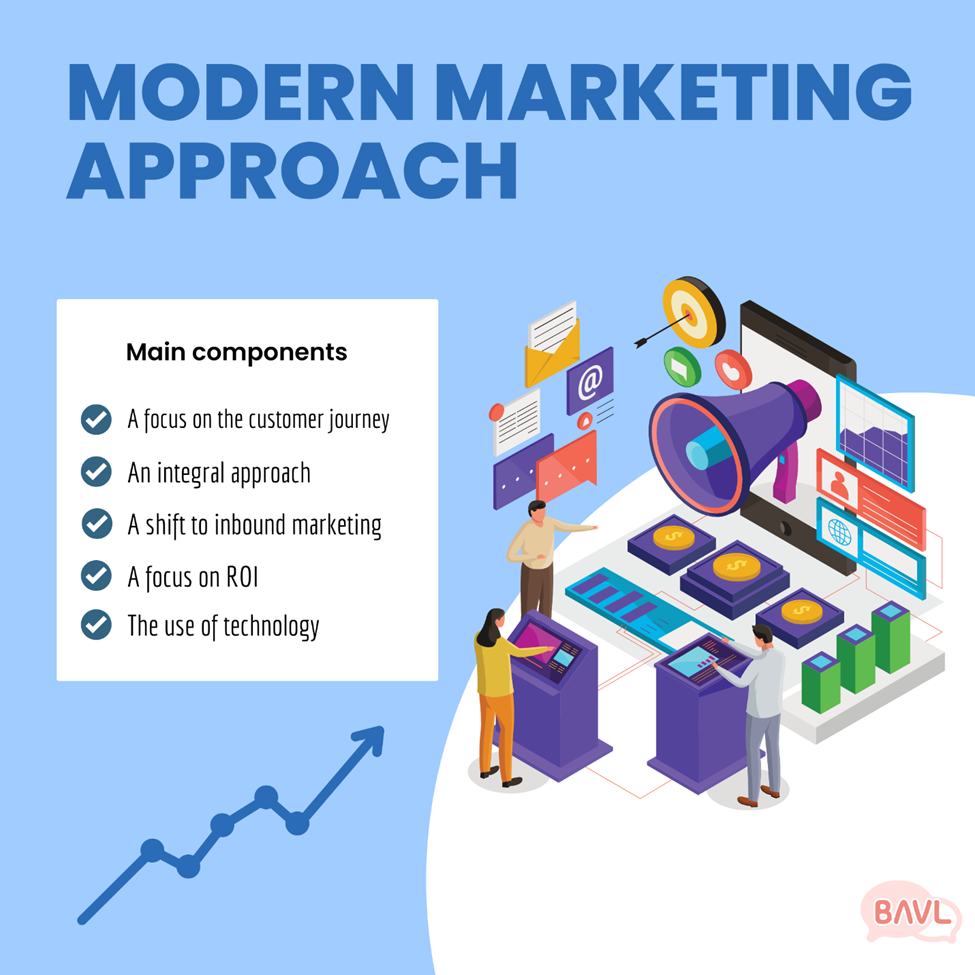
Components of a modern marketing approach
1. A focus on the customer journey Gone are the days of one-size-fits-all marketing. To be successful, businesses must now focus on creating a personalized customer journey. This means understanding where your customers are in their buyer’s journey and creating content that meets them there.
2. An integrated approach Modern marketing is all about integration. No longer can businesses silo their marketing efforts. Instead, they must take an integrated approach that combines all aspects of their marketing mix to create a cohesive strategy to increase its impact.
3. A shift to inbound marketing Gone are the days of interruption marketing. Inbound marketing is now the name of the game. This type of marketing focuses on creating helpful, relevant content that draws customers in rather than pushes them away. It’s all about providing value first to genuinely help them solve their needs with a basic solution, building trust, and finally converting them into happy paying clients.
4. A focus on ROI In the past, businesses would often throw money at marketing efforts with no real way to measure their ROI, or return on investment. Today, however, companies must be focused on ROI. With the use of data and analytics, businesses can now track their marketing efforts and see exactly what’s working and what isn’t, fine-tune their strategy, and correct it along the way.
5. The use of technology Technology has completely changed the landscape of marketing. From marketing automation to big data, businesses now have easy access to a wealth of tools and data that can be used to improve their marketing efforts, and this is our main focus for this article.
In short, if you want to be successful in today’s market, you must adapt your marketing efforts to meet the needs of the modern consumer. Focusing on the customer journey, taking an integrated approach, and using technology to your advantage can set your business up for success.
How does NLP fit in?
Technologies that can analyze, understand, and respond to human language are becoming increasingly prevalent. With the rise of voice-activated assistants like Siri, Alexa, and Cortana, and chatbots that can mimic human conversation, it’s clear that companies are heavily invested in natural language processing (NLP). Marketing has always been about understanding the context in which our audience makes decisions. NLP provides more context by helping us understand the meaning behind the words people use. This makes NLP hugely applicable to marketing, as it can be used to help answer questions such as:
• What makes people click on our ads?
• What makes potential clients bounce off our landing page?
• What makes them inquire about our services, only to then not avail them?
• What is our target audience looking for, and how can we provide more value to serve them better?
There are many ways to use NLP in marketing, such as understanding customer sentiment, building chatbots, identifying trends, scaling content creation, and leveraging NLP for voice assistants. Here are a few ways that companies are using NLP in marketing.
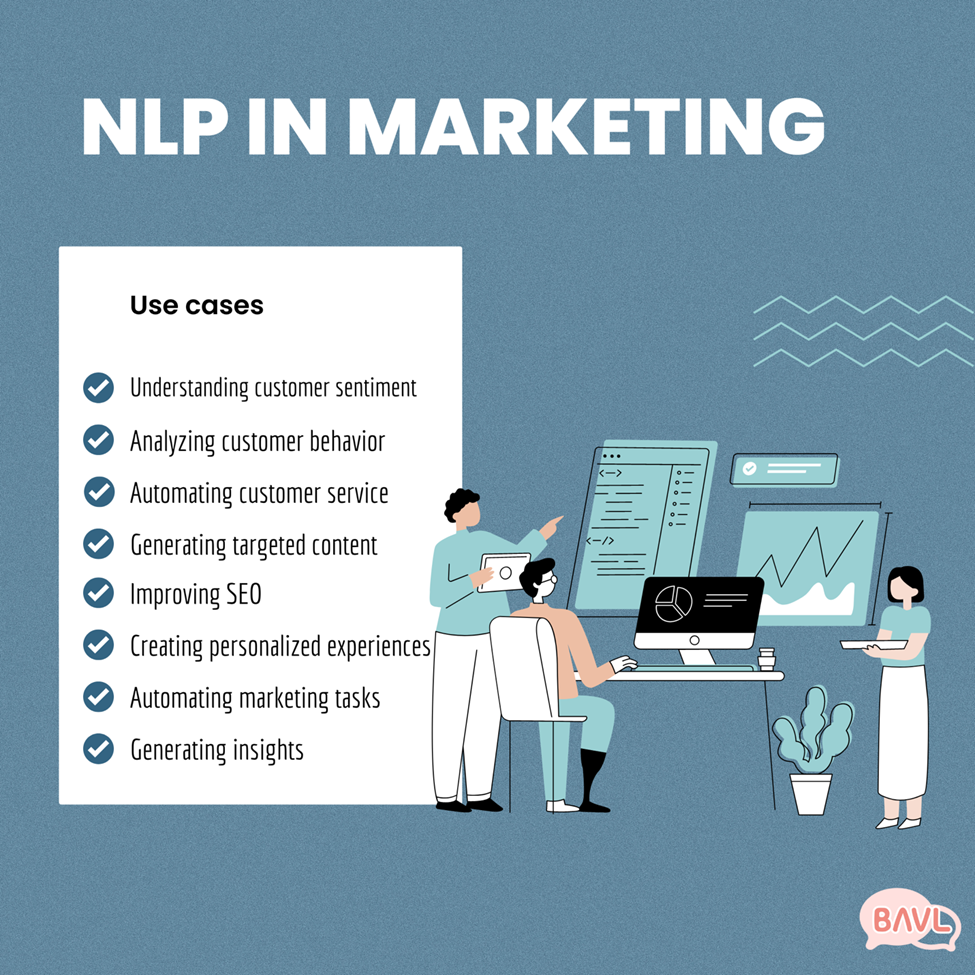
Use of natural language processing in marketing
1. Understanding customer sentiment NLP can be used to analyze customer sentiment in social media posts, reviews, and customer service interactions. This understanding can improve the customer experience, resolve issues more quickly, and create targeted marketing campaigns.
2. Analyzing customer behavior NLP can be used to identify patterns in customer behavior. This understanding can be utilized to learn about customer habits that, in turn, can improve how they experience your products and services and make recommendations.
3. Automating customer service NLP can be used to create chatbots that can mimic human conversation. This can automate customer service tasks, such as answering common questions, making recommendations, and scheduling appointments.
4. Generating targeted content NLP can be used to analyze a customer’s interests and intent. This understanding can generate targeted content, such as blog posts, e-books, and even newsletters, with interesting and relevant content that helps improve engagement.
5. Improving search engine optimization NLP can be used to analyze customer queries and identify trends. This understanding can be used to improve search engine optimization (SEO) and ensure customers can find the content they’re looking for by utilizing the right keywords in all your communications.
6. Creating personalized experiences NLP can be used to create personalized experiences for customers. These experiences can come in the form of relevant recommendations, customized content, and a series of personalized interactions that provide a more pleasant and memorable experience.
7. Automating marketing tasks NLP can be used to automate marketing tasks, such as identifying potential customers, segmenting customers, and creating targeted marketing campaigns. This alone can help companies save a considerable amount of time in research that in the past would take hundreds of hours when done by other means.
8. Generating insights NLP can be used to generate insights from data. This understanding can help improve marketing strategies, make decisions about product development, and identify new business opportunities.
Final thoughts and a shameless plug
To summarize, NLP provides marketers with advanced tools that allow them to provide a better experience to customers. When it comes to marketing analytics, NLP can be used to understand your audience’s intentions so that you can create smarter, more efficient marketing strategies, which allows you to be more relevant, granting you attention, and with the right approach, you can stay in a constant conversation with your target audience. Once the audience is engaged, NLP provides the tools to cater to each client’s specific needs as a faster and more cost-effective solution for companies competing in an ever-evolving market.
Now that we have your attention, we want to hear directly from you and understand how you found this content. We’d appreciate it if you could email us at bavl@lexcode.com. Here at Lexcode, we run several platforms in the language industry, and we would be delighted to explore the multiple ways we can help you take your business to the next level.
For all your translation and localization needs, LEX-Cloud is an enterprise-level translation platform based on Lexcode’s 20 years of experience. Get started in only five minutes, and transform language barriers into opportunities.
Whenever you need interpretation services on demand, you can find interpreters for every language at eQQui, an innovative interpretation platform that brings technology-driven opportunities.
BAVL is an industry-proven language data solutions platform that allows you to transform the infinite value of language data into experiences and knowledge to create new opportunities by building language datasets in any language or subject to power the future of human communication.
Journal Lab aims to make your research and knowledge more accessible to your readership through the linguistic expertise of Lexcode, our AI data solutions, and a community of editors, authors, peer reviewers, data experts, and linguists. We research your research for editing excellence in theory, in practice, and on paper.
Our goal with this article is to provide insights into the industry and, hopefully, get you curious about our services so we can help you solve your business needs. Let’s get connected; please leave us a comment here on the blog or email us at bavl@lexcode.com. We’d love to hear from you!
메타데이터
- post_id
- 98bb76f1ed57
- slug
- using-natural-language-processing-in-marketing-98bb76f1ed57
- url
- https://medium.com/@BAVL/using-natural-language-processing-in-marketing-98bb76f1ed57
- canonical_url
- https://medium.com/@BAVL/using-natural-language-processing-in-marketing-98bb76f1ed57
- author_url
- https://medium.com/@BAVL
- status
- ok
- fetched_at
- 2026-06-10 08:17:25