#Weeknotes 174 (7 Jun) — Two Conferences, One Thread
Reflections from SXSW London and Summer at the Wharf
#Weeknotes 174 (7 Jun) — Two Conferences, One Thread
Reflections from SXSW London and Summer at the Wharf
This week, my head has been buzzing with existential questions. My body has been holding a tangle of feelings: dread, overwhelm, awe, and hopefulness, sometimes all at once. This is due to my attendance at two conferences in one week, both grappling with the same urgent questions about how we work, live, and relate to each other in an age of AI, climate crisis, and mounting uncertainty.
The two conferences couldn’t have been more different on the surface.
SXSW London: over 20,000 attendees, £300+ for a day pass, Michelle Obama, Pete Tong, K-pop artists flown in from Korea, sessions spread across more than ten venues. Summer at the Wharf by Made by Many: roughly 100 people, £10–15 a ticket, one venue, one track of talks, comedy in the evening (which was genuinely brilliant).
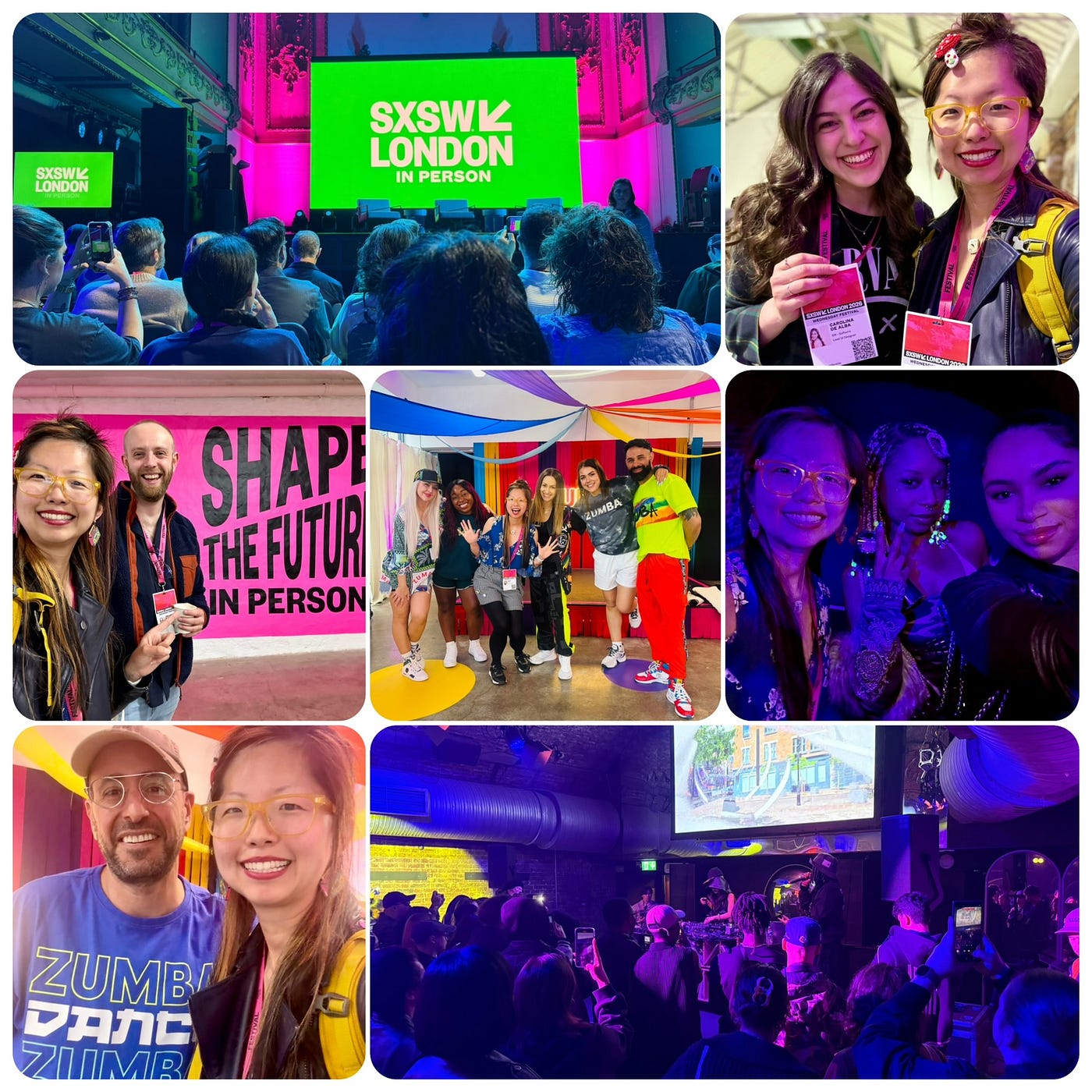

Conference vibes comparison between the two conferences. One feels like a big production festival while the other more fringe and intimate
It might seem unfair to compare them as they’re clearly built for different purposes and different audiences. But I went to both with the same three goals: to gauge current sentiment about our modern challenges; to get inspired by different perspectives; and to connect with people working across different spaces and have thoughtful conversations. Both conferences delivered on the first two. But for the third, the genuine human connection, Summer at the Wharf won hands down.


#SXSW venue map vs the one location venue at Summer at the Wharf by Made by Many
The small scale was an advantage. One venue, one track of talks, meant everyone had a shared experience. There was no rushing off to the next session 10 minutes down the road. The atmosphere was relaxed, intimate, unhurried. The conversations that emerged were natural extensions of what we’d just heard together, rather than strangers scrambling to network between slots. It reminded me, again, that the conditions for genuine connection aren’t created by scale. If anything, scale works against them.
Despite their differences in format and feel, both conferences kept returning to the same tension: how do we hold onto what’s most human about us in a world that increasingly doesn’t seem to require it?
The answer, across speaker after speaker, was more hopeful than I expected.
On modern branding, speakers like Elisa Gregori, Gráinne Wafer, and Jay Richards at SXSW and Lucinda Bounsall and the Troupe at OK COOL from Summar at the Wharf enforced the audience’s need for authenticity. They shared how to approach modern brand building, and it’s not chasing trends but building worlds to help people attach to meaningful identities and a sense of belonging while enriching culture and rituals.
Baroness Beeban Kidron reminded us that as individuals, we have more agency than we think, from putting our phones down when we can (especially as parents of young children) to demanding greater scrutiny of our technology policies. Movements start with individuals. The ripple effect of one person’s action shouldn’t be underestimated.
Oliver Sweet, author and head of ethnography, delivered a sharp wake-up call with some uncomfortable data. His research showed that young people on average spends about four hours a day on social media, which roughly translates to about 700 posts engaged with daily. When asked how many they remembered from the day before, most people could recall just 5 or 6. That’s 500 moments of attention, mostly gone. It’s the kind of statistic that should give us pause about where our time and focus actually go and whether we’re making those choices deliberately.
Matt Webb and Sarah Gold had an interesting conversation on the difference between how humans remember and how machines do. They made a case for the value of forgetting, for ephemeral conversations that don’t get recorded, reduced to data points, and fed back into a system. Real innovation, they argued, comes from people socialising, from serendipitous encounters, from the kind of spontaneous human friction that language models simply don’t have the social intuition to replicate. We need more conditions for serendipity.
Louis VI, rapper, musician, zoologist, and film presenter, made a compelling case for the power of language and storytelling. Something as small as shifting “net zero economy” to “free energy economy” changes how people engage with a conversation, removing the political freight that stops people from feeling like it’s for them. His broader argument: we need better language, more coordination between sectors, and a way of helping people understand they’re not alone in this. Storytelling, in all its forms, is how humans connect with each other, with their surroundings, and with nature. It’s more infrastructure than a soft skill.
Jenny Kleeman, journalist and author, reinforced this with the example of Avatar therapy, a technology-enabled treatment that helps people with psychosis externalise and confront the voices they hear. It works because it’s built around a real human need, with the right story to support it. Technology in service of people. Not the other way around.
And then there was Alberto Perlman, co-founder of Zumba, which happens to be my favourite workout, so I may be slightly biased. He spoke about what’s kept a 25-year-old fitness brand not just alive but thriving (currently the number 1 fitness brand!). The answer wasn’t a perfect product or a clever marketing strategy. It was listening. Relentlessly leaning into what their community actually wanted: connection, shared experience, freedom, joy through movement. As someone who goes to Zumba every Saturday morning, I can feel that the brand is indeed led by love and community. That isn’t accidental. You build it by putting people first, consistently, over decades.

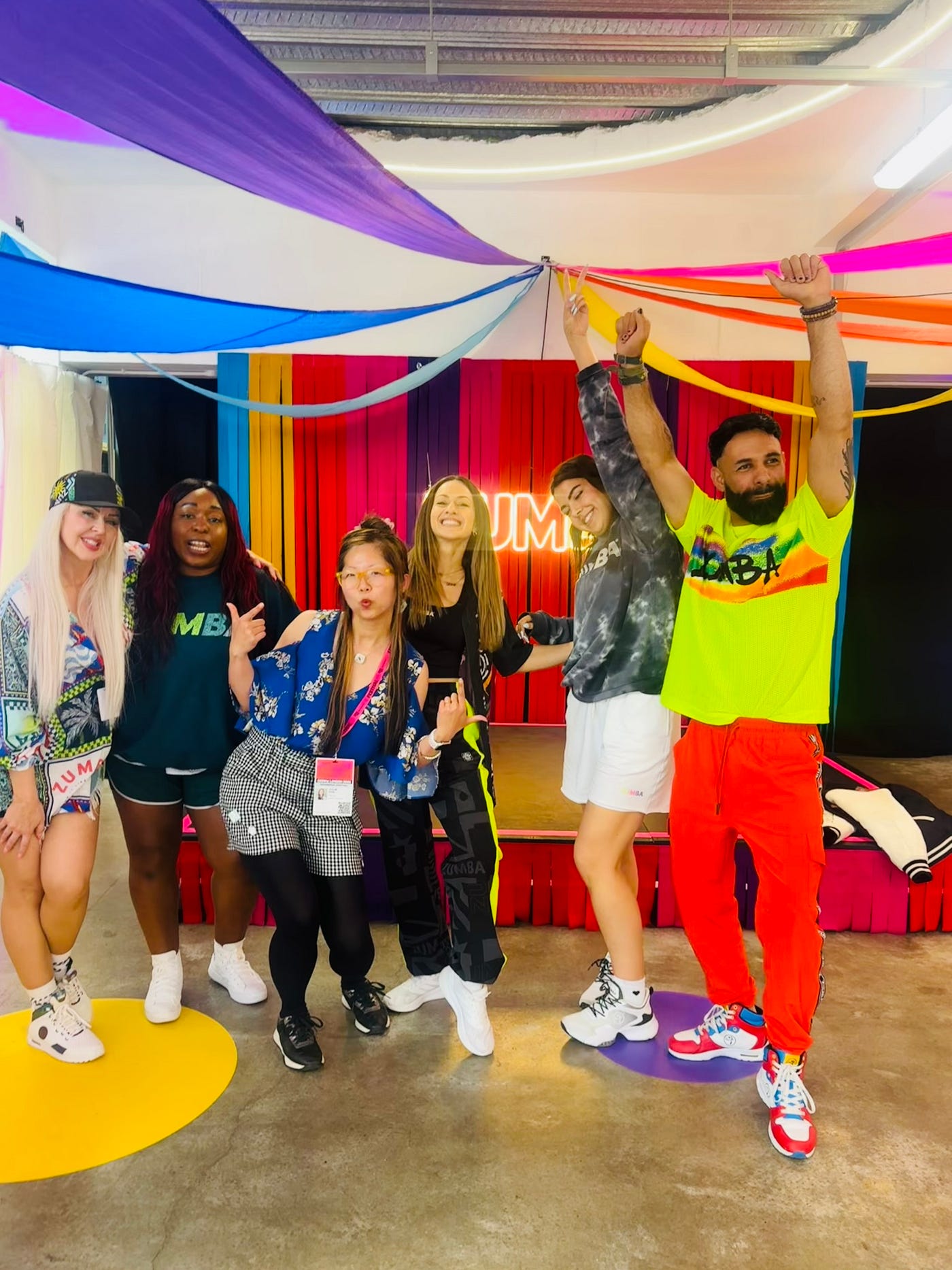
My highlight from SXSW London was undoubtedly the Zumba presentation by its co-founder and then dancing with the amazing team of high energy Zumba instructors between sessions. ❤
On the technology and design side of things, the conversations were equally energising and affirming.
Jade Pughe, a creative technologist, put it simply: AI creates “mid” answers. Designers bring human eyes and insight. Adam Morris, VP of Product Design at The Economist, went further: the ultimate remit of a designer is to build the right thing, to understand what businesses and people actually care about. The thinking matters. Without that thinking, we’re just shipping poor experiences faster.
Joel Lewis and Iain Tait offered something genuinely hopeful: AI is now enabling people with deep, specialised expertise to build and create without being held back by a lack of computer science knowledge. The barrier between having an idea and being able to realise it is getting lower, and that’s a good thing, if we’re intentional about it.
There’s a lot I’m still processing. My head hasn’t had the time or space to properly work through everything I heard. But if I had to distil the feeling across both conferences into a single thread, it would be this: amongst the uncertainty, fear, distrust, and paralysis of modern life, there is an unmistakable sense of human potential pushing back.
Younger generations are taking matters into their own hands. Successful brands are leaning into people’s craving for authentic shared experience. The most resonant ideas this week weren’t about what technology can do, but rather about what humans can do alongside it, and in spite of it.


Sessions from Summer at the Wharf that discussed the impact of AI on designers.
What the week ultimately gave me was a clearer articulation of something I’ve felt for a while but struggled to convey succinctly.
My work as a designer has so little to do with the artefacts I produce at the end of a project. It has everything to do with the process and the journey that led to them.
The deep listening to users, to stakeholders, to the silences in a room when something isn’t quite right. The gathering of evidence to understand which problems are really worth solving. The work of getting the right people in the same space and helping them align, connect, and actually hear each other. The storytelling that makes complexity legible to people who don’t share your vocabulary. The facilitation that holds a team together when uncertainty threatens to pull it apart.
These are the things I do that I can point to and say: this moved something forward. Not the polished Figma prototype or the carefully crafted interface, though those have their place. The real value has always lived in the relational, the interpretive, the deeply human parts of the work. Empathy. Interpersonal sensitivity. The ability to translate between worlds. These are not soft skills. They are the whole job. And they are developed slowly, through lived experience, through thousands of conversations, through failures and repairs and the gradual accumulation of pattern recognition that no model can shortcut.
The artefacts: the wireframes, the prototypes, the decks, can be, and increasingly are being, generated faster and more efficiently than I can produce them. That used to unsettle me more than it does now. Because what I understand more clearly after this week is that the artefacts were never the point. They were always evidence of a process. And the process: the thinking, the questioning, the human navigation of complexity and competing needs, that’s where I work and live. That’s what I’m for.
Jade said it plainly: AI gives you the “mid” answer. The human brings the eyes.
I know whose eyes I want looking at the problem.
For that, I remain hopeful about the future need for designers like me. And more broadly, hopeful about the future of all of us messy, resilient, connection-hungry humans navigating this together.
메타데이터
- post_id
- 98c88bc3ee04
- slug
- weeknotes-174-7-jun-two-conferences-one-thread-98c88bc3ee04
- url
- https://medium.com/@julie-sun/weeknotes-174-7-jun-two-conferences-one-thread-98c88bc3ee04
- canonical_url
- https://medium.com/@julie-sun/weeknotes-174-7-jun-two-conferences-one-thread-98c88bc3ee04
- author_url
- https://medium.com/@julie-sun
- status
- ok
- fetched_at
- 2026-06-21 15:33:18






