Ebola in Goma — May 2026
When a Cholera/WASH Program Is Mistaken for an Ebola Response
All rights reserved Virginie Guignard-Legros & ECOSYSTEM VLG world
Ebola in Goma — May 2026
When a Cholera/WASH Program Is Mistaken for an Ebola Response
by Virginie Guignard Legros — Founder of ECOSYSTEM VLG World
The recent Ebola alert in Goma raises serious concerns.
One of them is not only the virus itself.
It is also the risk of confusion between different levels of sanitary response systems.
The humanitarian WASH/Cholera community initiative deployed in Goma through human social relay networks was originally initiated and structurally designed within the framework of ECOSYSTEM VLG World by Virginie Guignard Legros.
This approach mobilized hundreds of local actors and humanitarian consortium members through decentralized community coordination logics adapted to the realities of the field.
These systems were specifically designed because traditional international structures often struggle to deploy sufficiently localized, fast, and community-anchored operational models in highly unstable environments.
The objective was to structure:
- hygiene awareness,
- community vigilance,
- local sanitary relays,
- decentralized prevention mechanisms,
- and rapid community coordination capacities.
However, it is essential to state clearly:
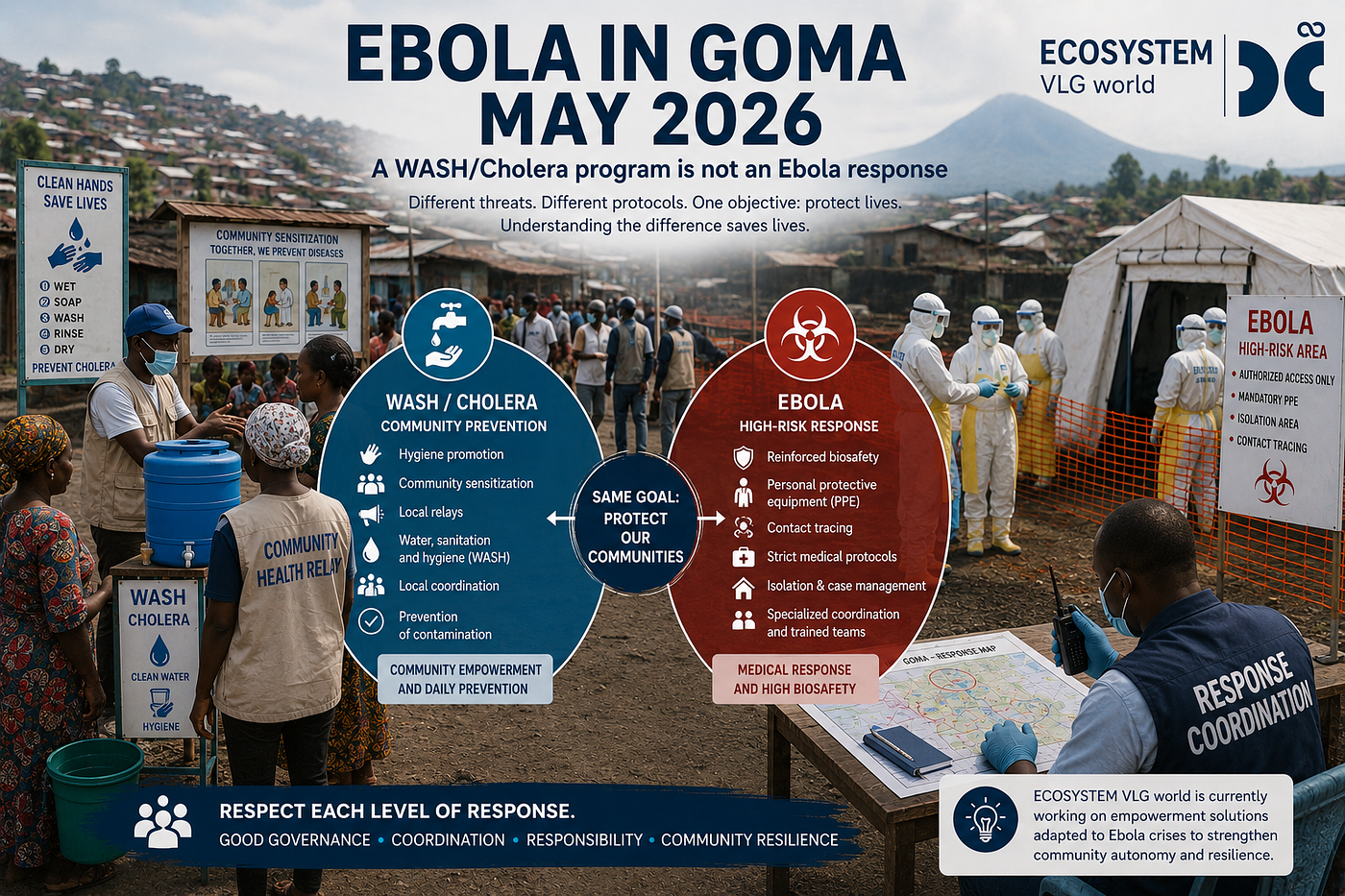
A cholera/WASH program is NOT an Ebola response system.
Some preventive measures overlap:
- hand washing,
- sanitation,
- awareness campaigns,
- local vigilance,
- community coordination.
But Ebola requires a completely different biosafety level:
- biological fluid management,
- reinforced protection procedures,
- specialized protective equipment,
- contact tracing,
- strict medical protocols,
- high-risk containment procedures.
Confusing these layers can become dangerous if populations or organizations believe that a standard WASH response is sufficient for Ebola containment.
This is precisely why governance, methodology, operational briefing, and field coordination matter.
At ECOSYSTEM VLG World, humanitarian frameworks are not designed as freely reusable templates disconnected from their governance structure.
Programs, operational methodologies, deployment logics, and community systems are linked to:
- contextual adaptation,
- trained teams,
- governance rules,
- operational supervision,
- and licensing frameworks.
This is not a question of prestige or communication visibility.
It is about avoiding dangerous reinterpretations, operational distortions, or incomplete deployments in crisis situations where lives are directly at stake.
In highly sensitive humanitarian environments, partially reusing systems without their governance layer can create serious risks:
- false security,
- operational confusion,
- weakened coordination,
- inappropriate sanitary responses,
- or dangerous misunderstanding of risk levels.
At the same time, ECOSYSTEM VLG World is currently reflecting on community empowerment and resilience solutions adapted specifically to Ebola-type crises.
The objective is not only emergency reaction, but also helping local populations develop safer autonomous capacities for:
- community vigilance,
- sanitary coordination,
- prevention support,
- trusted relay systems,
- and resilient local organization during crisis situations.
Protecting communities also means protecting the integrity and correct interpretation of the systems designed to support them.
© ECOSYSTEM VLG World Humanitarian Governance & Community Resilience Frameworks Author: Virginie Guignard Legros
메타데이터
- post_id
- 98dd4be068a7
- slug
- ebola-in-goma-may-2026-98dd4be068a7
- url
- https://medium.com/@info.ecosystem.vlgworld/ebola-in-goma-may-2026-98dd4be068a7
- canonical_url
- https://medium.com/@info.ecosystem.vlgworld/ebola-in-goma-may-2026-98dd4be068a7
- author_url
- https://medium.com/@info.ecosystem.vlgworld
- status
- ok
- fetched_at
- 2026-06-17 08:20:12