No, Amazon Does Not Own 90% of the Used Book Market
That stat is in every antitrust debate, every “you can’t compete with Amazon” post, and every publishing panel. It’s real, but it’s…
No, Amazon Does Not Own 90% of the Used Book Market
That stat is in every antitrust debate, every “you can’t compete with Amazon” post, and every publishing panel. It’s real, but it’s measuring a completely different market. Here’s what the data actually says.
Disclosure: I’m the founder of BiblioScan, a book-scouting app I reference once or twice below. This is a research piece built on antitrust filings, Carnegie Mellon data, and company financials — not a pitch. Sources are linked throughout.
There’s one number that shows up in nearly every article, podcast, and LinkedIn post about the book business: “Amazon controls 90% of the used book market.” It’s in antitrust debates. It’s in publishing panels. It anchors every “why you can’t compete with Amazon” piece.
It’s wrong.
Or more precisely: it’s a real statistic about a different market. Amazon does control ~90% of something in books — just not used books. I spent a few days in antitrust filings, Carnegie Mellon research, and the financials of ThriftBooks, AbeBooks, eBay, and Better World Books. The real picture is far more interesting, and far more useful if you resell books, than the lazy “Amazon owns everything” story.
The three Amazon numbers everyone mixes up
Almost all the confusion comes from collapsing three separate markets into one. Amazon’s share of US books actually breaks down like this:
- E-books (Kindle ecosystem): ~90% — per the Hagens Berman antitrust filing.
- New print books sold online: ~90% — per the House antitrust subcommittee report.
- All print books, all channels: ~50%+ — same report.
- Used books (global): 40–45% — per Persistence Market Research.
The “90%” everyone repeats comes from the e-book and new-books-online categories. Those are genuine near-monopolies, and the FTC and Congress are actively scrutinizing them. But the used book market — the subject of this piece — is a different beast. Amazon leads it. It’s nowhere near 90%.
How big is the US used book market?
The numbers are substantial:
- US used book market (2023): $5.29 billion, projected to reach $8.64 billion by 2032 (5.6% CAGR).
- Global used book market (2024): $14.65 billion, projected at $45.1 billion by 2033.
- Online share of used sales (global): 41%.
(Sources: Credence Research, Fact.MR, Persistence Market Research.)
That $5.29B sits inside a much larger $32.5B US book publishing industry — so used books are roughly 16% of the total US book business by value, notably lower than in a market like France.
Who actually sells used books in the US
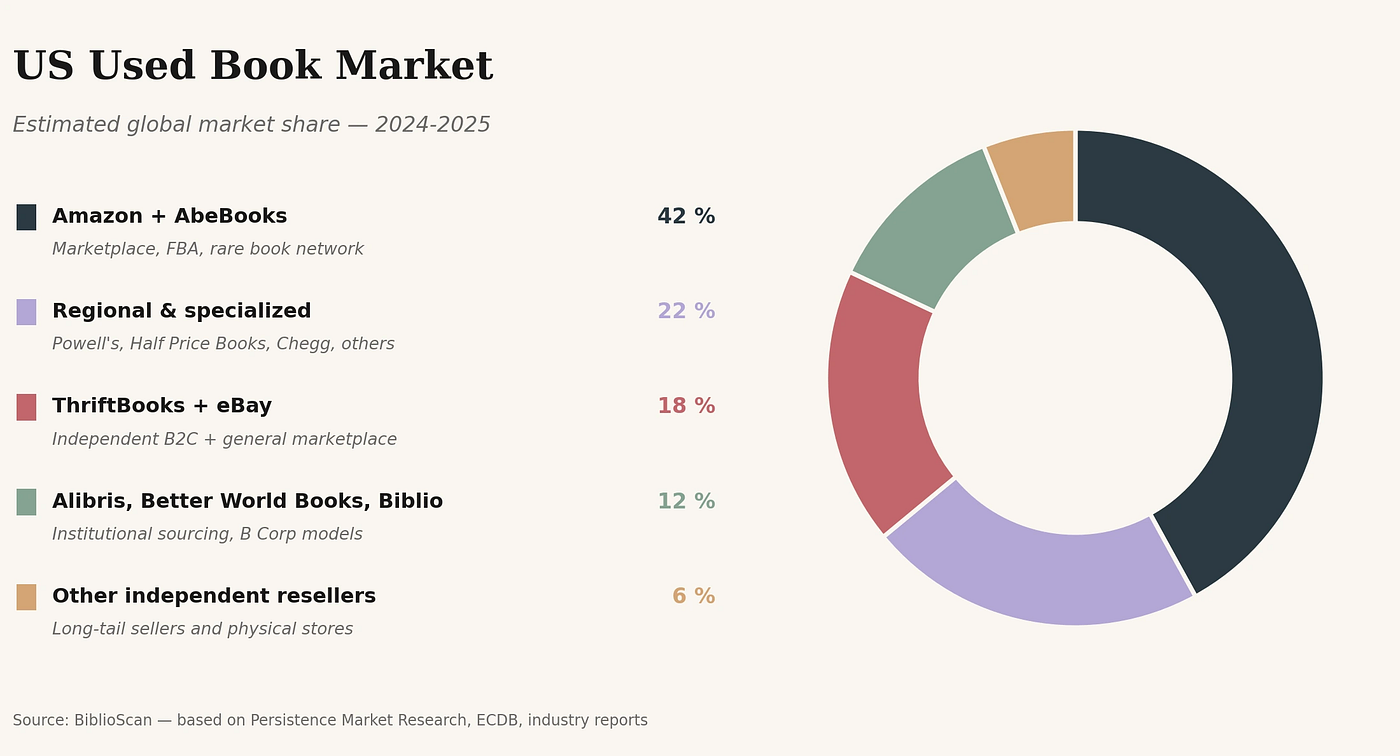
Based on global share estimates, the field looks like this:
- Amazon (including AbeBooks): 40–45% — marketplace plus FBA logistics plus rare/specialist acquisition.
- ThriftBooks + eBay: 15–20% — ThriftBooks is centralized B2C; eBay is fragmented C2C.
- Alibris, Better World Books, Biblio: 10–15% — ethical positioning, institutional sourcing, rare books.
- Regional and specialized: 20–25% — Powell’s, Half Price Books, Chegg (textbooks), independent stores.
The dynamics behind each are very different, and that’s where it gets interesting.
Amazon: the infrastructure, not the seller
Amazon isn’t really a used-book seller in the traditional sense — it’s infrastructure. The used books “on Amazon” are overwhelmingly sold by third parties, over 2 million active marketplace sellers, many book specialists. The typical flow: a seller sources used books from thrift stores, estate sales, or library liquidations; scans each one with a scout app to pull sales rank, FBA competition, median resale price, and profit estimate; targets roughly a 4x multiplier at purchase to absorb fees; ships inventory to a fulfillment center (FBA); and Amazon handles storage, shipping, returns, and support for a ~15% commission plus FBA fees.
Amazon also owns AbeBooks (acquired 2008), the leading platform for rare and antiquarian books. That’s why its grip on collectibles is so strong: it owns both the mass-market platform and the specialist one.
The dark side is commingling. Amazon treats identical ISBNs from different sellers as interchangeable for logistics. A copy you sent from California might ship to a New York buyer from someone else’s Pennsylvania stock. If one seller mixes in counterfeit or poor-condition copies, every legitimate seller’s reputation takes the hit — a problem especially documented in pricey textbooks and bestsellers.
ThriftBooks: the independent giant that actually works
This is the most interesting story in the US used book industry. ThriftBooks started in 2003 as just another third-party Amazon seller, then pivoted hard in 2007 to launch its own site. Today:
- 2024 revenue: $276 million on thriftbooks.com alone (ECDB).
- 13–19 million SKUs, and 250 million books sold since inception.
- Double-digit revenue growth sustained for over a decade, with holiday sales up 20% YoY in 2023 — and no discounting during Cyber Week.
Their whole strategy is escaping the Buy Box race-to-the-bottom that Amazon forces on sellers. Instead they own the customer (direct-to-consumer), run a ReadingRewards loyalty program, use generative AI for recommendations (great for out-of-print titles), and deploy proprietary dynamic pricing that adjusts across thriftbooks.com, Amazon, eBay, and Walmart in real time. ThriftBooks is proof you can build an independent used-book business at scale in the US — but the entry cost (proprietary logistics, millions in tech, 20 years of compounding) is out of reach for individuals.
eBay: the declining pioneer
eBay is still enormous overall ($73.2B GMV in 2023, 132M buyers), but on used books specifically it’s been losing ground for structural reasons. Conversion runs ~1–3% on eBay versus 10–15% on Amazon, because Prime pre-sells buyers on fast shipping eBay can’t match. Amazon unifies every offer for an ISBN on one page; eBay scatters the same book across hundreds of listings. And there’s no eBay equivalent to FBA at scale.
Where eBay still wins: rare, signed, vintage, and condition-specific books — when the photos matter more than the barcode. But for bulk volume on modern titles, most pros I know have moved to Amazon FBA with a secondary ThriftBooks listing.
Better World Books: the ethical B Corp
Founded in 2002 and B Corp certified, Better World Books has resold, reused, or recycled 475M+ books, donated 38M+, and raised $35M+ for literacy. Its real edge is free sourcing: libraries and universities prefer liquidating stock to a B Corp, which means a steady flow of merchandise at near-zero marginal cost. Not ThriftBooks’ scale, but a consistently profitable niche.
Textbooks: a whole different market
Here’s a big US-versus-everywhere-else difference: college textbooks, the single most profitable niche in the US used book market, with no real equivalent in most of Europe. New textbooks run $100–300 a copy; the average full-time four-year student spent about $1,290/year on books and supplies in 2024–25; the US higher-ed course-materials market was $4.35 billion in 2024. Around 40% of students buy textbooks from Amazon, and 45% of textbooks are bought usedper McKinsey’s survey.
The key players: Chegg (rentals plus study help — $616M revenue in 2024 but falling fast, down ~14% YoY with an $837M net loss, gutted by ChatGPT eating its study-help business); Amazon (40% of student purchases); campus stores(mostly Barnes & Noble College or Follett); and ThriftBooks/AbeBooks for older editions.
For resellers, textbooks stay the highest-margin category if you source cheaply. End-of-semester campus liquidations, library sales, and estate sales are the classic goldmine — a textbook bought for $2 can sell for $80–150. The math genuinely doesn’t work like this anywhere else in the world.
The Carnegie Mellon finding nobody in publishing cites
This is the part the “Amazon is killing publishing” camp never mentions, because it undercuts the whole narrative. In 2006, Carnegie Mellon researchers ran the first rigorous economic analysis of used book sales on Amazon using actual transaction data. What they found:
- Cross-price elasticity between new and used demand: 0.088 — essentially zero.
- Only 16% of used sales cannibalize a new sale. The other 84% are net-new buyers who wouldn’t have paid new prices at all.
- Average used discount versus new: about 50%.
- Annual consumer surplus created: +$67.2 million. Publisher loss: -$45 million — just 0.3% of total profits.Amazon profit captured: +$65.8M. Net welfare: +$87.9 million.
Translation: used sales on Amazon don’t kill new sales. They create a mostly additional market of price-sensitive buyers. The Authors Guild and publishers have lobbied against used sales for twenty years on an intuition the data simply doesn’t support. The ones who actually lose are long-tail authors and small presses — but in aggregate, the cannibalization fear is wildly overstated.
Where Amazon actually gets sued
The US has no fixed-price book law like France’s loi Lang; regulation runs through antitrust — and here Amazon is in real trouble, though again not over used books. The central charge in the ongoing suits (Bookends & Beginnings, Hagens Berman, and related) is Amazon’s use of Most-Favored-Nation “price parity” clauses with the Big Five publishers.
MFN clauses guarantee Amazon gets at least as good a deal as any rival retailer. If Penguin Random House gives Barnes & Noble a 5% promo, Amazon automatically matches or beats it. The effect: competition is mathematically neutered (no one can out-price Amazon), new-book prices stay artificially high across the market, and used sellers benefit indirectlybecause the ~50% used discount stays attractive while Amazon still takes marketplace margin on both ends. The EU reached a (widely considered toothless) settlement on the same clauses in 2017 and is now pushing for Kindle interoperability, which would actually crack the lock-in.
What I’d tell anyone reselling in the US in 2026
- Amazon FBA is still the default at scale. Over 500 books/month, the logistics and Prime shipping are hard to beat.
- Start smaller with FBM or eBay under 50 books/month — FBA fees will eat you alive on low volume.
- Textbooks are still the goldmine. Campus end-of-semester liquidations, house cleanouts, and estate sales. One rare engineering or medical title can net $100–200.
- List across ThriftBooks and AbeBooks too, not just Amazon — with dynamic pricing, that’s the standard pro playbook.
- Watch counterfeits. Amazon’s commingling is getting worse for authentic sellers; pay for no-commingle/brand-protected settings on textbooks and premium editions.
- Scout apps are non-negotiable. Nobody sources blind anymore — scan first for real median price, sales velocity, FBA competition, and net profit. (This is the problem I built BiblioScan to solve, but the principle stands whatever you use.)
- Track Keepa. A book ranked 1M+ that sells 2–3 times a year at $50 can still be a good slow-capital flip; a 50K-ranked book flooded with FBA sellers at razor-thin margin is a trap.
What’s coming in 2026
A few things worth watching: the Amazon antitrust cases (FTC plus private suits) — forced changes to Marketplace or FBA would reshape reseller economics entirely; Chegg’s decline freeing up textbook-rental share for Amazon, ThriftBooks, and AI-native entrants; generative AI reshaping book discovery (ThriftBooks is betting hard here); and sustainability shifting from nice-to-have to decisive, especially with Gen Z buyers who choose used on environmental grounds rather than pure cost.
The used book market isn’t dying. It’s growing — just not in the dramatic “Amazon ate everything” way that makes headlines. The sellers who thrive will be the ones who understand the actual market structure instead of the myth of total Amazon dominance.
TL;DR: The US used book market is worth $5.29B and growing 5.6% a year. Amazon plus AbeBooks hold 40–45% globally, not 90% — that number comes from e-books and online new books, two entirely different markets. ThriftBooks ($276M revenue) proves an independent player can scale. Textbooks remain the highest-margin niche. And Carnegie Mellon’s data shows used sales barely cannibalize new ones. Before buying any book to resell, scan it, check Keepa, and list across Amazon FBA plus ThriftBooks plus AbeBooks.
Key sources: Carnegie Mellon welfare study, ABA Amazon antitrust white paper, Persistence Market Research, Credence Research, ECDB — ThriftBooks.
메타데이터
- post_id
- 98ecb456c8ca
- slug
- no-amazon-does-not-own-90-of-the-used-book-market-98ecb456c8ca
- url
- https://medium.com/@biblioscanai/no-amazon-does-not-own-90-of-the-used-book-market-98ecb456c8ca
- canonical_url
- https://medium.com/@biblioscanai/no-amazon-does-not-own-90-of-the-used-book-market-98ecb456c8ca
- author_url
- https://medium.com/@biblioscanai
- status
- ok
- fetched_at
- 2026-08-16 02:56:05



