The Enterprise AI Readiness Gap, Revisited: What JPMorgan Chase’s Journey Suggests
Part 3 of a series on why enterprise AI programs fail before they start
The Enterprise AI Readiness Gap, Revisited: What JPMorgan Chase’s Journey Suggests
Part 3 of a series on why enterprise AI programs fail before they start
In the previous piece in this series, I argued that the enterprise AI readiness gap is fundamentally an organisational problem — one of accountability, ownership, and incentives — rather than a technology one. The architecture had changed in most serious enterprises. The organisational structures sitting around it largely had not.
A fair question follows: what does an enterprise that has meaningfully engaged with that gap actually look like? Not in theory, but in practice, with the messiness and trade-offs that real organisational decisions involve.
JPMorgan Chase is worth examining here — not as a blueprint, and certainly not as a story of perfection. It is worth examining because it is one of the more documented cases of an enterprise that appears to have treated the organisational questions with the same seriousness it treated the technology ones. And when you look at what they actually did, two structural patterns stand out that seem relevant well beyond their specific context.
Pattern One: Where the Function Sits Is a Signal, Not a Detail
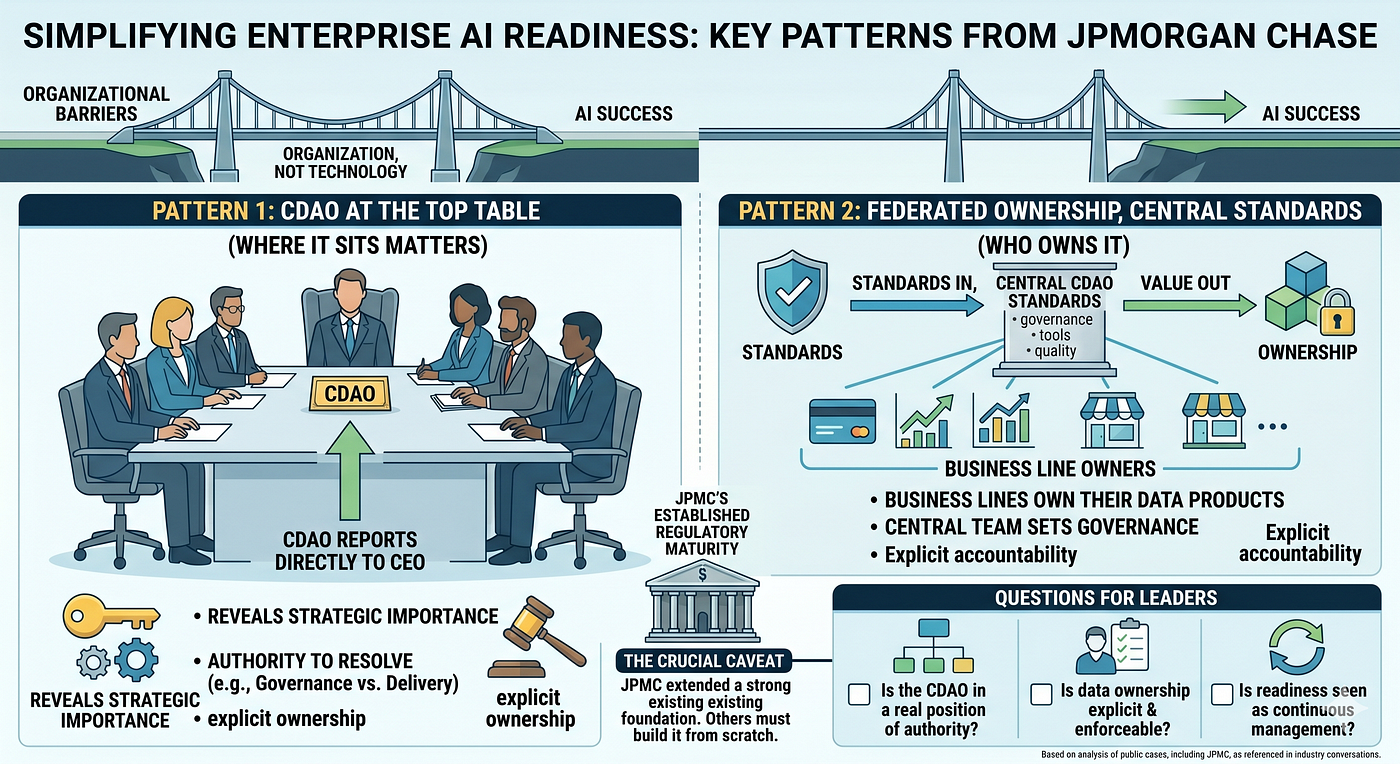
In mid-2023, JPMorgan Chase made a decision that received less attention than it deserved. As Mark Birkhead, the firm’s firmwide Chief Data Officer, described in a June 2025 interview with McKinsey, Jamie Dimon and the operating committee recognised the need to create an organisation whose only job was to focus on data — pulling all data initiatives together under one umbrella. The Chief Data and Analytics Officer now reports directly to Dimon and sits on the operating committee. As Birkhead noted, that reporting line “shows how critical this function is.”
It would be easy to read this as a large bank doing something only a large bank can do — a structural luxury enabled by scale and resources that most enterprises cannot replicate. I think that reading misses the point.
The more interesting observation is about what the decision reveals rather than what it creates. Across enterprises where AI adoption appears to be gaining genuine traction — not just proof of concepts that get funded but programs that make it into production and stay there — there is a pattern worth noting. The AI and data function tends to sit closer to the top of the house. Not always at CEO level. But consistently closer than in the enterprises where adoption quietly stalls.
What JPMC’s version of this decision did, in practice, was resolve a set of questions that most enterprises leave perpetually open. Who arbitrates when the data team’s governance standards conflict with a business line’s delivery timeline? Who has the authority to enforce data ownership accountability across functions that don’t report to the same leader? Who decides, when resources are constrained, whether the pipeline ships or the semantic link to the policy document gets maintained?
In most enterprise org structures, these questions get answered by negotiation, seniority, and whoever is most persistent in the room. The function that owns the AI and data mandate rarely has the organisational weight to consistently win those negotiations. The result is that the governance commitments made in strategy documents get quietly deprioritised in execution — not because anyone decided to abandon them, but because the structure never gave them a fair fight.
Where the function sits does not guarantee that these questions get answered well. But its absence from the right level of the organisation is a fairly reliable early indicator of where the accountability gaps will eventually surface.
Pattern Two: Ownership That Is Federated But Not Abandoned
The second pattern is subtler, and in some ways more directly relevant to the specific problem the previous article identified — the question of who owns the knowledge assets, the policy documents, the governing definitions that AI systems now depend on.
JPMorgan Chase’s answer to this was not to centralise ownership in a data team that becomes a bottleneck, nor to fully decentralise it to business lines that then interpret governance standards inconsistently. What they built was something more considered: business lines carry the ownership and accountability for their data products, while the central function sets the governance standards, provides the tooling, and holds the line on quality.
Birkhead described the underlying principle directly in the same McKinsey interview: “Because these teams are closest to the data, we believe they should have responsibility for it and ownership of it. We provide them with data strategies around privacy and governance, and then with the capabilities and tooling to extract value from our data.”
This is worth sitting with, because it is a meaningful departure from how most enterprise data functions are structured. The typical model concentrates governance authority centrally but distributes accountability so diffusely that it effectively belongs to nobody — which is precisely the dynamic the previous article described. The policy document that governs a pricing exception doesn’t have a clear owner because the data team assumes the business owns it and the business assumes the data team does.
The federated model resolves this not by mandating a single owner for everything, but by making ownership a property of the data product itself. If you are the business line closest to that product, you own it. The central function’s job is to make that ownership legible, enforceable, and supported — not to assume it on the business’s behalf.
The specific implementation — data mesh, data fabric, or something else entirely — matters less than the underlying principle. What seems to distinguish enterprises making progress on the accountability problem is that they have made ownership explicit at the point where the knowledge actually lives, rather than leaving it to be inferred from org charts that were drawn before AI made the question consequential.
The Caveat That Deserves Its Own Paragraph
It would be intellectually dishonest to discuss JPMorgan Chase’s AI governance journey without acknowledging the context it happened in.
JPMC operates in one of the most heavily regulated environments in the world. Model risk management, data lineage, access controls, audit trails — these were not built for AI. They were built over decades in response to financial regulation, and they happened to constitute exactly the governance foundation that AI programs require. When JPMC extended its governance model to cover AI, it was extending something that already existed at a level of institutional maturity most enterprises outside financial services have never had to develop.
The two patterns above are real and worth noting. But they emerged in an organisation that had a significant head start on the governance culture underlying them. For an enterprise building that culture from scratch — without a regulatory forcing function and without the institutional memory that comes from years of model risk management — the path looks meaningfully different. The patterns suggest a direction. They do not provide a shortcut.
What This Actually Suggests for Other Enterprises
I want to be careful here about the gap between observation and prescription. What JPMorgan Chase’s journey suggests is not a checklist. It is closer to a set of questions worth asking seriously — and perhaps more importantly, worth asking at the right level of the organisation.
Where does the AI and data function actually sit, and does that position give it the authority it needs to resolve the governance questions that will inevitably arise? Not in the strategy document — in the actual org chart, with the actual reporting lines and the actual resourcing decisions that follow from them.
And on ownership: is it explicit? Not assumed, not inferred, not the subject of a governance policy that has never been operationalised. Explicit — to the point where you can name the person or team accountable when a policy document goes stale or a governing definition drifts.
These are not comfortable questions in most large enterprises, because the honest answers tend to reveal gaps that require difficult organisational decisions rather than technology investments. Which may be exactly why they keep getting left off the roadmap.
The Gap Does Not Close. It Gets Managed.
Perhaps the most useful thing JPMorgan Chase’s journey suggests is also the least satisfying: the readiness gap is not a problem to be solved and checked off. It is a condition to be actively managed as the AI program scales, as business lines evolve, and as the definition of what “ready” means keeps shifting.
The enterprises that appear to be making the most durable progress on AI adoption are not the ones that found the perfect governance framework. They are the ones that treated the organisational questions — the reporting lines, the ownership model, the accountability structures — as live, ongoing commitments rather than one-time decisions made at program launch.
The gap in this series’ title will keep reasserting itself. The question is whether the organisation is structured to notice when it does.
Source: “Data in the age of AI: A conversation with Mark Birkhead of JPMorgan Chase,” McKinsey & Company, June 5, 2025.
메타데이터
- post_id
- 98fa130a678d
- slug
- the-enterprise-ai-readiness-gap-revisited-what-jpmorgan-chases-journey-suggests-98fa130a678d
- url
- https://medium.com/@samir.madhware/the-enterprise-ai-readiness-gap-revisited-what-jpmorgan-chases-journey-suggests-98fa130a678d
- canonical_url
- https://medium.com/@samir.madhware/the-enterprise-ai-readiness-gap-revisited-what-jpmorgan-chases-journey-suggests-98fa130a678d
- author_url
- https://medium.com/@samir.madhware
- status
- ok
- fetched_at
- 2026-06-09 15:37:30