Why Most AI Projects Fail the People Side - Insights from Alexis Fink on CultureClub X
Fewer than half of successful AI implementations cut headcount. The real barriers have nothing to do with the model you choose.
Why Most AI Projects Fail the People Side
And what HR leaders need to understand before their next implementation
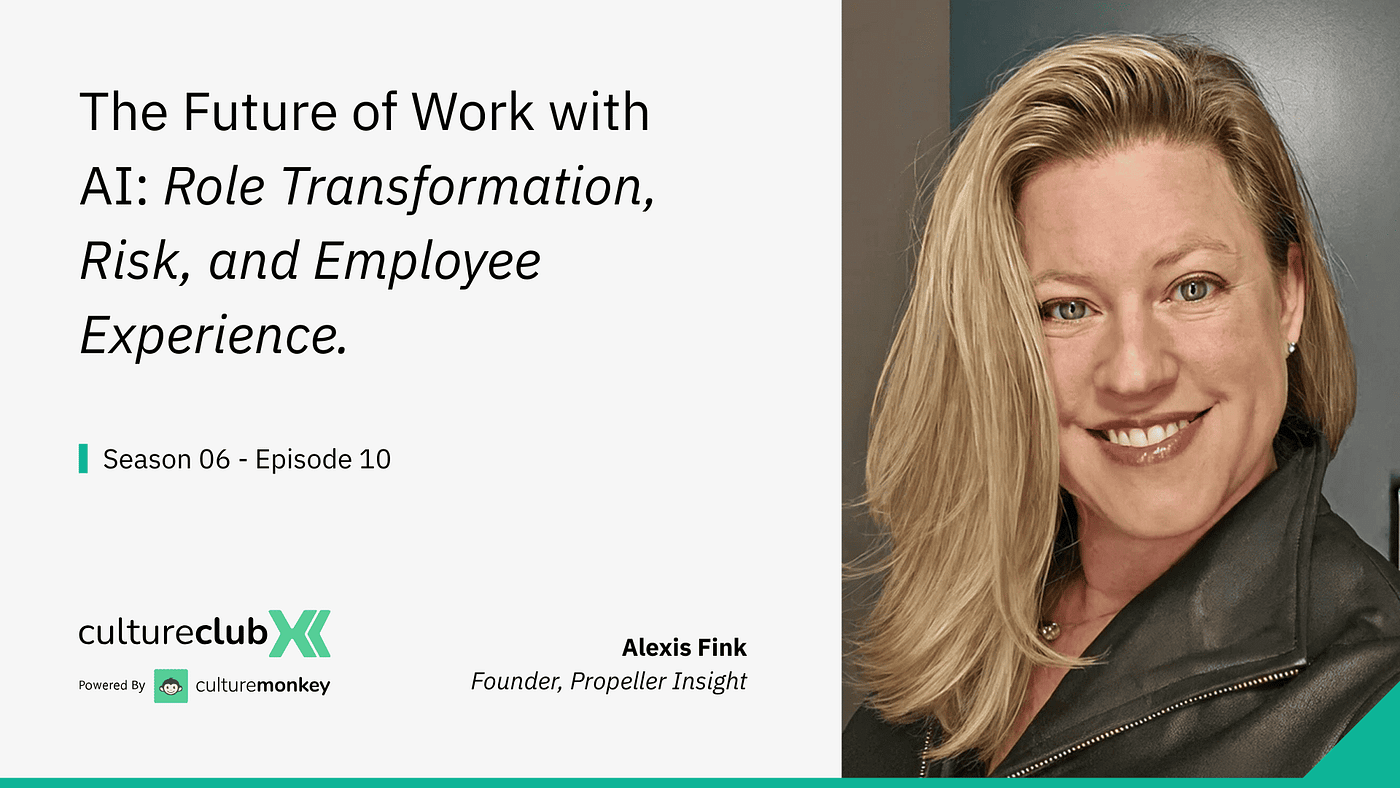
CultureClub X S06 E10 — Alexis Fink on AI, Role Transformation, and Employee Experience
A Stanford study that Alexis Fink keeps citing should make every CHRO pause. Of all the organizations that successfully implemented AI — real implementations, not layoffs with an AI label on them — fewer than half resulted in headcount reductions. The majority pointed toward upside: higher quality work, expanded capability, more done with the same people.
Most employees never hear that number. Most leaders never share it.
That gap, between what the data says and what people inside organizations actually believe, is exactly the kind of thing Fink has spent her career trying to close. As the founder of Propeller Insight and former head of people analytics at Meta, Microsoft, and Intel, she has seen what happens when organizations treat AI as a procurement decision rather than an organizational design challenge. It tends not to go well.
In a recent episode of CultureClub X, Fink sat down with host Darcy Mehta to talk through where AI transformations actually break down, how leaders are underestimating employee anxiety, and what HR needs to do right now to stay relevant.
Watch the full conversation here: CultureClub X S06 E10 — Alexis Fink on AI, Role Transformation, and Employee Experience
The technology is rarely the problem
The most common misconception Fink encounters is that AI failure is a technology problem. Teams debate models, contracts, and tooling, while the real barriers go unexamined.
“The technology, of course, is important, but it is a yes-and situation. You need to get the technology right, and you need to do more in terms of tackling the right problem and rethinking habits we have had for a century of organizational management.”
The Stanford research she references puts specific names to those barriers: integration, updating business processes, reimagining jobs, change management, and a lack of active executive sponsorship. These are not technology failures. They are organizational failures — and they are entirely preventable.
Fink draws a useful parallel with robotic process automation. RPA has existed for years. It was never widely adopted, not because it was technically difficult, but because everything around it was hard. The tools were ready. The organizations were not.
Augmented versus replaced is the wrong frame — at first
When leaders think about AI’s impact on roles, they typically reach for a binary: which jobs are safe and which are not? Fink reframes it differently. The more useful question is which roles are being augmented and which are being replaced, and the answer depends on the nature of the work itself.
Replacement-friendly work tends to be repetitive, well-described, and lower risk. Scheduling is the example she uses most often: threading calendars together is exactly the kind of task a machine can do without a person in the loop. In large organizations, some people’s entire job was scheduling. That work is genuinely replaceable.
But many roles fall on the other side. When AI makes previously impossible work possible, or lifts the quality of existing work to a level that was not achievable before, you are not in a headcount reduction. You are in a quality play or an innovation play, and those tend to pull in talent rather than shed it.
The deeper question is what sits beneath the role. When a scheduling job disappears, what were the actual skills of the person doing it? Negotiation, diligence, expertise? That person may have just reached the first rung on a career ladder that was not accessible before.
Leaders are living in a bubble
Here is the dynamic Fink describes most plainly: executives are excited. Excited about efficiency, excited about capability, anxious about falling behind. And that excitement creates a thick insulation from what employees are actually feeling.
“Most executives do not really know what the work is. They remember how they did it 20 years ago; that is not how it is happening now. You have to get close enough to the work to make thoughtful decisions about how to redesign it.”
Employees are asking different questions entirely. What does this mean for my skills? For my family? For the mortgage I committed to? That anxiety is rational, not irrational. Layoffs of recent years have shown people being re-employed at substantially lower wages. The fear is based on real evidence.
Fink anchors this in Tversky and Kahneman’s loss-aversion research: humans systematically overestimate loss. When there is genuine risk in the environment, people over-index on what they might lose long before they register any potential upside. Leaders who know this have a responsibility to over-communicate and over-engage — not to manage perception, but because the anxiety is real and the data is actually more reassuring than most employees know.
Survey fatigue is not what you think it is
Fink has a sharp reframe for one of the most common HR complaints. People talk about survey fatigue — employees who stop responding to pulse checks and engagement tools. Her explanation is more precise.
“It is actually inaction fatigue. If I have told you five times that something is broken and you have never done anything about it, I will stop telling you.”
Every question an organization asks creates an expectation that something will happen. Ask something you are unwilling to act on, and you can manufacture discontent that was not there before. The fix is not to ask fewer questions. It is to design better ones: questions you are genuinely willing to act on, embedded in a regular rhythm, with visible follow-through.
Closing the loop sounds like: “You said X. We did Y. Three months later, X has improved.” That is not a survey program. That is a trust mechanism.
For HR leaders thinking about how to build this kind of infrastructure, CultureMonkey’s guide to real-time employee feedback loops covers the listening architecture in detail, and their pulse survey tools resource is worth reading alongside this conversation.
This is HR’s moment, if they take it
Fink’s closing argument is one of the more direct things said about HR’s role in the AI era. HR is the specialty organization about work, not just workers. It owns org design, job design, job pricing, and the architecture of performance management. That is not a support function. That is the function best positioned to author what comes next.
“The more HR embraces its partner organizations and embraces that role in reinventing how work happens, the more opportunity organizations have to really leapfrog in their capabilities and competitive advantage.”
The leaders who will get this right are the ones who stop treating AI as something happening to their workforce and start treating it as something their workforce can help shape.
The full conversation, including Fink’s framework for real-time employee sensing during AI rollouts and her advice on HR’s structural partnerships with finance and engineering, is available here:
CultureClub X is CultureMonkey’s HR leadership video series. New episodes every week.
메타데이터
- post_id
- 98fcfe862be7
- slug
- why-most-ai-projects-fail-the-people-side-insights-from-alexis-fink-on-cultureclub-x-98fcfe862be7
- url
- https://medium.com/culturemonkey-hq/why-most-ai-projects-fail-the-people-side-insights-from-alexis-fink-on-cultureclub-x-98fcfe862be7
- canonical_url
- https://medium.com/culturemonkey-hq/why-most-ai-projects-fail-the-people-side-insights-from-alexis-fink-on-cultureclub-x-98fcfe862be7
- author_url
- https://medium.com/@hari-cm
- status
- ok
- fetched_at
- 2026-06-13 07:35:29