Self-Care Is Design, Not a Luxury
I didn’t take self-care seriously because of some deep epiphany; I got serious because I was terrified.
Self-Care Is Design, Not a Luxury
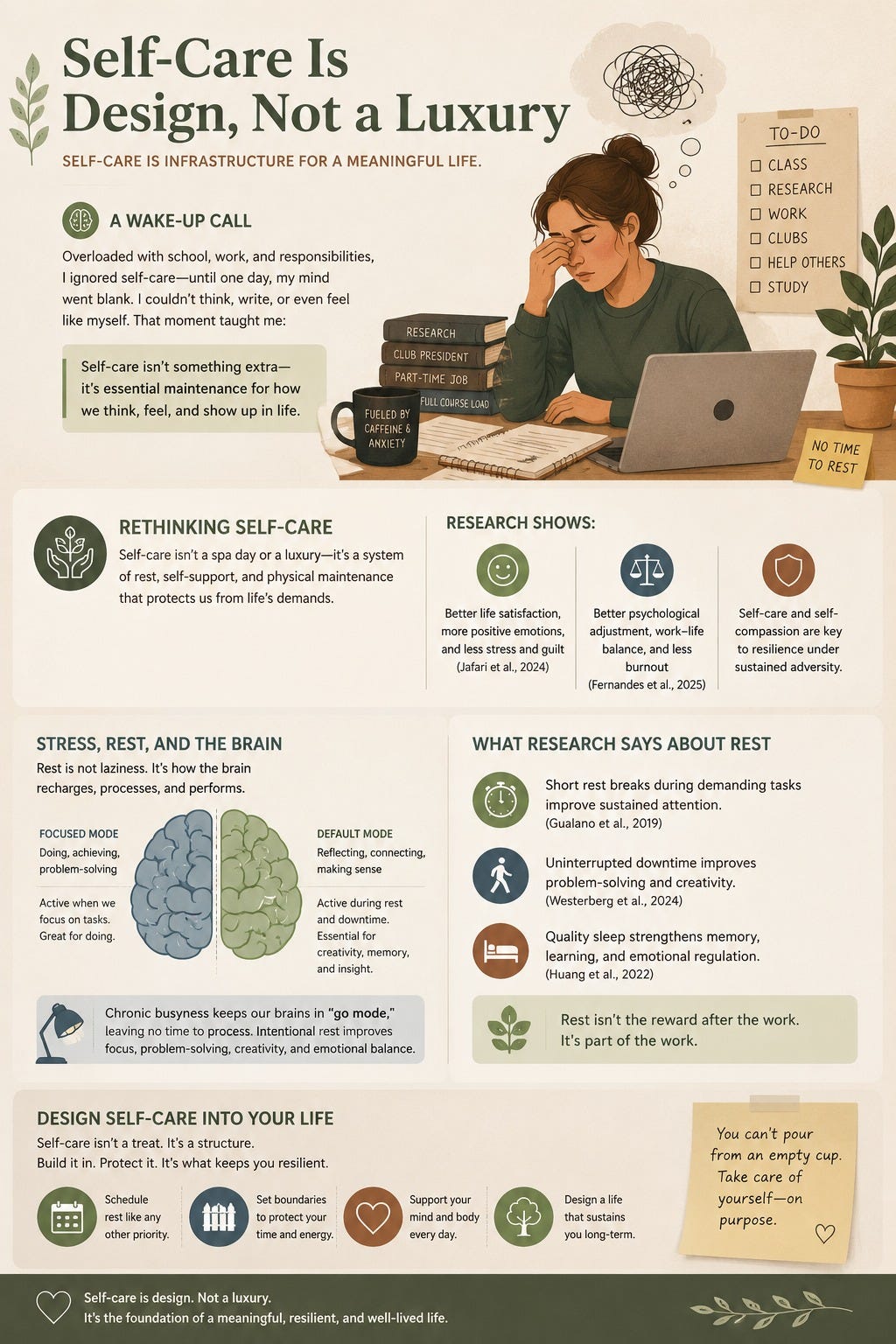
Image generated using AI
I didn’t take self-care seriously because of some deep epiphany; I got serious because I was terrified.
In my sophomore year in college, I decided to model the schedule that seemed so enviable to all my peers (and I know I did this to myself, because that was my choice): taking a full course load, working as a research assistant at the time, holding a part-time job, and being the club president of two different clubs, all while being constantly available for the other students who were struggling as well. The way that I kept it all together by sacrificing everything that didn’t fall into the realm of “productivity” (like sleep, downtime, and anything that could be thought of as relaxing) worked for quite some time (I kept my GPA up, my resume expanded, and people commented that I was “doing it all so well”). Until one day, I sat down to write a two-page reflection paper in my class and found that no words were coming out of my brain. This wasn’t writer’s block in that stereotypical way; this was a mental blankness that couldn’t be shaken. I could feel like an alien in my own body, my thoughts felt like they weren’t mine, and my emotions felt dull, like there was a dimmer switch on my life, and none of my usual go-tos were doing anything to help (a cup of coffee or tea, a walk, a second round of music). That moment where I sat in front of my laptop, trying to create meaning and words, I began to have an honest encounter with what a lack of self-care can lead to.
This experience shifted my understanding of self-care. Rather than it being something extra I can add to a good life, it’s actually the essential maintenance for life: it’s what allows me to think, relate, and work in a meaningful way over time. And as studies increasingly show, self-care may have more to do with how I design my life than how much willpower I have.
In what follows, I posit that self-care is best viewed as a system: the routines of rest, self-support, and physical maintenance we design to protect ourselves from the demands of everyday life. I discuss what we know from research about the benefits of self-care, what we know about self-care that doesn’t work, and what a better way might look like.
Rethinking Self-Care: From Treat to Necessary System
Self-care is often associated with a sense of treat or luxury, as when one goes to a spa or indulges in a pricey skincare routine in the morning. Not only are these stereotypes not necessarily the most effective, but the way that we think of self-care as a luxury to a good life is actually the issue at hand. These stereotypes frame self-care as something we can take time out for from “work” or “life,” rather than a critical part of the structure.
Research from psychologists supports this idea. Most measures of self-care in adults look at two components: self-care as behavior (physical care, like sleep, exercise, medical care, nutrition) and self-care as behavior (psychological care, such as managing emotions, setting boundaries, seeking support, practicing reflection). The studies have shown that adults who take more care of both aspects of their self-care tend to have better life satisfaction and positive emotion and fewer negative emotions like stress and guilt related to competing role demands, including parents/caregivers (Jafari et al., 2024). Likewise, in mental health and health care workers, those who practice a routine self-care schedule report better psychological adjustment and work–life balance, and fewer symptoms of burnout (Fernandes et al., 2025). Notably, this is true even in controlling for other aspects of resilience like optimism or social support. Thus, self-care and self-compassion are key in the system of resilience under sustained adversity.
Self-care, then, is not a luxury, more like an infrastructure. It is akin to maintaining a bridge instead of decorating it: not pretty, not always noticeable, but essential to prevent damage.
Stress, Rest, and the Brain
If self-care is infrastructure, rest is a load bearing beam.
We tend to think about rest as a luxury or, in worst cases, an inferior. It rests on the premise that greater work input yields greater output. Over decades of study, performance science and neuroscience have suggested a non-linear relationship. There exists an upper limit to how much high-quality mental work the brain produces in a day, after which it simply produces more bad work (Wu et al., 2016).
Why? Neuroscience has helped explain why. When not focused on a task, the brain switches to a so-called default mode network, which involves a series of regions in charge of internal processing (Mancuso et al., 2022). That includes connecting past memories and events, mentally rehearsing social interactions, simulating potential future events, and making sense of what we perceive. This network becomes active in wakeful rest, daydreaming, or during low-demand activities like aimless walking. It is not idle; instead, it is working behind the scenes, synthesizing information.
Chronic busyness puts this mode to sleep. If we are constantly switching tasks, our attention is always outwardly focused. As a result, our brains are never given a long enough break to make sense of everything we've taken in. Subjectively, it is an uneasy combination of being too busy to be productive and yet not tired enough to actually sleep, while still somehow lacking the intellectual depth that we usually pride ourselves on.
Studies on intentional rest support this notion. Deliberate rest pauses while working on cognitively demanding tasks are associated with better sustained attention during that task (Gualano et al., 2019). Uninterrupted downtime, without work or screen distractions, is associated with improved performance on problem-solving tasks and increased ideational fluency (Westerberg et al., 2024). Studies of the daily routines of some of the most productive scientists and writers reveal that many spend a few hours engaged in highly focused work, and then several hours doing some form of leisure, whether that means taking walks, reading, or other hobbies. They did not produce brilliant work despite doing less; they did so in large part because they treated rest as an important part of work.
In my case, I returned to that blank document with no new ideas or solutions. Instead, I made an intentional decision to treat rest as part of my work. I went to the library for two weeks, and every night I walked home from around 10, no headphones, for 30 minutes of purposeless activity such as stretching, gazing out a window, or reading a chapter of fiction unrelated to school. The first few nights felt like a failure. By the second week, my daytime concentration was once again where it had started. I hadn't become a more moral person; I had merely stopped asking my brain to work without breaks.
So then why do most self-care regimes fail after a couple of weeks?
It's that self-care routines are tailored to a fantasy life. It's a well-known finding in behavioral science that the 'planning fallacy' results in people underestimating how busy, tired, or distracted they'll be in the future (Buhler et al., 2010). Self-care routines are often designed with the assumption of the 'future, new me', in which people have more ambition to be active and energetic.
Self-care routines also often lack adaptability. Take, for example, a workout for 45 minutes for 4 days a week, 20 minutes of daily journaling, and a particular bedtime routine. When things go according to plan, that's fine; when things don't (because sometimes they won't!), self-care routines are often inflexible. Miss a few days, and it can feel like failure, leading you to give up the entire regime.
Another interesting study of self-employed people showed a stronger positive relationship with self-care in participants who had high frequencies of self-care practice. They also found that individuals who exercised regularly, in particular, were able to better maintain their vitality and experience fewer symptoms of poor mental health. The authors conclude that high levels of self-reported entrepreneurial stress in self-employed individuals do not hinder performance of self-care if the individuals intend to perform self-care practices and have practices already in place.
These studies show that people can continue to engage in self-care despite difficult circumstances; it just helps to have realistic and practical habits in place.
Self-care doesn't have to be something you're grinding against all your own willpower trying to 'do the things' and 'be better.' Self-care is something that is doable and fit for your context, that fits within the limits of your time, energy, demands, and motivation.
Rather than think of a self-care plan as a series of routines, you might find it more helpful to think of it as a system.
Self-care as a system focuses on: 'How do I structure my days and weeks so that self-care for my body or mind will probably happen as often as not in any given day, regardless of my current state of health, time, energy levels, and mood'.
To get self-care to work for me, I designed my day to include a series of simple self-care system practices using a few steps: Anchoring, Scaling, and Swapping.
Anchoring. Anchor self-care practices to something that is already part of your everyday routine. During your evening commute, whether walking or riding, make the initial ten minutes screen-free.
Anchors tackle two distinct obstacles: they cut down on memory load ("I forgot to meditate") and they lower the perceived cost ("I'm already here for this; let me add another thirty seconds"). Once established, the new behavior attaches itself to the old one, and the new routine almost begins to run on its own.
Reducing it to the smallest useful form, peopletend to overestimate how big a habit needs to be for it to count. An effective system hinges on the smallest version that still provides a real benefit, the smallest useful practice. For example, if the goal is 30 minutes of exercise, the smallest useful form might be five minutes of brisk walking or 10 bodyweight squats. The smallest version of writing in a journal before bed might be a single sentence about your day. The tiniest version of an hour's worth of no screen timebefore sleep might be 10 minutes. The intention is not to remain at the smallest version forever, but to keep things in motion. It's far easier to continue something that got smaller than to pick up something that got broken.
Swapping within categories rather than quitting completely. Expect to lose specific plans in your routine. A workable system allows for alternatives rather than relying on just one. If "movement" is a component of your self-care menu, your choices might be a full workout at the gym, a 20-minute walk, stretches on the floor to music, or taking the stairs and adding short walking breaks between tasks. On days when you have the energy, choose the more robust version. When you feel beat, swap to the simpler option rather than skipping your activity altogether. This allows the "I am the kind of person who moves around daily" part of your identity to flourish, which is important to the habit-stacking process.
When I rebuilt the foundation of my own self-care, I stumbled onto this anchor-scale-swaps model of change mostly by accident. My non-negotiable anchor is a nightly wind-down routine in which I place my phone in a different room before bed and read three pages of a book. On some nights, I can read 30 pages. On others, I fall asleep halfway through the first page. Still, the ritual of entering my bedroom without my phone and reaching for a book tells my brain that the day is over, and it has had an outsized impact on my sleep and waking mood as well as how I feel about my day.
--- (Díaz-Goñi et al., 2026; Heuven et al., 2026)
Individual Self-Care and the Social World
In any conversation around self-care, there's a concern that it can be used as a subtle way to shift the burden of the solutions to the people who are the most affected by systemic problems. Telling burnt-out nurses, overworked adjuncts, or underpaid employees to “take better care of themselves” without addressing workload, staffing, or wages is both inequitable and pointless. The evidence from high-stress professions bears this out. Although self-care and self-compassion are important resilience resources, they do not negate the harmful effects of chronic under-resourcing, extended work hours, or cultures that encourage constant availability. In these cases, it is necessary to combine self-care with structural adjustments such as defined limits to after-hours communications, reasonable staffing ratios, regular scheduled breaks, and a leadership culture that considers recovery to be part of good job performance rather than a sign of inadequacy. However, most people do not have immediate control over institutions. They may, though, have more control over how they navigate within existing parameters, for example, by saying no to one more thing, negotiating an achievable deadline, deciding to take a break before total exhaustion, or treating their own limitations as data instead of as a character flaw. Self-care operates on both an individual level of design and a collective, systemic level. Both levels matter.
A Subtly Revolutionary Observation
One of the most important things I changed during my undergraduate years was not a certain practice but the question I asked myself. Instead of “What is the most that I can do today?” I asked, “What kind of pace will allow me to keep doing good work for years without burning out?” That is ultimately what self-care is about: longevity rather than excess. It is the recognition that you have to maintain and care for your body and mind as you would any other resources. Self-care is accepting the fact that you are a human being and not a machine; that there is no secret productivity hack you can use to work forever.
The evidence points to a basic, if challenging, reality: People who routinely and realistically maintain their well-being are less stressed and less burnt out. They think better. They relate better. They are able to keep going for longer periods of time. They don’t avoid work; they plan for it.
Setting this up is not as exciting as making an ambitious resolution on the first of January. It involves small acts like putting your phone away at night, putting breaks into your calendar as often as you do meetings, and paying attention to your feelings when you start to get tired. These moments may not be photogenic, yet all that matters is that they add up to your life. Self-care is not about putting on a show. Self-care is the ongoing, quiet choice you make to build a life you want to live. The aim is to maintain the capacities that make the tasks you love to perform and the people you love to interact with possible and sustainable.
메타데이터
- post_id
- 99120abf3714
- slug
- self-care-is-design-not-a-luxury-99120abf3714
- url
- https://medium.com/a-home-for-your-heart/self-care-is-design-not-a-luxury-99120abf3714
- canonical_url
- https://medium.com/a-home-for-your-heart/self-care-is-design-not-a-luxury-99120abf3714
- author_url
- https://medium.com/@Itsqueen76
- status
- ok
- fetched_at
- 2026-06-21 15:33:18