The Death of the Dating Profile
(Re)imagining what (re)moving profiles might mean
The Death of the Dating Profile
(Re)imagining what (re)moving profiles might mean
![Slowly, before Sarah’s eyes, the familiar swipe feature began to fade away. Her finger was lost, unsure of what might be next […] could it be her PROFILE?](https://miro.medium.com/v2/resize:fit:1400/1*zhMjhEgUlX2EQicWB1DGyQ.jpeg)
Slowly, before Sarah’s eyes, the familiar swipe feature began to fade away. Her finger was lost, unsure of what might be next […] could it be her PROFILE?
This article was originally published on my Substack.
How would you feel if the dating platform you regularly use announced that it would be removing profiles? The change is packaged and presented as a new design feature that genuinely supports wellbeing, aimed at eliminating appearance-based judgements and aesthetic comparison.
What a relief! No need to craft a witty “About Me” bio compressed into 500 characters. Instead, your new AI assisted matchmaker knows everything about you, because you have spent hours chatting with it, much as you would a close friend.
Your AI matchmaker presents potential matches. Instead of typical profiles, you are shown a handful of keywords, a small carousel of photographs, and an AI generated introduction to each match, highlighting the traits and characteristics the matchmaker believes are most relevant to your interests and preferences.
But you are not encouraged to linger for too long. Rather than spending time evaluating profiles, the AI matchmaker nudges you straight into conversation. It suggests opening messages, recommends prompts that might spark discussion, and encourages you to start chatting immediately.
Does that sound (im)possible?

Everyone pointed to the little robot, blaming it for their matching outcomes. This made the little robot sad, and sad robots end up doing bad things! We have all seen how that movie plays out.
The Dystopian AI Matchmaker for the Eutopian User
I am not in the field of speculative (design) futures, but looking at how trends are moving, I do not think it is entirely off the table that the profile could be removed at some point.
The idea of a dating platform taking a far more active role in selecting and shaping potential matches may no longer feel quite so far-fetched. In May 2026, Bumble founder and CEO, Whitney Wolfe Herd told Axios that the company would be “saying goodbye to the swipe and hello to something that I believe is revolutionary for the category”. The replacement is an AI assistant called Bee.
Rather than browsing profiles and selecting matches by hand, users share detailed information about themselves, including their goals, communication style, and preferences. Bee then recommends compatible matches directly and explains the reasoning behind each suggestion.
It is also important to take into account that Bumble reported a roughly 21% drop in paying users in the first quarter of 2026, down to 3.2 million. According to PYMNTS, a 2024 Forbes Health survey found that 79% of Gen Z users reported fatigue with dating apps, while mobile analytics firm AppsFlyer reported that 65% of dating apps downloaded in 2024 were deleted within a month, a figure that rose to 69% in 2025.
The AI matchmaker is, among other things, a retention strategy for a product category whose users are leaving. That does not make it wrong. But it is worth asking whose problem is being solved. Is the swipe being removed to address user fatigue, or to address the platform’s retention problem?
Tinder has been moving in the same direction. Its AI feature, Chemistry, is designed explicitly to combat “swipe fatigue”. Instead of scrolling through, in CEO Spencer Rascoff’s words, “many, many profiles”, users answer questions and, with permission, allow the app to scan their camera roll to infer interests and aspects of personality. Based on this information, they receive just “a single drop or two” of potential matches each day.
At Tinder’s 2026 product keynote, Chemistry sat alongside Camera Roll Scan (Photo Insights based on patterns in your camera roll) and a Learning Mode that tailors recommendations in real time. Grindr is developing an AI Wingman, while startup Amata raised 6 million dollars to launch an AI matchmaker that arranges one-on-one dates and handles the logistics entirely.
These developments point towards a future in which users spend less time browsing profiles and more time delegating the selection work to AI.

Created by the author from their Bumble profile, December 2025.
The Profile
A dating profile has always been a performance, a compressed, optimised, visual-first pitch. The sociologist Eva Illouz (as cited by Jessica Pidoux) calls this visual economy of self-presentation “scopic capitalism” (I love this term), a logic in which people, and women especially, are reduced to images to be consumed.
Research on Tinder by Timmermans and Courtois describes how users curate idealised versions of themselves through selective photos and brief bios, a structure that encourages rapid, appearance-based judgement.
The loop of curation, comparison, and validation has measurable costs. Castro and Barrada’s systematic review links appearance-driven, compressed profiles to emotional strain, lower self-esteem, and anxiety.
Research by Hutson and colleagues further suggests that profile architectures which privilege visual cues can reinforce bias and discrimination.
There has been (and is) a lot of social commentary, academic discussion, and workshops that I have sat in on, which increasingly refer to dating app users leaning on AI to generate their bios or enhance their photos. Tinder itself is rolling out a Photo Enhance tool. The debate is whether this is really anything new, given that society has been leaning on software such as Photoshop for decades to manipulate images and Grammarly to refine their copy.
But in this thought experiment I have taken you on, the case for removing the profile is not a hard one to make, especially if we consider what it is that we are actually swiping on. Profiles. Exactly.
Let’s Not Write an Obituary Yet!
Before we celebrate, or commiserate, at the profile’s funeral, it is worth asking what the profile’s role actually is, beyond curating photos.
If we look at Jessica Pidoux’s comparative study, of how people use dating app profiles, one of her key findings is that the profile is where users exercise agency. They practise elicitation, choosing which categories to declare in order to project a desired image, but also omission, strategically leaving fields blank, whether height, politics, or star sign, to avoid being filed into a disqualifying box. They use allusion through coded language that a category cannot capture, and hesitation by changing their mind or refusing to classify themselves neatly.
Crucially, Pidoux notes that an algorithm reads omission as a null value and “cannot interpret why this value is missing”, whereas a human reader often understands the omission itself as having a meaning.
The profile, for all its flaws, remains a space where people can be vague, ambiguous, contradictory, or playful. It is one of the few places where users can resist becoming fully legible to the machine. Remove the profile, and you remove the raw, sensory layer of judging a profile for yourself.
Consider that, for Bumble’s new matchmaker, Bee, to know who you are best suited to, it does not ask for less information about you; it asks for more: your values, your relationship goals, and your communication style. And maybe even in the not-too-distant future, it will ask for access to your camera roll.
In their study of Bumble’s design, Rena Bivens and Anna Shah Hoque argue that every interface encodes a “view from somewhere”, the assumptions of the people who built it, baked invisibly into the categories the software allows. With a visible profile, you can at least see the boxes you are being sorted into and push against them. An AI matchmaker that claims to “know everything about you” makes those judgements in places you cannot reach.
Boston University’s Kathryn Coduto, speaking to *The New York Times* about this wave of features, states: “People don’t know how AI is going to use their data.” To be wary of this is not irrational. It is a reasonable response to being asked to trust a black box with one of the most consequential filtering processes and a host of insights into your psychological profiling.
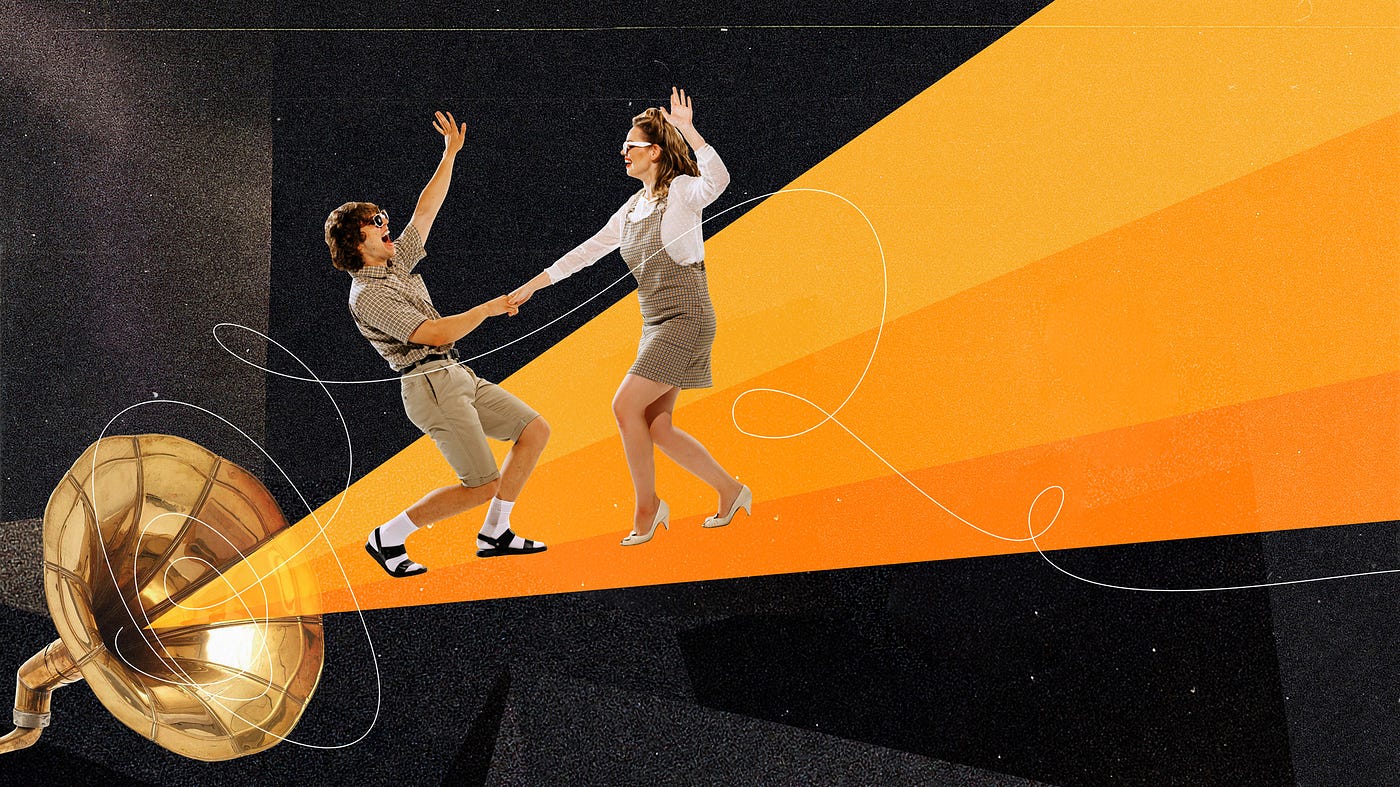
After years of swiping into the void, frictionless and outsourced AI matching was a welcome trade-off (and a perfect match) for all the attention capital Alex and Sarah had invested.
Reflections
If the problem is that profiles are too thin to support meaningful judgement, the answer is to make the signal richer and the interaction more legible, not to delete the signal and hand the decision-making to AI.
Based on my postgraduate research into dissatisfaction among dating app users, I would argue for two things. First, deeper self-expression: prompts, badges, and structured ways for people to share their interests, values, and intentions. Hinge’s prompts, voice notes, and video features offer a partial version of this approach. Although many platforms have a plethora of options, users still want more! Second, a concept I call Interaction Progression States, which emerged from my research findings. Essentially, this is an interface layer that provides people with clearer signals about where an interaction stands. I am not going to go into detail on this here, but if you would like to know more, you are welcome to reach out to me via LinkedIn.
User fatigue is not only about swipes and profiles. It is about uncertainty, not knowing whether a conversation is alive, fading, or effectively over, and the emotional cost of having to guess.
Let’s say platforms do remove the profile and absorb the judgement into AI. The profile, at its worst, is a treadmill of curation, comparison and validation that exhausts people and rewards the most polished performance. Shifting it into something new could be a genuine relief.
The profile, at its best, or at least at its most useful, is the one place in the system where you get to decide how you are seen, to be strategically silent, to refuse a category, to author your own ambiguity. If that is removed, you do not get less curation. You get invisible curation, performed by a system that is increasingly involved in deciding what you see, who you meet, and how those decisions are made.
In this “death of the profile” thought experiment, my mind immediately cast back to the 2017 Black Mirror episode *Hang the DJ*. In the story, two characters, Frank and Amy, are matched by a dating system that not only determines their compatibility but also controls the duration of each relationship before assigning them a new partner. Rather than searching for partners themselves, they place their trust in a system designed to decide who they should meet and when.
I consider Hang the DJ as an apt metaphor for how contemporary dating platforms shape romantic experiences through systems of prediction, measurement, and reward. Just as Frank and Amy believe they are exercising free choice while operating within the confines of an algorithmic simulation, dating app users may feel they are independently pursuing connection while their behaviour is subtly guided by platform design.
Karim Nader used Hang the DJ as a metaphor in his paper, *The Gamification of Dating Online*. He highlights how the pursuit of love can be transformed into a game of quantifiable outcomes, where matches, swipes, and engagement metrics risk becoming ends in themselves. Nader argues that the tension between genuine connection and the game-like pursuit of matches lies at the heart of how Tinder-style apps reshape dating.
So, returning to the introduction, perhaps we need to consider how much of the profile is already being (re)engineered, and which aspects may be the first to disappear. A future of keyword tagged, bio light, AI brokered matching feels less like an episode of Black Mirror and more like a plausible innovation packaged to improve user wellbeing and matching outcomes.
Lauren
If you enjoyed this article, please consider following me or sharing this with your network. Thank you.
References
- Bivens, R., & Hoque, A. S. (2018). Programming Sex, Gender, and Sexuality: Infrastructural Failures in the “Feminist” Dating App Bumble. Canadian Journal of Communication, 43(3), 441–459. https://cjc.utppublishing.com/doi/full/10.22230/cjc.2018v43n3a3375
- Castro, Á., & Barrada, J. R. (2020). Dating Apps and Their Sociodemographic and Psychosocial Correlates: A Systematic Review. International Journal of Environmental Research and Public Health, 17(18), 6500. https://doi.org/10.3390/ijerph17186500
- Correspondent, M. B., Technology. (2017, February 23). Tinder has a date with artificial intelligence. https://www.thetimes.com/business/technology/article/tinder-has-a-date-with-artificial-intelligence-ht3g6bkpp
- Hutson, J., Taft, J., Barocas, S., & Levy, K. (2018). Debiasing Desire: Addressing Bias & Discrimination on Intimate Platforms. In Proceedings of the ACM on Human-Computer Interaction (Vol. 2). https://doi.org/10.1145/3274342
- Nader, K. (2025). The gamification of dating online. Theoria, 91(3), e12549. https://doi.org/10.1111/theo.12549
- Pearson, C. (2026, May 14). Dating in a Swipeless World. The New York Times. https://www.nytimes.com/2026/05/14/well/bumble-swipe-feature-online-dating-apps.html
- Perez, S. (2026, February 4). Tinder looks to AI to help fight ‘swipe fatigue’ and dating app burnout. TechCrunch. https://techcrunch.com/2026/02/04/tinder-looks-to-ai-to-help-fight-swipe-fatigue-and-dating-app-burnout/
- Pidoux, J. (2023). A comparative study of algorithmic–user classification practices in online dating: A human–machine learning process. Porn Studies, 10(2), 191–209. https://doi.org/10.1080/23268743.2022.2104352
- PYMNTS. (2026, May 22). Bumble Replaces the Swipe With an AI Matchmaker. PYMNTS.com. https://www.pymnts.com/artificial-intelligence-2/2026/bumble-replaces-the-swipe-with-an-ai-matchmaker/
- Silberling, A. (2026, May 7). Bumble is getting rid of the swipe, CEO says. TechCrunch. https://techcrunch.com/2026/05/07/bumble-is-getting-rid-of-the-swipe-ceo-says/
- Timmermans, E., & Courtois, C. (2018). From swiping to casual sex and/or committed relationships: Exploring the experiences of Tinder users. The Information Society, 34(2), 59–70. https://doi.org/10.1080/01972243.2017.1414093
- Tinder Debuts Inaugural Product Keynote Tinder Sparks 2026: Start Something New. (n.d.). Tinder Newsroom. Retrieved 17 June 2026, from https://www.tinderpressroom.com/2026-03-12-Tinder-Debuts-Inaugural-Product-Keynote-Tinder-Sparks-2026-Start-Something-New
메타데이터
- post_id
- 992ad6edbafb
- slug
- the-death-of-the-dating-profile-992ad6edbafb
- url
- https://medium.com/@laurenevasharp/the-death-of-the-dating-profile-992ad6edbafb
- canonical_url
- https://medium.com/@laurenevasharp/the-death-of-the-dating-profile-992ad6edbafb
- author_url
- https://medium.com/@laurenevasharp
- status
- ok
- fetched_at
- 2026-06-23 17:05:31