🧠 AI-First Thinking: The Imperative for Executives, Architects, and AI Leaders
🧠 AI-First Thinking: The Imperative for Executives, Architects, and AI Leaders
Picture the opening of a typical enterprise modernization meeting. The use case is on the table — a document processing workflow that currently requires eight people to review, classify, and route incoming contracts. The architect leading the session asks the first question: “Do we have enough labeled data to train a model for this?”
That question is the problem. Not because it’s wrong in isolation — but because it’s the first question. Before evaluating foundation models. Before scoping an agentic workflow. Before anyone has asked whether a custom ML build is actually necessary. The ML default activates before the problem has been fully described, and the rest of the session is spent either justifying it or working around the constraints it creates.
79% of organizations have already deployed AI agents in some form. Yet most enterprise teams are still opening modernization conversations in exactly this way. That instinct is costing time, capital, and competitive ground.
💸 The ML Default Is an Expensive Habit
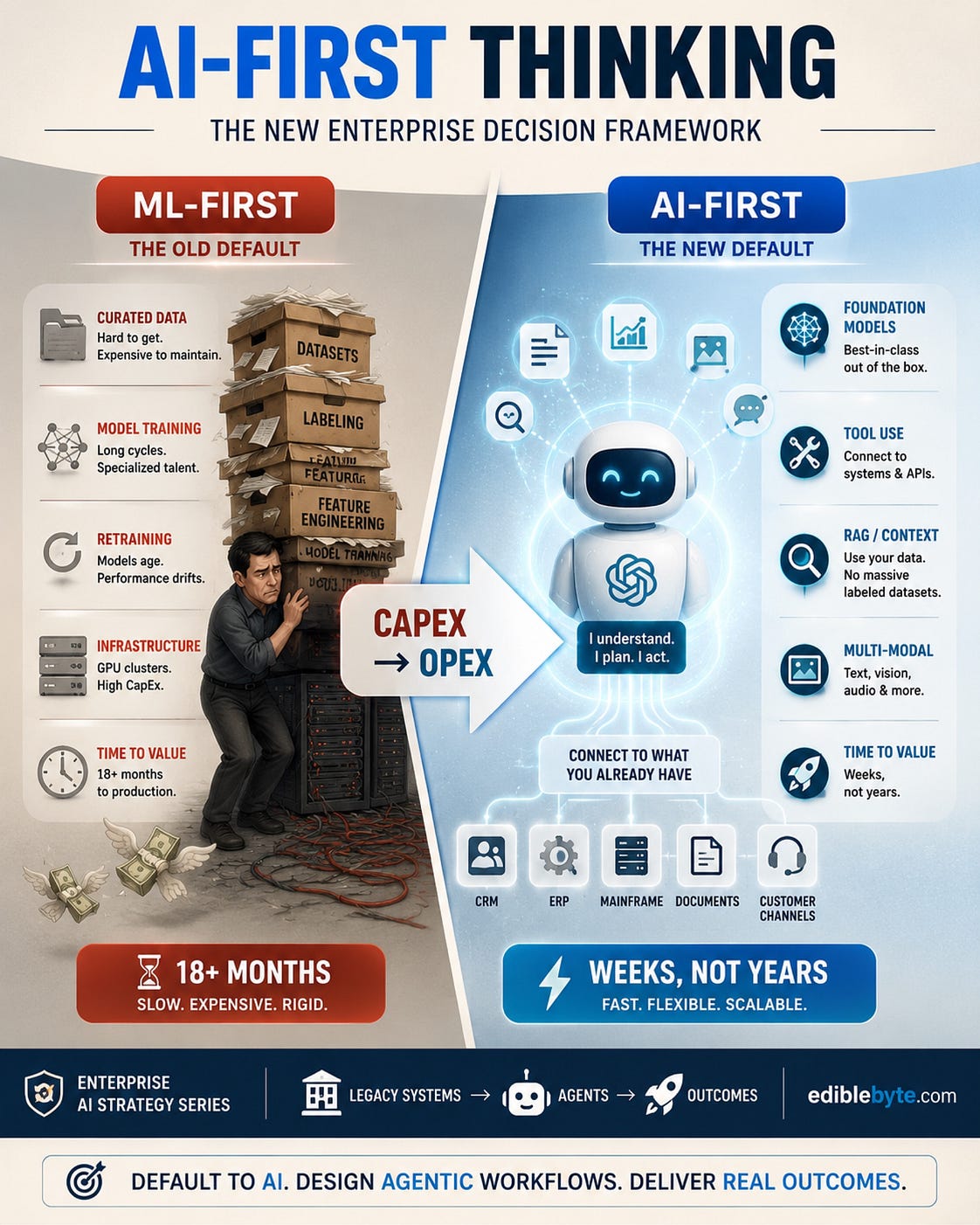
Traditional ML demands curated datasets, retraining cycles, and narrow task-specific models that age quickly — plus significant capital expenditure in GPU infrastructure, specialized talent, and data pipelines before a single prediction reaches production. It’s a front-loaded bet that assumes you have the data, the time, and the runway to wait.
Consider what ML feasibility actually costs to establish. A serious labeling exercise for a document classification task runs three to six months minimum, requires domain experts to validate labels, and produces a dataset that starts degrading in relevance the moment business requirements shift. Add the infrastructure for training runs, the specialized ML engineers to run them, and the monitoring stack to detect drift, and you’re twelve to eighteen months from production on a system whose core assumptions may already be wrong.
Most brownfield projects have none of that time in abundance. And more importantly — most of them don’t need it.
⚡ The Shift That Changes the Calculus
Frontier LLMs from Anthropic, OpenAI, and Google — alongside a maturing open-source model ecosystem — are now production-ready infrastructure, not experimental tooling. Multi-modal capabilities are baseline, not advanced. And with inference costs dropping precipitously, the economics decisively favor an AI-first decision framework from day one.
This isn’t just a technology argument. It’s a financial one. ML is capex. AI-first is opex. For executives, that distinction changes the investment conversation entirely. A capex ML build requires board-level justification, a multi-year timeline, and a risk profile that assumes the problem stays stable long enough for the model to be worth building. An
AI-first approach gets a production pilot running in weeks, generates real operational data, and adjusts as the problem evolves. One approach bets on a future state. The other works with the current one.
🏗️ Brownfield Is the Biggest Opportunity in the Room
Enterprise portfolios are full of systems that function but frustrate — demanding constant human intervention, delivering poor user experiences, and resisting modernization at every layer. The traditional answer was rebuild or retrain. Both are slow. Both are expensive.
Agentic AI offers a third path. Return to the contract processing example. The existing system has a document intake queue, a classification taxonomy, and a routing workflow — all built and maintained. What it lacks is intelligence at the classification step. An LLM with document retrieval, a structured output schema, and a deterministic routing layer can sit atop that existing system and handle the classification step with no retraining cycle, no labeled data requirement, and no GPU cluster. The humans who were reviewing every document shift to reviewing edge cases and exceptions.
For architects and AI leads, this is the unlock: you don’t need perfect data to start. You need the right model, the right context, and clear task boundaries.
🤝 The Human-in-the-Loop Reduction Is Real — In the Right Places
In targeted workflows — document processing, customer service, decisioning, and code review — early enterprise deployments are demonstrating 50 to 80 percent reductions in human escalations. In the contract classification example, that means the team of eight shifts to a team of two managing exceptions, with the agentic pipeline handling routine volume. This isn’t automation replacing judgment. It’s automation handling the decisions that don’t require it, so judgment is available for the ones that do.
The workflows being staffed with humans for supervision today are precisely where agentic pipelines with deterministic guardrails are proving their value.
🎯 What AI-First Thinking Actually Means
It’s not about replacing engineering judgment. It’s a decision framework applied before the ML question is asked:
→ Default to foundation models first — evaluate what a well-prompted frontier model can do before scoping a custom build. Most tasks that feel like ML problems are actually prompt engineering problems.
→ Evaluate agentic patterns before adding headcount — if a workflow requires human review, ask whether a deterministic guardrail layer can handle the boundary cases instead.
→ Treat multi-modality as baseline — document, image, audio, and structured data inputs are table stakes in current foundation models. Design for it from the start.
→ Design for model-agnosticism — the cost and capability curve is still moving fast. Avoid tight coupling to a single provider. The abstraction layer you build today protects the investment as the market shifts.
ML retains its place — for high-volume, latency-critical, specialized inference where you own a genuine data advantage and can justify the capital. That’s a real lane. It’s just a narrow one, and it comes after the AI-first question has been answered, not before.
🚀 The Window Is Now
Gartner projects 40% of enterprise applications will embed task-specific AI agents by end of 2026 — up from less than 5% today. Organizations that spend this year in ML feasibility debates will watch that window close in real time.
The models are ready. The economics work. The brownfield opportunity is sitting in your portfolio right now — in the document queues, the review workflows, the escalation paths that are consuming headcount while producing inconsistent results.
AI-First Thinking isn’t a trend to evaluate. It’s a decision framework to adopt — before your next architecture review, your next modernization proposal, and your next budget cycle.
메타데이터
- post_id
- 993e8d45a7ee
- slug
- ai-first-thinking-the-imperative-for-executives-architects-and-ai-leaders-993e8d45a7ee
- url
- https://medium.com/ai-architecture-and-engineering/ai-first-thinking-the-imperative-for-executives-architects-and-ai-leaders-993e8d45a7ee
- canonical_url
- https://medium.com/ai-architecture-and-engineering/ai-first-thinking-the-imperative-for-executives-architects-and-ai-leaders-993e8d45a7ee
- author_url
- https://medium.com/@koujala
- status
- ok
- fetched_at
- 2026-06-14 13:58:26