We Built an Emergency App for People. Now We Need One for Places.
The logic behind the myResponder CERT model
We Built an Emergency App for People. Now We Need One for Places.
The logic behind the myResponder CERT model
SCDF built myResponder with a simple idea: if someone collapses nearby, a citizen responder can help before the ambulance arrives.
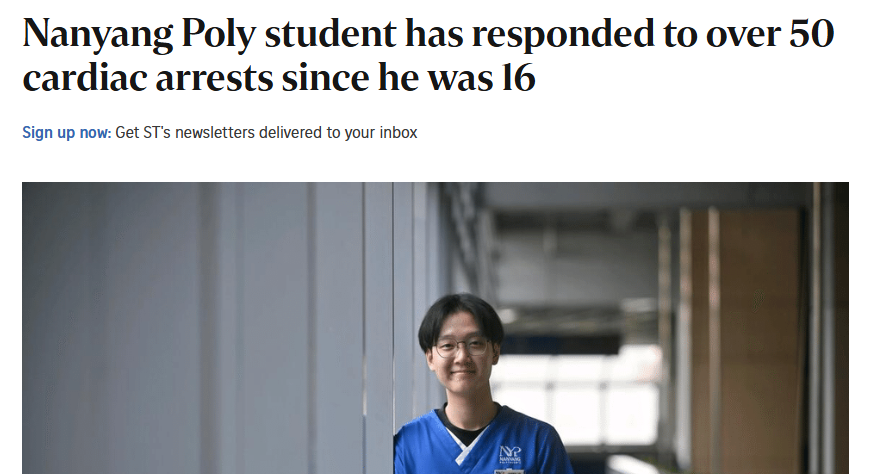
For years, this model focused on people — ordinary members of the public who happened to be close to a cardiac arrest or a minor fire.
Then I found myself asking a different question:
What about the thousands of emergencies that happen quietly inside malls, parks, and condominiums — where trained teams are already on site but never informed?
That question changed how I think about scale.
After writing “From Emergency to Recovery,” I wanted to explain in more detail why I am confident that the myResponder Company Emergency Response Team (CERT) model will scale.
Today, myResponder is built around notifying nearby members of the public when a cardiac arrest or a minor fire occurs. These are important events, but they represent less than one percent of all emergencies reported from premises such as shopping malls.
The fundamental shift is this:
From alerting random members of the public for rare events, to notifying CERT teams of all incidents occurring within their own spaces.
The idea is to have a myResponder CERT app that informs CERT teams of all types of emergencies happening within their premises. This could be a fall, someone feeling faint, or someone feeling unwell and calling 995 for help. The CERT teams can then take immediate action to assist their customers while SCDF ambulances are still on the way, typically arriving 10 to 15 minutes later.
This is in addition to cardiac arrest and minor fire cases today, which together represent only about one percent of all incidents reported from these premises.
This shift feels to me like the GrabTaxi to GrabCar moment for myResponder — a change in scope, customer, and impact.
In this article, I share my perspective on Singapore’s institutional context, key operational blind spots, and organisational incentives to explain why I am confident this approach can scale.
What this change really unlocks: from 5,000 to 70,000 responses a year
Today, myResponder is mobilised mainly for cardiac arrest and minor fire cases. In total, this amounts to about 5,000 activations a year.
That is meaningful. But it is also narrow.
By shifting from alerting the general public for rare events to notifying CERT teams of all emergencies occurring within their premises, the scale changes completely.
Each year, about 70,000 emergency calls are made by members of the public to SCDF 995 from commercial and managed premises when they fall ill or get injured while visiting these places.
This means the same platform is no longer mobilised a few thousand times annually, but tens of thousands of times.
This is the biggest impact of the CERT model.
It is not just about doing the same thing better. It is about making help available in far more situations, far more often, and far closer to where people actually fall ill or get hurt.
When response becomes routine instead of exceptional, the system finally begins to scale.
From people to places: Singapore already has a response force
Singapore’s key strength is that we already have a ready response force.
Many premises are required under fire safety regulations to maintain Company Emergency Response Teams (CERT). These teams are on site every day, understand the physical layout of their premises, operate under standard operating procedures, and are accountable to management. They already respond to emergencies — at least to the ones they are aware of.
Yet today, this capability is largely confined to general security and administrative tasks. It is under-utilised for medical and public emergencies.
This represents a large, under-utilised force that already exists within our built environment.
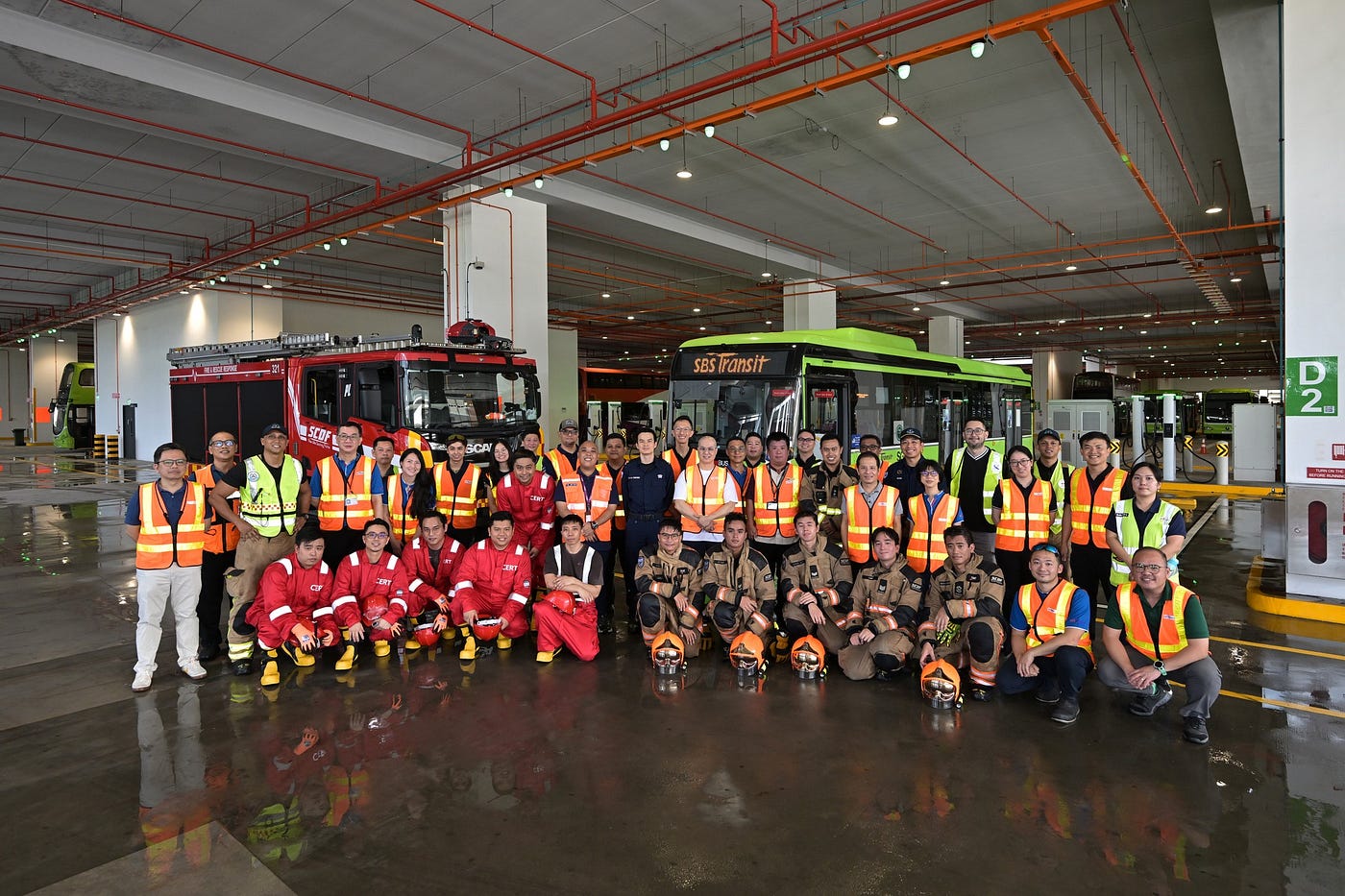
SBS Transit CERT Team with SCDF Responders after a joint drill
The invisible problem: most emergencies are unknown to the premises
In conversations with several premises owners, I compared SCDF call histories with their security logbooks.
A clear pattern emerged:
CERT teams were unaware of emergencies reported by members of the public from their own premises roughly eighty percent of the time.
At first, this seems surprising. But it becomes understandable when examined more closely.
Imagine you are shopping at a mall with a loved one. She suddenly feels faint. You know she has a medical condition and you are concerned, so you call for an ambulance. At the same time, you also know this is not an acute emergency that requires shouting for help or creating a big scene. You do not know how to contact the security guards either, so you wait quietly for help to arrive.
In many such situations, people call for an ambulance and wait quietly.
As a result, the security team — the people physically closest to the patient — often has no idea that anything has happened.
This creates a structural inefficiency for emergency response:
- responders arrive without local guidance
- access routes are unclear
- time is lost locating the patient
The issue is not response speed or capacity. It is awareness.
Even when teams are ready, they are often not informed
In a deeper study, I examined Clarke Quay’s response data.
Clarke Quay has several advantages: a small footprint, low-rise buildings, highly alert security teams, and strong informal networks with bouncers and venue staff. If any CERT team response should perform well, it should be Clarke Quay.
Yet even there, security teams were aware of only about 50% of the emergency cases reported to 995.
When CERT teams were aware, ambulance crews typically reached the patient within two to three minutes after parking on arrival.
When CERT teams were unaware that an emergency had been reported, patient-side time ranged from five to seventeen minutes.
The difference was not ambulance speed. It was local coordination.
When security knew, they located patients in parallel, stood by at taxi stands or access points to meet the crew, cleared paths, and guided paramedics through crowds.
This demonstrates a critical insight:
Awareness, not manpower, is the bottleneck.
Why parks, malls and condos are where scaling should begin
From a scaling perspective, the most natural starting points are not random cardiac arrest or minor fire cases across the island, but managed environments with staff already on duty.
These include:
- NParks-managed parks
- Sentosa Island with 24/7 rangers
- shopping malls and commercial premises
- tourist attractions
- transport nodes
- residential condominiums
These places share common characteristics: high transient populations, complex navigation, frequent incidents, and a shared responsibility to protect visitors.
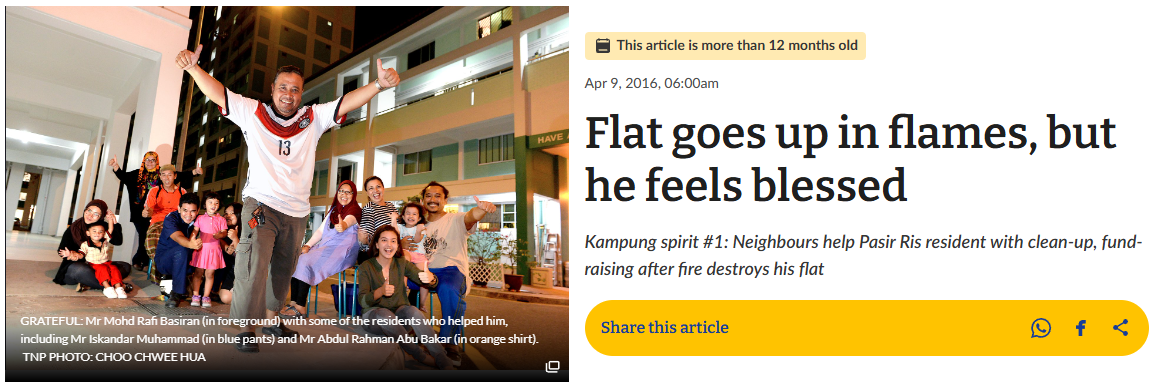
Residential condominiums are another important example. I have personally responded to myResponder incidents in condos and experienced repeated delays — being stopped at access gates, questioned, allowed in, and then stopped again at lift lobbies without access cards. This results in lost time when minutes matter. All of this could have been avoided if security teams had known in advance that responders were coming to help.
A digital alerting system that notifies CERT teams directly changes this fundamentally. They can start searching immediately, anticipate the arrival of help, meet ambulances at access points, and locate casualties in parallel.
Any managed space with on-site staff becomes a response partner.
It’s not about medical skill. It’s about being there first.
A common objection to this idea is that CERT teams or security guards today lack the competence to perform such roles. This reflects current market realities: low pay, limited training, narrow job scope, and low expectations.
But this critique misunderstands the initial value proposition.
Security teams do not need to provide advanced medical care to be immediately impactful. Their immediate contribution is logistical:
- locating casualties
- mapping routes
- opening access points
- guiding responders
- cordoning areas
These actions alone can save minutes at every call. With around 70,000 calls per year in commercial premises alone, this translates into significant time saved across the system — improving patient outcomes and saving lives.
Today, security teams do not participate much in the emergency response journey. Once they are involved and can see their impact, they will naturally want to be upskilled. Management investment will follow, and an upward spiral will form.
Why the old model could not work — and why this one can
Earlier efforts focused on persuading individual CERT members to download and use the myResponder app in its current form. This failed for rational reasons.
Today, the system only alerts for:
- cardiac arrest cases (less than one percent of all premises emergencies, and in such situations panicked callers would already create a scene), and;
- minor fires (which CERT teams would already know about because smoke or fire is visible).
From their perspective, having the app or not made little difference. They would know about these emergencies anyway. It brought little value and felt like extra work. It did not help them perform their job better.
The new model is fundamentally different.
CERT teams will now be aware of the 80% of emergencies they previously did not know about. The system becomes genuinely useful to them.
Not only CERT teams, but also management will benefit. They will gain real-time awareness of emergencies reported in their premises and can mobilise help for their customers before SCDF arrives. This also helps them stay ahead in managing media and reputational risks in serious or controversial incidents.
Management will gain full visibility of emergencies across their property portfolio instead of relying on fragmented logbook data. They will be able to improve safety design in their premises based on real patterns of incidents.
This approach is organisational, top-down, and management-driven. CERT teams will receive the resources and training needed to make it work.
This is something management actually wants.
Conclusion
Scaling community response is not primarily a technology problem. It is a systems and incentives problem.
Singapore already has the people, the places, and the institutional foundations. What is missing is a digital layer that connects premises owners to what is happening in their own spaces, in real time.
This is why I am confident this model will scale — not because it is inspiring, but because it fits how organisations already work.
The future of community response will not be accidental. It will be institutional.
메타데이터
- post_id
- 9943d1188f4e
- slug
- we-built-an-emergency-app-for-people-now-we-need-one-for-places-9943d1188f4e
- url
- https://medium.com/@doidyboy/we-built-an-emergency-app-for-people-now-we-need-one-for-places-9943d1188f4e
- canonical_url
- https://medium.com/@doidyboy/we-built-an-emergency-app-for-people-now-we-need-one-for-places-9943d1188f4e
- author_url
- https://medium.com/@doidyboy
- status
- ok
- fetched_at
- 2026-06-21 12:17:11