THE LAST POLITICAL SURVIVOR OF TODAY’S INDIA
NITISH KUMAR
THE LAST POLITICAL SURVIVOR OF TODAY’S INDIA
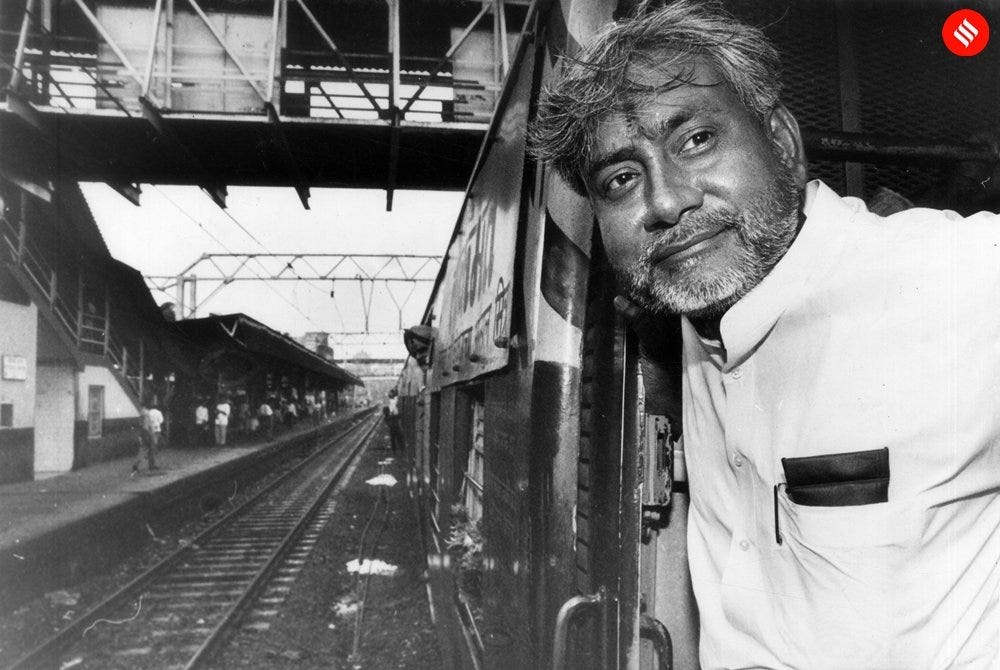
NITISH KUMAR
In recent years, the Indian political system has witnessed dramatic changes. After the 2024 Lok Sabha election, some regional parties gained power at the Centre after 10 years of BJP rule. Nothing changed much for Nitish in Bihar, except that he became even more powerful. Politics has no permanent friends, but Nitish seems to have his own dictionary of friendship, twisting it to suit his needs and interests. For the last 20 years, and probably for the next five years, Nitish has placed himself at the centre of Bihar politics. Being a new-age political observer, I have not seen the old Nitish talking about socialism and Mandal politics, but as much as I have seen him, for me, he is simply the CM of my state and has been in power for a long time. But once I started getting into the political map, I could not find anyone like him. And that made me curious: how did a boy coming from a middle-class family, doing engineering from Patna Engineering College, become the centre of politics? I will not get into the stories of his rise, how he came up from nowhere, created a party, and remained in power for the longest time in a state that is often called poor. I will not discuss his governance as CM. Instead, I will talk about his political survival, a survival that has crushed most big political domains in recent years.
Nitish’s Ideology and Early Political Positioning
Nitish’s political ideology is rooted in socialist and secular governance. He focuses on the parallel growth of the oppressed and strongly believes in social justice. We often call him “Sushasan Babu.” Let me take you back to 2000, the first time he came into power and took oath as CM, which lasted only seven days. After forming his own party in 2003 and contesting the 2005 election, his rise as a political saviour became clear. Before this, Bihar was suffering from the scares of jungle raj, and the increase in crime was a key factor.
For the first time, a person from a caste that had just 2.87% population became CM. This marked the start of a new social-political drama that still continues. Nitish Kumar was very clear about his vision of not aligning himself with any caste or religion and talking openly about social justice and secularism. At that time, Bihar’s political dynamics unintentionally placed him in the perfect position from where he would remain in power for years.
After the 2005 election, Nitish stayed in his natural alliance with the BJP for the next nine years. And then came 2014, when the real political turmoil began and when Nitish proved his political brilliance.
The 2014 Split, Modi Factor, and Nitish’s Stand
Breaking the NDA alliance was a big decision, but the reason behind it was even bigger: going against Modi. This is exactly why we talk about Nitish. He may not match the development work of CMs from other states, but what makes Nitish different is that he is a leader with a spine. He publicly criticised Modi and distanced himself from the alliance because his own political values and ideology did not align with Modi. Throughout this turmoil, he stood firm on his values of Sushasan and zero tolerance for crime, not the kind claimed in UP.
Such decisions are rare in Indian politics. And this was possible only because Nitish had a clear alternate route to form the government with RJD. This allowed him to make the flip. Nitish has done many flips in his political career, and he is the only leader in India who can make such major alliance changes and still remain relevant. But he had to pay a price. In the 2014 Lok Sabha election, JDU fell from 20 MPs to 2 MPs. Taking moral responsibility, he resigned. Even in all this, one thing becomes clear: how he survived India’s political system even after going against the most powerful leadership at the Centre.
Surviving the Shah Era and the 2022 Crisis
The current central government is one of the most aggressive ones. Amit Shah has dismantled major political families across states — Haryana, Maharashtra, Madhya Pradesh, Assam, Punjab, and even LJP in Bihar. Shah has the power to destroy any political outfit. But how did a small regional politician like Nitish survive this entire political tsunami?
It’s not like Shah didn’t try to split JDU. He did. But when Nitish left the BJP alliance in 2022, the result showed that Nitish still had the upper hand. That move made Shah realise that BJP needed Nitish in the 2024 Lok Sabha election, because if Nitish and Lalu came together, BJP would not stand a chance in Bihar due to vote share distribution.
This led to “The Big Flip.”
Just before the election, Nitish took one of the most brilliant political decisions. It made him strong at the Centre, and eventually, JDU won the 2025 Bihar election, a win that was practically served to him. JDU won without doing much groundwork; it was Shah who ensured the victory.
Why did BJP do this? Because BJP has failed to create a strong political alternative in Bihar. They have no big state leader. Bihar has been abandoned on central terms, and this creates perfect opportunities for regional parties to dominate. In this scenario, Nitish has the perfect position to return to power repeatedly.
This also created the third gap, RJD is more polarised and limited to its vote bank, BJP too is restricted to its core voters, while Nitish stands in the middle. BJP’s recent rise in Bihar came from youth, OBCs, and a section of JDU voters, as BJP attempts to become JDU’s successor. Thus, two poles stand at extremes, and Nitish plays the key role between them.
Elections of 2020, 2022, and 2025: The Shifts
Nitish’s weakest performance was in 2020 when he won just 43 seats, largely because LJP directly targeted JDU. Many claim this was a BJP attempt to weaken JDU, and they succeeded to some extent. But even then, he proved his political existence. Despite being the third-largest party, he still became CM, not because of political intuition but because of Bihar’s political demographics.
Floating voters played a big role. In 2020, they tilted toward MGB. The margins for RJD victories were sharp, showing a wave. But in 2025, floating voters shifted to the NDA, mostly influenced by last-hour government schemes. Women voters (Jeevika) with 10000, especially moved toward JDU and BJP. This made the big win possible.
Anti-incumbency was strong, corruption narratives were loud, and many believed this would be the last run for JDU due to Nitish’s health. But the game flipped. The election was fought on Nitish’s name but was never meant to be fought on his name. The Centre realised that Bihar is not UP; people won’t vote solely on the central BJP agenda. So Shah returned to the old narrative of jungle raj fears combined with enormous freebies, something Nitish always opposed but silently accepted this time. This combination successfully pulled floating voters and JDU’s core back to JDU.
Thus, 2025 played out exactly as planned.
Even though BJP never wanted to give equal seats to JDU, the 2024 Lok Sabha results showed they needed Nitish desperately. This gave JDU strong bargaining power. BJP had to share power. And this is how an unwell and politically underestimated Nitish became an unavoidable compulsion for BJP.
Whenever JDU and RJD come together, BJP finds it impossible to win alone. This is what makes Nitish politically invincible, even with doubts about his health. In 2025, MGB wasn’t hard on Nitish; the absence of criticism created space for appreciation. The opposition failed to create an agenda based on real issues and ended up playing on the pitch set by BJP. In all this, Nitish got the cake of Bihar without doing anything himself.
But the question is: why does BJP need Bihar this desperately? Political gains are obvious, but BJP never gives anything for free. Why are they feeding Nitish and JDU? Maybe corporate interests. Who knows?
Understanding Bihar’s Political Demography
We can divide Bihar’s voters into three categories based on my political understanding:
1. Party Voters
These are hardcore voters who will vote for their party no matter what. Bihar has more such voters than many states.
BJP core voters:
Rajput, Bhumihar, Brahmin, Kayasth, Baniya → about 13% population.
RJD core voters:
Yadav + Muslim → about 20% population.
This defines their highest possible vote share in the 2025 election.
BJP has tried hard to shed its upper-caste image. It has created or supported smaller caste-based parties:
• LJP for Paswans (5.31%)
• VIP for Mallah/Nishad (10%)
• HAMS for Musahar (3%)
• Upendra Kushwaha for Kushwaha (4%)
This is Shah’s strategy to divide the OBC/EBC vote so that it doesn’t consolidate under MGB. This micro- level election engineering defines Shah’s political reach.
Thus, Bihar has two major core vote blocs — BJP and its allies, and RJD’s traditional base.
2. Nitish Voters
Nitish has no caste-based core. His own caste, Kurmi, is just 2.87%.His voters include:
- EBCs
• Mahadalits
• Upper castes who saw jungle raj and appreciated his work
• Middle class
• Government scheme beneficiaries (Jeevika, the ₹10,000 assistance, etc.)
• Those who fear RJD and dislike BJP’s upper-caste tilt
These voters support Nitish because of his work, not caste identity.
3. Floating Voters
This group includes:
• Youth
• Migrant labourers
• Women (mostly pro-Nitish)
• People who decide at the last moment
They are crucial in close contests and can swing elections.
Why Nitish Always Gets the Cakewalk
From the political structure, it’s clear that Nitish has no fixed vote bank like BJP or RJD. But this actually works to his advantage. He becomes the balance in the middle. In 2010, NDA won 206 seats, and in 2015 MGB won 178, both times Nitish was the central figure.
After the 2014 split, the 2015 election became the first real test of Nitish’s own brand. The MGB victory proved that his brand was intact and strong enough to challenge BJP’s future in Bihar.
Nitish’s Political Future and Party Structure
Indian politics often follows a one-man leadership model. Modi succeeded Vajpayee, Akhilesh succeeded Mulayam, Tejashwi succeeded Lalu, Hemant succeeded Shibu Soren, and Maharashtra’s politics is full of dynasties.
But Nitish intentionally avoided creating a successor. No one in JDU has grown enough to take his place. His son stays away from politics, adding to his clean image.
Names like Lalan Singh, Upendra Kushwaha, Prashant Kishor, Chirag Paswan, Jitan Ram Manjhi, and RCP Singh all emerged but never succeeded in challenging him. Nitish kept the party structure centred around himself. He created a situation where Nitish is the party and the party is Nitish. Crushing internal rises secured his position further.
He is probably the only leader in India who has remained with the BJP without his party being split. This shows why he is still surviving in today’s India. After the 2020 results, many thought it was the end for him. Many blamed his alleged betrayals and his vote-bank decline. But he proved once again that he is alive and powerful enough to remain the centre of Bihar politics for the next five years.
Maybe it is his hard work from the early years, maybe it’s his political timing, or maybe it’s just Bihar’s desperation for stability after decades of crime, but Bihar still chooses Nitish. Not because of what he does now, but his ideas of socialism and secularism made him politically acceptable in Bihar.
Conclusion
Bihar is a state of deep social and caste politics. Its political voters can be divided into party voters, Nitish voters, and floating voters. This complex political demography naturally creates the perfect middle space. Nitish occupies that space entirely.
This is why he survives.
This is why he remains invincible.
This is why Bihar cannot ignore him, even when there are clouds over his health.
And this is why Nitish Kumar continues to be the last political survivor of today’s India.
메타데이터
- post_id
- 999eecc98ff4
- slug
- the-last-political-survivor-of-todays-india-999eecc98ff4
- url
- https://medium.com/@ayush4750kumar/the-last-political-survivor-of-todays-india-999eecc98ff4
- canonical_url
- https://medium.com/@ayush4750kumar/the-last-political-survivor-of-todays-india-999eecc98ff4
- author_url
- https://medium.com/@ayush4750kumar
- status
- ok
- fetched_at
- 2026-07-13 22:03:30