We Ask Lakshmi for Wealth. But What Does Lakshmi Ask of Us?
Lessons on Prosperity from Ancient Indian Wisdom
We Ask Lakshmi for Wealth. But What Does Lakshmi Ask of Us?
Lessons on Prosperity from Ancient Indian Wisdom
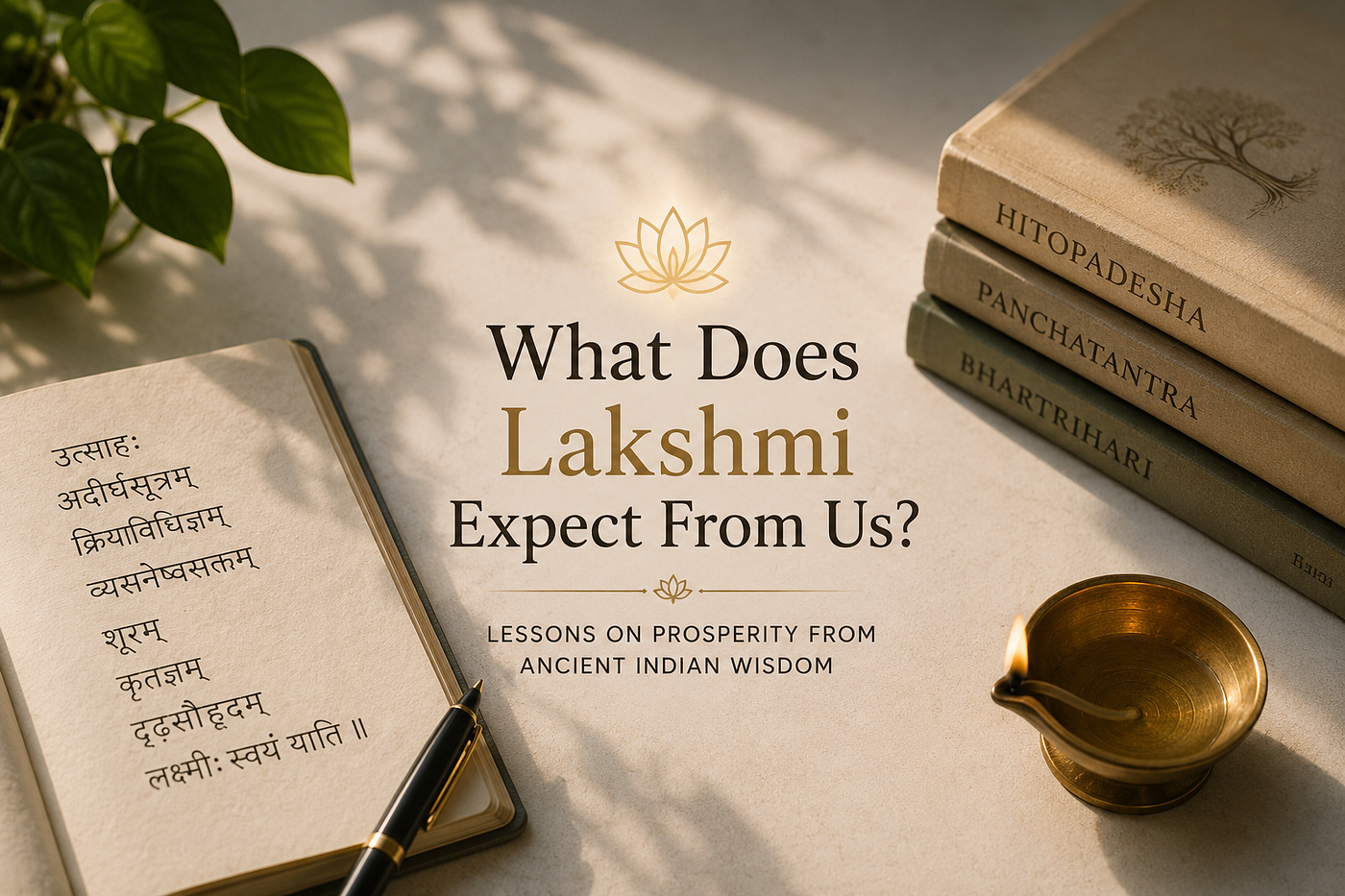
image made by author
What Attracts Wealth? Lessons from Ancient Indian Wisdom
Money is one of the most discussed subjects in the modern world. Open any social media platform and you will quickly find countless videos, articles, and courses teaching people how to earn more, invest wisely, build passive income, or achieve financial freedom.
Yet amidst all this advice, one question is rarely asked:
Why does wealth come to certain people in the first place?
Most modern discussions focus on wealth management. Ancient Indian wisdom, however, often appears to focus on something deeper — the qualities of the individual who attracts and sustains prosperity.
Before exploring these ideas, it is worth noting that humanity’s relationship with wealth is not new. Money did not suddenly become important in the twenty-first century. Long before paper currency existed, societies used gold, silver, copper coins, and even barter systems to exchange value. Wealth, in one form or another, has always been a part of human civilization.
If wealth has existed throughout history, then it is natural to ask whether earlier civilizations also reflected on the principles behind prosperity.
Interestingly, several Indian texts did exactly that.
The Qualities Lakshmi Seeks
One such verse from the Hitopadesha states:
उत्साहसम्पन्नम् अदीर्घसूत्रं क्रियाविधिज्ञं व्यसनेष्वसक्तम्। शूरं कृतज्ञं दृढसौहृदं च लक्ष्मीः स्वयं याति निवासहेतोः॥
Transliteration
Utsāhasampannam adīrghasūtraṁ Kriyāvidhijñaṁ vyasaneṣv asaktam Śūraṁ kṛtajñaṁ dṛḍhasauhṛdaṁ ca Lakṣmīḥ svayaṁ yāti nivāsahetoḥ ॥
According to this verse, prosperity is naturally drawn toward a person who is enthusiastic, avoids procrastination, understands how to perform work effectively, stays away from destructive habits, possesses courage, remains grateful, and knows how to maintain meaningful relationships.
- उत्साह → Initiative
- अदीर्घसूत्रम् → Freedom from procrastination
- क्रियाविधिज्ञम् → Skill and competence
- व्यसनेष्वसक्तम् → Self-control
- शूरम् → Courage
- कृतज्ञम् → Gratitude
- दृढसौहृदम् → Long-term relationships
What is striking is not only what the verse says, but also what it does not say.
It does not mention being born into a wealthy family. It does not mention luck. It does not offer a secret formula for becoming rich. Instead, it focuses entirely on character and conduct.
Today, we are surrounded by advice on how to earn money. Learn this skill, start that business, invest here, build multiple income streams, create passive income, and so on.
Yet amidst all these discussions, a simpler question often gets ignored:
What is prosperity actually attracted to?
Many people pray to Lakshmi for wealth. But before asking what we want from Lakshmi, perhaps it is worth asking what Lakshmi expects from us.
Interestingly, the verse does not describe people chasing Lakshmi. It describes Lakshmi moving toward certain qualities.
Wealth Stays Where Discipline Stays
The same theme appears in the Panchatantra:
यत्रोत्साहसमारम्भो यत्रालस्य विहीनता । नयविक्रमसंयोगस्तत्र श्रीरचला ध्रुवम् ॥
Transliteration
Yatrotsāhasamārambho yatrālasya vihīnatā । Nayavikramasaṁyogas tatra śrīr acalā dhruvam ॥
The verse suggests that prosperity remains where enthusiasm exists, laziness is absent, and wisdom works together with courage.
What I find interesting is that this verse does not introduce a completely new idea. Instead, it reinforces the previous one.
Once again, prosperity is linked not to investment strategies or secret techniques, but to enthusiasm, discipline, wisdom, and courage.
Perhaps this is because earning wealth and sustaining wealth are two different things. Many people succeed in making money, but not everyone succeeds in keeping it.
Hard work alone is not always enough. Wisdom without action often remains unused, while courage without wisdom can become recklessness. Prosperity seems to favor a balance of both.
Effort Over Excuses
A similar perspective can be found in Bhartrihari’s famous verse:
उद्योगिनं पुरुषसिंहमुपैति लक्ष्मी दैवेन देयमिति कापुरुषा वदन्ति । दैवं निहत्य कुरु पौरुषमात्मशक्त्या यत्नेकृते यदि न सिद्ध्यति कोऽत्रदोषः ॥
Transliteration
Udyoginaṁ puruṣasiṁham upaiti lakṣmīḥ Daivena deyam iti kāpuruṣā vadanti । Daivaṁ nihatya kuru pauruṣam ātmaśaktyā Yatne kṛte yadi na siddhyati ko’tra doṣaḥ ॥
Here, prosperity is associated with effort and initiative rather than passive dependence on fate.
Even if success does not arrive despite sincere effort, there is dignity in having tried. The greater failure is often the refusal to act.
What makes this verse particularly interesting is that it comes from Bhartrihari, a figure traditionally associated with kingship and worldly experience. Yet even here, the emphasis is not on rituals or fortune. The focus remains firmly on effort and personal initiative.
In an age where information is available everywhere, the real difference may no longer be knowledge. Two people can read the same book, watch the same videos, and receive the same advice, yet end up with completely different outcomes.
The difference often lies in who acts and who keeps waiting.
Prosperity and Personal Responsibility
The Hitopadesha reinforces this point with another verse:
अव्यवसायिनमलसं दैवपरं साहसाच्च परिहीनम् । प्रमदेव हि वृद्धपतिं नेच्छत्युपगूहितुं लक्ष्मीः ॥
Transliteration
Avyavasāyinam alasaṁ daivaparaṁ sāhasāc ca parihīnam । Pramadeva hi vṛddhapatiṁ necchaty upagūhituṁ lakṣmīḥ ॥
The message is direct: laziness, excessive dependence on fate, and lack of courage repel prosperity.
What makes this verse striking is its directness. It leaves little room for excuses. Laziness is not presented as an obstacle to prosperity — it is presented as something that actively drives prosperity away.
The verse is surprisingly relevant even today. While ancient texts may have referred to laziness in a traditional sense, modern distractions can take many forms: endless scrolling, constant entertainment, and postponing important decisions.
The Law of Cause and Effect
Another traditional saying offers an equally fascinating observation:
सत्यानुसारिणी लक्ष्मीः कीर्तिस्त्यागानुसारिणी। अभ्याससारिणी विद्या बुद्धिः कर्मानुसारिणी॥
Transliteration
Satyānusāriṇī lakṣmīḥ kīrtis tyāgānusāriṇī । Abhyāsasāriṇī vidyā buddhiḥ karmānusāriṇī ॥
Prosperity follows truth. Reputation follows sacrifice. Knowledge follows practice. Wisdom follows action.
The underlying idea is simple yet profound: meaningful outcomes rarely appear without corresponding causes.
Knowledge requires practice.
Wisdom requires action.
Reputation requires sacrifice.
Prosperity requires qualities that extend far beyond financial techniques.
Unlike the previous verses, this one shifts the discussion from effort to cause and effect. In a world obsessed with outcomes, it reminds us to pay attention to the habits that produce those outcomes.
Final Thoughts
When these verses are examined together, a clear pattern emerges. They repeatedly associate prosperity with enthusiasm, discipline, courage, competence, truthfulness, gratitude, and meaningful relationships.
Today, we often discuss how to manage money.
These texts seem more interested in discussing how to manage oneself.
We spend a great deal of time learning how to earn wealth, multiply wealth, preserve wealth, and sometimes even praying for more of it.
Yet after reading these verses, I am left with a different question:
What does Lakshmi expect from us?
The answer offered by these texts is surprisingly consistent. Not shortcuts. Not secret formulas. Not guaranteed methods of becoming rich.
Instead, they point toward qualities that improve the individual: effort, discipline, courage, gratitude, wisdom, and integrity.
Whether one sees Lakshmi as a goddess or as a symbol of prosperity, the message remains thought-provoking.
Before asking how to attract wealth, perhaps we should ask whether we are cultivating the qualities that wealth seems to favor.
And if these qualities improve us regardless of how much money we eventually earn, there seems to be very little to lose and much to gain.
메타데이터
- post_id
- 99db1f7dcb31
- slug
- we-ask-lakshmi-for-wealth-but-what-does-lakshmi-ask-of-us-99db1f7dcb31
- url
- https://medium.com/the-pillionaire-diaries/we-ask-lakshmi-for-wealth-but-what-does-lakshmi-ask-of-us-99db1f7dcb31
- canonical_url
- https://medium.com/the-pillionaire-diaries/we-ask-lakshmi-for-wealth-but-what-does-lakshmi-ask-of-us-99db1f7dcb31
- author_url
- https://medium.com/@rishabhshukla973
- status
- ok
- fetched_at
- 2026-07-17 03:23:32