The 75-Year Silence: Why Menstrual Health is Finally a Constitutional Right
The Supreme Court’s 2026 judgment in Dr. Jaya Thakur v. Union of India didn’t just mandate sanitary pads in schools. It told the law to…
The 75-Year Silence: Why Menstrual Health is Finally a Constitutional Right
The Supreme Court’s 2026 judgment in Dr. Jaya Thakur v. Union of India didn’t just mandate sanitary pads in schools. It told the law to finally acknowledge a body it had spent seven decades ignoring.

Image-1- its is an ai generated image if it is any depiction of the real-life scenario then its pure coincidence.
The Invisible Barrier
Picture a classroom of forty students. Every few weeks, without warning, some of them start disappearing. Not all at once one by one. Some come back. Some don’t.
This is not hypothetical. Research cited in the 2026 Supreme Court judgment found that nearly one-third of adolescent girls in parts of North India were absent from school during menstruation because their schools had no functional girls’ toilet, no sanitary napkins, no safe disposal mechanism. In some cases, girls stopped coming altogether.
On January 30, 2026, the Supreme Court in Dr. Jaya Thakur v. Government of India ruled that this is not just a policy failure. It is a constitutional violation. For seventy-five years, the law treated menstruation as a private inconvenience. This judgment calls it what it actually is: a constitutional crisis hiding in plain sight.
The “Neutral” Law Trap
Here is a question that sounds simple until you sit with it: can a law be biased without meaning to be?
The answer, as the Court confirms, is yes. The RTE Act guarantees every child the right to free and compulsory education. It does not mention menstruation, sanitary napkins, or what it actually takes for a girl to stay enrolled once she gets through the door. It was written as gender-neutral which sounds fair, until you realise that “neutral” implicitly meant male.
This is formal equality: treating everyone the same regardless of circumstance. The Dr. Jaya Thakur judgment rejects it in favour of substantive equality the idea that treating people differently can sometimes be the only way to treat them fairly. As the Court quotes Amartya Sen: “Equal consideration for all may demand very unequal treatment in favour of the disadvantaged.”
A law that ignores a biological reality is not neutral. It has simply chosen whose reality to ignore.
Reclaiming Article 21: Life, Dignity, and Biology
The judgment does something doctrinally significant: it reads menstrual health into Article 21’s right to life.
Dignity, the Court holds, is not abstract it “finds expression in conditions that enable individuals to live without humiliation, exclusion, or avoidable suffering.” A girl forced to sit through class anxious about leakage or forced to carry used sanitary products home because her school has no bin, is not merely uncomfortable. She is being systematically humiliated by the State’s inaction.
The Court also invokes privacy. Under K.S. Puttaswamy, privacy protects decisional autonomy the right to make choices about your own body free from coercion. When a girl cannot access a toilet or a pad at school, her choices about her own body are dictated by institutional failure. That, the Court says, is a privacy violation.
The link to education runs through Section 3 of the RTE Act, which bars any “fee or charges or expenses” that prevent a child from completing elementary education. The Court reads this broadly: if the cost of sanitary products is causing girls to miss school, that cost is a legal barrier — and eliminating it is the State’s obligation, not its generosity.
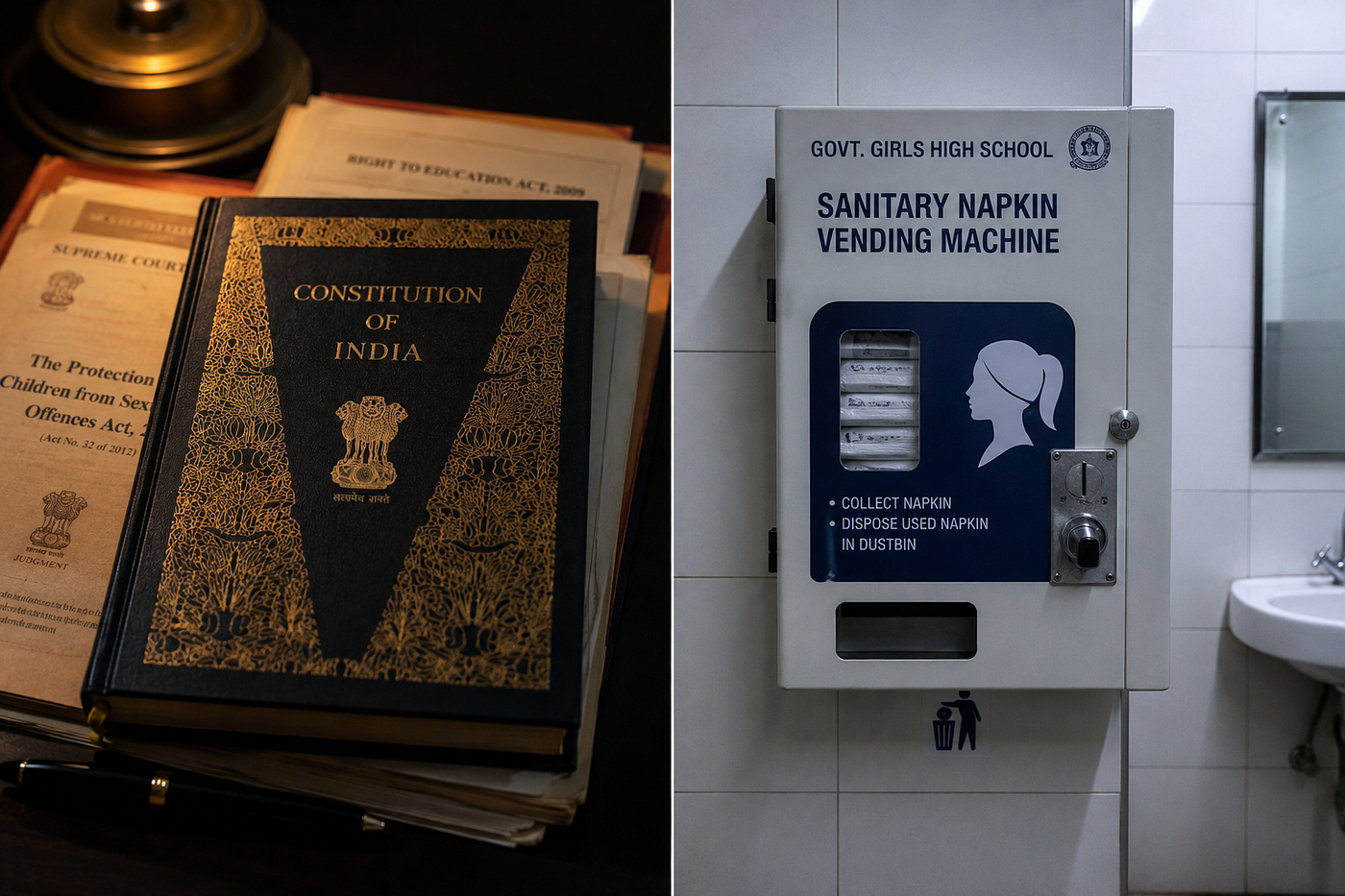
Image-2- its is an ai generated image if it is any depiction of the real-life scenario then its pure coincidence.
From Charity to Duty
This is the judgment’s most consequential move. For years, state governments have distributed sanitary pads as welfare schemes well-meaning, underfunded, and entirely discretionary. Schemes can be cut. Fundamental rights cannot.
The Court rules that adequate menstrual hygiene infrastructure is a mandatory standard under Section 19 of the RTE Act the same provision that requires schools to have separate toilets and safe drinking water. Non-compliance can cost a school its recognition.
The directions are specific: free oxo-biodegradable sanitary napkins in every school, MHM corners stocked with spare uniforms and disposal bags, compliant sanitary waste disposal, and menstrual health incorporated into NCERT and SCERT curricula for all students, not just girls. The Court also issued a continuing mandamus, meaning the Union must return with proof of compliance. This is not a one-time order. The bench is watching.
One often-overlooked part of the judgment deserves mention: Section F, on the role of men. The Court places explicit responsibility on male teachers and students to be educated and sensitised about menstruation. A school with functional toilets but a hostile environment, it notes, has solved only half the problem. “Ignorance breeds insensitivity, knowledge breeds empathy.” Menstrual health, the Court says plainly, is a shared responsibility not a women’s issue.
The Constitution Finally Catches Up
Whether implementation follows is a harder question. Multiple states didn’t even file affidavits in this case; retrofitting thousands of schools in three months is optimistic at best. But what cannot be undone is the doctrinal shift.
The Constitution now has to account for the female body — not work around it. Menstruation is not a choice. For seventy-five years, how the law responded to it was. That silence has been formally, constitutionally broken.
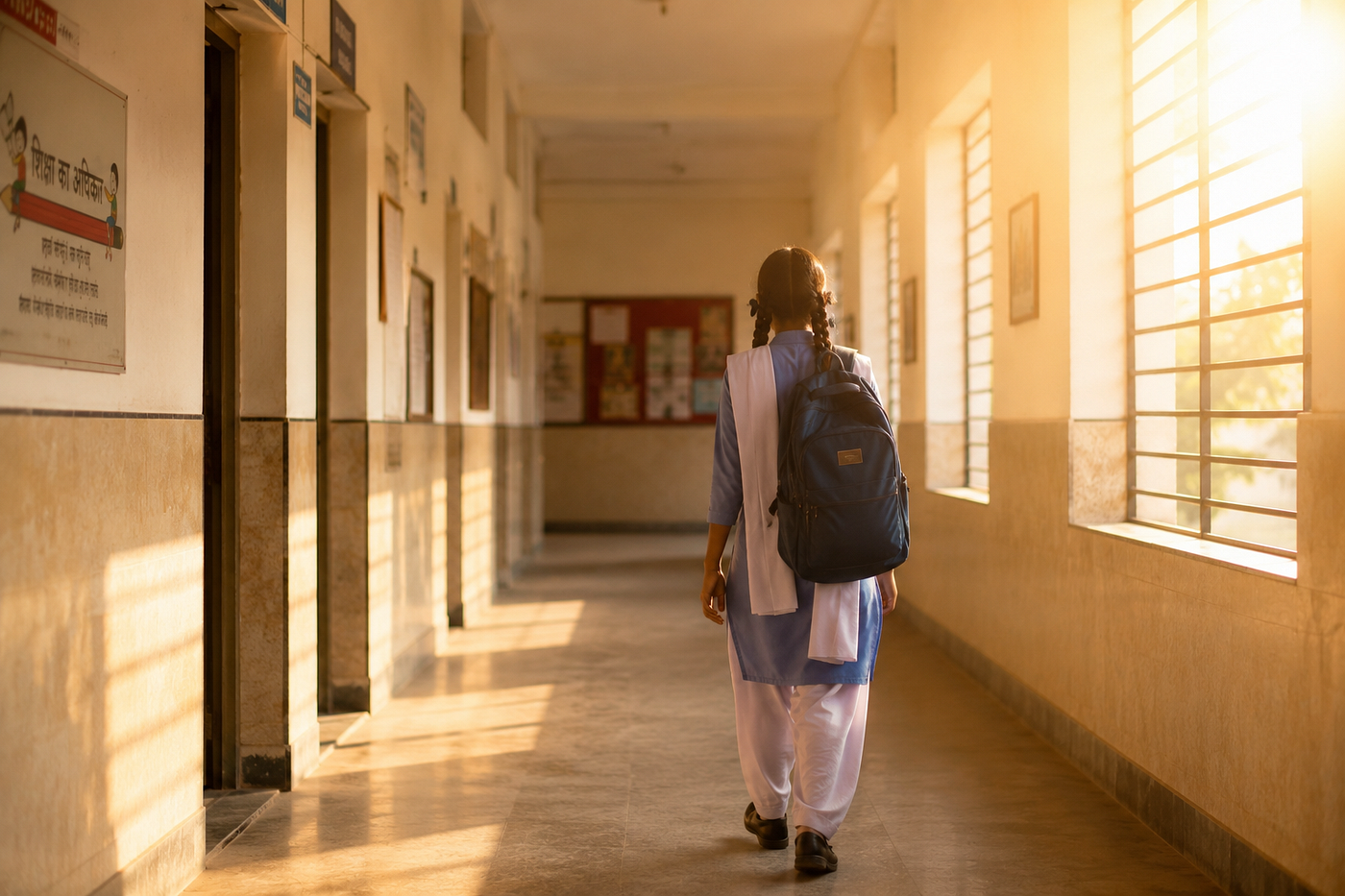
Image-3- its is an ai generated image if it is any depiction of the real-life scenario then its pure coincidence.
Dr. Jaya Thakur v. Government of India, 2026 INSC 97, decided January 30, 2026, by J.B. Pardiwala and R. Mahadevan, JJ.
메타데이터
- post_id
- 99e0c9df3ed2
- slug
- the-75-year-silence-why-menstrual-health-is-finally-a-constitutional-right-99e0c9df3ed2
- url
- https://medium.com/@naishakhandelwal2007/the-75-year-silence-why-menstrual-health-is-finally-a-constitutional-right-99e0c9df3ed2
- canonical_url
- https://medium.com/@naishakhandelwal2007/the-75-year-silence-why-menstrual-health-is-finally-a-constitutional-right-99e0c9df3ed2
- author_url
- https://medium.com/@naishakhandelwal2007
- status
- ok
- fetched_at
- 2026-06-09 15:37:30