S&P 500 Forecast: What Could Drive the Next Major Market Move?
The S&P 500 has entered another important decision zone after a powerful advance, strong corporate earnings, changing inflation…
S&P 500 Forecast: What Could Drive the Next Major Market Move?
The S&P 500 has entered another important decision zone after a powerful advance, strong corporate earnings, changing inflation expectations, uncertainty around Federal Reserve policy, and continued enthusiasm surrounding artificial intelligence investment.
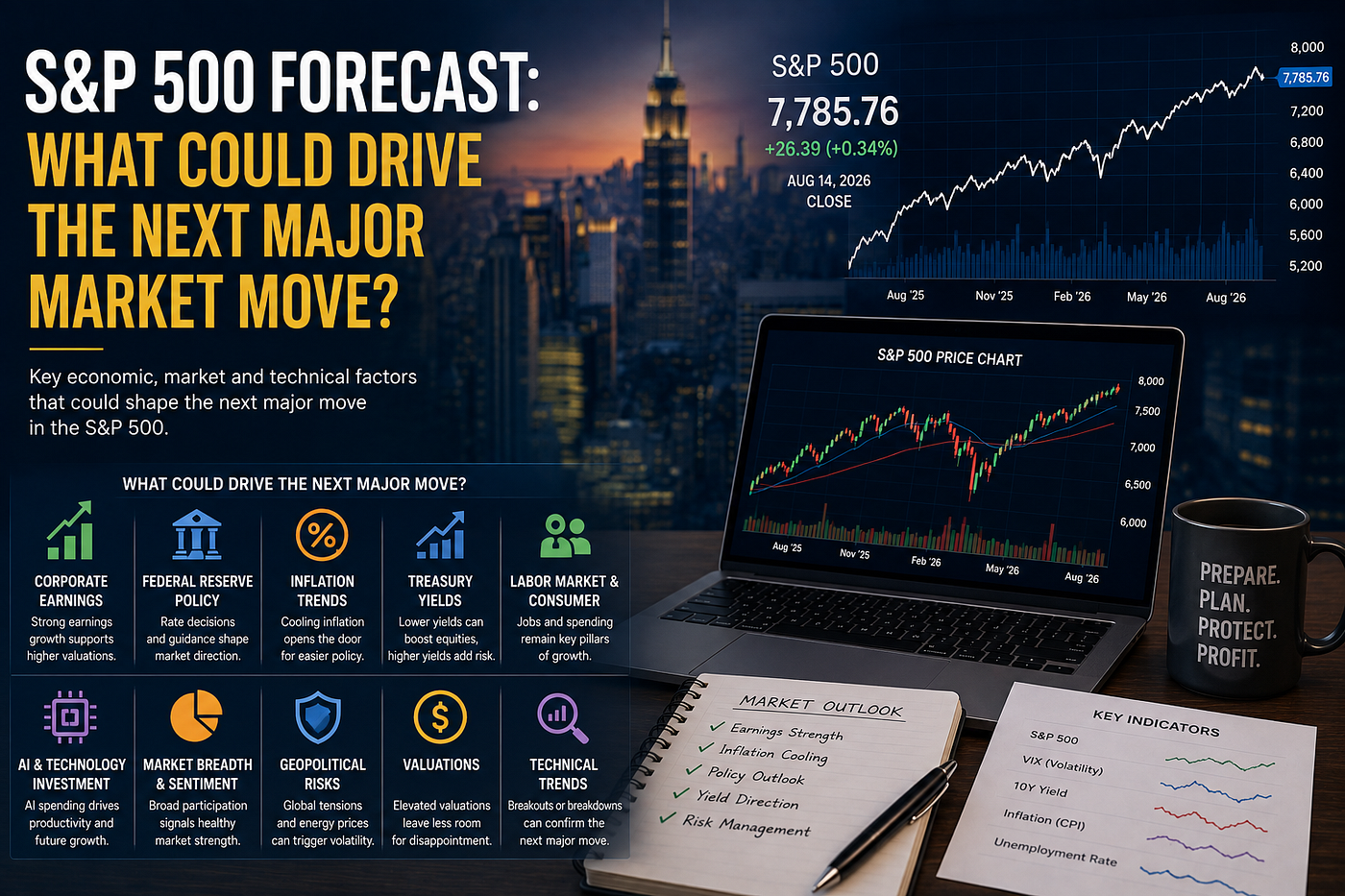
As of the August 14, 2026 close, the S&P 500 stood at 7,785.76, just below the record closing level of 7,798.99 reached a day earlier. The index has gained roughly 14% during 2026, making the question increasingly important for investors: what could drive the next major move?
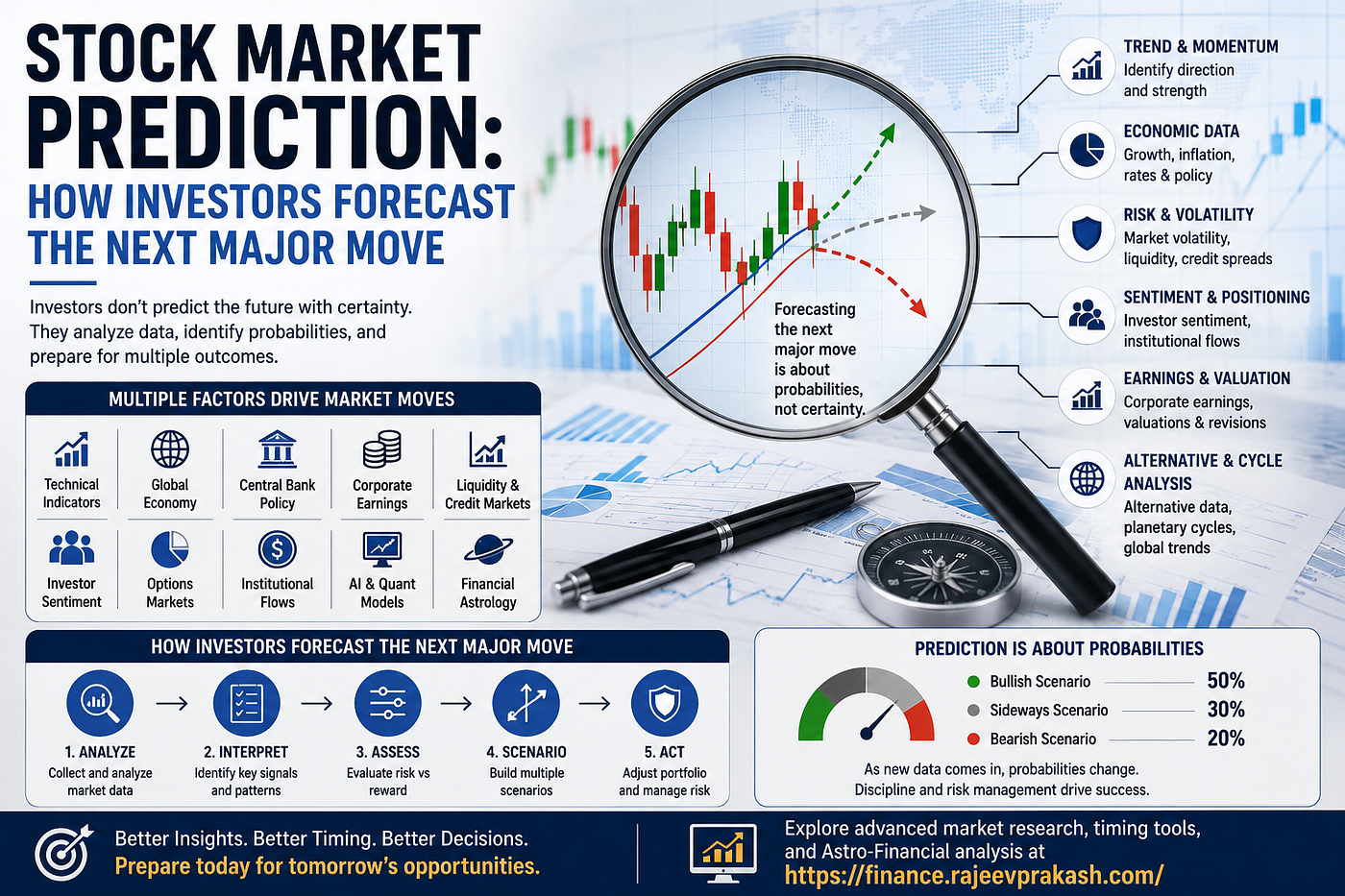
A useful S&P 500 forecast should not depend on a single price target. Markets rarely move because of one variable. Earnings growth, inflation, Treasury yields, Federal Reserve policy, consumer demand, employment, liquidity, valuation, AI investment, technical momentum, geopolitical risk, and investor positioning can interact simultaneously.
The next major S&P 500 move could therefore emerge when several of these forces begin pointing in the same direction.
For investors, family offices, hedge funds, and professional market researchers, the most important objective is not predicting an exact index level. It is identifying the conditions that could shift the probability toward another major advance — or toward a meaningful correction.
Where Does the S&P 500 Stand Now?
The current market environment contains both powerful bullish forces and meaningful sources of risk.
Corporate earnings have provided strong support. Reuters reported in early August that second-quarter S&P 500 earnings were running more than 30% above the prior-year period, with technology earnings particularly strong. A later Reuters report noted that roughly 85% of reporting S&P 500 companies had beaten earnings estimates.
At the same time, valuations remain demanding. Reuters reported that the index’s forward price-to-earnings ratio was around 20.4 in early August, meaning future earnings growth remains important if current valuations are to be sustained.
This creates an interesting setup.
The market has strong earnings support, but investors are already paying relatively high prices for those earnings.
That means the next major S&P 500 move could depend less on whether profits are currently strong and more on whether the market believes that strength can continue into 2027.
Earnings Could Be the Most Important Bullish Driver
Earnings ultimately provide the fundamental foundation for stock-market valuations.
When companies generate higher profits, investors can justify paying higher prices, provided valuation multiples do not contract dramatically.
The 2026 earnings season has so far been unusually strong. AI-related investment has been a major contributor, but profit strength has also extended into sectors outside megacap technology.
This broadening is important for the S&P 500 forecast.
A rally driven by only a handful of companies can become fragile. If financials, healthcare, industrials, consumer companies, and other sectors begin contributing more meaningfully to earnings growth, the bull market becomes less dependent on a small number of technology leaders.
The bullish scenario therefore depends partly on earnings breadth.
If corporate revenue continues rising, margins remain healthy, and earnings expectations for 2027 move higher, the market could absorb relatively high valuations and potentially establish another leg upward.
If earnings momentum slows sharply, however, investors may begin questioning whether current index levels already discount too much future optimism.
AI Spending Remains a Major Market Variable
Artificial intelligence has become one of the largest structural investment themes influencing U.S. equities.
Major technology companies are investing enormous amounts in data centers, semiconductors, networking, cloud infrastructure, and AI computing capacity. Reuters reported that spending connected to AI infrastructure among leading technology companies could exceed $700 billion during 2026.
This spending has multiple effects.
It supports semiconductor demand, data-center construction, electrical infrastructure, networking equipment, cooling systems, software, cloud services, and other parts of the technology ecosystem.
For the S&P 500, however, the next phase may require more than rising capital expenditure.
Investors will increasingly want evidence that massive AI investments can produce sustainable revenue and profit.
If companies demonstrate strong returns on AI spending, the market could continue rewarding the theme.
If capital expenditures continue rising while monetization disappoints, valuation pressure could develop across technology stocks.
Because the largest technology companies carry substantial weight in the S&P 500, this issue could influence the direction of the entire index.
Federal Reserve Policy Could Trigger the Next Major Move
Monetary policy remains another critical factor in the S&P 500 outlook.
At its July 28–29, 2026 meeting, the Federal Reserve maintained the federal-funds target range at 3.50% to 3.75%. The decision was made by a 9–3 vote, highlighting disagreement within the committee over the appropriate policy stance.
The Fed therefore remains an important potential catalyst.
If inflation continues moderating and economic growth weakens without producing a severe recession, investors may increasingly expect monetary policy to become less restrictive.
That could support equities by reducing the discount rate applied to future corporate earnings.
On the other hand, persistent inflation or another acceleration in energy prices could force the Fed to maintain restrictive policy — or potentially tighten again.
That would create a more difficult environment for high-valuation equities.
For the S&P 500, the direction of policy expectations may matter almost as much as the actual policy rate.
Markets often move months before central banks formally change rates.
Inflation Is Sending a Mixed but Important Signal
July inflation provided some encouraging evidence.
The U.S. Consumer Price Index increased only 0.1% on a seasonally adjusted basis in July. Headline inflation stood at 3.4% year over year, down from 3.5% in June, while core CPI excluding food and energy slowed to 2.5% from 2.6%.
That moderation helps reduce immediate concerns about a renewed broad inflation surge.
However, inflation has not disappeared.
The Federal Reserve’s preferred PCE measure showed headline inflation of 3.7% year over year in June and core PCE inflation of 3.3%.
The difference between CPI and PCE trends creates uncertainty around how quickly monetary policy can become easier.
For equities, a gradual decline in inflation without a collapse in economic growth would likely represent one of the most constructive environments.
Inflation falling because the economy enters a severe recession would be much less supportive.
The reason inflation declines therefore matters as much as the decline itself.
Treasury Yields Could Decide Whether Valuations Expand or Contract
Bond yields represent one of the most important competitors to equity valuations.
On August 14, 2026, the U.S. Treasury’s official closing curve showed the 10-year Treasury yield at 4.68%, while the 2-year yield stood at 4.17%.
A 10-year yield near these levels creates a meaningful alternative to equities for institutional capital.
When bond yields rise, future corporate cash flows are discounted at a higher rate. This can place particular pressure on companies whose valuations depend heavily on earnings expected many years into the future.
If the 10-year Treasury yield moves decisively higher, the S&P 500 could face valuation compression even if corporate earnings remain solid.
If yields fall because inflation moderates while the economy remains reasonably healthy, equity valuations could receive additional support.
Bond-market behavior should therefore be central to any S&P 500 forecast.
The Labor Market Is Becoming More Important
The labor market is producing another important signal.
U.S. nonfarm payroll employment declined by 23,000 in July 2026, while the unemployment rate remained at 4.1%. Employment weakness was concentrated partly in local government education and retail trade, while healthcare continued adding jobs.
One weak employment report does not automatically imply recession.
However, continued labor-market deterioration would become increasingly important because employment supports consumer spending.
If companies begin reducing hiring, consumers may become more cautious.
That could eventually affect revenue growth and earnings expectations.
For the stock market, the ideal environment would be moderate cooling that reduces inflation pressure without creating a deep contraction.
That is the classic soft-landing scenario.
A transition from slow employment growth to widespread job losses would create a much more negative S&P 500 outlook.
Consumer Spending Could Become a Critical Confirmation Signal
The American consumer remains crucial to economic growth.
Recent retail data have shown signs of cooling, with Reuters reporting on August 17 that U.S. retail sales had declined for the first time in nine months.
This makes upcoming consumer-company earnings particularly important.
Investors should watch whether households continue spending despite elevated borrowing costs and economic uncertainty.
Strong retail activity would support corporate revenue and reduce recession concerns.
Persistent deterioration could instead reinforce the weaker employment signal.
The combination of consumer spending and labor data may therefore determine whether investors interpret slower growth as healthy normalization or as the beginning of a more serious downturn.
Why Market Breadth Matters for the S&P 500 Forecast
An index can rise even when many individual stocks are struggling.
Because the S&P 500 is weighted by market capitalization, the largest companies can have an outsized influence on index performance.
That is why market breadth matters.
If more sectors and individual companies participate in the rally, the advance becomes healthier.
If the index continues reaching new highs while fewer stocks participate, vulnerability can increase.
Recent earnings strength outside technology has provided some support for the broader-market argument, but investors should continue monitoring whether price participation confirms the fundamental broadening.
Breadth can become particularly useful near turning points.
A market may appear strong at the index level while underlying participation quietly deteriorates.
Valuation Could Limit the Next Upside Phase
Valuation rarely identifies the exact day when a market will reverse.
Expensive markets can remain expensive for a long time.
However, valuation influences the amount of future optimism already reflected in prices.
With the S&P 500 trading near record levels and forward valuation multiples still elevated, future upside increasingly depends on earnings continuing to grow.
If profits accelerate faster than prices, valuation can become more reasonable even without a market decline.
If prices continue rising significantly faster than earnings, the market becomes increasingly dependent on valuation expansion.
That makes the index more sensitive to interest rates and economic disappointment.
Investors should therefore distinguish between an earnings-driven rally and a multiple-driven rally.
The former is generally easier to sustain.
Could the S&P 500 Move Above 8,000?
The 8,000 level has become an obvious psychological milestone.
Recent institutional forecasts illustrate how closely investors are watching this area. JPMorgan recently lifted its year-end S&P 500 target to 8,000, while Citi maintained an 8,100 target after increasing its 2026 earnings estimate.
These targets should not be treated as guarantees.
However, they show that a move above 8,000 is no longer considered an extreme bullish scenario.
From the August 14 close of 7,785.76, the index would require only a relatively modest advance to reach that threshold.
For a sustained breakout, however, investors would likely want continued earnings strength, stable or declining Treasury yields, improving breadth, and no major deterioration in economic conditions.
Simply crossing 8,000 would matter less than whether the market can maintain the breakout.
What Could Trigger a Bullish Breakout?
The strongest bullish scenario would involve several favorable developments occurring together.
Inflation continues moderating.
The Federal Reserve remains on hold or begins moving toward easier policy.
Treasury yields stabilize or decline.
Corporate earnings continue beating expectations.
AI investment produces stronger monetization.
The labor market cools without collapsing.
Consumer spending remains resilient.
Market breadth expands.
Under that combination, investors could become increasingly comfortable paying premium valuations for continued earnings growth.
The S&P 500 could then move beyond its existing highs and establish another sustained advance.
The key word is confirmation.
One positive inflation report or one strong earnings season is unlikely to determine the entire next market cycle.
What Could Trigger a Major Correction?
The bearish scenario also requires attention.
One major risk would be renewed inflation pressure, particularly if oil and energy costs remain elevated.
That could push Treasury yields higher and make the Federal Reserve more restrictive.
A second risk would be earnings disappointment.
If AI-related companies begin reducing guidance or fail to demonstrate adequate returns on enormous capital investments, technology valuations could come under pressure.
A third risk involves the consumer and labor market.
If weak employment turns into sustained job losses while consumer spending contracts, recession probabilities would rise.
Geopolitical escalation could add another layer through energy prices, global trade, inflation, and investor risk aversion. Current market commentary continues to identify Middle East tensions and oil prices as important uncertainties.
The most dangerous environment would be several of these risks appearing simultaneously.
Could September Become an Important Volatility Window?
Market participants are already looking toward September because several major policy and macroeconomic events will converge around that period.
The Federal Reserve’s next policy decisions, updated economic expectations, inflation releases, employment data, and changing earnings expectations could all influence positioning.
The upcoming Jackson Hole symposium on August 27–29 may also provide additional insight into how policymakers view inflation and growth.
Investors should be careful about assuming that calendar seasonality alone predicts a correction.
However, when seasonal vulnerability coincides with stretched positioning or deteriorating macro conditions, volatility can become more meaningful.
Technical Analysis Could Confirm the Next Direction
Fundamental analysis explains why markets might move.
Technical analysis can help determine whether the move has actually begun.
Investors should watch whether the S&P 500 continues producing higher highs and higher lows.
A convincing breakout above recent record levels accompanied by broad participation would strengthen the bullish case.
Repeated failures near record highs, followed by weakening breadth and broken support levels, would deserve more caution.
Volume, momentum, volatility, sector leadership, and relative strength can help distinguish temporary consolidation from a genuine change in trend.
Technical analysis is therefore best used as confirmation rather than as a stand-alone forecasting system.
Alternative Data Could Provide Earlier Clues
Traditional economic reports arrive periodically and often describe activity that occurred weeks earlier.
Alternative data can provide faster information.
Consumer transactions, corporate hiring, shipping activity, online pricing, credit-card spending, internet traffic, and business sentiment can all help investors estimate whether underlying economic momentum is changing.
For example, weakening transactions combined with reduced hiring and slower transportation activity could confirm that consumer demand is deteriorating.
Improvement across those indicators could support the soft-landing scenario.
For investors attempting to forecast the next major S&P 500 move, alternative data can therefore provide another layer between official economic releases.
Market Cycles and Financial Astrology as Timing Overlays
Longer-term market-cycle analysis can also help investors evaluate whether current conditions resemble historically important transition periods.
Some researchers examine business cycles, liquidity cycles, volatility cycles, sentiment cycles, seasonal patterns, and specialized frameworks such as financial astrology.
Financial astrology studies whether planetary and astronomical cycles show historical associations with changes in market behavior.
Such methods should not replace earnings, macroeconomic data, technical analysis, or risk management.
A more disciplined framework is to treat cycle analysis as a timing overlay.
If a potentially important cycle window coincides with weakening market breadth, rising volatility, deteriorating liquidity, or negative macroeconomic developments, investors may increase monitoring.
If conventional market evidence remains strongly positive, a timing window alone should not be treated as proof that a reversal must occur.
A Probability-Based S&P 500 Forecast
The most useful S&P 500 forecast at current levels is therefore conditional rather than absolute.
The bullish case remains supported by exceptionally strong corporate earnings, substantial AI investment, moderating core CPI, and an index trading close to record highs.
The risks are equally clear.
Treasury yields remain relatively high, the Federal Reserve is maintaining a 3.50%–3.75% policy range, labor-market momentum has weakened, and valuations leave less room for major disappointments.
This creates a market where the next large move may come from changing expectations, not simply current conditions.
If investors become more confident that earnings can remain strong while inflation falls, the index could continue higher.
If markets conclude that earnings growth is peaking while rates remain high and the economy weakens, the same valuation levels could become difficult to sustain.
Final Thoughts: What Could Drive the Next Major S&P 500 Move?
The question behind the S&P 500 Forecast: What Could Drive the Next Major Market Move? is ultimately a question about convergence.
No single economic release is likely to determine the market’s direction.
Investors should watch the relationship between earnings, inflation, Federal Reserve policy, Treasury yields, employment, consumer spending, AI investment, valuations, market breadth, liquidity, technical trends, and geopolitical risk.
At present, the market’s fundamental support remains strong because corporate profits have exceeded expectations.
Yet the S&P 500 is already near record levels, which raises the standard required for future positive surprises.
The next powerful rally could emerge if inflation moderates further, Treasury yields decline, earnings estimates continue rising, and market leadership broadens.
The next meaningful correction could emerge if earnings expectations roll over while bond yields remain high, consumer demand weakens, unemployment rises, or geopolitical developments push inflation upward again.
For sophisticated investors, the most productive approach is therefore not to predict one exact number.
It is to define the conditions that would make different outcomes increasingly probable.
Watch earnings.
Watch Treasury yields.
Watch the Federal Reserve.
Watch employment and consumer behavior.
Watch market breadth and volatility.
And most importantly, watch whether these indicators begin moving together.
When several independent signals align, the probability of the next major S&P 500 move can become much clearer.
Explore : https://finance.rajeevprakash.com/
메타데이터
- post_id
- 99ef509edef9
- slug
- s-p-500-forecast-what-could-drive-the-next-major-market-move-99ef509edef9
- url
- https://medium.com/@astrohulk/s-p-500-forecast-what-could-drive-the-next-major-market-move-99ef509edef9
- canonical_url
- https://medium.com/@astrohulk/s-p-500-forecast-what-could-drive-the-next-major-market-move-99ef509edef9
- author_url
- https://medium.com/@astrohulk
- status
- ok
- fetched_at
- 2026-08-18 09:49:05