Quartz for Chemical Processing: 5 Critical Products & Specs
Quartz for chemical processing solves a problem few other materials can: aggressive chemistry combined with high temperature. Glass-lined…
Quartz for Chemical Processing: 5 Critical Products & Specs
Quartz for chemical processing solves a problem few other materials can: aggressive chemistry combined with high temperature. Glass-lined steel cracks under thermal cycling. PTFE softens above 260C. Hastelloy and tantalum cost a fortune and still corrode in halogen-rich streams. Borosilicate handles the chemistry but tops out at 500C. For a wide band of applications combining corrosive chemistry with elevated temperature, fused quartz outlasts every alternative, except when it doesn’t.
This guide is written for process engineers, R&D chemists, purchasing managers, and equipment specifiers running acid service, oxidizer handling, halogen processes, and high-temperature reactions. It covers where quartz earns its place, how to specify it for corrosive duty, the failure modes that show up in service, and the specific chemistries where quartz is the wrong answer regardless of what else you’d save.
Quartz resists nearly every common chemistry except hydrofluoric acid and hot concentrated alkali. The engineering work is not deciding whether quartz can handle a chemistry. For most acids and solvents, it can. The work is deciding whether temperature, pressure, and mechanical loading combine in a way the material can survive over the design service life.
Where Quartz Appears in Chemical Plants
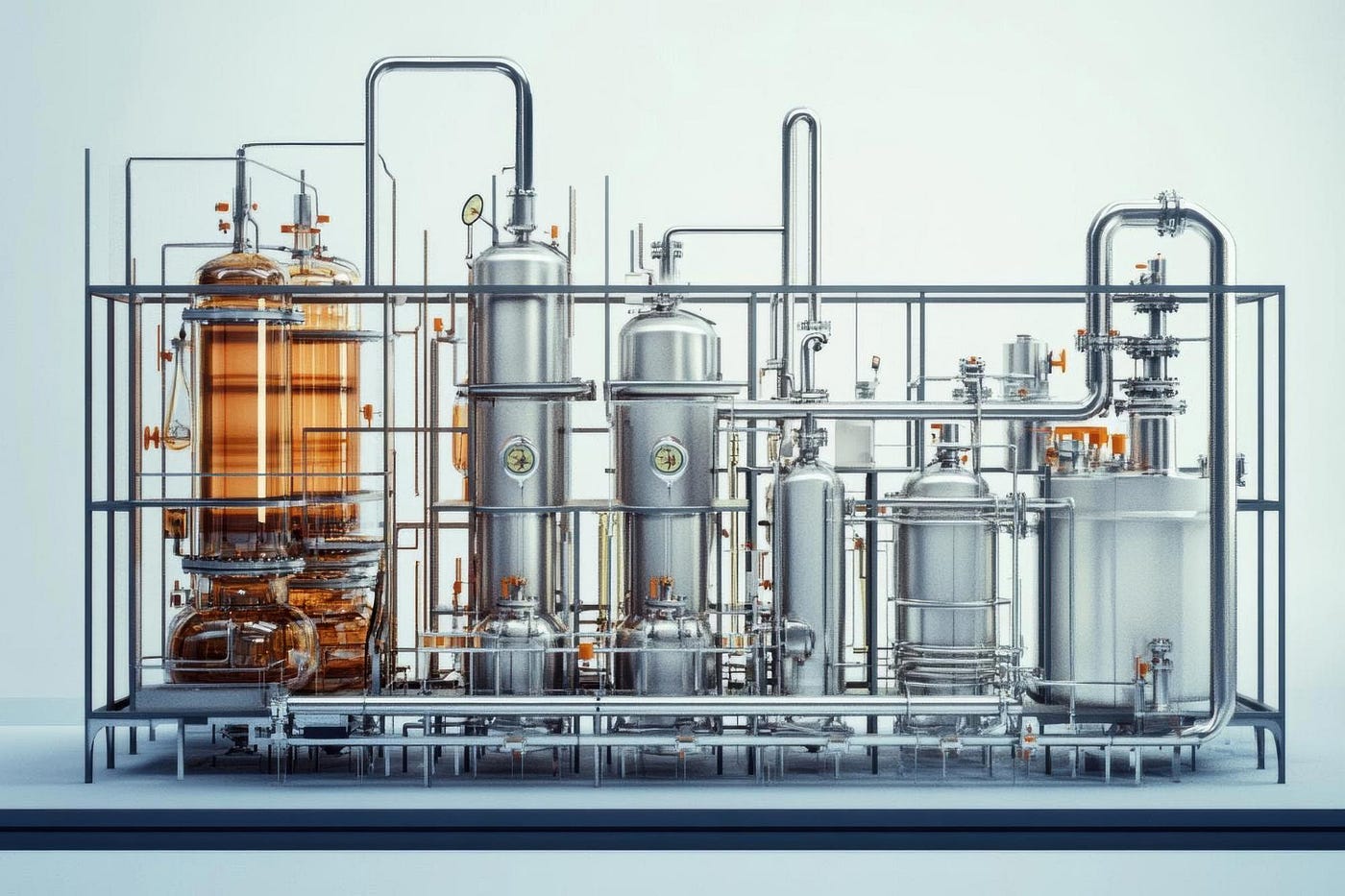
Chemical plants use quartz in five primary places. Each has different failure modes and specification priorities.
Bench-scale and pilot-scale reactors handling hot acid reflux, oxidation chemistry, halogen reactions (other than HF), or any reaction requiring temperatures above 500°C typically use clear or opaque fused quartz reactor bodies. Quartz reactors handle continuous temperatures up to about 1100°C, transmit visible light for in-process observation, and shrug off the acid streams that would dissolve a stainless reactor in weeks.
Production-scale chemical reactors are usually glass-lined steel or alloy, but quartz appears at process-critical points: heated reflux columns, vapor-phase reaction tubes, photochemical reactor inserts, and any vessel where the chemistry combines with temperature in a way that exceeds borosilicate’s range.
Direct-contact heating of corrosive liquids is one of quartz’s signature applications. A quartz-sheathed immersion heater puts a heating element directly into hot acid, oxidizer, or salt solution without the metal contamination that any alloy sheath would introduce. Quartz heat exchanger tubes serve the same role in shell-and-tube configurations where the process stream would attack metal tubing.
The specifications are demanding: thin enough wall to transfer heat efficiently, thick enough to handle pressure differential and mechanical load, and a wall surface fire-polished to slow chemical attack.
Quartz Sight Glasses and Inspection Windows
Process visibility matters in chemical service. Quartz sight glasses on reactors, distillation columns, scrubbers, and pressure vessels withstand the thermal gradient between hot interior and cool exterior, resist the chemical attack that would frost a borosilicate window in weeks, and pass enough UV and visible light for spectroscopic in-process monitoring. Round discs from 25 to 200 mm are standard; rectangular plates handle larger viewports on bigger vessels.
Quartz Columns for Distillation & Vapor-Phase Components
For specialty chemical distillation, particularly involving acids or compounds that would corrode metallic columns, quartz column sections, packing supports, and condenser coils handle the duty. Quartz is also the standard for any distillation involving photolabile compounds because it transmits the wavelengths that would degrade them through borosilicate.
Quartz Sample Probes and Analytical Components
Process analytical instruments handling hot or aggressive process streams (UV-Vis flow cells, FTIR sample probes, in-line spectrometer windows) use quartz because no other material gives you optical clarity plus chemical resistance plus thermal stability in one package. For continuous-stream analytical service, fire-polished interior surfaces matter as much as the bulk material.
How to Specify Quartz for Chemical Processing
Chemical service specification differs from industrial heat treatment in three ways: chemistry compatibility comes first, surface finish drives service life, and pressure rating becomes a real consideration.
Chemical Compatibility Check
Before specifying quartz at all, run through the exclusion list. Quartz fails in:
- Hydrofluoric acid at any concentration, any temperature
- Fluoride-containing reagents that release HF (TBAF, certain fluorinating agents)
- Hot concentrated alkali (NaOH, KOH above 10% and 80°C)
- Hot phosphoric acid above 200°C
- Molten alkali metals (Na, K, Li)
For everything else common in chemical processing (sulfuric, hydrochloric, nitric, aqua regia, all organic solvents, oxidizing gases, halogens other than F₂), quartz is appropriate up to its temperature limits.
Material Grade
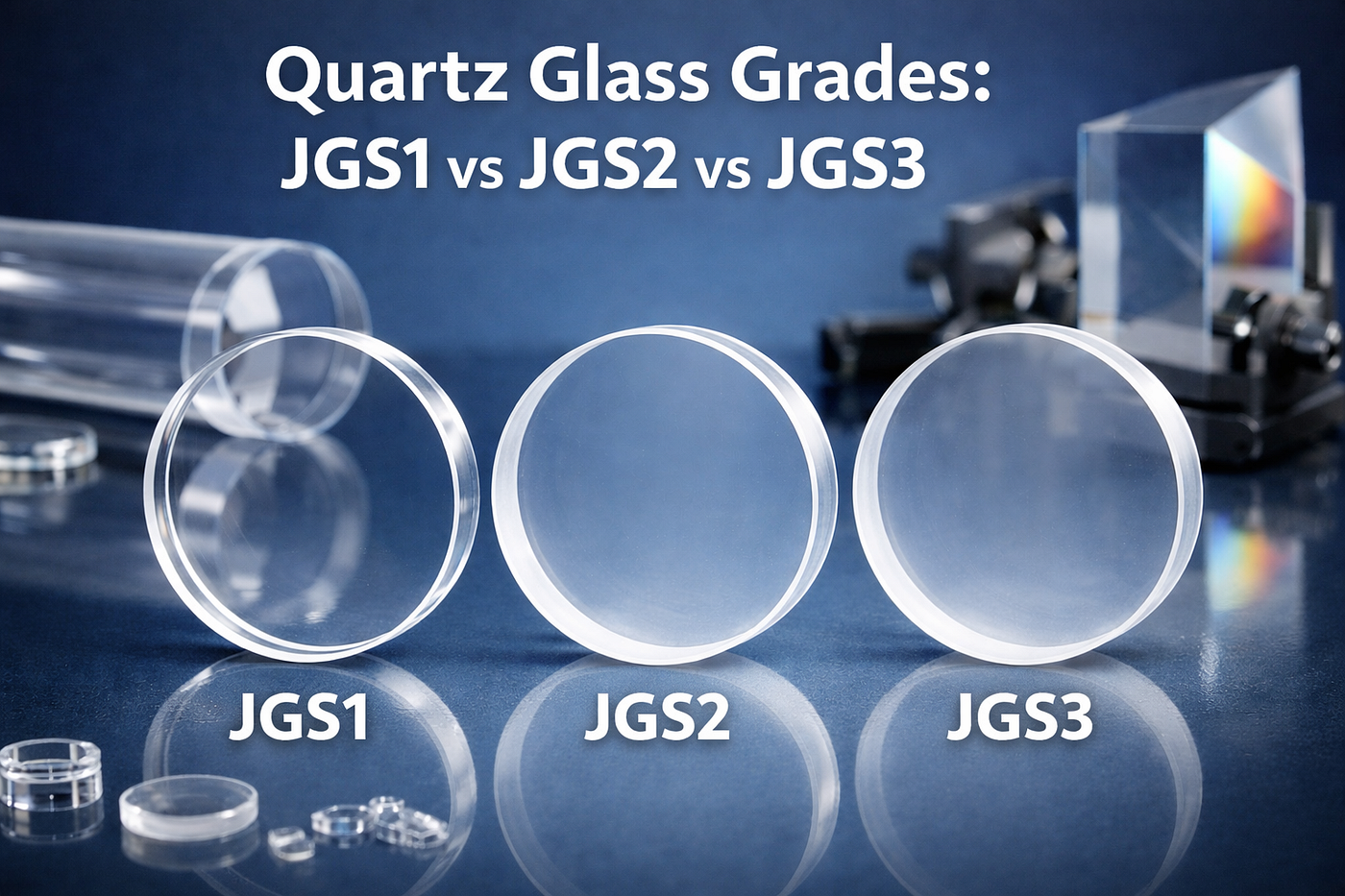
Most chemical processing service uses standard fused quartz ( JGS3 equivalent or natural-quartz-derived material). Trace metal impurities at ppm levels do not affect chemistry outcomes for typical industrial reactions. Pay for synthetic fused silica (JGS1) only when the application is photochemistry requiring deep-UV transmission, or when the process is intolerant of even trace metal leaching.
Wall Thickness and Pressure Rating
Atmospheric-pressure reflux: 2 mm wall for tubes up to 60 mm OD, 3 mm above that. Pressure or vacuum service requires explicit engineering. Fused quartz has high tensile strength but is brittle; it does not yield gracefully under overpressure. For positive-pressure service above 1 bar, specify wall thickness based on a documented stress calculation including thermal stress, mechanical load, and a safety factor of at least 4. For full vacuum service, the same approach applies on the implosion side.
Most quartz fabricators will provide pressure ratings on request. If they won’t, that’s a sign they shouldn’t be supplying you.
Surface Finish
Fire-polished interior surfaces last significantly longer in hot acid service than ground or as-fabricated surfaces. Micro-scratches from grinding concentrate stress and provide nucleation sites for both chemical attack and devitrification. For any continuous hot acid service, specify fire-polished bore. For exterior surfaces or non-contact geometry, fire polish is optional.
End Configuration and Joint Design
Sphere joints (ground glass) work for benchtop and pilot-scale rigs that disassemble frequently, but the ground surface wears with each thermal cycle and acid exposure. For permanent installations or production service, fused weld joints or flanged connections with PTFE gaskets and external clamps are more reliable. Specify the joint to match how the part will actually be installed and serviced, not the most convenient option for the fabricator.
The combination of high temperature plus aggressive chemistry plus mechanical stress is what shortens quartz service life. Any one of these alone is usually fine. Two together require careful specification. All three together require either over-engineering the part or accepting a planned replacement schedule.
Failure Modes in Chemical Service
Quartz parts in chemical service typically fail in one of four ways. Recognizing the early signs prevents an unscheduled outage and a process loss.
Thermal Shock from Quench Events
Splash exposure, sudden cold-feed addition to a hot reactor, or emergency cooldown can introduce thermal gradients that exceed even fused quartz’s tolerance. The crack initiates at the temperature interface and propagates fast. Mitigation: avoid direct cold-liquid contact with hot quartz surfaces, design feed nozzles to disperse incoming streams, and use thermal jackets to moderate gradient on cool-down.
Slow Chemical Attack
Even within compatibility limits, hot acid slowly thins the wall over months or years of service. Concentrated H₂SO₄ at 250°C, hot phosphoric below the 200°C threshold, or oxidizing gas streams at high temperature will all eventually reduce wall thickness. Inspection: measure wall thickness at known stress points annually for continuous-service parts. Replace before wall thickness drops below the design minimum.
Devitrification
Above 1100°C in any service, fused silica slowly crystallizes into cristobalite. In chemical service, the catalyst is usually alkali contamination from process residue, condensate, or atmospheric salt deposition on exterior surfaces. Once visible (hazy or milky patches), the wall is mechanically compromised. Replacement is the only fix.
Mechanical Damage at Installation
The most common failure mode in chemical service is not the chemistry. It’s a chip on the rim from a careless installation, a crack from over-torqued clamping, or a stress fracture from a poorly supported tube under thermal cycling. Inspect every part before installation. Document handling and torque specifications. Train operators on quartz handling.
If your process involves rapid temperature changes, halogen-rich oxidizing streams, or any continuous service above 1000°C, treat quartz components as planned consumables. The replacement interval based on inspection data is always cheaper than an unplanned outage.
What to Look For in a Quartz Supplier for Chemical Service
Chemical service suppliers must understand process engineering, not just glass fabrication.
- Process engineering literacy. A supplier who can discuss your chemistry, temperature, and pressure conditions and recommend a specification, rather than just quoting whatever drawing you send, is worth significantly more than one who only fills orders.
- Wall thickness engineering. For pressure or vacuum service, the supplier should provide a stress calculation and pressure rating in writing. If they cannot, find another supplier.
- Custom geometry capability. Chemical reactors rarely match standard catalog dimensions. A fabricator who can produce a tube to an exact length, with a specific flange configuration, and a fire-polished bore, on a reasonable schedule, will save you weeks compared to one who only sells stock parts.
- Material grade flexibility. A supplier offering only one or two grades is forcing you to over-specify or under-specify. Look for someone who stocks multiple grades and can recommend based on your application.
- Annealing and stress relief. Quartz parts under thermal cycling need proper annealing to minimize residual stress. This is not optional for chemical service. Annealing records should be available on request.
When Quartz Is Not the Right Answer
Three situations push the answer away from quartz, even when the chemistry would otherwise allow it.
First, anything containing HF or fluoride at elevated temperature. Use PTFE-lined steel up to 260°C, sintered tantalum or silicon carbide above that.
Second, hot concentrated caustic. Sodium hydroxide above 80°C and 10% concentration will steadily etch quartz. Nickel alloys (Inconel, Hastelloy C-276) handle hot caustic indefinitely.
Third, applications combining high pressure with thermal cycling. Quartz handles modest pressure differentials well, but it is brittle. Cyclic stress at elevated pressure favors borosilicate (lower temperature ceiling, more forgiving fatigue behavior) or metallic vessels with quartz sight glasses for the visibility you need.
Frequently Asked Questions About Quartz for Chemical Processing
Is quartz resistant to sulfuric acid?
Yes. Quartz resists sulfuric acid at all concentrations up to its temperature limit. Hot concentrated H₂SO₄ above 250C will slowly thin the wall over months, so for continuous hot-acid service, specify periodic wall-thickness inspection. For ambient and moderate temperatures, service life is effectively indefinite.
What is the maximum temperature for quartz in chemical service?
Quartz operates continuously up to about 1100C. Above 1100C it slowly devitrifies (crystallizes into cristobalite), especially with alkali contamination present. The softening point is far higher (~1665C), but 1100C is the practical ceiling for sustained chemical service.
What chemicals attack quartz?
Four things: hydrofluoric acid at any concentration, fluoride-releasing reagents, hot concentrated alkali (NaOH or KOH above 80C and 10%), and molten alkali metals. For everything else common in chemical processing, including all other acids, organic solvents, and oxidizers, quartz is appropriate up to its temperature limit.
Quartz vs glass-lined steel for acid service, which is better?
Glass-lined steel handles broad acid duty cheaply but cracks under thermal cycling and fails if the lining chips. Quartz for chemical processing wins where you need high temperature, thermal-shock resistance, optical visibility, or freedom from metal contamination. For low-temperature bulk acid storage, glass-lined steel is usually the more economical choice.
Can quartz be used for pressure or vacuum service?
Yes, with explicit engineering. Quartz has high tensile strength but is brittle and does not yield gracefully. For positive pressure above 1 bar, specify wall thickness from a documented stress calculation with a safety factor of at least 4. Most reputable fabricators provide pressure ratings on request.
Conclusion
Quartz earns its place in chemical processing because it does what no other single material does: resists nearly every common chemistry, survives temperatures up to 1100°C continuously, and provides optical access for in-process observation. The specification work is mostly about checking the exclusion list, sizing wall thickness for the actual service conditions, and choosing a supplier who treats fabrication as engineering rather than commodity glass-blowing.
For the right chemistry and the right service envelope, quartz components run for years. For the wrong chemistry, anything with HF, hot caustic, or molten alkali metals, quartz fails fast and there is no way to make it work. Knowing the difference is the entire job.
Uniglass fabricates fused quartz reaction tubes, immersion heater sheaths, sight glasses, and custom reactor components for chemical processing applications, with engineering support on grade selection and pressure ratings. Contact Uniglass team for material recommendations and a quote.
Found this helpful? Share it:
Originally published at https://uniglassquartz.com on May 21, 2026.
메타데이터
- post_id
- 9a01ce2a785e
- slug
- quartz-for-chemical-processing-5-critical-products-specs-9a01ce2a785e
- url
- https://medium.com/@uniglassquartz/quartz-for-chemical-processing-5-critical-products-specs-9a01ce2a785e
- canonical_url
- https://medium.com/@uniglassquartz/quartz-for-chemical-processing-5-critical-products-specs-9a01ce2a785e
- author_url
- https://medium.com/@uniglassquartz
- status
- ok
- fetched_at
- 2026-06-09 14:34:10