Davos Showed Us Two Kinds of “Leadership”. Only One Was Leadership.
Davos Showed Us Two Kinds of “Leadership”. Only One Was Leadership.
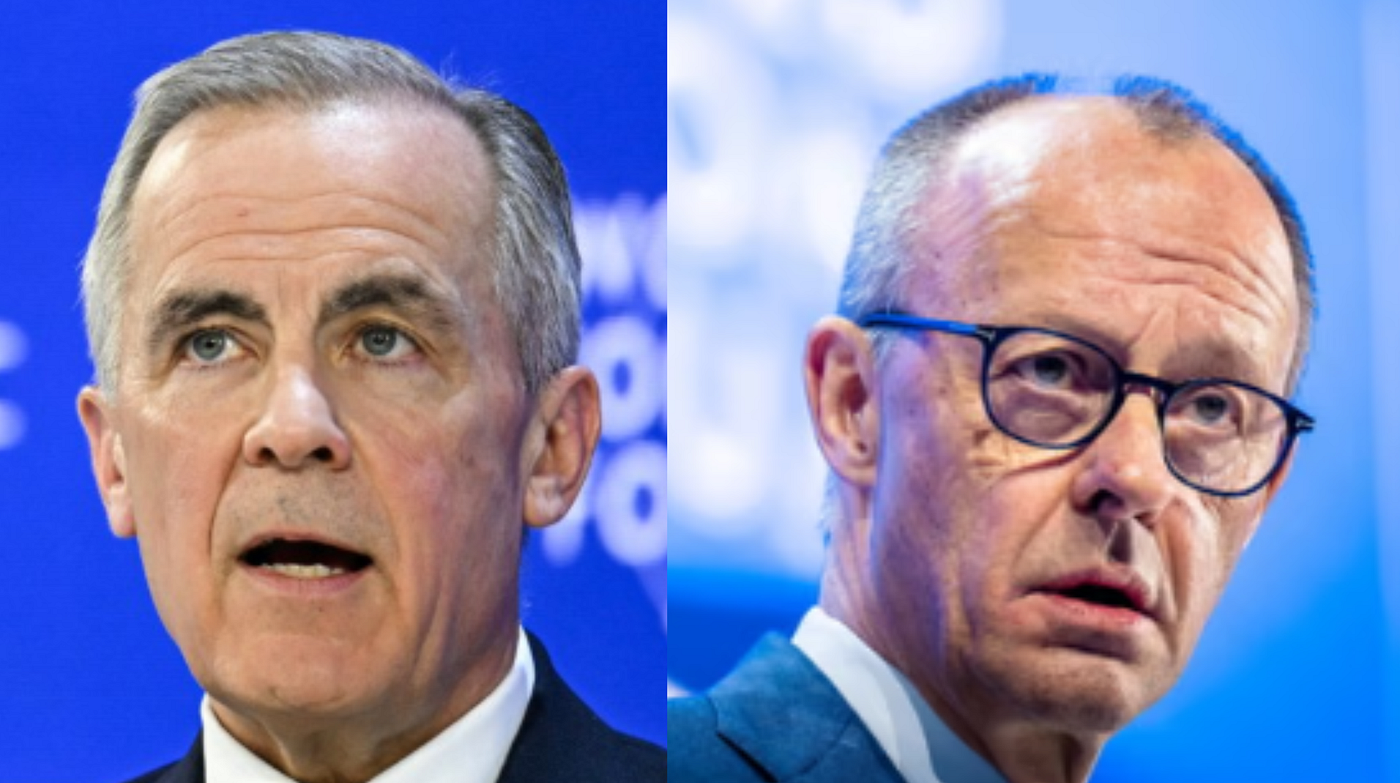
Davos this year offered a rare moment of clarity. Not because of what was announced, promised, or pledged, but because two leaders, speaking from radically different positions of power, revealed two fundamentally different relationships with the future.
On one stage stood the German chancellor, Friedrich Merz, representing the largest economy in Europe, the historic industrial engine of the continent, backed by an 400 million person bloc. On another stood Mark Carney, Prime Minister of Canada, leading a country of forty million people, living in the permanent shadow of a volatile neighbour and a rapidly fragmenting global order.
Both spoke about uncertainty. Both spoke about disruption. Both spoke about a world changing faster than institutions can adapt.
Only one of those speeches sounded like leadership.
The difference was not policy detail. It was posture.
Reassurance versus agency
Merz’s speech was polished, serious, and heavy with numbers. Billions in investment. Infrastructure upgrades. Energy cost relief. Competitiveness. Strategic alliances. Stability. It was the language of a leader acutely aware that Germany is slipping, and equally aware that naming this openly would be destabilising.
The underlying message was reassurance. Germany is still in the game. German industry will return to its former glory. With enough investment, modernisation, and regulatory calibration, the existing system can be carried forward into the future.
That framing matters. Because it reveals where the mind is facing.
It looks backward.
That is not vision. That is continuity therapy.
Carney’s speech did something entirely different. It did not soothe. It unsettled. It acknowledged limits, risks, and trade-offs without nostalgia. It treated citizens as adults capable of facing reality rather than as children needing comfort. It did not pretend that the old model could be preserved. It spoke with confidence that, whatever the world throws at us, we retain agency.
That distinction is everything.
Europe’s problem is not industrial. It is cultural.
Italy makes this painfully visible.
Italy’s stance on climate, energy, and industry is often framed as political or economic. It is neither. It is cultural. The operating system of Italian society is fear. Fear of loss. Fear of decline. Fear of falling further behind. And fear produces one dominant reflex: defence.
Defend legacy industries. Defend fossil fuel narratives by spreading doubt about climate science. Defend the mythology of the oily engine, its noise, its smell, its masculinity. Defend tradition by confusing it with immobility. The public applauds because fear recognises itself and feels protected.
The results are not ambiguous. Decades of lost opportunities. Chronic underperformance. Talent flight. Stagnation is normalised as fate.
Defence did not preserve strength. It preserved weakness.
What is striking is not Italy behaving this way. What is striking is Germany joining it.
When fear becomes contagious
Germany did not seek out Italy because Italy offers a winning model. Germany sought out Italy because Italy offers emotional permission. Permission to delay. Permission to defend. Permission to soften the language of decline without naming it.
Fearful systems recognise each other instinctively.
When Germany aligns itself with the worst-performing major economy in Europe in the name of protecting industry, it is not leading. It is confessing. You do not regain leadership by anchoring yourself to failure. You normalise retreat.
This is why the Germany–Italy axis feels so hollow. It is not a coalition of renewal. It is a coalition of anxiety.
And that brings France into focus.
France as the litmus test
France also has an auto-industrial complex. France also has legacy assets to protect. But culturally, France has not fully internalised fear in the same way. Its instinct remains projection rather than protection. Nuclear is the clearest example. One can debate its merits endlessly, but it is not defensive. It is an attempt to impose a future rather than hide from one.
If France stays out of this alliance, it suggests that somewhere, however imperfectly, France still believes in rupture, in replacement, in saying this ends here and something else begins.
If France joins, then the picture becomes stark. It would mean that all three of Europe’s major industrial powers have converged not on a shared vision, but on shared fear. At that point, Europe has not merely hesitated. It has admitted defeat without saying the words.
What real vision would have sounded like
If Germany or the EU wanted to signal that they still believed in the future, Davos offered the perfect stage. And the signal would not have required hype, fantasy, or moral grandstanding.
It would have required one sentence of courage.
Something like this:
“We accept that renewables are the end state. We accept that lithium batteries are the current bridge. We accept that China leads this phase. Our response is not to delay, but to leap.
We will use the remaining earnings of our current industrial strength to fund the technologies that come next, at scale, now.”
Or a statement on AI leadership, or Crypto or something that the EU/Germany are investing in to secure the future!
That would have been leadership.
Germany and the EU still generate enormous industrial cash flows. Auto, chemicals, machinery, exports. Even in relative decline, they are wealthy by any historical measure. The tragedy is not a lack of capital. It is that this capital is being spent defending yesterday instead of building tomorrow.
A credible leapfrog strategy would have been explicit.
Salt-based batteries for grid-scale storage. Solid-state batteries for mobility and energy density. Power electronics, inverters, and grid intelligence as sovereign infrastructure. Manufacturing scale-up, not pilot programs. Ten-year funding commitments, not annual budget scraps.
This would not have been reckless. It would have been rational.
The model already exists. Norway showed it.
Norway did not pretend that oil and gas would last forever. It used fossil exports to build a sovereign future. It converted extractive wealth into optionality. Today, Norway does not scramble. It chooses. It can afford patience, experimentation, and values alignment because it had the courage to turn the past into a vault, not a crutch.
Germany and Europe could have done the same.
Instead of spending political capital delaying the inevitable, they could have said:
We will run legacy industries responsibly to the end. We will extract their final value transparently. And every surplus euro will be invested in the technologies that define the next fifty years.
That would have neutralised China’s lead without denial. Not by chasing lithium late, but by owning what comes after.
The absence of such a declaration is not an oversight. It is a psychological refusal.
Fear-based systems cannot name endings. They defend. They delay. They comfort.
That is why Merz’s speech mattered so much. Not for what it said, but for what it avoided.
Kennedy, the moon-shot, and the leadership Europe no longer dares to imagine
There is a historical precedent that exposes Europe’s hesitation more clearly than any contemporary comparison.
When John F. Kennedy stood before the world in the early 1960s, the United States was not leading the space race. The Soviet Union had launched Sputnik. Yuri Gagarin had already orbited the Earth. America was behind, visibly and uncomfortably.
Kennedy could have done what today’s European leaders instinctively do. He could have reassured. He could have said the Russians are ahead, but we will invest steadily, modernise existing capabilities, and catch up over time.
He did not: He leapfrogged.
Kennedy did not define success as catching up. He redefined the race itself. He declared that the United States would put a man on the moon and return him safely to Earth before the decade was out. A goal so audacious, so concrete, and so forward-facing that it rendered the existing competition almost irrelevant.
That was leadership.
It was not rooted in certainty. It was rooted in confidence in collective capability. Kennedy did not promise ease. He promised meaning.
Merz spoke as if the goal were to preserve Germany’s place in an existing hierarchy. Kennedy spoke as if the goal were to build a new horizon altogether. One optimises decline. The other escapes it.
Carney’s moon-shot was not technological. It was human.
Mark Carney did not announce a moon-shot in the Kennedy sense. He did not declare a single audacious technological objective with a date attached.
And yet he did something just as rare.
In a world addicted to spin and reassurance, Carney chose honesty. He chose transparency. He chose to call reality what it is. He trusted citizens with complexity rather than shielding them from it. He refused to infantilise society.
That was his moon-shot.
Confidence is not always expressed through grand targets. Sometimes it is expressed through moral posture. Through leadership that says: I trust you enough to be honest with you.
That is why the speech landed so powerfully. That is why it lit a fire.
In that sense, Carney articulated something deeper than policy. He articulated belief. Belief that even under pressure, even beside an unpredictable neighbour, even in a destabilising world, a society can choose courage over fear.
This is where his speech quietly aligns with what I call **the 4th Way**. Not left or right. Not growth versus austerity. But leadership grounded in honesty, dignity, and care for the collective future. Leadership that understands that love, in political terms, is not softness. It is courage without armour.
Scale does not create leadership. Intent does.
This is what makes the Davos contrast so devastating.
Europe speaks with the voice of eight hundred million people and says fear. Canada speaks with the voice of forty million and says courage.
Canada does not have Europe’s industrial depth or historical dominance. It sits next to an unpredictable superpower, under constant pressure. And yet that pressure sharpened rather than paralysed it.
Carney decoupled dignity from the past.
He did not say we will be great again. He said we will be honest now, and that is how we earn the right to move forward.
That is leadership.
Why Europe cannot say what Carney said
Europe is not lacking intelligence, capital, or tools. It is lacking permission.
Permission to name endings. Permission to create losers. Permission to admit that some industries will not survive. Permission to risk discomfort in the present to author the future.
Fear-based cultures reward caretakers, not founders. They elevate managers of decline, not architects of renewal. Political careers are built on reassurance, not rupture.
So Europe talks about resilience instead of ambition. Balance instead of direction. Competitiveness instead of leadership. It builds defensive alliances and calls them strategy.
Others move.
China does not romanticise the past. It tolerates chaos and disruption because it understands that transitions are violent, whether you like it or not. Canada does not promise comfort. It promises agency.
Europe promises protection.
Why this matters now
This moment is not another cycle. It is a closing window. The last years of ICE’s profitability, legacy industrial cash flow, and geopolitical relevance are being spent right now. They can either be converted into a future or consumed defending a past that will end regardless. Delay no longer preserves options. It destroys them.
Final cut
Davos did not show us two policy approaches. It showed us two psychologies.
One looks backward and tries to preserve dignity through continuity. The other looks forward and earns dignity through honesty.
Kennedy showed us long ago that true leadership leapfrogs rather than competes. So did China 20 years ago! Carney reminded us that courage can also take the form of truth, trust, and care for the collective future.
Until Europe finds leaders willing to break the spell of reassurance and dare to speak in the language of possibility again, it will continue to bunker while the world reorganises itself without waiting.
Canada showed that courage is not about size or power. It is about belief.
And belief, once spoken aloud, has a way of pulling the future toward it.
메타데이터
- post_id
- 9a4964a7e927
- slug
- davos-showed-us-two-kinds-of-leadership-only-one-was-leadership-9a4964a7e927
- url
- https://medium.com/@aldogrech55/davos-showed-us-two-kinds-of-leadership-only-one-was-leadership-9a4964a7e927
- canonical_url
- https://medium.com/@aldogrech55/davos-showed-us-two-kinds-of-leadership-only-one-was-leadership-9a4964a7e927
- author_url
- https://medium.com/@aldogrech55
- status
- ok
- fetched_at
- 2026-07-13 06:23:13