Where to Build the Park
The first real problem: finding the right location. And why the answer matters more than you’d think.
Where to Build the Park
The first real problem: finding the right location. And why the answer matters more than you’d think.
In the first article of this series I asked whether Asturias — a green, largely undiscovered region in northern Spain — could have a world-class theme park. I promised the next step would be the most concrete one yet.
Where, exactly?
It’s not a rhetorical question. The location of a theme park isn’t a logistical detail — it’s a decision that shapes everything else: who comes, how they get there, how long it takes, whether they come back, whether the tourist landing at the regional airport considers the park part of their trip or an inconvenience.
A great park in the wrong place fails. A mediocre one in the right place survives. That’s how much it matters.
How much space does a park like this actually need?
Before talking about where, we need to talk about how much. There’s a significant difference between looking for 5 hectares and looking for 100.
Here’s the real data from the parks we use as benchmarks:
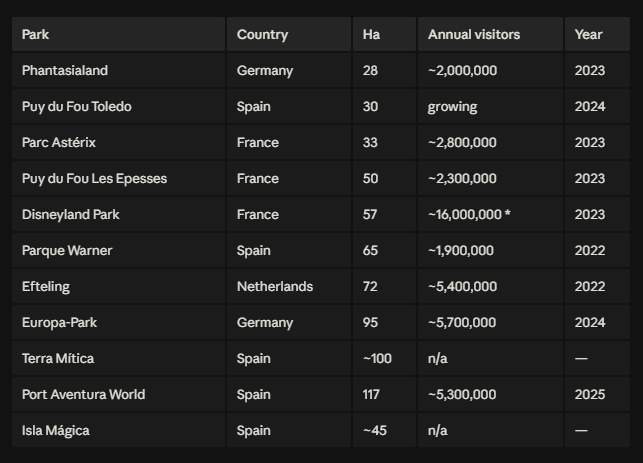
*Full Disneyland Paris Resort figure (two parks combined).
Two numbers stand out. First, Phantasialand: top-3 in Europe for quality, 2 million visitors a year, on just 28 hectares. Size is not the determining factor — what you do with it is.
Second, Terra Mítica and Isla Mágica: two Spanish parks with genuine potential, both victims of years of underinvestment. A warning about what happens when a project stops believing in itself.
Our project doesn’t launch in its final form. It grows. But we need to secure enough land from the start to avoid being trapped without room to expand.
Land requirement estimate:
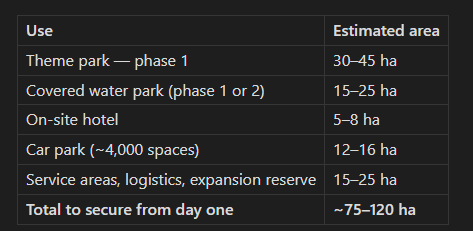
Use Estimated area Theme park — phase 1 30–45 ha Covered water park (phase 1 or 2) 15–25 ha On-site hotel 5–8 ha Car park (~4,000 spaces) 12–16 ha Service areas, logistics, expansion reserve 15–25 ha Total to secure from day one ~75–120 ha
That’s what we need to find. A contiguous, largely flat plot of 75 to 120 hectares. In Asturias. With good accessibility.
Not impossible. But not common either.
The selection criteria
I’ve worked through an objective checklist to evaluate any candidate location:
Road access: motorway or dual carriageway with direct access. Without this, the park doesn’t work.
Rail connectivity: train or commuter rail within reasonable distance. Essential for visitors without cars and for the sustainable mobility policy we intend to have.
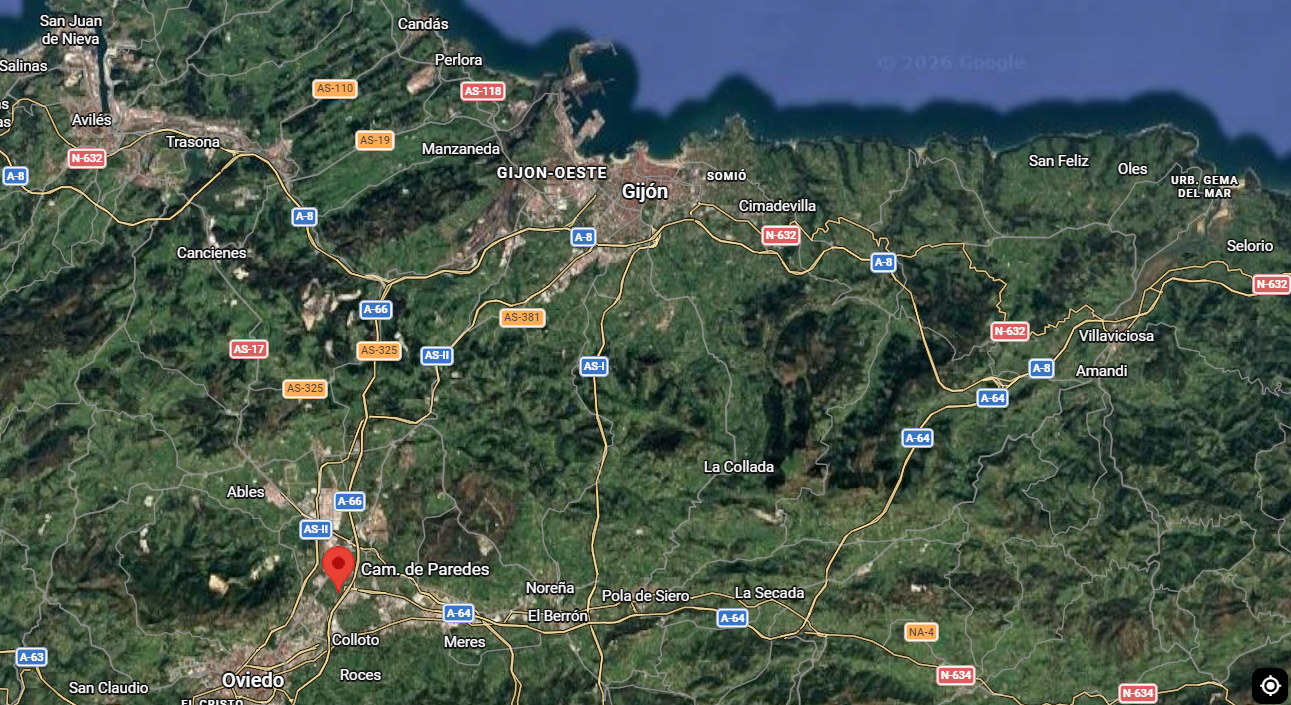
Distance to major population centres: Oviedo and Gijón account for over 60% of Asturias’s population. The park can’t be far from both at once.
Distance to the airport: relevant for national and international tourism, though not decisive — Efteling is 90 minutes from Amsterdam Schiphol and welcomes 5.4 million visitors a year.
Topography: predominantly flat terrain. A park wedged in a narrow valley or on a hillside isn’t viable at this scale.
Municipal investment profile: not all Asturian councils respond equally to large investments. Some actively seek them, others complicate them.
Land availability: the ideal location means nothing if there’s no available land in sufficient quantity.
The candidate: Siero, Parque Principado / Lugones area
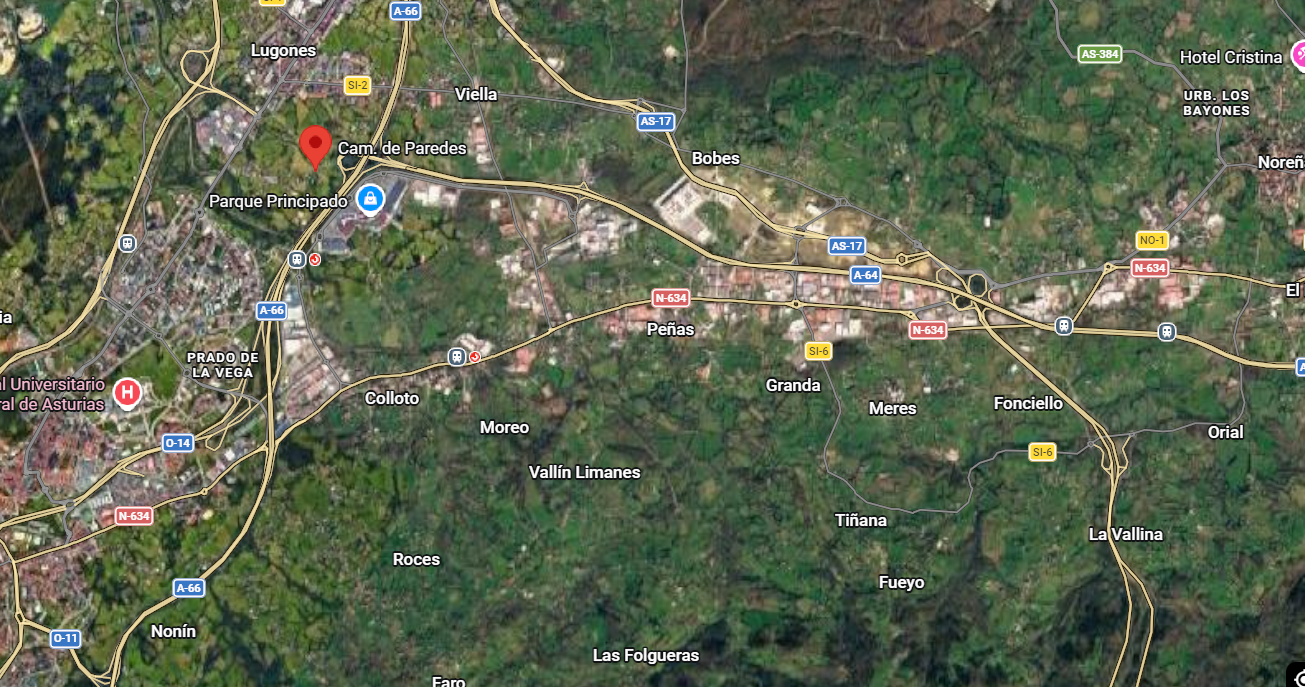
There is one area in Asturias that meets more criteria than anywhere else. It’s the Siero district, around the road junction at Lugones and the Parque Principado retail complex.
Here’s the data.
Road access — outstanding
Three motorways converge in this area:
- A-66 (Ruta de la Plata) — the main north-south axis, direct from Oviedo
- A-64 — connection east towards Gijón
- AS-II — Cantabrian motorway
It’s one of the best-connected road nodes in all of Asturias. No other point in the region combines three motorways at this distance from both major urban centres.
Real distances
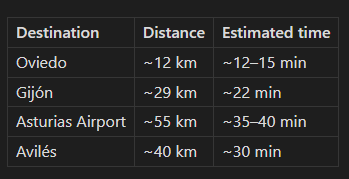
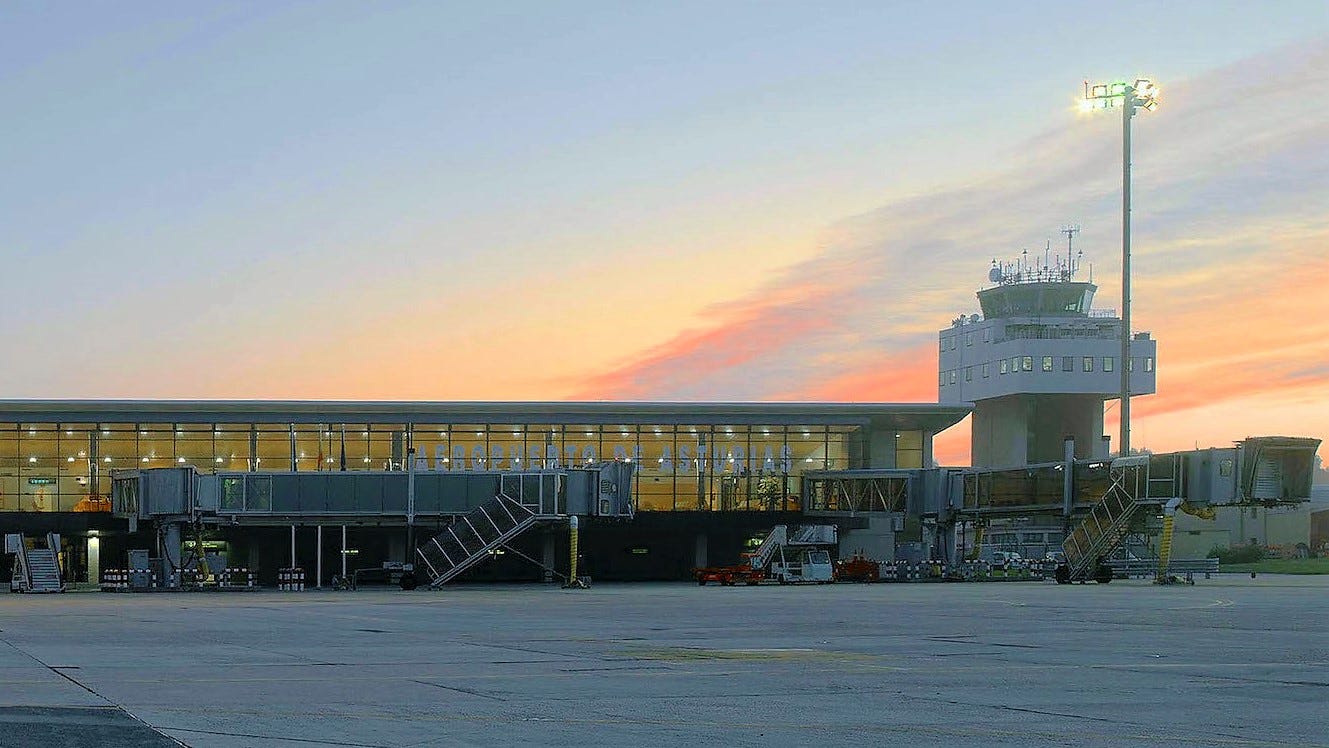
The airport is 40 minutes away. That’s perfectly competitive by European standards: Europa-Park is over 80 km from Basel-Mulhouse airport, Efteling is 90 km from Amsterdam. Neither struggles to attract international visitors.
Rail connectivity — very good
Siero has three Cercanías lines (Spain’s commuter rail network, operated by Renfe):
- Line C-1: Oviedo — Lugones — Gijón, every 30 minutes on weekdays
- Line C-5: Gijón — Langreo, passing through Siero
- Line C-6: Oviedo — Infiesto, with stations in Siero
Lugones station (C-1) connects to Oviedo in 12 minutes and Gijón in 18. Spain’s high-speed rail already serves both Oviedo and Gijón, meaning a visitor from Madrid could travel by high-speed train and connect to commuter rail almost to the door.
The only gap is the last kilometre between the station and the park, which isn’t walkable. The solution is a free shuttle — the standard model at top European parks.
Available land
The area has confirmed pockets of undeveloped land. The topography of Asturias’s pre-coastal lowland is predominantly flat here, making it well suited for an installation of this scale.
Investment track record — the political argument
Siero is not a council that makes large investments difficult. Quite the opposite:
- Amazon: 200,000 m² logistics centre, €100 million investment, 1,000–2,000 direct jobs
- Costco: approved under the Regional Strategic Project framework (PIER), €40 million investment
The PIER designation matters. It allows the Asturian regional government to fast-track planning for projects of strategic regional interest. Siero already has this precedent. A park generating 1 million visitors a year — and the economic impact that goes with it — has strong grounds to apply for the same status.
The flow synergy
There’s something no other Asturian location can offer: people already go here.
Major retail destinations — Decathlon, IKEA, Obramat, Toys R Us among others — a first-class logistics hub, and a steady flow of visitors from across the Oviedo-Gijón metropolitan area every weekend.
The park wouldn’t have to build its audience from nothing. It would arrive in a zone where the habit of travelling there already exists — and convert it into something far more interesting than a shopping trip.
Next steps
This analysis is the foundation. To turn hypothesis into decision, three specific studies are needed: a cadastral survey to confirm available land and ground prices; a planning review of Siero’s urban development plan to establish land classification and permitting timelines; and a traffic capacity study to quantify the park’s impact on local access roads and define the necessary interventions — dedicated entry roundabouts, differentiated lanes, coordination with the regional government.
Those are the homework assignments before anything gets signed.
Por Ordenalfabetix — Trabajo propio, CC BY-SA 4.0, https://commons.wikimedia.org/w/index.php?curid=112748422
The conclusion
Siero, in the A-66/A-64/Lugones junction area, is the strongest location in Asturias for a project of this scale. Motorway access on three routes, three commuter rail lines, equidistance between Oviedo and Gijón, flat terrain, a proven municipal investment profile, pre-existing visitor flow, and a PIER planning precedent.
No other point in the region combines all of these factors at once.
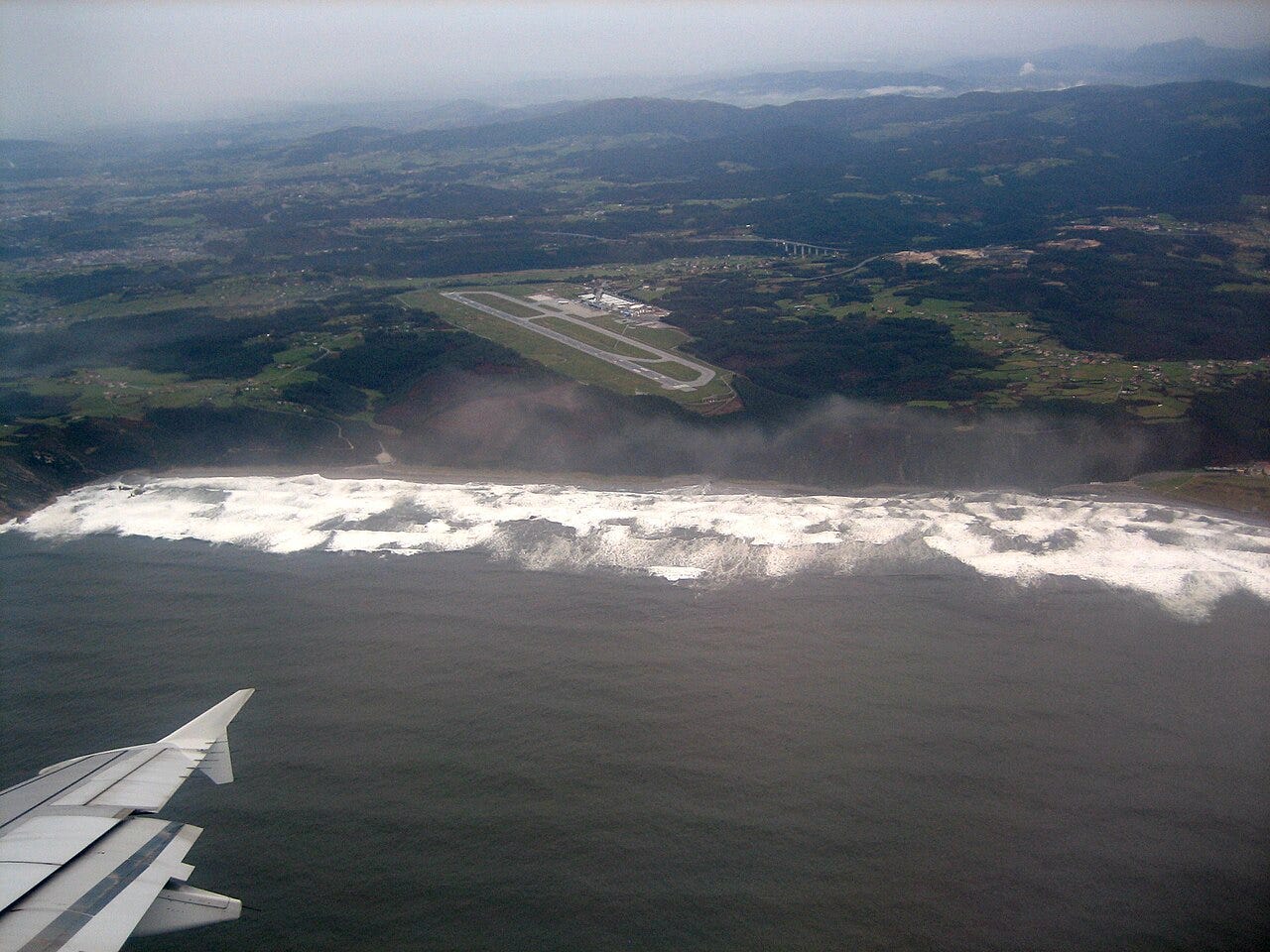
Por acebal from La Felguera, Spain — Aeropuerto de Ranón, desde el aire, CC BY 2.0, https://commons.wikimedia.org/w/index.php?curid=72430611
The next instalment tackles a question I’ve been sitting with for a long time: what kind of park do we actually want? And more importantly — what kind of park do we refuse to be?
Where would you put the park? If you know Asturias, you have an opinion. Comments are open.
This article is also available in Spanish / Versión en castellano.
Photographs by Bernardo Busto. His work can be found at Ría de la Villa.
메타데이터
- post_id
- 9a4e851cabde
- slug
- where-to-build-the-park-9a4e851cabde
- url
- https://medium.com/ride-intelligence/where-to-build-the-park-9a4e851cabde
- canonical_url
- https://medium.com/ride-intelligence/where-to-build-the-park-9a4e851cabde
- author_url
- https://medium.com/@lluisabg
- status
- ok
- fetched_at
- 2026-06-14 11:28:49