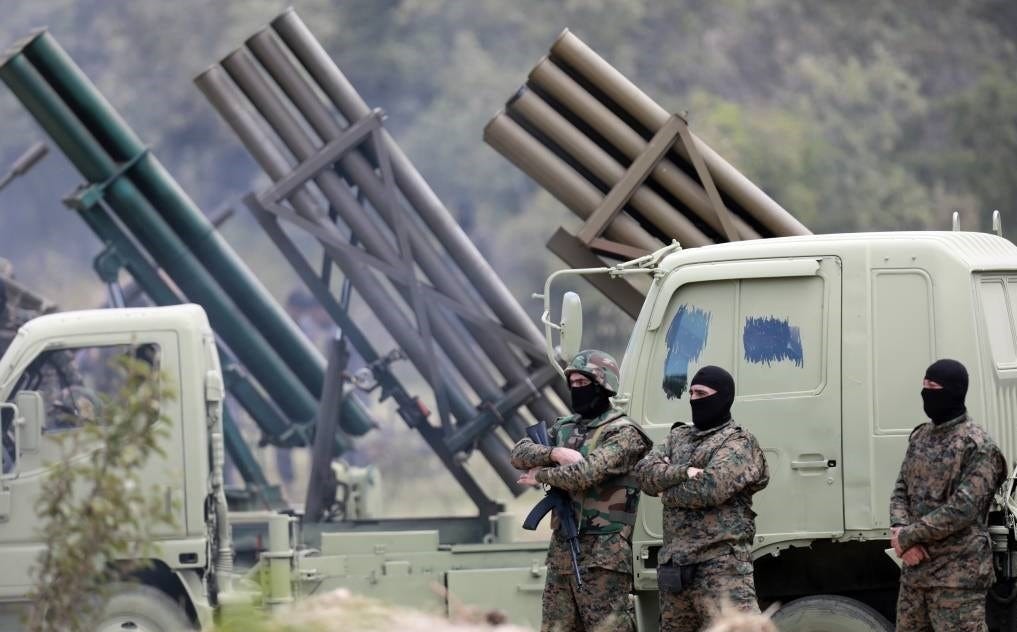
The Fighting Force the US Couldn’t Beat
Iran’s Revolutionary Guard Corps (the IRGC)
The Fighting Force the US Couldn’t Beat
Iran’s Revolutionary Guard Corps (the IRGC)
The Americans started a war with Iran, but backed down when the Strait of Hormuz was closed and the threat to the economy became dire. How did an alleged ‘third-rate’ fighting force compel the world’s best-funded military to blink? The answer: Iran’s Islamic Revolutionary Guard Corps (IRGC).
What is the IRGC? How was it formed? And what does it do?
Here, I answer all these questions and more. I use both linked and footnoted citations. This is because I want to ensure anyone who wishes to examine a source will be able to find it and access it (perhaps through a library, in some cases).
If you find this newsletter informative and care to offer a little something in support, feel free to buy me a coffee or upgrade to a subscriber. For those of you who prefer storytelling and art over this fictionalized reality we are living through, check out my other site, Inverted Umbrella.
Now, to the business at hand…
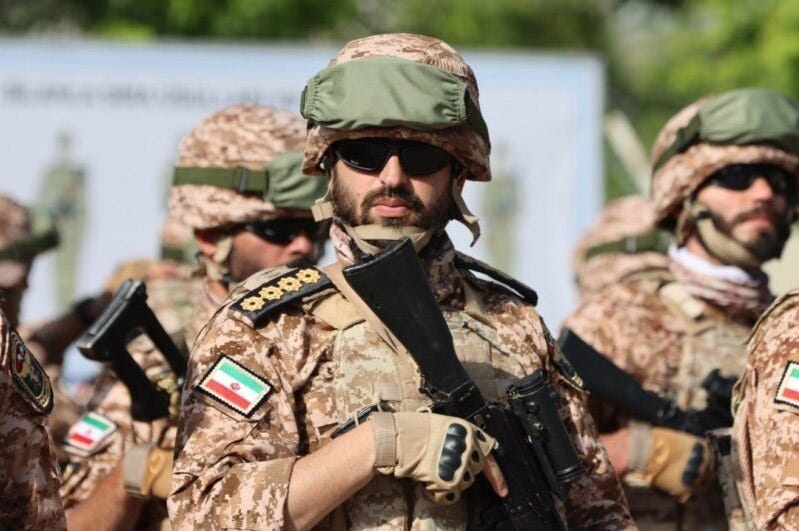
IRGC soldiers; Credit: Tasnim News Agency, CC BY 4.0
From the time it was formed, the IRGC was established under the supervision of the core of the Revolution. Its command and organization were centralized. The IRGC’s members and elements possessed religious and revolutionary values, including self-sacrifice and a continuous, jihadi presence, such as obedience and submission to the magnanimous Imam Khomeini. — Ali Khamenei
The history
Iran’s Islamic Revolutionary Guard Corps (IRGC — Sepāh e Pāsdārān e Enqelāb e Eslāmi — سپاه پاسداران انقلاب اسلامی) — otherwise known as the (“Guardians of the Revolution”) — is more than just a military organization. It is also deeply ingrained in Iran’s political, economic, and social systems.
Established in 1979 by the clerical leaders of the time, the IRGC answers directly to the Supreme Leader. Its primary mission, according to its own constitution, is:
To protect Iran’s Islamic Revolution and its achievements and persistently struggle to achieve the divine aims, spread the rule of the law of God in accordance with the Islamic Republic of Iran’s laws, and to fully strengthen the Islamic Republic’s defensive foundations through cooperation with other armed forces and through the military training and organizing of popular forces.
Ayatollah Khomeini, who was very popular even before the 1979 revolution, regularly denigrated Iran’s armed forces (the Artesh) under Shah Mohammad Reza Pahlavi. Khomeini viewed the Artesh as weak and dependent on Western powers allied with the Shah. Although the Artesh declared itself neutral in the conflict between the revolutionaries and the Shah’s camp, a declaration that ultimately made the revolution possible, Khomeini still didn’t trust it.¹
The group that later would become formalized into the IRGC began as a loose collection of militias whose mission was to protect Khomeini and other senior clerical leaders. They officially became the IRGC on May 5, 1979, by decree of the Ayatollah.²
Khomeini’s government later permanently enshrined the IRGC into Iran’s constitution (in the English version, it is depicted as the Islamic Pasdaran Revolutionary Corps, where Pasdaran means “guardian”). Article 19, for example, grants the Supreme Leader the power to appoint the IRGC’s commander-in-chief. Article 150 charters the corps with “protecting the Revolution and its achievements.” (Note, the Iranian and IRGC constitutions are two separate and distinct documents.)
While Khomeini did not trust the Artesh, he nonetheless decided not to disband it. Instead, his clerical allies engaged in a purge of military leaders who they viewed as loyalists to the Shah’s regime. The discovery of a planned coup involving both military members and civilians led to an even deeper purge that effectively decapitated the entirety of the military’s leadership.³
The IRGC was (and remains) separate from the Artesh in virtually every respect. Early in the Iran-Iraq war (1980–1988), poorly trained IRGC soldiers did not do well against Saddam Hussein’s much more sophisticated forces (the Artesh performed only nominally better).⁴ After about a year and a half, however, the situation began to shift in the IRGC’s favor.
Two important characteristics of the IRGC enabled it to turn the tide against Iraq — informality and religious zealousness. Maryam Alemzadeh, at the Crown Center for Middle East Studies, explained:
Individuals were able to drift away spontaneously from collective agreements without risking criticism or exclusion, and they could rejoin the community immediately afterwards, as long as the spontaneous move was not against the principles that held their community together: the dignity of Islam and of the clerics, along with a revolutionary passion for achieving and preserving an ideal Islamic society under Khomeini’s leadership.⁵
Its zealousness was greatly enhanced by the incorporation of the Basij — Iran’s voluntary fighting force and moral police. Making the Basij a formal part of the IRGC essentially conjoined their identities (the Basij is the IRGC and the IRGC is the Basij), and both became collectively identified with the revolution. Following the Basij’s integration, the IRGC engaged in a prodigious campaign of suppression of anti-revolutionary activity, particularly in the Kurdish areas along Iran’s western border.⁶
Alemzadeh argues the combination of informality, shared deeply held religious beliefs that lauded martyrdom, and a sense of brotherhood among the myriad militias eventually enabled the IRGC to fight the Iraq war with the discipline of traditional militaries, but without the requisite centrality. Khomeini’s stated vision was to turn Iran into an Islamic regional power with the IRGC serving as his tool. The IRGC rigorously pursued this goal both externally and internally.⁷
A few years into the war, as its victories began to mount, the IRGC divided itself into three formal branches: an army, air force, and navy.⁸ But that didn’t happen smoothly. More moderate voices in the Iranian government in the mid-80s still viewed the IRGC as an unprofessional, untrained collection of militias.⁹ They pointed to the corps’ preference for relationships over structure as proof of their claim and were not particularly interested in seeing it expand.¹⁰
Both the Artesh and IRGC suffered several major defeats in 1980 and ’81. Much of the blame was directed toward the Artesh, with critics decrying what they deemed a lack of defensive strategy. This resulted in the impeachment of President Abol-Hasan Bani-Sadr, who was close to the Artesh’s leadership, but not the IRGC’s.
At the same time, the Mojahedin-e Khalq Organization (MKO, also abbreviated MEK), a political party that opposed the policies of the Ayatollah and his clerics, commenced a campaign against them. What started as vociferous political opposition ultimately culminated in the bombing of Khomeini’s political headquarters, killing 73 (though the MKO denied responsibility). Two months later, another attack killed the acting President and Prime Minister.
This provided the clerics an opening to take control of all three branches of government by installing their loyalists. They handed control of the defensive strategy to the IRGC, removing the Artesh altogether from any decision-making. From this point, both militaries began to achieve more and more victories.
To determine how the IRGC overcame its initial incompetence and unprofessionalism, Alemzadeh analyzed various writings of veterans of the early stages of the war. She concluded:
The institutional survival of the IRGC in the first two years of the Iran–Iraq war can be attributed to a diffused, routinely accessible charisma in the everyday life on the front, the collective recognition of which was translated into organizational cohesion and structure through different instances of validation… It not only resisted both fragmentation and absorption into the standing army, but rose in size and military strength throughout the war’s second year, just ready to challenge the authority of the regular army in the years to come.¹¹
As the war dragged on, however, Khomeini’s coalition started to fracture. The Supreme Leader started speaking less about revolutionary ideals and focusing more on pragmatic problems, specifically the war and economy. More conservative members of his party did not appreciate the shift.
For its part, the IRGC became increasingly intent on territorial expansion, with its primary goal to ‘liberate Jerusalem’ after defeating its ‘lesser’ enemy, Iraq. By the middle of the decade, however, domestic tensions forced it to give up notions of creating a grand Islamic empire and turn toward addressing the widening divisions at home.¹²
When the war finally ended, Iran faced several challenges. It had serious economic problems. Without the threat of war, its revolutionary identity became increasingly irrelevant. And, only a year after the fighting stopped, Khomeini died, opening a power vacuum. Moreover, the IRGC no longer held an explicit objective.
By the late ‘80s, the IRGC had obtained operational superiority over the Artesh, but the issue of its post-war purpose lingered. Some feared it would be dismantled, giving the responsibility of self-defense back to the regular army.
Recognizing the value of the IRGC’s power and ideological zeal, conservative clerical leaders assigned it the task of leading Iran’s reconstruction. This entrenched the support of the veterans and enabled the conservative faction to promote Ali Khamenei to Supreme Leader. From there they pursued a platform that “support[ed] the ‘absolute’ (motlaqeh) rule of the guardian jurist, favor[ed] traditional commercial practices, and oppose[d] social liberalization.”¹³
Upon Khamenei’s appointment, the IRGC was lumped into the newly formed Ministry of Defense and Armed Force Logistics (MDAFL), which was overseen by the Supreme National Defense Council. For the first time, the IRGC fell under a central command. It was also restructured into formal ranks. Despite this, it still retained its sense of brotherhood and at least some degree of its informality.¹⁴
Khamenei’s weak religious credentials allowed President Ali Akbar Hashemi Bahramani Rafsanjani to expand the power of the presidency… for a while. But Khamenei was no fool — he knew allowing the president to take more power could put him at risk by the clerical authorities who would see him as weak.
Quietly, he worked to strengthen his ties with fellow conservatives, bazaari merchants, and IRGC leadership, and became increasingly critical of Rafsanjani. In the mid-90s, Khamenei’s conservative coalition took control over elections and exerted significant influence over the IRGC. This resulted in the IRGC gaining power domestically, which would continue to grow in the ensuing decades.¹⁵
Mojtaba Khamenei — Ali Khamenei’s son — joined the IRGC in 1987 and fought in several major battles of the Iraq war. He became the head of one of its major divisions in 2009. When Ali Khamenei was killed at the beginning of the current war with the US, Mojtaba was selected as Supreme Leader of Iran.
His ascension signified the acceleration of what had for two decades already been occurring — the IRGC intertwining into every fabric of Iranian society. Several of its former leaders now hold senior political positions, the military arm is superior in most ways to Iran’s regular armed forces, and it controls a substantial portion of Iran’s economy.
So let’s examine the present form of the IRGC.
War is not decided in tweets — it’s decided on the battlefield, the very place where you and your forces dare not go. — IRGC Spokesman Ebrahim Zolfaghari
Military structure
The IRGC is divided into six branches.
Its army is distributed across all 31 provinces of Iran. In total, it consists of approximately 150,000 to 190,000 troops — or around half to two-thirds the number of Iran’s regular army (which has around 350k). This branch is charged with protecting the territorial integrity of the country.
Supporting the ground forces is the Basij, formally known as the *Sâzmân-e Basij-e Mostaz’afin* (سازمان بسیج مستضعفین, ‘Organization for Mobilization of the Oppressed’). This is Iran’s (mostly) volunteer force. Although its primary mission is policing the citizenry, it can be called upon for the national defense. Its numbers are unclear, but spokesmen for the branch claim to be able to raise 600,000 or more troops.
In addition to regular and volunteer ground forces are the Quds, the IRGC’s special forces. The Quds’ official mission focuses on external matters (though, this is not always the case, especially in times of domestic crisis). Like American ‘advisers’, the Quds often assist in arming and training what the West calls Iran’s ‘proxies’, such as Hezbollah or the Houthis. How many members it has is unknown. American intelligence’s best estimate puts it between 5,000 and 15,000, as of 2022.
The IRGC’s navy (NEDSA) is larger than the Islamic Republic of Iran Navy (IRIN). NEDSA is distributed across five regions, with region one based at Bandar Abbas and the rest positioned northward along the Persian Gulf coastline. Its surface fleet consists of five classes of ships.
The smallest vessels comprise the Fast Attack class. They are modelled after civilian speed boats and carry mostly small arms and explosives. These boats can reach speeds of up to around 70 knots. Fast Attack boats are believed to make up the greatest portion of NEDSA. The IRGC’s largest ships are those of the Shahid Soleimani class — destroyer-like ships around 65 meters long.
NEDSA also has submarines. Its biggest, the Fateh, is 49 meters long, has a depth limit of 250 meters, and a nautical range of around 4,000 km. The smallest vessel in the submarine fleet, the e-Ghavasi, is a “swimmer delivery vehicle” that can place mines or carry out small-scale attacks. This vehicle is also believed to have served as the model for the development of an unmanned version called the Azhdar.
**Trump claims to have ‘totally destroyed’ Iran’s naval forces, but this does not appear to be true. What damage they have suffered, however, is unclear. It is also unclear whether the US destroyed IRIN or NEDSA crafts.
The IRGC Aerospace Force is about half the size of the Artesh Air Force (by number of troops). This branch oversees Iran’s missile and drone programs as well as its anti-aircraft operations. In addition, it controls Iran’s space program, which successfully launched its first spy satellite in 2022.
Finally, the IRGC runs a cyber-command center. As early as 2014, US intelligence determined Iran was “rapidly becoming a world-class cyber threat.” Iran’s capabilities in this sector have increased considerably over the last few years. (I served as an emergency response volunteer for America’s Cyber Defense Agency [CISA] over several years of my career and regularly received advisories about Iranian cyber threats.)
In April of this year, for example, CISA warned of Iran’s “ongoing cyber exploitation of internet-connected operational technology (OT) devices,” including military OT devices. Just as the Quds equips and trains allies for military operations, the cyber-command does the same for cyber capabilities (pg. 5).
Though I wouldn’t call it a branch, the IRGC also operates two intelligence-collecting bureaus called the Intelligence Protection Organization (IPO) and IRGC Intelligence Organization (IRGCIO). The two operate independently, with the former looking outward and the latter inward. In other words, the IPO monitors the IRGC itself for breaches of “ideological loyalty and internal discipline.” It directly reports to the Supreme Leader. The IRGCIO collects intelligence on potential foreign enemies.
It is difficult to determine the exact official budget of the IRGC (obviously, it is not a publicly released figure). Iran Open Data estimates it at around 6 billion USD, nearly double the Artesh’s budget, if accurate, but barely an accounting error when compared to the US military’s $849.8 billion. Notably, the IRGC’s official budget is not the sum total of its available funds. Its commercial empire contributes many times more to the total. More on this below.
This mountain, we see it get bombed almost every night, we see the smoke rise, yet when we wake up in the morning, it’s from these very same mountains that we see missiles rising into the sky. — a resident of Isfahan
Iran’s missile program
A description of the IRGC cannot be complete without an analysis of its missile and drone program. Iranian leaders received a painful lesson on the effectiveness of missiles and drones during the war with Iraq, when scud missiles routinely rained down on Tehran.¹⁶ Since then, they have gone all-in on developing their own program.
Surface missile launchers are easily identifiable and targetable by opposing forces. To combat this problem, the Iranians built a vast underground network that simultaneously conceals and protects their launchers. Defence Security Asia described the system this way:
The underground facilities are not conventional bunkers but extensive tunnel ecosystems containing internal transport networks, storage chambers, launch preparation zones, blast-door compartments, and multiple concealed exits intended to complicate enemy targeting cycles.
This network spans the entire country, much of it interconnected. It comprises at least a dozen major facilities and perhaps a hundred or more small ones. The Soffeh Mountain facility near Isfahan in central Iran (about 692 km [430 miles] east of Baghdad) is considered the most strategically important location because of its proximity to the largest missile manufacturer in the country.
During the 12-Day War of 2025, Soffeh endured a massive bombing campaign that included 2,000-pound penetrators and GBU-57 Massive Ordinance Penetrators (MOPs). The facility lost no more than 12 consecutive hours of operation despite suffering extensive surface damage.¹⁶
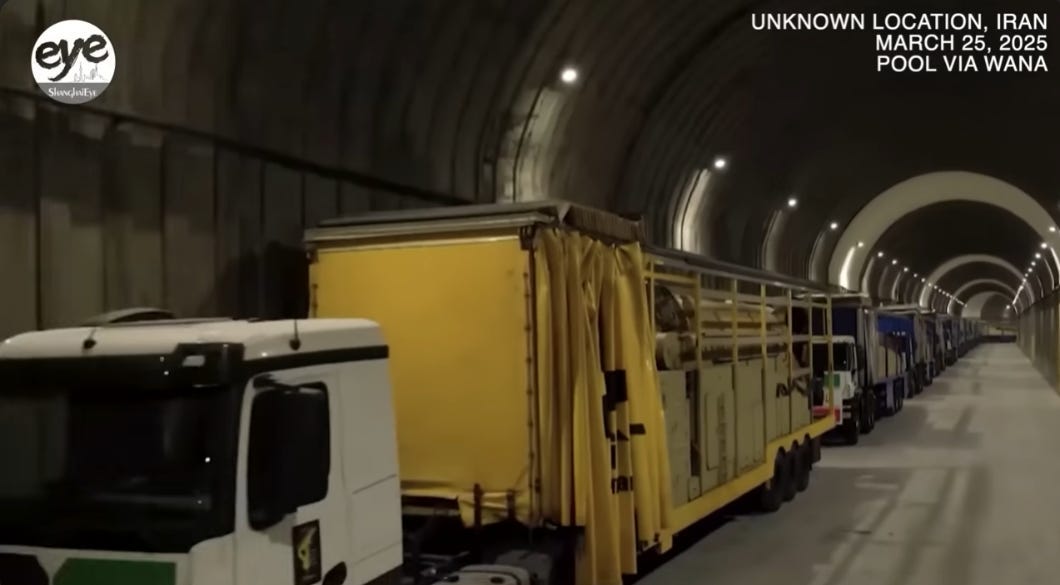
Video released by Iran-based press of a missile city (screen-grabbed from Shanghai Eye).
With a few exceptions, Iran’s missile production facilities are situated within this subterranean ecosystem. According to Israeli sources, these facilities can produce hundreds of ballistic missiles per month. Others estimate closer to half that number. In either case, the monthly tally depends upon which missiles are being discussed.
Here is the known inventory of Iranian missiles:
- Shahab-3 — liquid-fueled, road-mobile ballistic missile; can mount nuclear, heavy explosive, chemical, or submunitions warheads; has a range of 800–1,300 km (497–808 mi.)
- Emad, Ghard, Qadr (Shahab variants) — Road-mobile with ranges of up to 1,950 km (1,212 mi.)
- Sejjil — Two-stage solid propellant, road-mobile missile with a range of up to 2,000 km (1,243 mi.)
- Khorramshahr series — Liquid-fueled, road-mobile or stationary missile designed for high explosive or submunitions warheads; has a range of up to 3,000 km (1,864 mi.)
- Haj Qassem — solid-fuel, road-mobile missile with a range of up to 1,400 km (870 mi.)
- Fattah-1 — a hypersonic missile (Mach 18.5) that can carry a warhead of up to 450 kg (992 lbs.); it has a range of up to 1,400 km (870 mi.)
- Soumar — turbofan-powered cruise missile that may be nuclear-capable; it has a range of up to 3,000 km (1,864 mi.) — it is not certain if this missile has gone into operation.
Launch sites are the primary point of vulnerability. Opposing forces can locate them through several methods. One is reverse-engineering the trajectory of the missile to determine its launch point. Another is through satellite imagery that sees the surface opening or captures the ignition sequence. A third is through heat detection.
To protect them, the missiles are stored in deep caverns, then moved (still underground) by truck or train to ramps or vertical launch sites covered by camouflaged exterior doors. At vertical launch sites, the doors are opened right at the moment of missile-ignition and quickly reclosed to conceal their location after launch. The ramps work similarly, though the launch vehicle must briefly move into the open to fire (some sites have covered ramps positioned to horizontally launch certain missile types from cover).
Recent US and Israeli missile and bomb attacks have sought to collapse these openings. They learned in the 12-Day War that going after the larger underground network was largely ineffective. Still, there are many surface portals located all across the country. Targeting them is like a game of whac-a-mole.
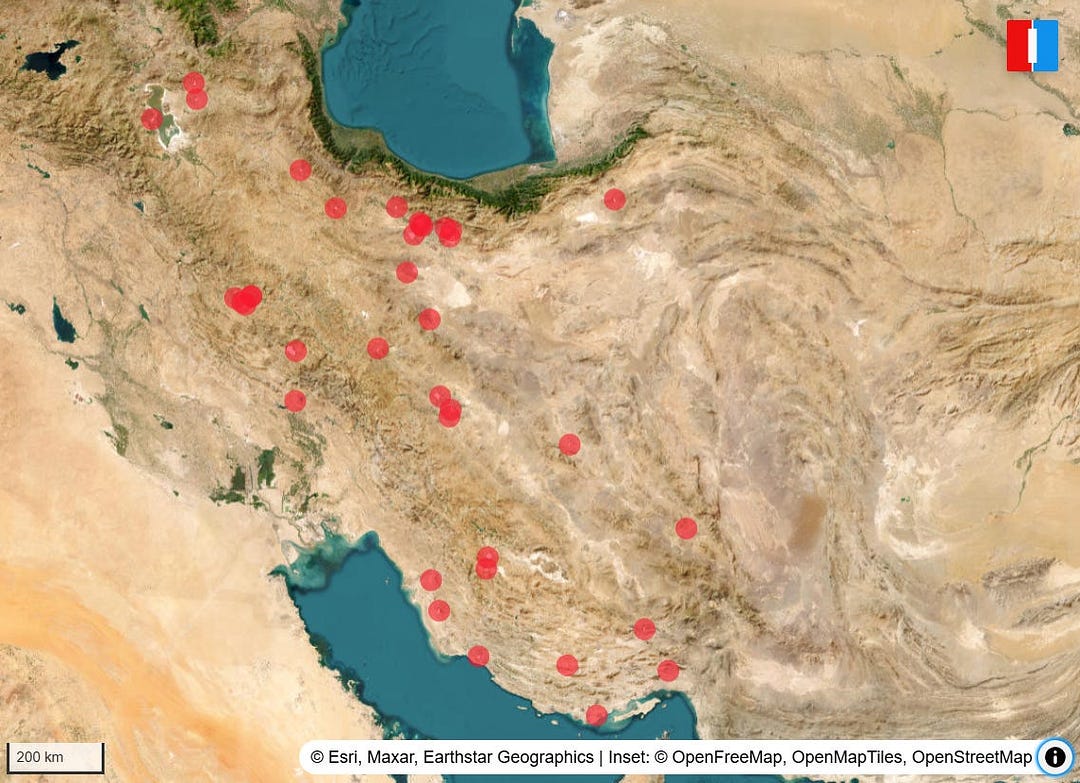
Known Iranian missile-city sites. (Used under creative commons license, with attribution in the image — sourced from Iran International).
The IRGC’s strike plans are coordinated through a mosaic of command and communication centers. Each can also operate independently. Coordinated attacks often add the use of drones to confuse and distract anti-aircraft and other defenses. It is difficult to pinpoint Iran’s exact rate of successful strikes because there are conflicting reports from all sides. There is, however, verified reporting of extensive damage caused by Iranian missiles, particularly on numerous US military bases in the region. This indicates the Iranian missiles were able to successfully evade defenses in many instances.¹⁸
Iran’s Shahed drone: ‘the poor man’s cruise missile’ — Dylan Butts, CNBC
The drone program
Iran’s drone arsenal greatly outnumbers its missile inventory (both the IRGC and Artesh have their own drone programs that include the overlap of many models). No one in the West seems to know the precise number of drones Iran possesses. Prior to the war, the general consensus hovered around 80,000, with an estimated production capacity of about 400 per day.
Perhaps the most famous craft in Iran’s drone fleet is the Shahed series, but there are many more models with varying purposes and capabilities. Here is a breakdown of them. (All are characterized as cross-purpose, meaning they can be configured to perform a specific function — suicide (one-time use), combat (repeat use), or intelligence/surveillance — except where noted):
- Meraj-521 — operator-directed suicide drone capable of carrying 1kg (2.2 lbs.) of explosives; range is unclear
- Mohajer series — range up to 500 km (300 mi.); payload up to 4 guided munitions up to 100 kg (220 lbs.) [bulk weight]
- Shahed-129 — range up to 1,700 km (1,056 mi.); payload up to two anti-tank missiles or four Sadid-345 PGM laser-guided bombs
- Shahed-136 — range up to 2,500 km (1,553 mi.); payload can include multi-effect fragmentation and thermobaric warheads of up to 50 kg (31 lbs.)
- Shahed-149 Gaza — range up to 2,000 km (1,200 mi.); payload up to 500 kg (1,102 lbs.) of various munitions
- Arash series — (suicide) range up to 2,000 km (1,200 mi.); payload up to 30 kg (66 lbs.) of explosives
- Ababil-2 — range up to 120 km (75 mi.); payload up to 40 km (88 lbs.) of explosives
- Ababil-3 — range up to 250 km (155 mi.); payload can include 2 precision-guided bombs weighing up to 2.4 kg (5.3 lbs.), or one guided anti-tank missile
- Fotros — range up to 2,000 km (1,240 mi.); payload can include 6 anti-tank missiles, or 4 anti-tank missiles and 2 precision-guided bombs weighing 2.4 kg (5.3 lbs.)
- Hamaseh — range up to 2,000 km (1,240 miles); payload can include same as Fotros; has extended flight time capability (up to 30 hours)
- Karrar — range up to 1,000 km (620 mi.); payload can include bombs up to 250 kg (550 lbs.); or 4 anti-ship cruise missiles with ranges of 25 km (15 mi.); or one Majid air-to-air missile with a range of 8 kilometers (5 miles)
- The Artesh exclusively operate an additional 5 varieties.
Through its drone program (combined with its missile program), Iran has proved quite effective at striking protected targets. The combined programs are also key to Iran’s ability to control traffic through the Strait of Hormuz.
Having taken a deep dive into the IRGC’s military structure, let’s now to turn to its economic power.
In Iran, whenever you make money, all of a sudden some organization, some institution, some quasi-governmental place pops up to throw itself in your business. — anonymous Iranian businessman
Commercial structure
IRGC leaders have spent decades building a financial empire to essentially self-fund the majority of their operations. It is difficult to know the full breadth of the IRGC’s economic web because it is divided into accountable and unaccountable businesses.
Accountable businesses consist of those that under Iranian law must provide certain reports to the central government. They are “normal companies like petrochemical, communication, and manufacturing companies.” Unaccountable businesses consist of black market dealers and charity foundations (bonyads) that report only to the Supreme Leader (pg. 1).
The IRGC is structured this way partly because of the myriad sanctions imposed upon it by the US, UN, EU, and certain other countries. To evade sanctions, the IRGC developed dark “networks that facilitate[] trade, oil exports, and shipping operations,” according to a recent Reuters report, citing sources inside Iran.
While the country of Iran is under various sanctions, the IRGC, specifically, is designated as a terrorist organization under US law (8 U.S.C. § 1189). That designation criminalizes doing business with it, whereas the penalties for violating civil sanctions are generally limited to financial.
There are many who believe sanctions, both on Iran and the IRGC, have actually been quite profitable for the IRGC. Maryam Alemzadeh explained why:
Sanctions have enabled IRGC businessmen and their political patrons to first, replace foreign companies that used to invest in Iran before the tightening of the sanctions, and second, benefit from additional opportunities for corruption that extralegal routes for business create. As civilian entities such as Iran’s National Oil Company faced trouble selling oil through conventional channels, for example, powerful individuals within the IRGC were likely to be tasked with deploying IRGC’s informal routes and connections throughout the region to export oil instead.
Through this kind of maneuvering, the IRGC has inserted itself into most of the major sectors of the Iranian economy. Kayhan Valadbaygi, a researcher at the International Institute of Social History in Amsterdam, Netherlands, estimates the IRGC controls nearly 50% of Iran’s GDP. A report in 2018 claimed the IRGC was the “dominant” force in energy, construction, telecommunication, media, mining, electronics, automobile, banking, and nuclear.
The IRGC’s empire was made possible by President Mahmoud Ahmadinejad (2005–2013), who appointed dozens of IRGC leaders to official positions. Those appointees were then able to steer an enormous number of government projects to IRGC-owned companies. In other cases, IRGC officials left to take executive jobs in major companies and directed their business to their allies.
To illustrate the breadth and success of these efforts, look at Khatam al-Anbiya, an IRGC-owned company. It oversees 812 of Iran’s registered construction companies who hold more than 1,700 government contracts.
Iran turned to a barter system to move its oil over the last several years. This has also benefitted the IRGC. Basically, Iran ships oil to its political partners, such as China, and receives in return various goods, which might include military equipment, surveillance tools, and infrastructure.
The IRGC’s companies typically enjoy outsized access to these goods (pg. 4). Through this program, the IRGC has become [the largest player in food distribution in the country (pg. 18); the same goes for energy production. In fact, Haokun Energy (a Chinese company), has itself been sanctioned for providing so much energy infrastructure equipment to the IRGC directly (pg. 19).
Essentially, in an effort to evade sanctions and keep the Iranian economy afloat, an environment of shadow-dealing emerged. Because the IRGC has the most capability to exploit it, it has profited more than any other entity in Iran.
Sanctions have their costs… I know very well what sanctions mean and what their costs are. I know their problems and I also know their blessings. — Iranian Foreign Minister Abbas Araghchi
Sanctions relief implications
The Iranians have demanded, as part of any peace agreement with the US, the lifting of all sanctions against them. This includes primary and secondary sanctions, imposed by whatever entity. Primary sanctions prohibit citizens of the country imposing them from doing business with the sanctioned entity. Secondary sanctions basically tell third parties ‘either do business with us’ or ‘do business with them, but you will be excluded from doing business with us.’¹⁹
Although lifting sanctions will further enrich the IRGC, it will also help some of that organization’s wealth flow downward to the population. This is because it will enable Iran to resume selling on the legitimate global market. It will become easier to procure needed materials. State (and IRGC) projects will become easier to commence, which will equate to many new jobs, helped by the potential inflow of investment proposed in the MOU. All of this will at least create the possibility for Iranian citizens to re-enter the global market.
This is a good thing. Long-term financial sanctions do more harm to the public than to the governments or organizations they are meant to target.
Iran’s tattered economy played a large part in the protests that took place in January of this year. Many in Iran believed the passing of Ali Khamenei would bring about change. They likely did not expect his passing to come as a result of American and Israeli missiles. What happens next will largely depend upon what agreement is reached to end the war.
Trump’s early, dubious claims about wanting to ‘liberate’ the people of Iran would become far more credible if he is able to end the sanction regime against the country. Sanctions primarily give rise to shadow networks, which then foster higher levels of corruption (anytime business is conducted outside the realm of regulation, it is primarily bad actors who profit). What sanctions don’t do — after a while, anyway — is prevent the sanctioned entities from doing business.
Leaving the sanctions in place will only worsen the corruption in the country and keep the broader economy depressed, which harms the public. The IRGC will continue with business as usual. If the people are going to be oppressed either way, it seems it would be better for them to have a functioning economy where they can find jobs and manage normal day-to-day finances.
Furthermore, the more impoverished a society is, the weaker any opposition will be. It is difficult to focus on reforms or protest when every day is a struggle simply to eat. Enabling the environment to create financial opportunity is perhaps the only way to give the people power — outside of completely conquering the regime, and the United States has shown it is entirely unwilling or incapable of doing that.
You’ve made it to the End
As I hope I’ve made clear, the IRGC is a vast, complex organization. It is more than a ‘parallel military’ of ideologues and fanatics. Holding considerable power and influence in the government, economy, military, and intelligence community, the IRGC is, in some ways, the true government of Iran. But it is also unlike any other government in the world.
In this context, the notion of regime change seems even more absurd. Either American officials hold a different view of what constitutes regime change, or they were utterly delusional if they believed it possible via a bombing campaign. Whatever opinion one might hold of the IRGC, it is indisputable that it is a powerful adversary.
Footnotes:
1 — Houchang Hassan-Yari. “The Artesh and Revolution.” Middle East Institute, (2025).
2 — Ostovar, Afshon. Guardians of the Islamic Revolution Ideology, Politics, and the Development of Military Power in Iran (1979–2009). (2009); at p. 46. Some accounts claim the decree occurred a few weeks earlier, on April 17. See, for example, Alemzadeh, Maryam. “The Islamic Revolutionary Guards Corps in the Iran–Iraq War: An Unconventional Military’s Survival.” British Journal of Middle Eastern Studies, vol. 46, no. 4, Mar. 25, 2018, pp. 622–639.
3 — Houchang, (2025).
4 — Roberts, Mark. “Temperature Rising: Iran’s Revolutionary Guards and Wars in the Middle East. By Nader Uskowi. Lanham, MD; Rowman & Littlefield, 2019.” Journal of Strategic Security, vol. 13, no. 1 (2020); pp. 128–130.
5 — In Sohrabi, Naghmeh, et al. “The Informal Roots of the IRGC and the Implications for Iranian Politics Today.” Crown Center for Middle East Studies; Middle East Brief. (2019); at pp. 2–3.
6 — Sohrabi, at p. 5.
7 — Alemzadeh, Mar. 25, 2018, et. seq.
8 — Golkar, Saeid and Kasra Aarabi. “Iran’s Revolutionary Guard and the Rising Cult of Mahdism: Missiles and Militias for the Apocalypse.” Middle East Institute, Jan. 8, 2026.
9 — Alemzadeh, Mar. 25, 2018, at p. 2.
10 — Ansari, Ali “The Revolution Will Be Mercantilized,” The National Interest. January/February 2010, pp. 50–61, at p. 50. In Revolutionary Guards in Iranian Politics: Elites and Shifting Relations. Abingdon, Oxon: Routledge (2016).
11 — Alemzadeh, Mar. 25, 2018, at p. 18.
12 — Ostovar, (2009), at pp. 84–92.
13 — Ostovar, (2009), at pp. 130–133.
14 — Ostovar, (2009), at p. 134.
15 — Ostovar, (2009), at pp. 135–139.
16 — John H. Cushman Jr., “Iraqi missile attacks on Iran: A new twist to the old war,” New York Times, March 2, 1988.
17 — “‘Bombed 20 Times, Still Launching Missiles’: Iran’s Underground Missile City Defies B-2 and B-52 Strikes near Isfahan.” Defence Security Asia, May 14, 2026.
18— Information in this section was also sourced from Anvari, Amirhadi. “Atlas of Iran’s Missile Cities.” Iran International, (2026).
19 — The Americans do not have the unilateral authority to lift all sanctions from Iran. The UN still imposes sanctions under the JCPOA “snapback.” The EU also has sanctions on the country. It is unclear how this will affect peace talks.
메타데이터
- post_id
- 9a74e6ca9af2
- slug
- the-fighting-force-the-us-couldnt-beat-9a74e6ca9af2
- url
- https://medium.com/southern-winds/the-fighting-force-the-us-couldnt-beat-9a74e6ca9af2
- canonical_url
- https://medium.com/southern-winds/the-fighting-force-the-us-couldnt-beat-9a74e6ca9af2
- author_url
- https://medium.com/@rlvanwey
- status
- ok
- fetched_at
- 2026-06-26 21:52:29