Fall Detection Isn’t Just About Technology. It’s About Trust.
Falls are one of the most difficult risks to manage in older adults’ daily lives.
Fall Detection Isn’t Just About Technology. It’s About Trust.

Falls are one of the most difficult risks to manage in older adults’ daily lives.
They can happen suddenly, silently, and in places where help is not immediately available. For families, caregivers, and nursing home teams, the hardest part is often not only the fall itself. It is the uncertainty that follows.
Did the person fall? Are they conscious? Can they call for help? How long have they been on the floor?
This is why fall detection matters.
But fall detection is not just about choosing a device. It is about building a safer environment around a person without taking away their independence, privacy, or dignity.
— -
Table of Contents
- Why fall detection matters
- The real problem is not only the fall
- Why wearable devices are not always enough
- The limits of emergency buttons
- Privacy should never be an afterthought
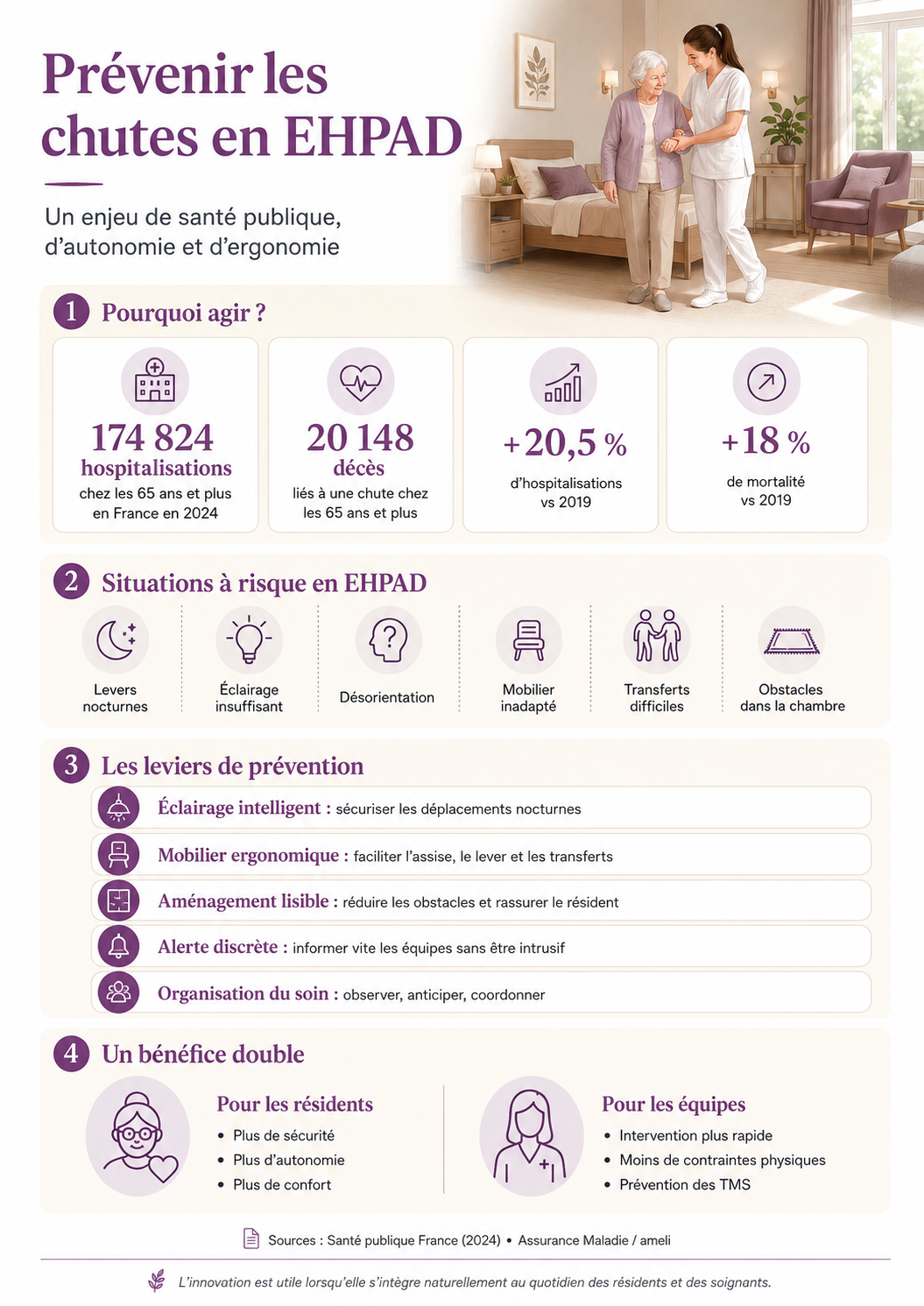
- Detection is useful, but prevention is better
- Why nighttime falls are especially risky
- What to look for in a fall detection system
- Fall detection in nursing homes and care facilities
- Technology should support caregivers, not replace them
- Final thoughts
— -
Why fall detection matters
A fall can be a turning point in an older adult’s life.
Sometimes the physical consequences are immediate: pain, injury, fracture, hospitalization. But the psychological consequences can be just as serious.
After a fall, many older adults become afraid of moving. They may walk less, avoid certain rooms, refuse to go out, or become more dependent on others.
This loss of confidence can lead to reduced mobility, muscle weakness, social withdrawal, and a greater risk of future falls.
That is why fall detection is not only a technical subject.
It is also a question of confidence, autonomy, and quality of life.
A good fall detection system does not remove every risk. No device can do that. But it can help reduce one of the most dangerous parts of a fall: the time before someone is alerted.
And in real life, the delay between a fall and a response can make a major difference.
— -
The real problem is not only the fall
When people talk about falls, they often focus on the moment of impact.
But in many situations, the real danger begins after the fall.
An older adult may be unable to stand up. They may be injured, confused, unconscious, or simply too weak to reach a phone or emergency button.
They may remain on the floor for minutes or hours before someone finds them.
This is one of the reasons fall detection has become such an important topic for families and care facilities.
The question is not only:
“Can we detect that a fall happened?”
The better question is:
“Can we make sure help is alerted quickly when the person cannot call for help themselves?”
That distinction matters.
Because a system that only works when someone presses a button may fail in exactly the moment when it is needed most.
— -
Why wearable devices are not always enough
Many fall detection solutions are based on wearables: watches, bracelets, pendants, or emergency buttons worn around the neck.
These devices can be useful. For some people, they are simple, familiar, and effective.
But they also depend on one major condition:
The person has to wear them.
That sounds obvious, but it is often the weak point in real life.
An older adult may remove the device at night. They may forget to put it back on after showering. They may find it uncomfortable, stigmatizing, too visible, or difficult to charge.
In some cases, cognitive disorders can make regular use even more difficult.
A wearable fall detection device only works if the person:
- remembers to wear it;
- accepts it every day;
- keeps it charged;
- does not remove it during the night;
- understands how it works;
- feels comfortable using it.
This does not mean wearables are bad.
It means they are not universally suitable.
The best solution is not the one that looks best in a brochure. It is the one that works in the person’s actual daily routine.
— -
The limits of emergency buttons
Emergency buttons are widely used because they are simple. The person presses a button, and help is alerted.
But this model relies on a critical assumption:
The person must be able to press the button.
After a fall, that is not always possible.
The person may lose consciousness. They may be too frightened to react. They may be confused or physically unable to move. The button may be out of reach. The person may not even be wearing it.
This is why automatic fall detection is so important.
A strong system should not depend entirely on the person asking for help.
It should also be able to identify a serious situation when the person cannot react.
This is particularly relevant for older adults with cognitive impairment, mobility problems, or a history of nighttime falls.
In these cases, relying only on a manual alert can create a false sense of security.
— -
Privacy should never be an afterthought

Fall detection is not only about safety. It is also about dignity.
This is especially true in bedrooms, bathrooms, assisted living facilities, and nursing homes.
Families and caregivers may want reassurance, but older adults should not feel constantly watched.
There is a fine line between protection and surveillance.
A camera-based system may seem effective from a technical standpoint, but it can raise serious concerns about privacy and acceptability.
For many people, the bedroom is one of the last truly private spaces. Any safety solution used in that environment must be chosen carefully.
That is why **camera-free fall detection** can be particularly relevant.
The goal should be to detect risk without making the person feel monitored.
A good system should protect without intruding. It should support care without compromising dignity.
In elder care, this balance is not optional.
It is essential.
— -
Detection is useful, but prevention is better
Most people start thinking about fall detection after a fall has already happened.
That is understandable. A fall creates fear and urgency.
But the best approach is broader than detection alone.
Detecting a fall is important. Preventing one is even better.
Many falls are linked to predictable situations:
- getting out of bed too quickly;
- walking in the dark;
- trying to reach the bathroom at night;
- forgetting a walking aid;
- standing up from a chair without support;
- moving through a cluttered room;
- poor lighting;
- unsuitable furniture height.
These situations cannot always be eliminated, but they can often be reduced.
This is where prevention becomes practical.
A safer environment may include better lighting, clearer walking paths, adapted furniture, accessible call systems, and solutions that help identify risky movements.
Fall detection should therefore be part of a larger strategy.
Not just a reaction tool.
A prevention tool.
— -
Why nighttime falls are especially risky
Nighttime is one of the most sensitive periods for fall risk.
The person may be tired, disoriented, half-awake, or in a hurry to reach the bathroom.
The room may be dark. The walking path may not be clear. The person may forget their cane, walker, or glasses.
In nursing homes, nighttime also creates an additional challenge: care teams are present, but they are fewer than during the day.
This means that an unnoticed fall can remain unnoticed longer.
Common nighttime risk situations include:
- getting out of bed without support;
- searching for the light switch;
- walking to the bathroom in low light;
- losing balance when standing up;
- tripping over furniture or objects;
- being unable to reach the call button.
This is why nighttime fall prevention should not rely on one single measure.
It requires a combination of environmental design, lighting, alert systems, and care organization.
A discreet automatic light, for example, may reduce disorientation. A reliable alert system may reduce response time. A clear room layout may reduce obstacles.
Each measure may seem small.
Together, they can make the environment significantly safer.
— -
What to look for in a fall detection system
Choosing a fall detection system should not begin with the technology.
It should begin with the person.
Their mobility. Their habits. Their cognitive state. Their environment. Their level of acceptance. Their daily routines.
A solution that works for one person may be completely unsuitable for another.
Before choosing a system, it is worth asking several practical questions.
Does the person need to wear something?
If yes, will they actually wear it every day?
A wearable device can be useful, but only if it is accepted and used consistently.
Does the system work at night?
Many falls happen during nighttime movements. A system that is only practical during the day may miss important risk situations.
Does it require manual activation?
If the person has to press a button, the system may fail if they are unconscious, confused, injured, or unable to move.
Does it respect privacy?
This is especially important in bedrooms and care facilities. Camera-free solutions can be more acceptable in private spaces.
Does it generate too many false alerts?
Too many alerts can create stress and alarm fatigue for caregivers.
A useful alert must be relevant, understandable, and actionable.
Does it help with prevention?
Some solutions only detect incidents after they occur. Others can help identify risky situations earlier.
A strong approach should ideally support both detection and prevention.
Is it easy to integrate into daily care?
In real life, the best technology is not always the most advanced.
It is the one that fits naturally into existing routines.
— -
Fall detection in nursing homes and care facilities
In nursing homes, fall detection is not just a family concern. It is also an operational challenge.
Care teams cannot be everywhere at once.
This is especially true at night, during transfers, or when several residents need attention at the same time.
A useful fall detection system should help care teams:
- identify risky situations;
- reduce uncertainty;
- respond faster;
- avoid unnecessary room checks;
- preserve resident privacy;
- reduce stress linked to unnoticed falls.
The goal is not to replace caregivers.
The goal is to give them better information at the right time.
In care facilities, fall detection should also be compatible with the way staff already work. A system that creates too much complexity may be ignored or abandoned.
A good solution must therefore be practical, reliable, and respectful of both residents and caregivers.
For facilities exploring this type of approach, **fall detection systems for nursing homes** can help combine prevention, alerting, and privacy-conscious support.
— -
Technology should support caregivers, not replace them
There is sometimes a misunderstanding around health technology.
People imagine that devices will replace human attention.
But in elder care, technology should do the opposite.
It should make human attention more effective.
A fall detection system cannot comfort someone after a fall. It cannot assess pain with the nuance of a trained caregiver. It cannot replace clinical judgment, empathy, or human presence.
But it can help alert the right person faster.
It can reduce the time someone spends alone after a fall.
It can help caregivers prioritize.
It can give families reassurance.
It can support a safer environment without removing independence.
The best technology in elder care is not the one that takes over.
It is the one that quietly supports people doing difficult, human work.
— -
Final thoughts
Fall detection should not be presented as a miracle solution.
It is not.
Falls are complex. They are linked to health, mobility, medication, environment, lighting, cognition, fatigue, and human behavior.
No single device can solve all of that.
But a well-chosen fall detection system can still be extremely valuable.
It can reduce uncertainty. It can shorten response time. It can support caregivers. It can reassure families. It can help older adults remain more independent.
The real goal is not to monitor people more.
The real goal is to protect them better.
And the best fall detection solutions are the ones that understand this simple truth:
Safety matters. But dignity matters too.
메타데이터
- post_id
- 9aa34ef44acf
- slug
- fall-detection-isnt-just-about-technology-it-s-about-trust-9aa34ef44acf
- url
- https://medium.com/@alice_61338/fall-detection-isnt-just-about-technology-it-s-about-trust-9aa34ef44acf
- canonical_url
- https://medium.com/@alice_61338/fall-detection-isnt-just-about-technology-it-s-about-trust-9aa34ef44acf
- author_url
- https://medium.com/@alice_61338
- status
- ok
- fetched_at
- 2026-06-09 15:37:30