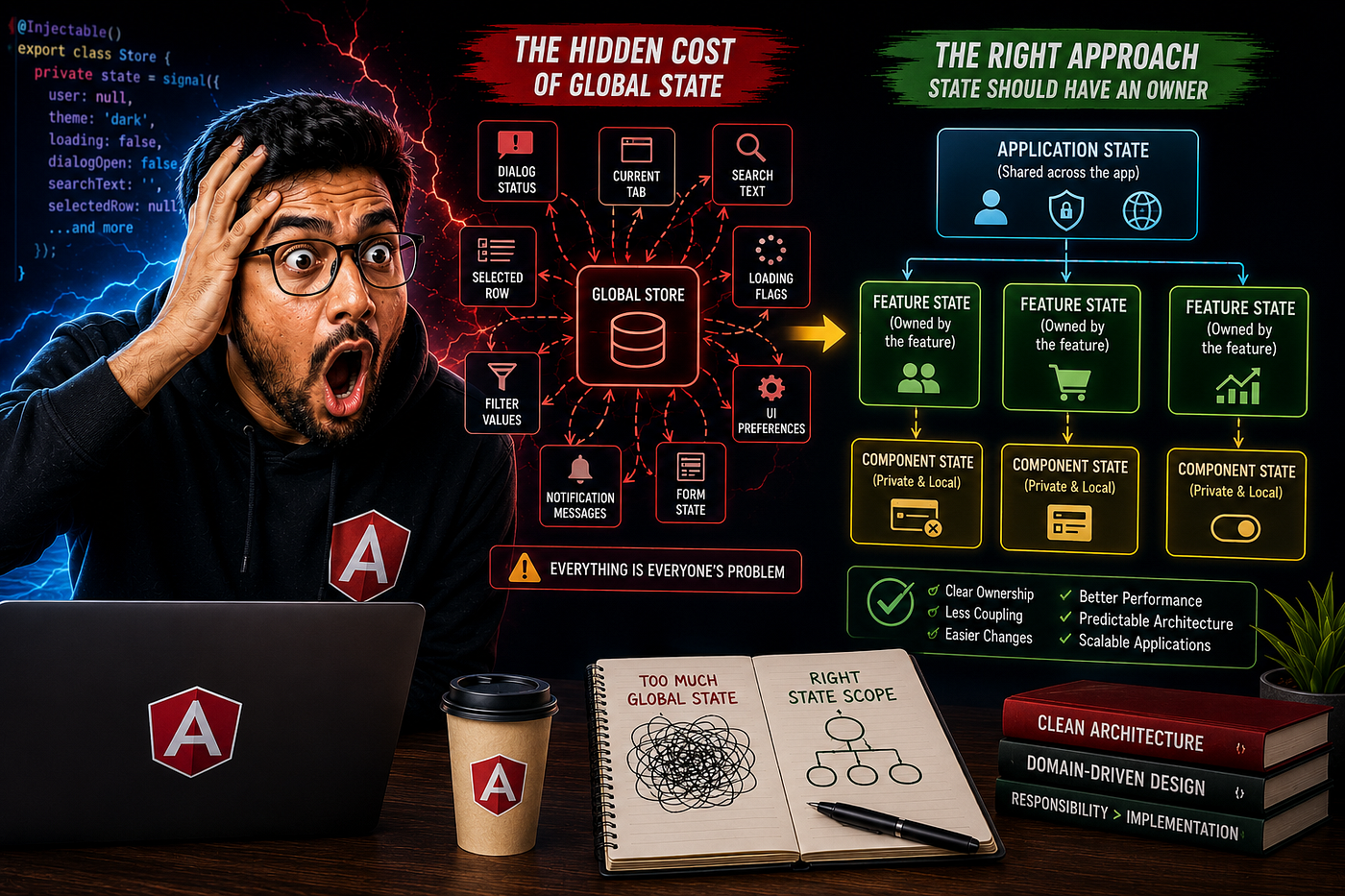
The Hidden Cost of Shared State: Why Read Access Is More Dangerous Than Write Access
The State Management Discussion Usually Focuses On The Wrong Risk
The Hidden Cost of Shared State: Why Read Access Is More Dangerous Than Write Access
The State Management Discussion Usually Focuses On The Wrong Risk

Whenever teams discuss state management, the conversation almost always becomes:
- Who can update the store?
- Who can dispatch actions?
- Who can mutate state?
- How do we prevent accidental writes?
These are valid concerns.
But they’re often not the biggest problem.
Because most large Angular applications don’t fail because too many developers can write state.
They fail because too many features can read it.
The Assumption Everyone Makes
Consider:
Customer StateA team creates a shared store.
Another feature needs customer information.
No problem.
Give it access.
Then another feature.
Then another.
Soon:
Orders
Billing
Support
Reports
Analytics
Notifications
all read from the same customer state.
Everything still works.
At least initially.
Reading Feels Safe
Write access feels dangerous.
Read access feels harmless.
After all:
Reading doesn’t change anything.
Technically true.
Architecturally misleading.
Because every read creates a dependency.
Dependencies Change Architecture
Imagine:
Feature A
     │
     ▼
Customer Store
Simple.
Now:
Feature B
     │
     ▼
Customer Store
Still manageable.
Then:
Feature C
Feature D
Feature E
Feature F
All connect to the same source.
The store slowly becomes a hub.
The architecture starts revolving around it.
Every Read Creates Coupling
Consider:
customerStore.customer()Looks innocent.
But the feature now depends on:
- State structure
- Data shape
- Update timing
- Availability
- Business meaning
The feature has become coupled to another domain.
Whether anyone realizes it or not.
The Problem Isn’t Technical
The code still works.
The application still compiles.
The issue appears later.
Imagine the Customer domain changes.
Suddenly:
Orders
Reports
Support
Analytics
all require updates.
One ownership change ripples across the organization.
This is architectural coupling.
Shared State Creates Invisible Contracts
Many teams document APIs.
Few teams document state consumers.
Yet state often has more consumers than APIs.
Example:
Customer Storemight be read by:
12 Features
40 Components
7 Teams
The store becomes a platform.
Every change becomes risky.
Ownership Starts To Erode
Originally:
Customer Team
      │
      ▼
Customer State
Clear ownership.
Over time:
Everyone
      │
      ▼
Customer State
Ownership becomes blurry.
Decision-making slows down.
Refactoring becomes difficult.
The architecture becomes less flexible.
The Read Explosion
The biggest risk isn’t:
Too Many WritersThe biggest risk is:
Too Many ReadersBecause readers multiply faster.
Every new dependency increases complexity.
Every new dependency increases coordination.
Every new dependency increases change cost.
The City Water Supply Analogy
Imagine a city.
A local water system serves one district.
Simple.
Now the same system serves:
- Residential Areas
- Factories
- Hospitals
- Airports
- Power Plants
Suddenly changing the system becomes difficult.
Not because the system is broken.
Because too many consumers depend on it.
State behaves exactly the same way.
Feature Ownership Works Better
Instead of:
Global Customer StoreConsider:
Customer DomainThe domain exposes only what other features genuinely need.
Dependencies become intentional.
Not accidental.
Ownership remains clear.
Signals Don’t Solve This Problem
Signals improve reactivity.
Signal Store improves ergonomics.
Neither solves coupling automatically.
A Signal Store with 50 consumers is still a highly coupled system.
Technology doesn’t remove architectural responsibility.
What Senior Engineers Ask
Junior developers ask:
Can this feature access the state?
Senior engineers ask:
Should this feature depend on the state?
The second question changes everything.
Because architecture is often about limiting dependencies.
Not enabling them.
A Practical Rule
Before exposing state, ask:
Does another feature truly need this?
Or:
Is this merely convenient?
Convenience often creates long-term coupling.
Ownership creates maintainability.
The Cost Of Convenience
Shared state feels efficient.
At first.
Over time:
- Dependencies multiply
- Teams coordinate more
- Refactoring becomes harder
- Ownership becomes unclear
The architecture becomes heavier.
Not because of write access.
Because of read access.
Final Thoughts
Most state management discussions focus on mutations.
Actions.
Reducers.
Updates.
But in large Angular applications, the more important question is often:
Who depends on this state?
Because every read creates a relationship.
Every relationship creates coupling.
And coupling is one of the primary forces that determines how easily software can evolve.
The healthiest Angular architectures don’t merely control who can write.
They carefully control who needs to read.
Because scalable systems are built from clear ownership boundaries.
Not unlimited visibility.
Connect with Me
If you enjoyed this post and would like to stay updated with more content like this, feel free to connect with me on social media:
- Twitter : Follow me on Twitter for quick tips and updates.
- LinkedIn : Connect with me on LinkedIn
- YouTube : Subscribe to my YouTube Channel for video tutorials and live coding sessions.
- Dev.to : Follow me on Dev.to where I share more technical articles and insights.
- WhatsApp : Join my WhatsApp group to get instant notifications and chat about the latest in tech
Email: Email me on dipaksahirav@gmail.com for any questions, collaborations, or just to say hi!
I appreciate your support and look forward to connecting with you!
메타데이터
- post_id
- 9ab06f3cfce4
- slug
- the-hidden-cost-of-shared-state-why-read-access-is-more-dangerous-than-write-access-9ab06f3cfce4
- url
- https://medium.com/angular-engineering/the-hidden-cost-of-shared-state-why-read-access-is-more-dangerous-than-write-access-9ab06f3cfce4
- canonical_url
- https://medium.com/angular-engineering/the-hidden-cost-of-shared-state-why-read-access-is-more-dangerous-than-write-access-9ab06f3cfce4
- author_url
- https://medium.com/@dipaksahirav
- status
- ok
- fetched_at
- 2026-06-21 07:44:09