When an Impression Causes a Revolution
How a Group of Rejected Artists Changed the Course of Art
When an Impression Causes a Revolution
How a Group of Rejected Artists Changed the Course of Art

Pierre-Auguste Renoir — Dance at Le Moulin de la Galette (Bal du moulin de la Galette, 1876) A vibrant Parisian gathering where light and movement merge into modern social life, central to Renoir’s vision of contemporary leisure (Public domain, Wikimedia Commons)
In the nineteenth century, the French art world operated under a highly structured and controlled system. At the center of this system was the prestigious Académie des Beaux-Arts and its official exhibition, the Paris Salon. For painters of the time, acceptance into the Salon was often the difference between success and obscurity. A painting displayed there could bring prestige, patrons, and a stable career. Rejection, on the other hand, frequently meant invisibility in the art market.
The Salon followed strict aesthetic rules. Paintings were expected to demonstrate refined technique, flawless finish, and subjects considered noble. Historical scenes, mythological narratives, and religious themes dominated the exhibitions. Artists worked carefully in their studios for months or even years to produce paintings with smooth, polished surfaces and nearly invisible brushstrokes. The viewer was meant to admire the represented scene rather than notice the process of painting itself.
This rigid structure shaped the artistic environment of the time. Yet beyond the walls of the Salon, a new generation of artists was beginning to question whether art needed to follow these traditional rules.

Claude Monet — Impression, Sunrise (Impression, soleil levant, 1872). The painting that gave Impressionism its name, capturing the fleeting light of the harbor in a scene critics once called unfinished (1872) (Public domain, Wikimedia Commons)
A Changing World
During the nineteenth century, France experienced profound political, social, and urban transformations. Under the rule of Napoleon III, Paris underwent large-scale modernization. Narrow medieval streets were replaced with wide boulevards, new parks were constructed, and the city gradually acquired the modern appearance recognizable today.
These changes transformed everyday life. Cafés, theaters, parks, and public avenues became important social spaces. For many artists, these new environments offered compelling subjects that differed dramatically from the grand historical themes promoted by academic institutions. Instead of depicting heroic myths or religious scenes, some painters began to focus on the fleeting moments of modern life.
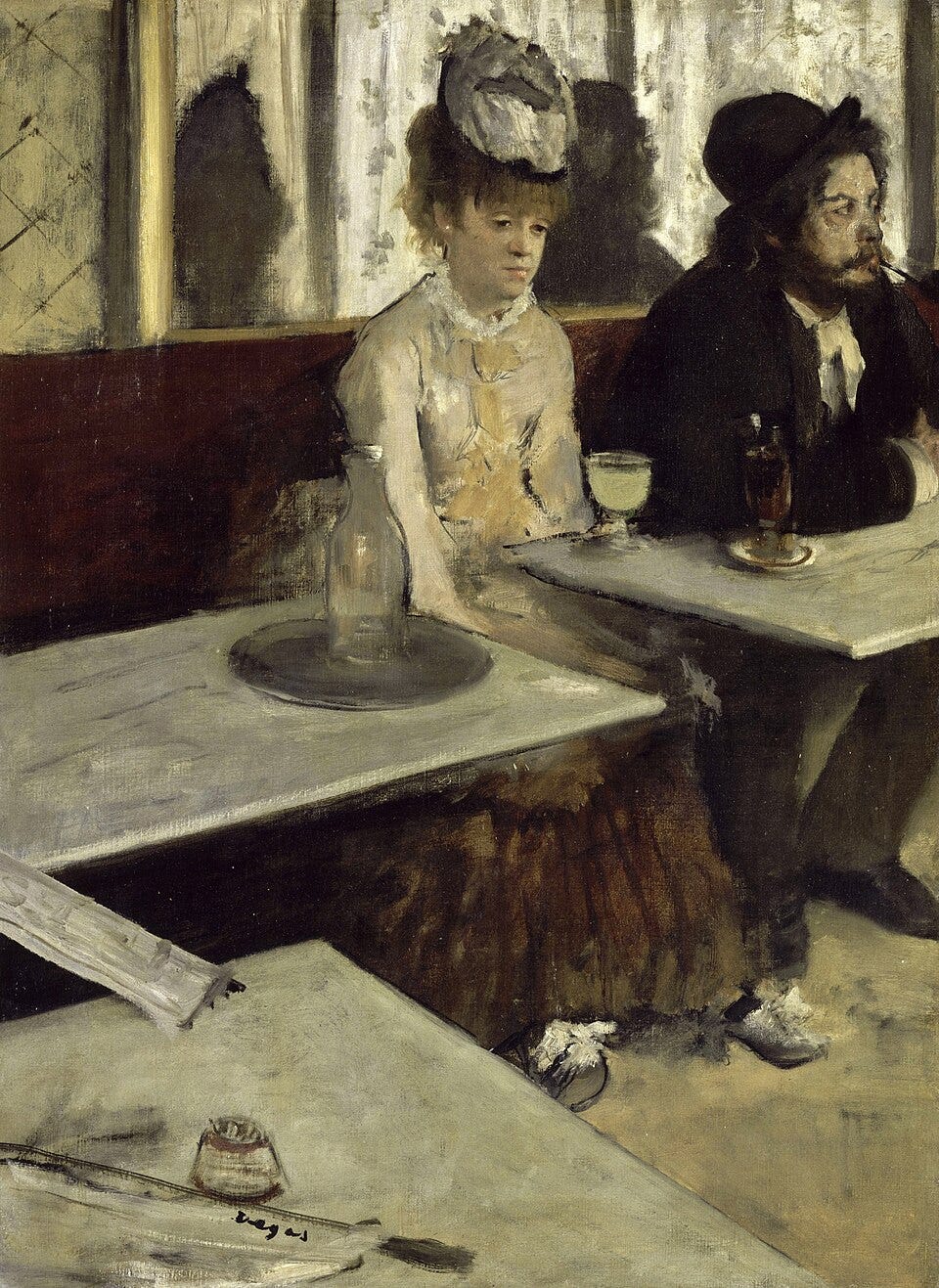
Edgar Degas — In a Café (L’Absinthe, 1876). A quiet and unsettling glimpse of modern Parisian life, reflecting Degas’s focus on contemporary urban observation (1876) (Public domain, Wikimedia Commons)
At the same time, technological developments also influenced artistic practice. The invention of commercially produced paint in metal tubes allowed artists to carry their materials outdoors with much greater ease. This innovation made it possible to paint directly from nature, a practice known as en plein air.
Working outdoors changed how artists observed the world. They became fascinated by the shifting effects of sunlight, the movement of shadows, and the atmosphere of a scene at a particular moment. Capturing these fleeting conditions required speed. As a result, brushstrokes became looser and more visible. The process of painting, once carefully concealed in academic works, now became part of the visual experience.
Advances in the chemical industry also expanded the available color palette. New synthetic pigments introduced brighter and more stable hues, allowing artists to experiment with vibrant blues, greens, and yellows. These technical and cultural shifts gradually prepared the ground for a new artistic movement.

Berthe Morisot — Summer’s Day (Jour d’été, 1879). A luminous and intimate scene of leisure, reflecting Morisot’s delicate approach to everyday modern life (Public domain, Wikimedia Commons)
The Birth of Impressionism
The decisive turning point came in 1874. Frustrated by repeated rejection from the official Salon, a group of artists decided to organize their own independent exhibition. They formed the Société Anonyme des Artistes Peintres, Sculpteurs et Graveurs, an association that allowed them to present their works without the approval of academic juries.
The exhibition took place in the Paris studio of the photographer Nadar. For the first time, artists working outside the academic system displayed their paintings directly to the public.
The reaction from critics was largely negative. Many viewers were shocked by what they perceived as unfinished paintings. The works featured visible brushstrokes, loose compositions, and scenes drawn from ordinary life. Compared with the polished perfection expected by the Salon, these paintings appeared rough and incomplete.
The name of the movement itself emerged from this criticism. In a satirical review of the 1874 exhibition, the critic Louis Leroy mocked Claude Monet’s painting Impression, Sunrise (Impression, soleil levant) and suggested that the works on display looked less like finished paintings and more like rough visual “impressions.” He used Monet’s title as the basis for his irony, extending the idea to the entire group of artists. The term “Impressionism,” originally intended as a form of criticism and mockery, was eventually adopted to describe the new artistic style.

Paul Cézanne — Mont Sainte-Victoire (Mont Sainte-Victoire, c. 1890). A structured landscape study that reveals Cézanne’s shift toward form and his influence on modern art (Public domain, Wikimedia Commons)
Several artists became closely associated with this movement. Pierre-Auguste Renoir explored scenes of social life, often depicting gatherings in cafés and gardens. Edgar Degas portrayed dancers, musicians, and urban activities. Camille Pissarro participated in every Impressionist exhibition and played a key role in maintaining the cohesion of the group. Berthe Morisot created luminous paintings that explored intimate domestic scenes, while Paul Cézanne participated in early exhibitions and later influenced the development of modern art.
Although these artists shared certain interests, Impressionism was never a rigid or unified style. Instead, it was an evolving network of artists experimenting with new ways of representing the modern world.
Rejection and Revolution
When the first Impressionist exhibition opened in 1874, few observers could have predicted its long-term impact. What critics initially dismissed as careless or unfinished gradually came to be recognized as innovative.
The Impressionists introduced a new sensitivity to painting. Instead of focusing on idealized narratives, they emphasized perception, light, movement, and everyday experience. Their paintings captured the fleeting quality of a moment rather than attempting to create timeless historical scenes.

Camille Pissarro — Boulevard Montmartre at Night (Boulevard Montmartre, effet de nuit, 1897). A glowing depiction of modern Paris at night, showing the evolving urban atmosphere that fascinated Impressionist painters (Public domain, Wikimedia Commons)
Over time, the influence of Impressionism extended far beyond its original circle of artists. The movement challenged the authority of academic institutions and opened the door to experimentation in modern art. Later developments such as Post-Impressionism, Fauvism, and Cubism would all build upon the freedom that these artists helped establish.
Today, paintings by Monet, Renoir, Degas, and Pissarro are among the most admired works in museums around the world. What began as a reaction against the restrictive system of the Salon ultimately became one of the most transformative movements in the history of painting.
Perhaps the enduring lesson of Impressionism is that artistic innovation often begins with resistance. Ideas that appear strange or controversial in their own time may later reshape how we see the world. By capturing the fleeting effects of light and everyday life, the Impressionists not only changed painting but also transformed our understanding of modern visual experience.
— Roberto Gasparini
Source and Further Reading
**BModern art 1851–1929: Capitalism and representation ** Brettell, R. R. (1999). Oxford University Press.
**HImpressionism: Art, leisure, and Parisian society **Herbert, R. L. (1988). Yale University Press.
**HImpressionism: Paint and politics **House, J. (2004). Yale University Press.
**TImpressionism: Origins, practice, reception **Thomson, B. (2026). London: Thames & Hudson.
**TMonet in the 90s: The series paintings **Tucker, P. H. (1995). Museum of Fine Arts Boston.
Suggested Article
If you enjoy discovering the hidden stories behind famous artworks, you might also like ***“The Last Supper We See Today Is Not Leonardo da Vinci’s,”*** about how centuries of restoration transformed and ruined one of the world’s most famous paintings.

Support Roberto Gasparini https://ko-fi.com/robertogasparini

메타데이터
- post_id
- 9abfae2f02e8
- slug
- when-an-impression-causes-a-revolution-9abfae2f02e8
- url
- https://medium.com/the-quiet-corner/when-an-impression-causes-a-revolution-9abfae2f02e8
- canonical_url
- https://medium.com/the-quiet-corner/when-an-impression-causes-a-revolution-9abfae2f02e8
- author_url
- https://medium.com/@robertogasparini
- status
- ok
- fetched_at
- 2026-06-09 15:37:30