Are we there yet?
Critical Review of the Fishman Island arc in One Piece, through the lens of an intersectional feminist.
Are we there yet?
Critical Review of the Fishman Island arc in One Piece, through the lens of an intersectional feminist.
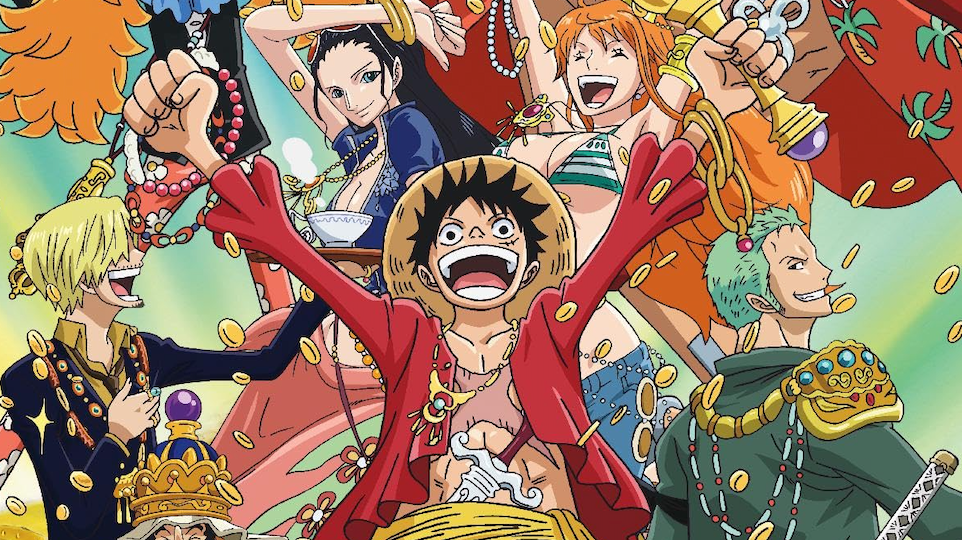
Luffy (center) and his crew
One Piece is a Japanese anime that follows the adventures of Monkey D. Luffy, a pirate with the goal of becoming King of the Pirates and attaining the One Piece. This treasure is said to hold everything the world has to offer. His journey spans multiple arcs, each one focusing on a different stop of Luffy and his crew’s expedition. One of the most crucial of these arcs is Fishman Island. This arc follows a critical turning point in the story where Luffy is separated from his friends while his brother (also a pirate) is captured and killed by the Navy. Overcome with grief and a sense of helplessness, Luffy instructs his crew to wait two years before reuniting in order to become stronger. This sends the narrative forward in time and from then on is referred to as “post-timeskip”. The anime itself takes a one year hiatus before fishman island was released to improve the show’s animation style and modify character designs. From easily bested antagonists to massive breasted protagonists, Fishman Island focuses heavily on displaying the changes Luffy’s crew has undergone, in terms of both strength and appearance. While One Piece generally does a good job at giving women in the show complex personalities and story lines, as well as steering clear of harmful stereotypes, this arc in particular declines in terms of intersectional feminism.
The arc opens with an introduction to a pirate crew impersonating the Straw Hat Pirates (Luffy’s Crew) on the island they were set to meet at. This fake crew is seen using the influence of the Straw Hats to intimidate and persuade others to join their crew in an attempt to bolster their own strength. Their plan is foiled by the arrival of the real Straw Hats Pirates, though when seeing the new character designs for the first time, some of the real Straw Hats look like they could be imposters themselves. Most notably Nico Robin, who looks like a completely different person, or a shell of a person, as she now suffers from the Same Face Syndrome that plagues the realm of anime. This redesign comes as a shock because of how much intention was previously put into the designs of each character. Along with having a different face, her body is also heavily altered to be more well-endowed, and a couple shades lighter too. This will become a constant theme throughout this arc and the anime as a whole.

Pre-timeskip Robin (left) and post-timeskip Robin (right)
Nami, for example, endures a similar transformation. While her face isn’t changed as drastically as Robin’s, partly because she already had a small case of Same Face Syndrome, her body reflects the same modifications. The portrayal of their new bodies is more blatantly misogynistic, and caters more to the male gaze. One example of this is when the first two crew members meet again after their separation. Nami is confronted by the imposter version of herself when Usopp steps up to save her. Nami celebrates being saved and the reunion with her friend by grabbing him, shoving his face in her now larger-than-average breasts, and jumping up and down, naturally. This scene is a prime example of how the show’s changes in the Fishman Island arc aim to appeal to the show’s largely male audience. Usopp, like Robin, is also visibly more pale, creating a sudden lack of diversity in the crew. Being widely acknowledged as canonically Black, with the creator of the anime himself stating that Usopp would be from Africa if One Piece was based in the real world, this adjustment can only be based in colorism. The racial implications of these skin tone changes are incredibly and horribly ironic, as the main plot of this arc centers around racism, oppression, and segregation.

Usopp (left) and Nami (right) reunite
This depiction of women is not uncommon in the anime community, but it does hit a little harder in this show because of how well women were characterized previously. For a show that tackles themes of systematic injustice, oppression, and marginalization regularly, it’s especially disappointing to see such a lack of concern when it comes to women and their rendering. The creator of One Piece, Eiichiro Oda, is not ignorant to how this affects his readers, in fact, he addresses it in many SBS columns. These SBS segments, that are featured in most of the manga volumes of One Piece, act as a Q&A column.

Chapter 786, Page 24; “D” is the reader, “O” is Oda

Chapter 381, Page 86; “D” is the reader, “O” is Oda
In these examples, Oda acknowledges that much of his female audience doesn’t appreciate the way the women characters in the show are illustrated. He actually doubles down and decides to mock his female audience and imply that because his show is for young boys (shonen refers to animes that are targeted towards young boys), he must cater to them. With an emphasis on the way women are depicted in the show being “a man’s dream”, he is putting his male audience in the Man Box, and upholding the idea that men are (or should be) hyper-sexual. It pushes toxic gender roles about women also being hyper-sexual, and a sexual object for men’s desires. Another example of this is how Sanji reacts to seeing the beautiful mermaid inhabitants of Fishman Island. Following another common anime trope of experiencing extreme nosebleeds due to sexual arousal, Sanji nearly dies from this encounter. Usually a simp and a hopeless romantic, this arc steers Sanji’s adoration of women in a different, unfortunate direction. He even goes so far as relinquishing his dream of finding the All Blue, a perfect sea where all the world’s varying marine life reside, stating that Fishman Island is his new All Blue. Aside from the harmful implications this has on men and women viewers alike, this goes agaisnt the story’s overall focus on the pursuit of one’s wildest dreams and ambitions.

Sanji (left) getting a nosebleed when meeting a mermaid (right)
It should also be mentioned that One Piece has been the best selling manga since 2011, when it really took off. With Fishman Island coming out just after it became fairly mainstream, between 2011–2012, it’s not all that surprising that the shows character designs took a turn. These superficial changes sacrifice excellent character design and unique personality traits in an exchange for eye candy, attempting to adhere to and promote modern beauty standards. As impressive as the new animation and some of the Straw Hats’ moments are, this arc lacks the depth and magnetism to measure up to most other arcs. Choosing to focus more on the sexualization of the anime’s female characters and shallow villains and side characters, it seems that the show’s writers assume the audience values visual gratification and aura-farming over well-developed characters and story. By butchering unique character designs, disregarding sacred dreams, and inserting countless forgettable characters and plot points, Fishman Island is disappointing, to say the least.
The anime genre as a whole has a problem with hypersexualization, objectification, and problematic tropes. From “fan service” to the sexualization of minors, many anime uplift harmful stereotypes and encourage troublesome ideals. While these are more-than-worthy topics of discussion, it is important to note that One Piece is pretty progressive in many ways. For example, many of the arcs deal with systemic oppression and social issues similar to real life challenges, or the fact that there are two transgender characters who are respected heroes of some of the main characters which is rather unique, compared to most of anime’s portrayal of transgender people. So why nitpick one arc from an anime that is otherwise quite forward-thinking? Having a mainstream anime, the best selling manga series of all time at that, be so trailblazing is a great advancement in the anime community. However, developing very complex female characters with depth and substance does not negate the lack of consideration for their representation. So, are we there yet? I think we’re on the right track, but the destination is still out of reach. One Piece sends the genre forward in terms of intersectional feminism, but Fishman Island highlights the work that still needs to be done. We can recognize the strengths of a piece of media and still call out problematic aspects and encourage the industry to do better, which I implore you all to do.
Sources:
Mulvey, L. (1975). Visual Pleasure and Narrative Cinema. Screen, 16(3), 6–18. https://doi.org/10.1093/screen/16.3.6.
Sydnor, K. (2022). “Lightskins Vs. Darkskins”: The Epidemic of Colorism on Social Media and in Pop Culture. Kansas City Defender. https://kansascitydefender.com/arts-culture/colorism-media-culture/
Heilman, B., Barker, G., and Harrison, A. (2017). The Man Box: A Study on Being a Young Man in the US, UK, and Mexico: Key Findings. Washington, DC and London: Equimundo and Unilever.
메타데이터
- post_id
- 9ad7ab99cd72
- slug
- are-we-there-yet-9ad7ab99cd72
- url
- https://medium.com/@emmalynschneider2003/are-we-there-yet-9ad7ab99cd72
- canonical_url
- https://medium.com/@emmalynschneider2003/are-we-there-yet-9ad7ab99cd72
- author_url
- https://medium.com/@emmalynschneider2003
- status
- ok
- fetched_at
- 2026-06-09 15:37:30




