Why the Most Beautiful Phone Ever Made… Failed
The saddest version of a product is when it ends up in a museum. Pretty. Untouched. Useless
Why the Most Beautiful Phone Ever Made… Failed
The saddest version of a product is when it ends up in a museum. Pretty. Untouched. Useless
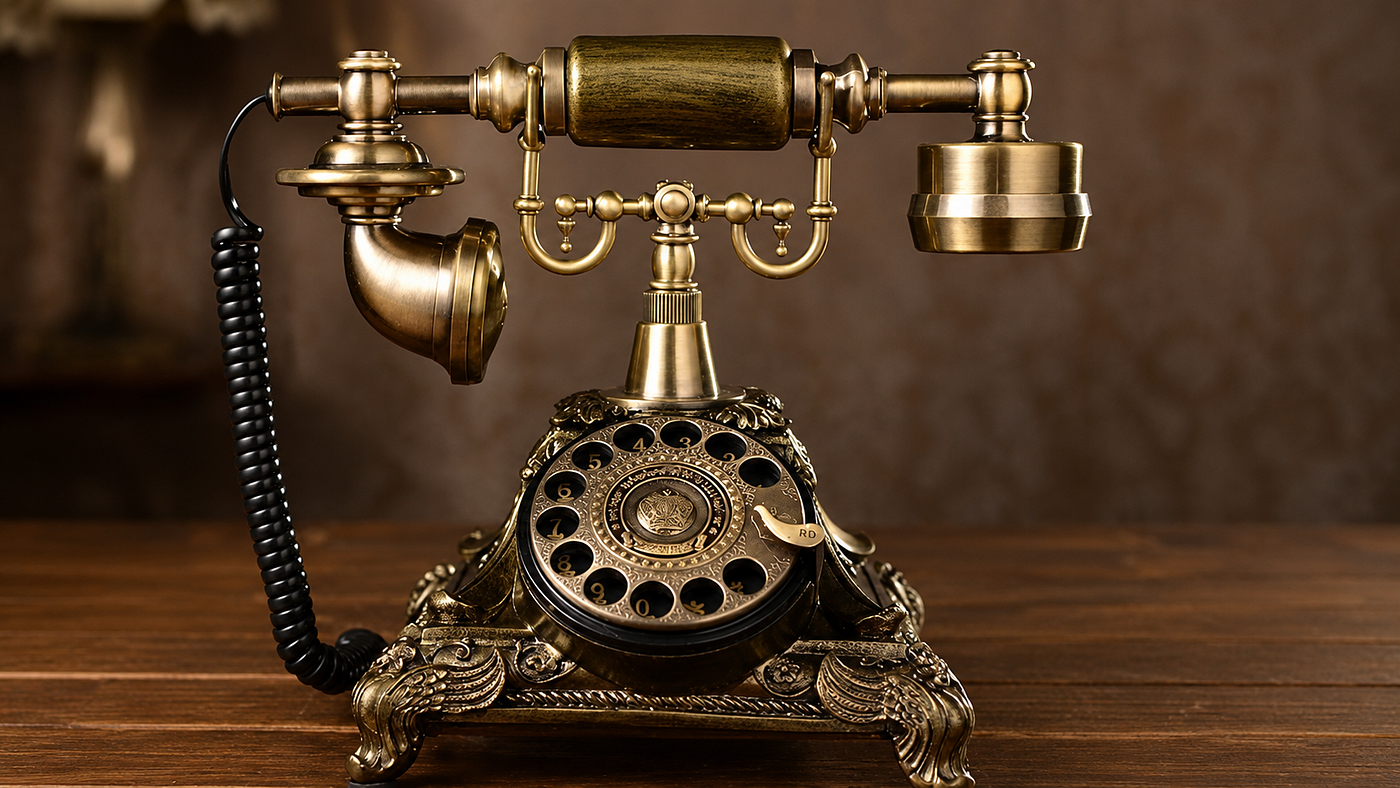
Rotary phone generated on ChatGPT.
We were in the bowling alley in Kathmandu, Nepal. We completed our session and headed toward the food court. In the middle of the food court, there was a red phone booth with a rotary telephone.
Haa?? Wait…. what/how/why….? Whatever. It was such a beautiful piece of art. I couldn’t stop myself, so I dragged my friend along to check it out.
“Do you know how to use this?” I asked her.
She actually told me, “Yeah, we are supposed to rotate by placing our finger at the exact number which we are supposed to dial.” That was her explanation. So I did what she said. I placed my finger on the dial, rotated it to the number 99718XXXXX and then… I stood there.
Two minutes’ silence later… Nothing happened. Yes. Or maybe something did? I don’t know. I honestly don’t know if it worked or not.
I asked her, “Did it work?”
She shrugged and said, “I don’t know either.”
And that’s when it hit me. We’re both designers. We’re both trained to notice when experiences feel off. And this felt really off. There was no confirmation. No feedback. No sound. No indication that anything was happening. There was no system status visibility at all, so I could not confirm if the call even went through.
We were both standing in the middle of a food court, just two designers discussing this random object, analysing why it failed. But my curious mind wouldn’t let it go. I really wanted to understand.
How did this thing work? Why did it work the way it did? Why did people tolerate it for so long?
So later on, when I came home, I went deeper. I tried to understand if what we experienced was actually the reason this product failed.
The Two Things We Discovered
I realised something. What we experienced was actually two fundamental failures that had been quietly frustrating people.
I. System Status Visibility
We got nothing. No confirmation. No feedback. No sound. Nothing. Just silence. And standing there in that food court, I’m thinking: did the call go through? Is someone picking up? Did I dial it right? Is the system even working?
For years, this is what people lived with. They couldn’t tell what was happening. The phone was a silent, opaque black box. You just had to “hope” it worked.
The Second One: Error Prevention
And then my friend pointed something out. “What if you mess up a number?”
And I’m thinking… yeah. What if you do?
You dial wrong. Now what? You can’t fix it. You can’t delete it. You can’t go back. You have to hang up and start the entire thing over again. Dial every single number again — all of it.
That’s not a design flaw. That’s punishment for making a human mistake.
In 1963, the touch-tone phone solved this. You could see what you’d dialled before pressing the final button. You could see your mistake coming. The system accommodated human error instead of punishing you for it.
Modern smartphones have gone further. You see the number as you type. Delete. Edit. Correct. Instantly. The system assumes you’ll make mistakes and designs around that Stress Situation.
How has it even survived for 70 long years?
Here’s what fascinated me. Both of these problems existed from day one. So why did it survive for seventy years?
It wasn’t about the rotary phone being good. It was about the problem it solved.
Who Was Almon Brown Strowger?
The Almon Strowger, inventor of the rotary dial automatic telephone exchange. He was an undertaker, which meant he was someone who arranged funerals and handled the dead.
When we say “undertaker,” you might picture someone without much education. But that’s not Strowger.
He was a school teacher first. He served in the Union cavalry during the Civil War. He had an education. He had experience. But he wasn’t a trained engineer. He didn’t know electricity or mechanics.
Yet in 1891, he patented the rotary dial automatic telephone exchange. One of the most revolutionary inventions in history.
How? Because he understood the problem better than anyone else.
The Four Forces at Play
Push: In the early days of the telephone, whenever you wanted to make a call, you picked up and got connected to an operator. A woman sitting at a switchboard. You told her the number, and she manually plugged in cables to connect you.

Human Operator
Operators used to be young boys. But they were replaced by women because they were perceived as softer, more polite, and more patient. The telephone company thought women would provide a better experience.
But this politeness didn’t stop the real problem
Operators had too much power.
- They could listen to your conversations.
- They could decide whether your call went through or not.
- They could be bribed.
- They could become part of schemes to help other businesses.
- They could sabotage your competition.
And that’s exactly what happened to Strowger.
His competitor’s wife was the telephone operator. She routed calls meant for Strowger to her husband instead.
But it wasn’t just a suspicion. It became real when his close friend died.
When Strowger’s close friend died, the family called for a funeral service. But that call never reached him. Later, he read in the newspaper that his friend’s funeral was handled elsewhere.
This pain was real.
Pull: Strowger imagined something radical: remove the operator entirely. Let people dial themselves. No human bias. No one is standing between you and the person you’re trying to reach.
A vintage version of end-to-end encryption.
Anxiety: But people were terrified. A machine? Connecting calls? What if it doesn’t work? What if I get it wrong? Why would I trust a machine over a person I know?
These fears were real, but The Push >>>>> The Anxiety.
Strowger’s competitor’s wife was literally stealing calls from him. This wasn’t just inconvenient; it was destroying businesses.
So even though people were anxious about machines, even though they didn’t trust the technology, the pain of the status quo was worse.
So people took the leap of faith. They overcame the anxiety because they had to.
Habit: Even after Strowger invented the rotary dial, people stuck with operators. They knew how to talk to an operator. They understood that system. Why change? But still they did.
So the rotary phone survived. Not because it was good. But because it solved one urgent problem: removing human bias and corruption from the system.
But in solving that one problem, Strowger created two new ones.
The very ones we experienced in that food court seventy years later.
The Real Lesson
Strowger couldn’t build this invention alone. He worked with his brother Arnold, his nephew William, and engineers who understood electricity and business. He wasn’t a lone genius.
But he had something more powerful: He understood the problem.
The power of figuring out the problem is the biggest advantage of all time. If you are a designer and you cannot solve a problem, that’s the biggest problem. No tool, no AI, nothing can help you better than the ability, the skill of figuring out the problem.
That’s what I’m taking forward.
That’s it for now. See you in the next blog with yet another UX audit from history :)
메타데이터
- post_id
- 9ae348c9fe70
- slug
- why-the-most-beautiful-phone-ever-made-failed-9ae348c9fe70
- url
- https://medium.com/the-springboard/why-the-most-beautiful-phone-ever-made-failed-9ae348c9fe70
- canonical_url
- https://medium.com/the-springboard/why-the-most-beautiful-phone-ever-made-failed-9ae348c9fe70
- author_url
- https://medium.com/@youskye
- status
- ok
- fetched_at
- 2026-06-21 07:44:09