Every Battery Has a Story
From Monitoring Systems to Circular Omnichannel Experiences
Every Battery Has a Story
From Monitoring Systems to Circular Omnichannel Experiences
This case explores how combining IoT, lifecycle data, and AI can shift the model from reactive maintenance → to predictive, circular decision-making.
Where the goal is no longer to replace devices, but to extend their lifecycle through better decisions.
The Digital Battery in 2027
In 2027, the way industrial assets are managed is quietly but fundamentally shifting.
Every battery carries a digital identity. Not just a serial number, but a living record: how it was produced, how it’s used, how it’s aging, and what can still be done with it.
At the same time, pressure is increasing, from regulation, from cost, and from sustainability targets. The question is no longer whether companies need to act, but how those decisions actually happen in day-to-day operations.
Based on my experience working on industrial solutions at Siemens Digital Industries, I began to see that many of these decisions remain reactive. Data exists, but it doesn’t always translate into clear action.
So the question I wanted to explore was:
What would it take to turn lifecycle data into something usable, something that helps people make better decisions in the moment?
This case imagines a near-future scenario where the Battery Passport, combined with Industrial Edge platforms and AI, becomes part of that decision-making process, shifting from reactive maintenance to a more circular, lifecycle-oriented way of operating.
Empathy Maps for Key Roles
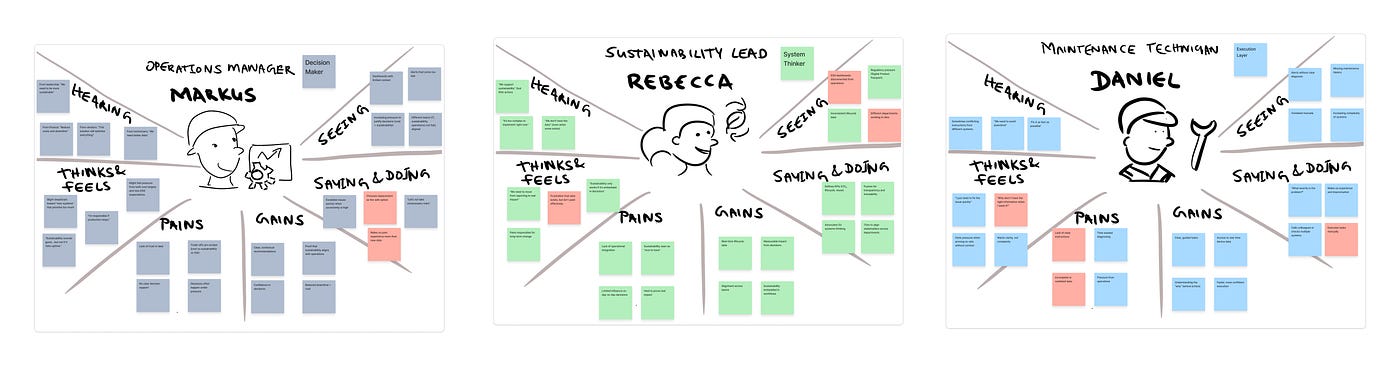
Three Key Roles for the Sustainable Business Case
To better understand how the Digital Battery Passport could create value in practice, I developed empathy maps for key roles involved in the lifecycle of industrial devices.
Rather than starting from the technology, I wanted to step into the perspectives of the people making decisions, interpreting data, and executing tasks in the field.
Through this, it became clearer that the challenge isn’t simply a lack of data. In many cases, the data already exists, but it’s fragmented, hard to interpret, or not available when decisions are made.
The empathy maps helped surface where friction actually happens: between operations, sustainability goals, and execution on the ground.
They also revealed an important shift: The Digital Battery Passport is not just a data layer; it becomes meaningful when it supports different roles in making better, more informed decisions within their daily workflows.
This understanding shaped how I approached the overall service design, focusing less on features and more on how information flows across people, systems, and moments of decision.
Opportunities Areas for Circular Decisions
The empathy maps helped me move beyond assumptions and think more carefully about how the experience could actually support better decisions, especially from a sustainability perspective.
One thing that stood out is that the challenge isn’t just awareness, but how information is made usable in the moment.
For Markus, the shift is subtle but important. He doesn’t necessarily resist sustainability, but in practice, he tends to default to replacement because it feels safer. The opportunity is to help him “relearn” that extending the battery lifecycle can be the better option, if the system gives him enough confidence in that decision.
For Rebecca, the issue is less about defining the right KPIs and more about where those KPIs live. If they remain at a reporting level, they don’t influence behavior. The opportunity is to make them visible and actionable within the systems Markus actually uses.
For Daniel, it’s more practical. He needs reliable, up-to-date device data — ideally accessible remotely before he even arrives on-site. Without that, decisions made upstream don’t translate well into execution.
Taken together, these insights suggest that improving the experience isn’t about adding more data, but about making the right information available, at the right time, to the right person.
The Circular Flow Story
From Current to Future Journey

The Role of the Battery Passport in the Flow
This is where the idea of the Digital Battery Passport becomes interesting.
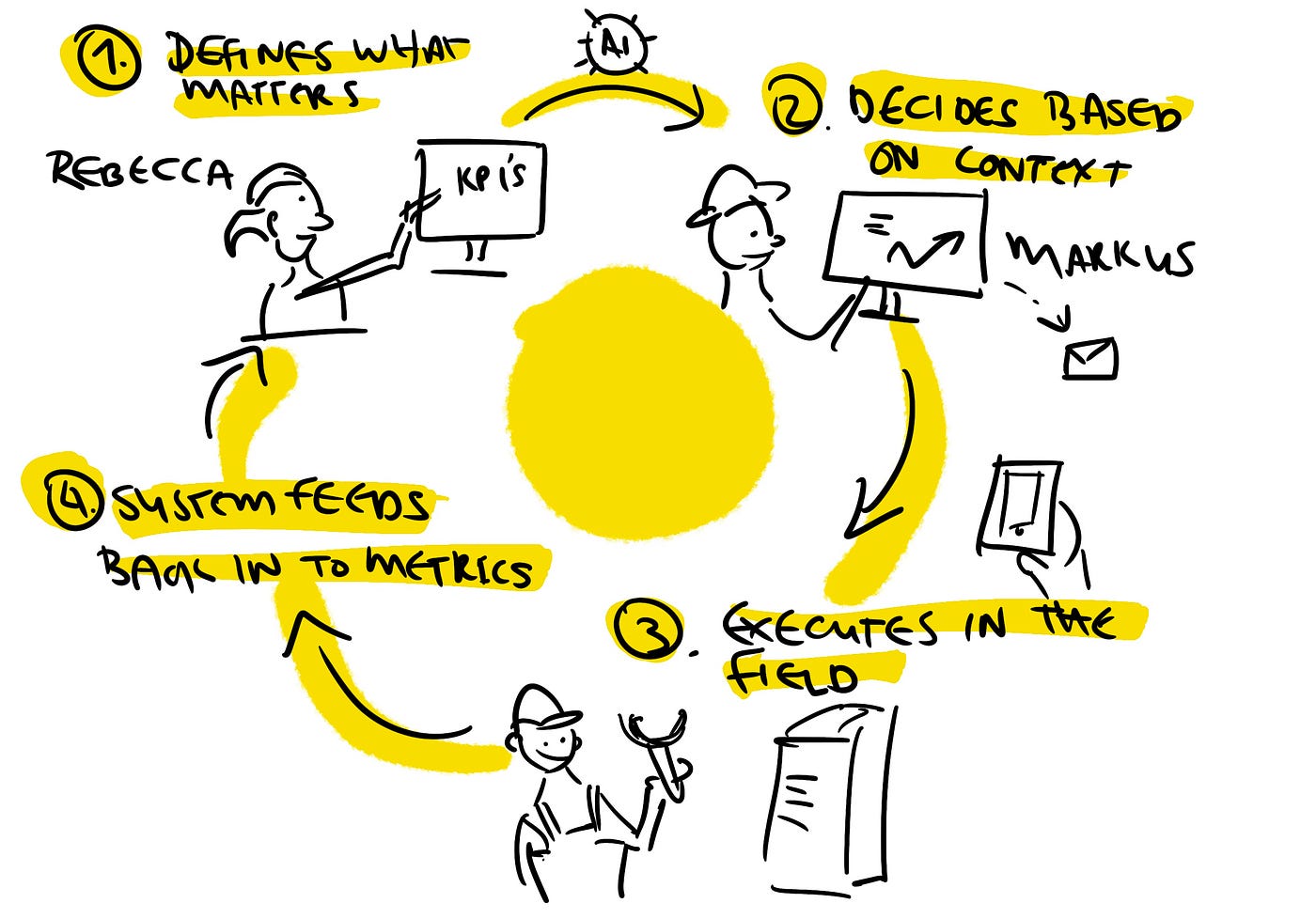
Within the omnichannel map, it acts almost like a connective layer across all touchpoints:
- On the dashboard, it translates raw data into meaningful insights
- In the decision moment, it compares repair vs replacement
- On the mobile interface, it informs the technician’s actions
- In the feedback loop, it updates lifecycle KPIs and system learning
Rather than being a standalone feature, it becomes part of the decision infrastructure.
And maybe more importantly, it changes how decisions are framed.
Instead of:
“Battery degradation detected.”
The system suggests:
“Extend lifecycle by +2.5 years with optimization.”
It’s a small shift, but it nudges behavior in a very different direction.
Designing the Omnichannel Experience
What became clear through the service blueprint is that sustainability doesn’t live in one interaction.
It’s shaped across the entire journey:
- How alerts are framed
- What defaults are set
- How information is visualized
- How easy it is to act on a recommendation
If one part of the system pushes toward circularity but another creates friction, the whole experience breaks down.
So the challenge is less about designing a single “sustainable feature,” and more about orchestrating a consistent experience across channels and roles.
Creating a Sustainable Service Offering
Building on this, the opportunity today is to design circular lifecycle services, not just tools.
By combining:
- Industrial Edge platforms
- lifecycle analytics
- AI-assisted maintenance
…we can start to shape systems that don’t just monitor devices, but actively guide better decisions.
The goal isn’t to force users into sustainable behavior.
It’s to make the sustainable option:
- visible
- understandable
- and, ideally, the easiest choice to make
A Shift in Perspective
Looking back, I don’t see the 2019 project as incomplete. It was a necessary step.
But what’s changed is how I understand its potential.
The same infrastructure, data, connectivity, and monitoring can be extended into something more systemic.
Something that connects:
- business goals
- user decisions
- and sustainability outcomes
Closing Thought
The omnichannel map made one thing very clear to me:
Sustainability is not a single decision.
It’s the result of many small decisions, across many touchpoints, over time.
And those decisions are shaped, often subtly, by the systems we design.
Which means the real question is no longer just:
“How do we monitor devices better?”
But:
“How do we design systems that help people make better decisions, again and again?”
Resources:
Empathy Map and Storyboard in the book: Game Storming by Dave Gray
메타데이터
- post_id
- 9af06559b52e
- slug
- every-battery-has-a-story-9af06559b52e
- url
- https://medium.com/@jasmin.v.dawes/every-battery-has-a-story-9af06559b52e
- canonical_url
- https://medium.com/@jasmin.v.dawes/every-battery-has-a-story-9af06559b52e
- author_url
- https://medium.com/@jasmin.v.dawes
- status
- ok
- fetched_at
- 2026-06-09 15:37:30



